Robust Theme
Dec 09, 2019 2020-04-08 7:40Robust Theme


Agile Before the Manifesto: Lessons From a Restaurant
By: Kumar Dattatryan
Before I worked a single day in IT, I was practicing agility in a kitchen.
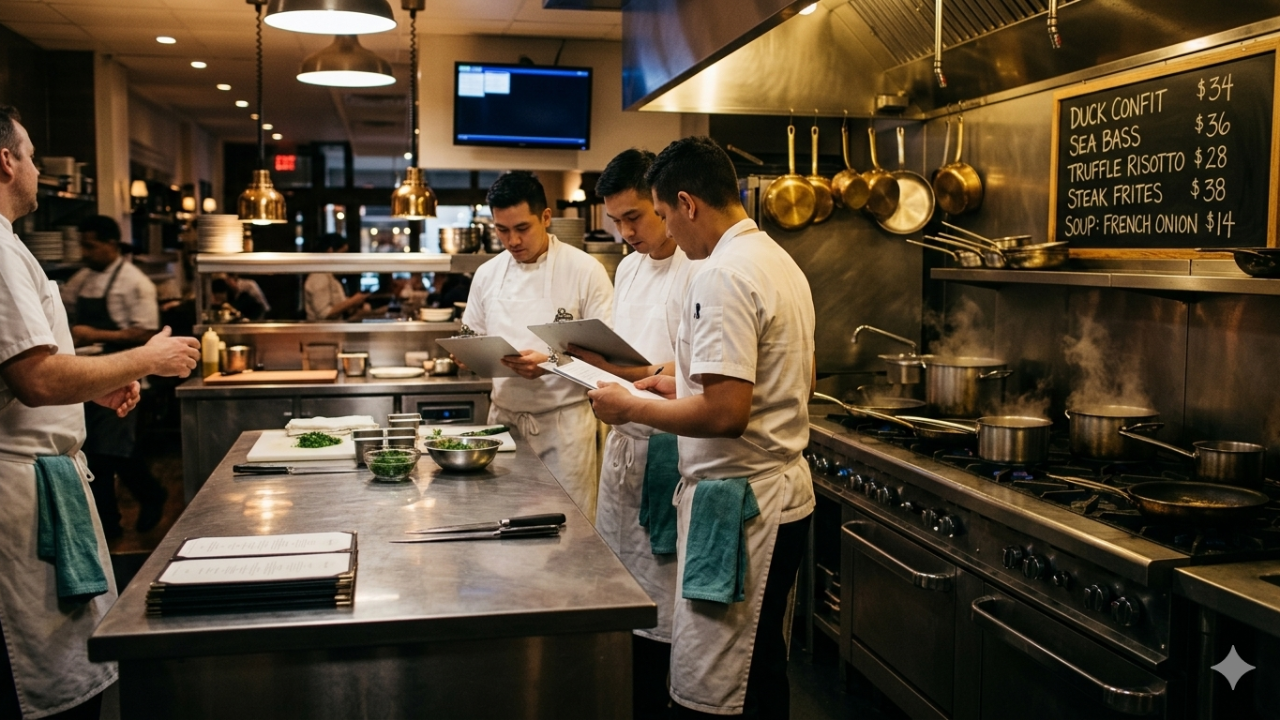
We ran two stand-ups a day, one before the lunch rush and one before dinner. Nobody called them stand-ups. We were on our feet anyway, and the only way to survive the next three hours was to be on the same page about the specials, the reservations, the staff calling out, the produce that came in wrong. We planned the menu and entertainment weekly because customers were going to walk in seven days from now. When the dishwasher went down on a Saturday night, three people swarmed to keep service moving while one person fixed it. Nobody assigned that. It just happened, because the cost of not happening was a dining room full of angry guests.
Years later I was in a conference room in IT and someone was explaining Scrum to me. Daily stand-ups. Iteration planning. Swarming on impediments. Inspect and adapt. I remember thinking, "we were doing this in the restaurant. We just did not have a word for it."
That memory has stayed with me for two decades, and it has only become more useful as the word "Agile" itself has become less useful. I am not saying Agile is dead. I am not saying the frameworks were a mistake. I am saying the word stopped working long before the practice did, and leaders who keep insisting on the word are losing the argument before they get to the work that actually matters.
The Word Got in the Way
I see this all the time. A C-suite executive hears "Agile" and what gets activated in their head is a decade of failed transformations, expensive consultants, SAFe roadmaps that died on a conference room wall, layoffs of Scrum Masters and Product Owners the same company hired three years earlier in a panic. The word does not mean what it meant in 2001. It means whatever the last bad experience taught them it means.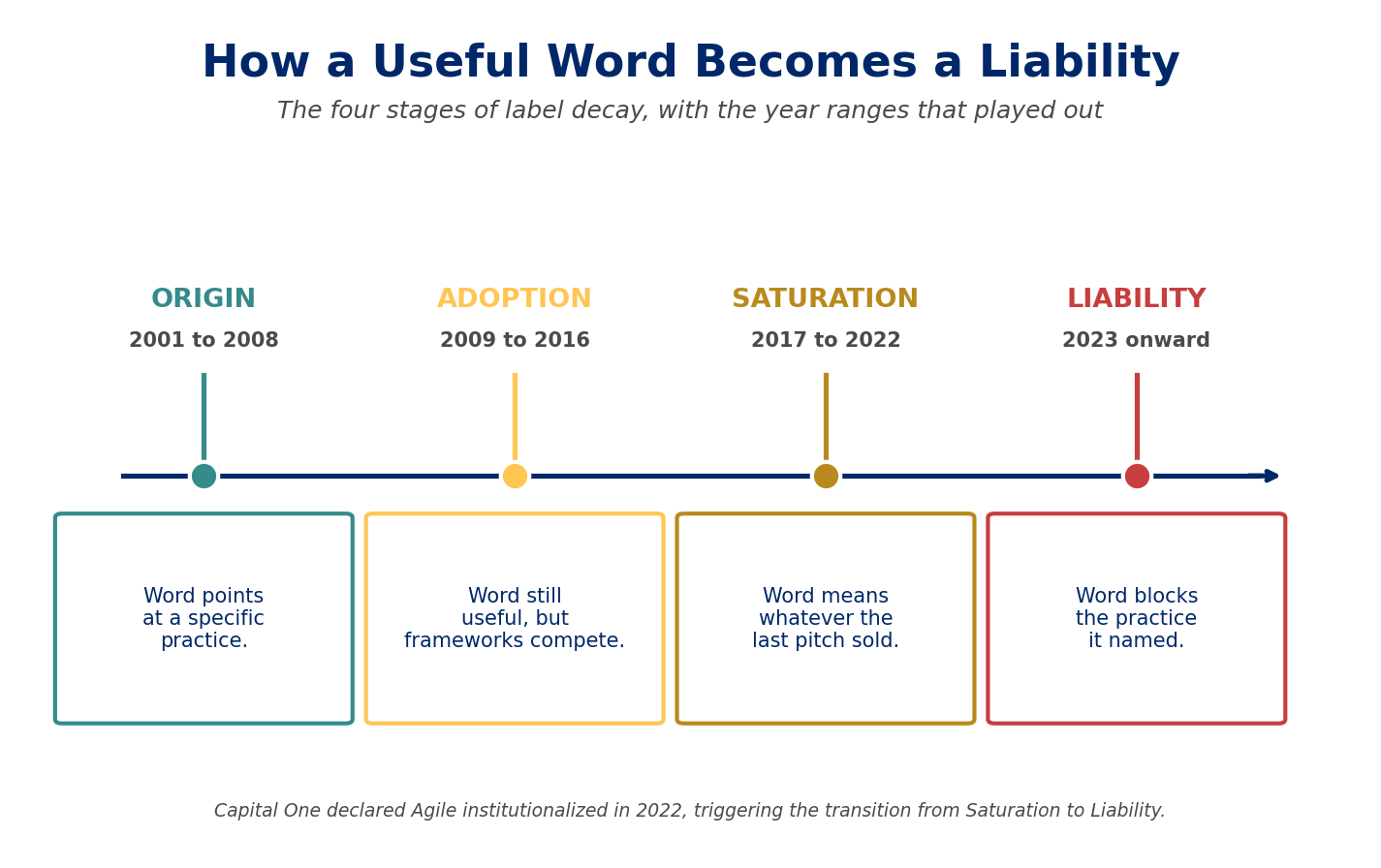
That is not the practitioners' fault. The principles in the Manifesto are still right. Iterative delivery still beats big bang. Customer feedback still beats internal opinion. Teams that swarm on the highest priority still outperform teams grinding through unrelated backlog items. None of that has changed. What has changed is that the label became a target, and the target absorbed every failed implementation, every cargo-cult adoption, every consultancy invoice that did not produce results.
Ron Healy put it bluntly to me. "Agile has become somewhat of a religion for some people. It's not about following a specific set of rules or a specific framework." He is right. He is naming what most senior leaders feel but cannot articulate. They are not opposed to working iteratively, transparently, or collaboratively. They are exhausted by the religious wars over which framework is "real" Agile.
So they stop listening. And the moment they stop listening, the practice they actually need stops getting adopted.
What the Construction Crews Knew
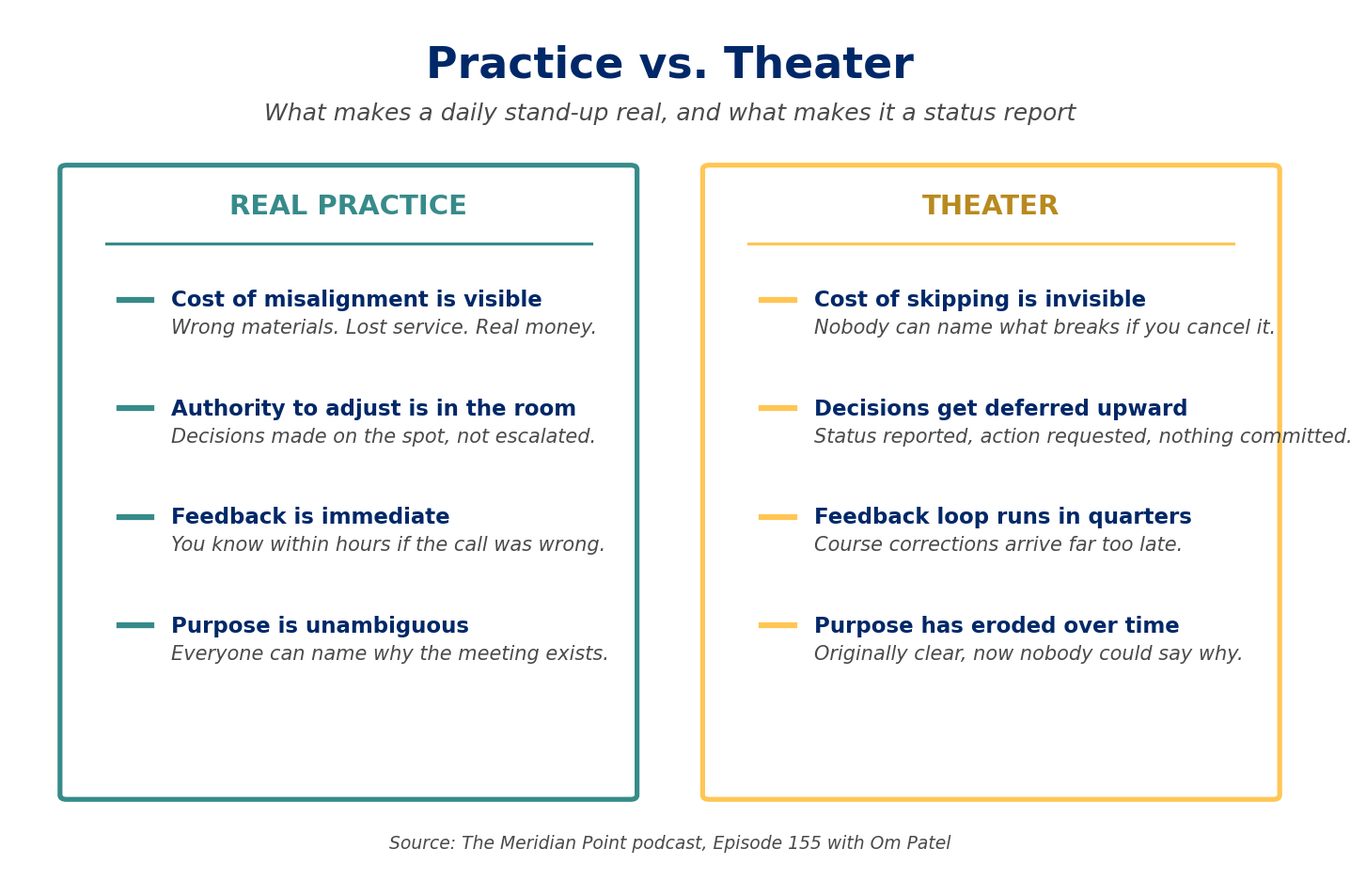
Om Patel told me a story on episode 155. Before he learned anything about Agile in IT, he watched a construction crew show up every morning, huddle for a few minutes, fan out to work, and reconvene at lunch. No framework. No coach. No ceremony.
"Agility is instinctive when the goal is clear and feedback is immediate," he said. "Those guys were not following a framework. They were solving problems together because the cost of misalignment was obvious to them." Then he gave me a line I have not stopped using since. "Agile theater happens when rituals replace purpose."
Here is the test. Not whether you are doing the practices. Whether the practices still trace back to a purpose that anyone in the room can identify. A stand-up where everyone reports status to a manager is not a stand-up. It is a status report happening in the morning. A retrospective where the same five issues come up every two weeks and nothing changes is not a retrospective. It is a complaint session with no outccome.
The construction crew did not need words for any of this because the cost of misalignment was concrete. Wrong materials show up. Two trades try to work in the same space. Somebody pours concrete that has to be ripped out. The feedback was immediate and visible. The huddle was not a ritual. It was the cheapest way to avoid the next expensive mistake.
Agile was supposed to be exactly this, at the team level, in 2001. In plenty of teams, it still is. The problem is the word has been over-applied at every other level of the organization until it stopped pointing at the thing it originally named.
How the Label Got Toxic
Sanjiv Augustine traced the institutional collapse for me on episode 152. The pandemic created a hiring boom in product and Agile. When the bubble shifted in 2022, the layoffs came in waves. Then a domino fell that almost nobody outside the industry noticed.
"A big trigger was some of the larger companies starting with Capital One, I believe it was in 2022. They took their entire Agile space unit and said, 'Hey, we've evolved beyond Agile coaching and training.' We've assumed that everybody's gone agile. So it's been something that's institutionalized."
Capital One did not say Agile failed. They said Agile succeeded so thoroughly that it no longer needed its own department. Whether that is true is a separate question. The signal they sent to the market is what mattered. If one of the biggest, most public Agile-investing companies in financial services declares the work institutionalized, every other CIO and CFO in the country has cover to ask, "do we still need this line item?"
The answer most of them landed on was no. Not because the practice was no longer valuable. Because the line item, the role title, the certification, the consultant relationship, had all become detachable from the value. You could keep the daily huddle and lose the Scrum Master. You could keep the Kanban board and stop paying for SAFe training. You could keep the iterative releases and fire the Agile Center of Excellence.
The practices kept producing value. The word stopped being able to defend its own line item.
The Mindset Was Always the Point
Alan Zucker said something to me on episode 154 that resonated with me. "Agile is a mindset." His daughter at Fannie Mae was on what they called a "Way of Working" team that brought iterative practices to non-technology groups. Not because those groups needed to be more like software developers. Because the underlying mindset, work in small batches, get feedback fast, adjust based on what you learn, applies to almost any work where the goal is not perfectly knowable in advance.
He built a whole course on it. Agile Beyond IT. He showed an example that stuck with me. A five-way intersection in Arlington that was crazy dangerous got turned into a traffic circle. The circle did not eliminate the chaos. It gave people a way to keep moving through it without anyone having central control. That is a more honest metaphor for organizational agility than any framework diagram I have seen.
A traffic circle works because the rules are simple, the feedback is immediate, and the consequences of bad decisions are visible to everyone involved. Nobody calls it Agile. Everybody uses it.
When I started Agile Meridian and we built what eventually became The Disruptor Method, I made a decision early on that I have not regretted. The word "Agile" appears nowhere in the name. Not because I am embarrassed by it. Because I knew the C-suite leaders we wanted to work with had stopped listening the moment they heard it, and we could not afford to lose the room before we got to the work.
The method underneath is full of the practices. Decision protocols that timebox conversation and force commitment. A weekly cadence that gives the leadership team a working rhythm they have never had before. Visual systems that make work and accountability visible. A coach who is there to teach, then mentor, then fade. If you squint, you can see Kanban, Scrum values, lean flow, servant leadership, all stitched together. We just do not call it any of those things. We talk about results, about decisions, about the bottleneck the leadership team itself has become.
And it works. The same C-suite that would have walked out of an Agile pitch sits forward in the chair when we describe what the next ninety days look like. Because we are not selling them a religion. We are selling them a faster way to make better decisions together.
Why I Stopped Naming It
The hardest lesson I have learned in twenty years of this work is that the people who need the practice the most are the most allergic to the word that describes it. Not because they are stubborn. Because they have been burned. By bad consultants, by hollow training, by frameworks sold as silver bullets that turned out to be paint.
You can spend your career arguing that the word was misused and the practice was misunderstood. I have watched colleagues do exactly that, and I have watched them lose contract after contract while making perfectly correct points. The market does not care about your correct points. The market cares whether you can help them get unstuck in the next ninety days.
Of course, the word still matters in the right rooms. With other practitioners, with audiences who have done the work, the vocabulary is useful shorthand. Outside those rooms, the word is a flag, and flags get shot at. The practitioners I respect most have made peace with this. They do not stop being Agile. They stop saying Agile.
Three Things to Try This Week
If you are a leader who has been frustrated by an Agile rollout that stalled, or burned by a consultant who left you worse off, here is what to try.
Drop the word in your next leadership meeting. Not forever. Just for that meeting. Describe what you actually want. Faster decisions, smaller commitments, visible work, real feedback. See if the room engages differently when the religious vocabulary is out of the way. I have run this experiment with senior teams dozens of times now. The temperature in the room changes inside ten minutes.
Identify one ritual that has become theater. A standing meeting that produces no decisions. A retro where the same complaints come back monthly. Kill it, or rebuild it from the purpose backwards. If you cannot name the purpose in one sentence that anyone in the room would agree with, the ritual is theater.
Find one team that is already doing the work without the words. A customer service team that swarms on escalations. An ops group that meets every morning to align. A finance team that releases reports in increments. Study what they are doing. Codify it. Spread it sideways, not down from a Center of Excellence. The construction crews and restaurant kitchens of your organization have been doing this work for years. They just never got the consulting invoice.
What I Carry Forward
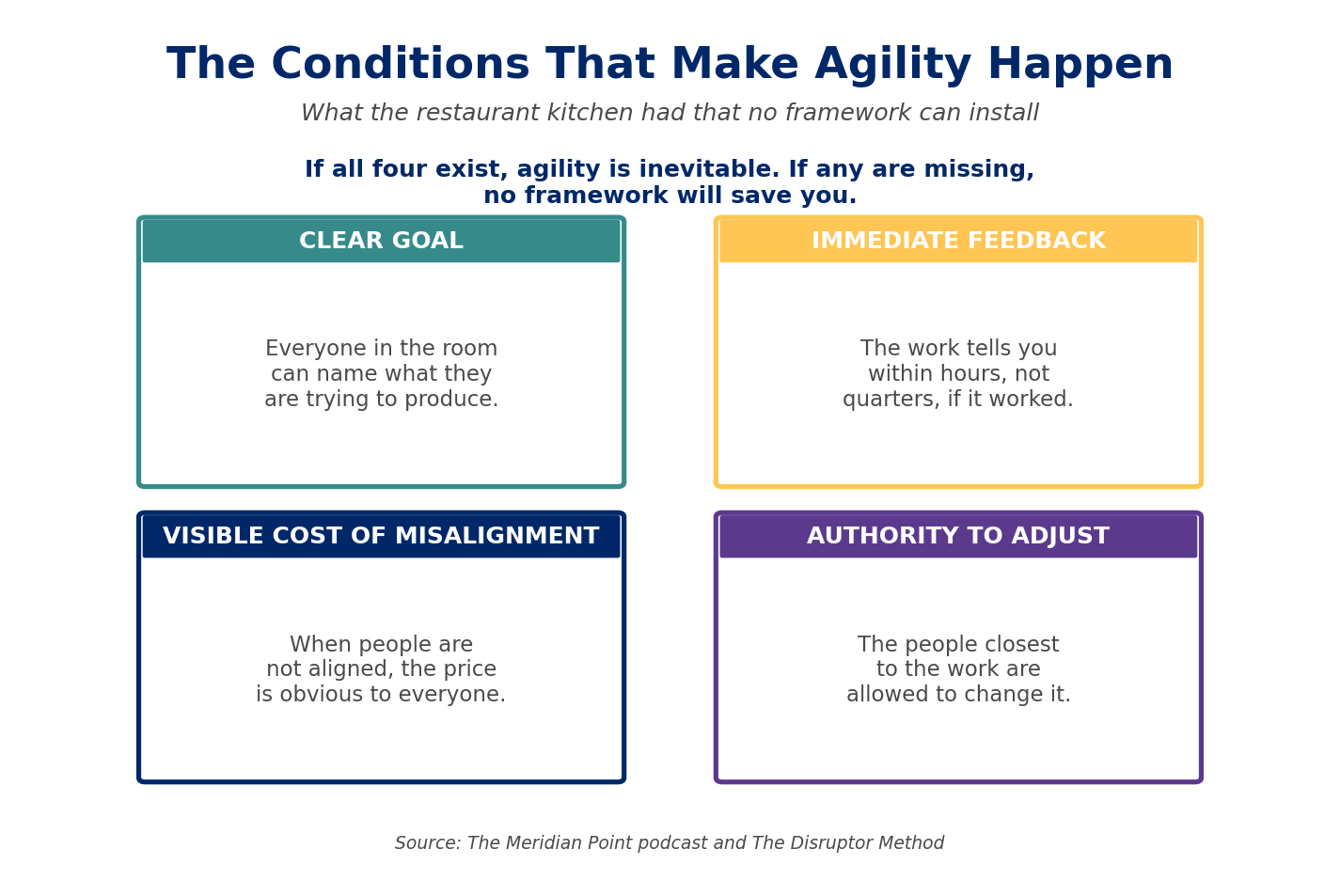
When I think back to that kitchen, what stands out is not the practices. It is the conditions that made the practices inevitable. The goal was clear. The feedback was immediate. The cost of misalignment was visible to everyone. The authority to adjust was in the room. None of that required a framework. All of it required a shared purpose and people who trusted each other enough to act on it.
The conditions are what matter. The word was useful for a while as shorthand for them, and then it stopped being useful, because the shorthand got separated from the conditions. The leaders who will do the best work in the next decade are the ones who can build those conditions without invoking the word that has now become a liability.
I have been doing this work for over two decades. I never want to stop practicing what that kitchen taught me. I just no longer need the name.
Ready to Build Agility Without the Religious War?
If your organization has been burned by an Agile rollout, or has senior leaders who shut down the moment they hear the word, that is exactly where The Disruptor Method works best. We bring the practice without the vocabulary. Let's talk about what the next ninety days could look like for your leadership team.
Or take The Disruptor Method assessment to see where your organization actually sits: thedisruptormethod.com/quiz
Related Episodes
Episode 155: Agile Without the Jargon with Om Patel: Om's story of watching construction workers run daily huddles before he knew the word for it, and his framing of "agile theater" as what happens when rituals replace purpose.
Episode 154: Agile vs. Traditional with Alan Zucker: Alan's "Agile Beyond IT" thesis, the traffic circle metaphor, and why three simple rules outperform any framework when leaders actually commit to them.
Episode 152: From Agile to AI with Sanjiv Augustine: The Capital One signal that institutionalized Agile out of its own department, and what AI adoption looks like when leaders apply the same iterative discipline without making the same labeling mistakes.