Robust Theme
Dec 09, 2019 2020-04-08 7:40Robust Theme


Why Enterprise AI Fails: The Same Trap as Agile
By: Kumar Dattatreyan
Almost every company now uses AI. Almost none has changed because of it.
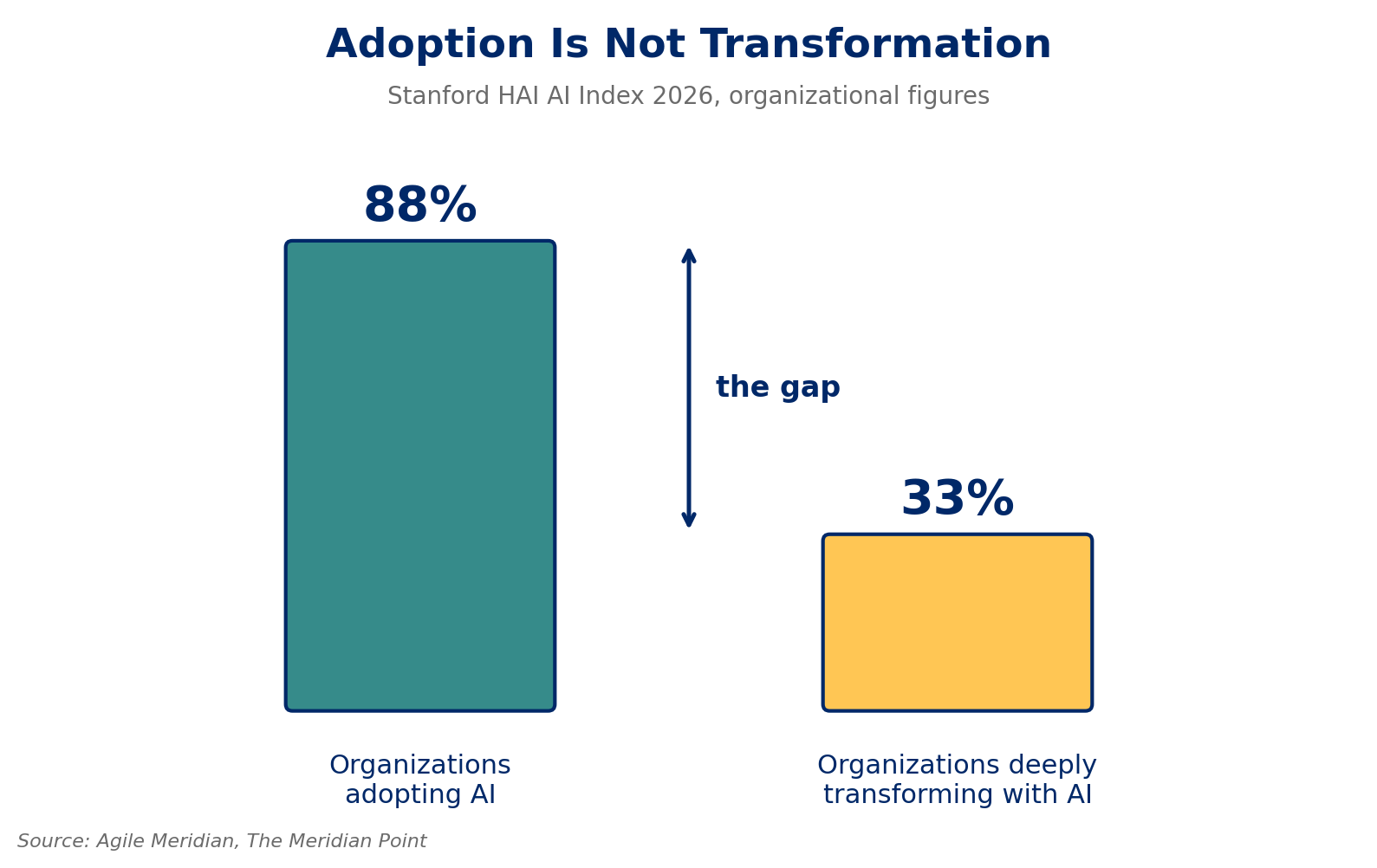
Stanford's 2026 AI Index puts organizational adoption at 88 percent, up from 71 percent a year earlier. It also puts deep transformation, the use of AI to actually reshape a product, a process or a business model, at about one third. McKinsey's November 2025 survey adds the number that should worry any executive signing the checks: more than 80 percent of organizations report no meaningful enterprise-wide profit impact from AI at all.
I have watched this movie before, and the models are not the plot.
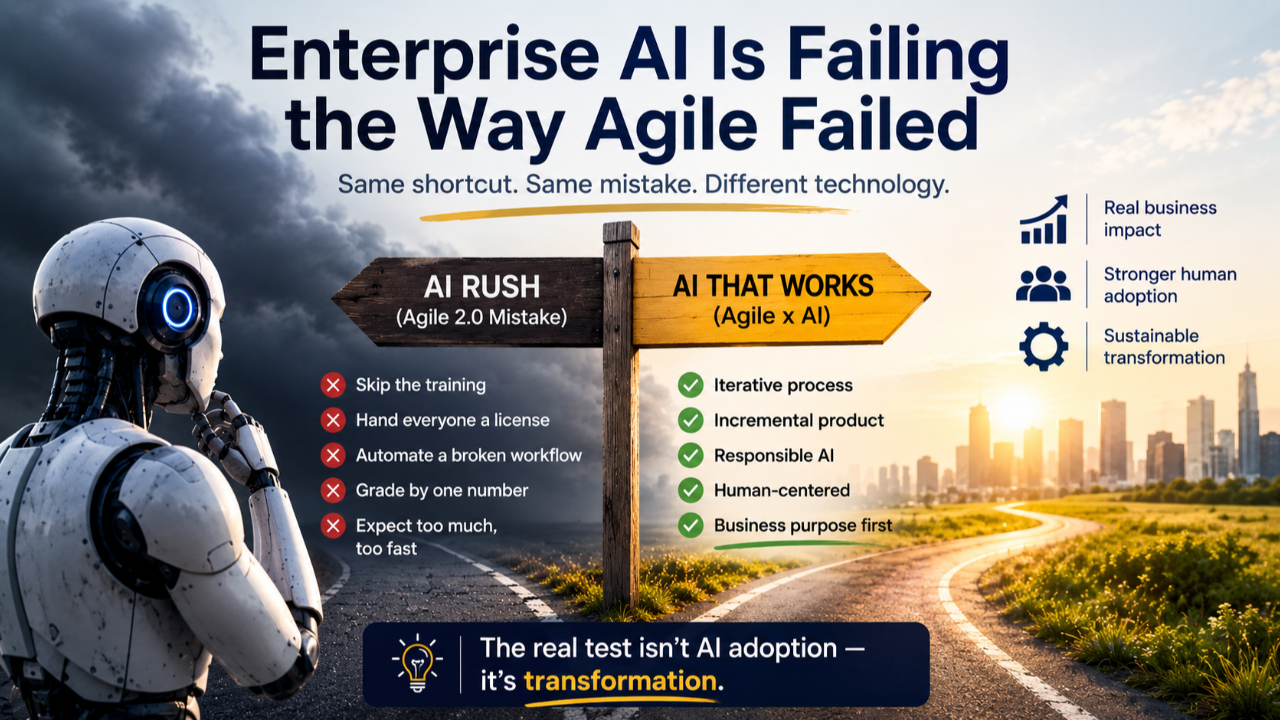
Twenty years ago the same organizations mandated agile. They kept every old meeting and every old incentive, bolted standups on top and declared a year later that agile did not work. Now they hand everyone an AI license, skip the training, point the tool at a workflow nobody fixed and grade the whole thing by one number. When Gartner asked the companies that hit AI failure what went wrong, the top answer this year was expecting too much too fast, cited by 57 percent of them. Same shortcut. Same failure. The tool changed. The mistake did not.
The gap is the whole story
Adoption is nearly universal. Transformation is nearly absent. The distance between those two facts is not a footnote. It is the problem.
Sanjiv Augustine put the through-line on the show more plainly than I could, and he sourced it to his own mentor. Sanjiv is founder and CEO of LitheSpeed and author of From PMO to VMO, with thirty years advising executives at Capital One, Nationwide and beyond. On "From Agile to AI: Avoiding the Same Transformation Mistakes" (ep 152), he quoted Jim Highsmith: "If you fail at Agile, you're going to fail at AI."
Then he explained why. Organizations adopt the new thing mindlessly, without the people and without the context, exactly as they adopted frameworks a decade earlier. His fix is a discipline, not a slogan. As he said it, "if we don't subjugate AI to two things, subjugate it to our business purpose and subjugate it to the human beings in the organization, we will fail, if not today, then tomorrow." He gives the disciplined version a name, Agile x AI, and three parts: "iterative process, incremental product, responsible AI." Iterate through short learning cycles, roll it out in increments you can test, and keep the human factors in view the whole time. That is how a company lands in the minority of AI projects that pay off instead of the majority that stall.
The failure is not a technology verdict. It is a transformation verdict.
The same failure, in three different rooms
Watch how consistent the pattern is across people who have never worked together.
Suzel Wyvill-Jones ran hundred-million-dollar portfolios at AT&T and Cricket before founding Mindshift Dynamics. On "She Ran a $120M Portfolio" (ep 172), she located the failure in method, not model: "One of the issues we are having is that project managers are managing artificial intelligence projects the same way they used to do regular software development. So 86 percent of the projects are failing right now." Her way back is the return to real agility, the kind she says got a bad reputation for a reason that has nothing to do with agility itself. "Many companies were changing people's titles but not changing the process. Now we are going to have to adopt agility. If not, there is no success." That is the agile-veneer failure stated in AI terms. New titles, old work. She adds the precondition leaders keep skipping: "There is no AI without data." Gartner now backs that from the outside, projecting that 60 percent of AI projects without AI-ready data get abandoned through 2026.
Tom Stiehm spent thirty years in software, was CTO of Coveros and is now at Steampunk. On "AI Won't Save You If You Can't Code" (ep 170), he named the repeat outright and described the mechanism in detail: "The same thing happened with Agile. Organizations bolted Scrum ceremonies on top of what they were already doing. They didn't change the culture or the incentives. They added standups and sprints but kept all the old meetings and all the old command-and-control structures. And then they said Agile doesn't work." Swap in AI and the sentence still runs. Hand everyone a license, skip the training, and you get the agile rollout again. His remedy is a safe place to practice before the stakes are real, what he calls the dojo model: smaller experiments, active training, mistakes made where they cost nothing. He draws the airline analogy for it. Train people for the failure modes they will rarely see, so they know what to do when the tool is confidently wrong. Because it will be. As he put it, "If you learn to code by using AI, you have no idea what to do when it fails."
Ashwini Kumar has spent six years building enterprise AI across manufacturing, energy, healthcare and telecom. On "AI Is Not a Magic Bullet: What Enterprise AI Gets Wrong" (ep 174), he closed the loop on scope. "Generally, a lot of these projects try to tackle too much." The ones that pay start narrow enough to attribute the return. He also named the two failure modes that echo agile most directly: executives who adopt AI as a resume item and stop asking what problem it solves, and teams that automate a broken human workflow instead of fixing it first. Then he named the part almost nobody plans for, the trust gap that kills adoption after the pilot technically works: "the hard part with AI is getting it to work, and the hard part is getting people to trust and rely on the data."
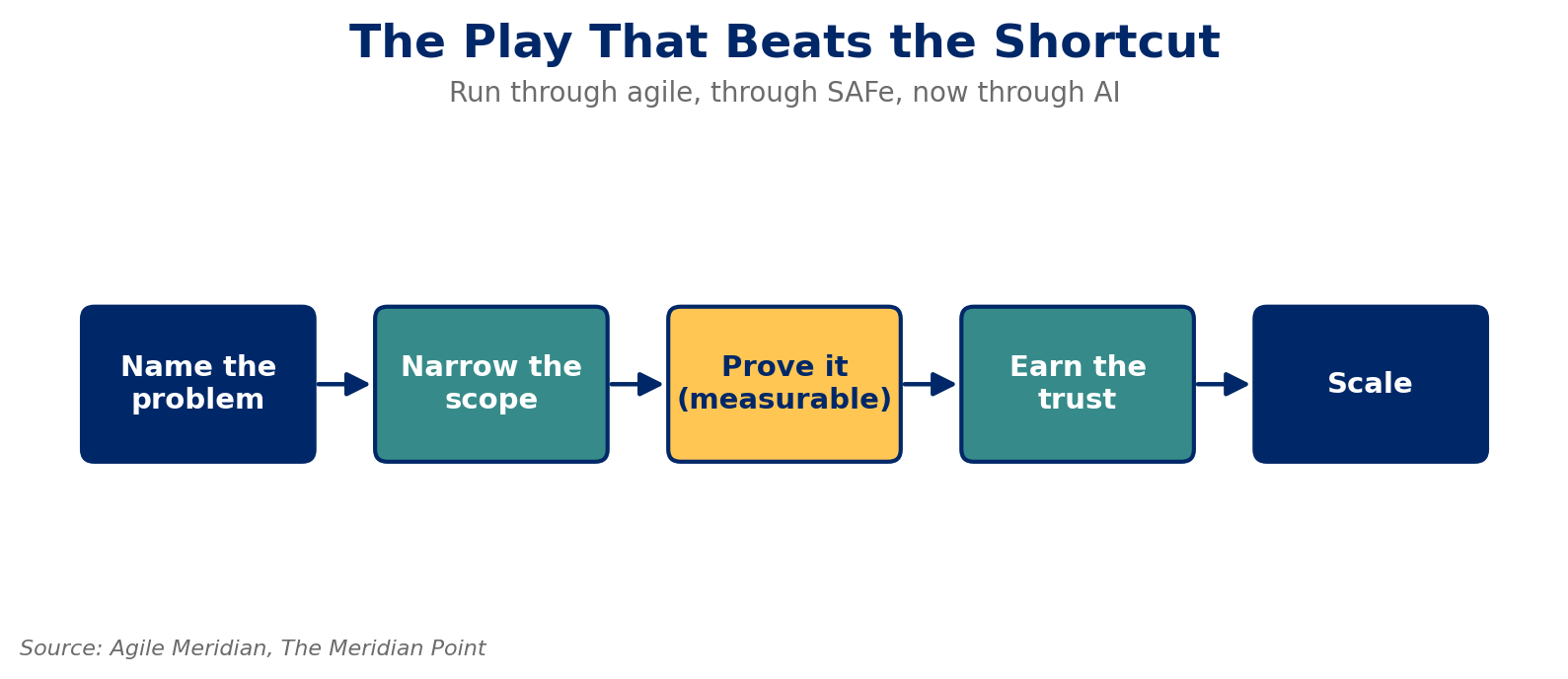
Put the four together and the pattern is not a coincidence. It is a habit. Every hype cycle offers the same shortcut, take the benefit of a hard change without doing the hard change. And the discipline that beats it never changes either. Name the problem, narrow the scope, prove it on something you can measure, earn the trust, then scale. I have run that play through agile, through SAFe and now through AI. The tool is new every decade. The failure and the fix are the same.
The strongest version of the other side
The sharpest reader is already pushing back, and the objection is a good one, so I want to state it in its own terms before I answer it.
AI is not a process methodology you roll out with change management, the argument goes. It is a general-purpose technology whose capability compounds monthly. So a disciplined pilot-first playbook is itself the risk. Wait to prove ROI on narrow pilots and a competitor who goes broad and aggressive captures a durable lead. There is data behind the harder version of this. MIT's "GenAI Divide" study from July 2025 found that while roughly 40 percent of companies had bought official LLM subscriptions, about 90 percent of workers already used personal AI tools daily to do their jobs. Value is diffusing bottom-up, through individuals, with no transformation program at all. On this view the whole "manage it like a transformation" prescription is fighting the actual mechanism of adoption, and the corporate failure numbers miss the value employees already capture on their own.
Here is why the counter proves the point it thinks it refutes.
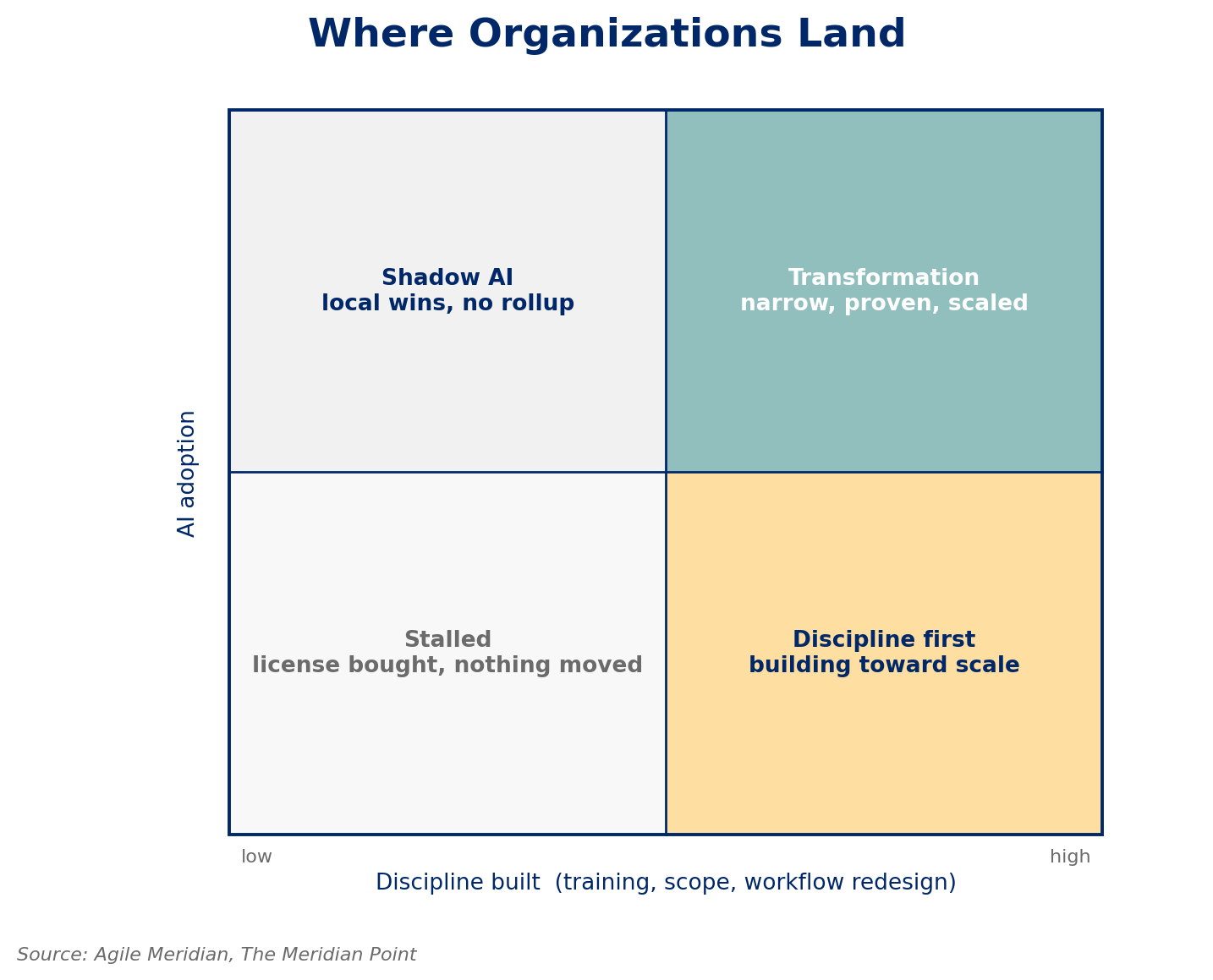
Near-universal adoption and near-absent transformation are both true in the same dataset. Stanford's own numbers, 88 percent adopt and about a third transform, and the gap between them is exactly the organizational discipline the counter says you can skip. A worker saving twenty minutes is real. It is also the automating-the-human trap Ashwini named, local productivity that never rolls up to the business because the workflow around it never changed. Shadow AI proves the tool works. It does not prove the enterprise changed. That is the same gap agile always had, a team that loved its standups sitting inside an org that still shipped nothing faster.
On speed, the frontier moving fast is an argument for narrow reversible bets, not against them. When capability changes monthly, the disciplined incrementalist re-aims every cycle. The big irreversible bet gets graded once, too late to steer. And the winners already agree in practice. The organizations getting real returns integrate deeply into a few high-value workflows instead of spraying pilots across the org. That is narrow scope, prove it, then scale. That is the discipline, not the exception to it.
What to do Monday
Three moves separate the companies that transform from the companies that adopt and stall.
First, pick one workflow you can measure and start there. Not the whole enterprise on day one. One process where you know today's baseline and can attribute the change. Ashwini's rule, narrow enough to measure, is the entry fee.
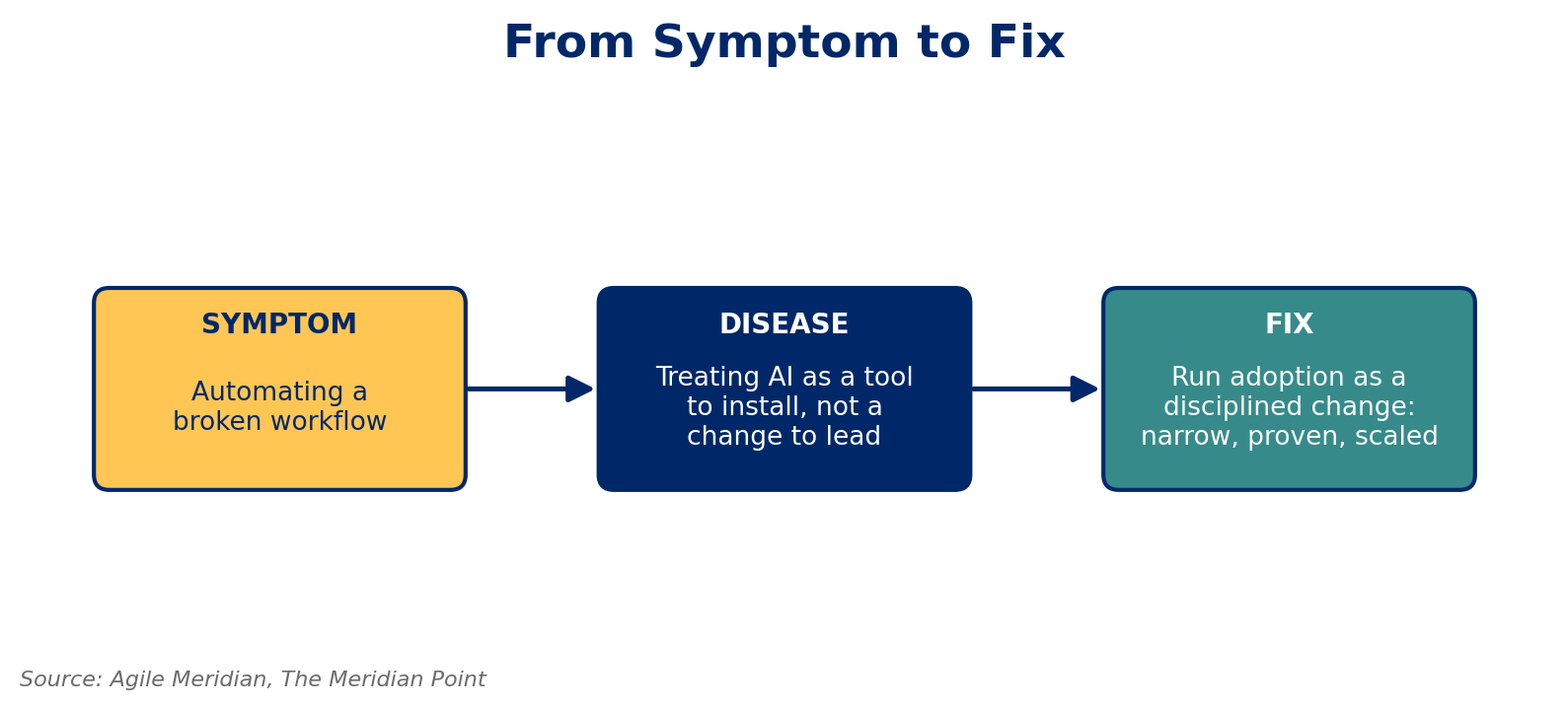
Second, fund the change, not just the license. Training, workflow redesign, a safe place to practice. A leader who mandates the AI result while refusing to pay for the redesign is not saving money. He is borrowing capability he did not build and calling the loan a strategy.
Third, fix the workflow before you automate it. Pointing an expensive machine at a broken process gets you a faster broken process. Ashwini's second failure mode is the most common one I see, and it is the cheapest to avoid.
The organization that demands the AI outcome without building the discipline pays twice. Once for the tools and again for the postmortem. The tool is genuinely powerful this time. That was never the question. The question is whether you will run the adoption as a change to lead or a product to install. Agile answered that question the hard way. AI is asking it again.
Related Podcast Episodes
Ep 152, From Agile to AI: Avoiding the Same Transformation Mistakes, Sanjiv Augustine. The spine of this piece. Sanjiv carries the Highsmith through-line and turns it into a working framework, Agile x AI, that separates the projects that pay from the ones that stall. If you read one companion to this article, read this conversation.
Ep 172, She Ran a $120M Portfolio, Suzel Wyvill-Jones. Suzel supplies the enterprise mechanism, managing AI like old software and renaming roles instead of changing the work. Her data-readiness point holds up against Gartner's forward look, and her start-small prescription is the discipline in miniature.
Ep 170, AI Won't Save You If You Can't Code, Tom Stiehm. Tom draws the cleanest line from agile's failure to AI's, then offers the remedy, the dojo model and training for the failure modes you will rarely see. His drunk-intern analogy for an AI assistant is worth the listen on its own.
Ep 174, AI Is Not a Magic Bullet: What Enterprise AI Gets Wrong, Ashwini Kumar. Ashwini brings the scope discipline and the trust gap, the two things that decide whether a working pilot ever becomes a working business capability.
You have watched this movie once already. If your organization is mandating the AI outcome without funding the change underneath it, that is the gap, and it is the fixable part. Book a 30-minute call and we will find the one workflow worth proving first. https://tidycal.com/coachkumar/30-minute-meeting