Robust Theme
Dec 09, 2019 2020-04-08 7:40Robust Theme


Where Clean Energy Is on the Adoption Curve

By: Kumar Dattatreyan
"Your electric bill is about to drop seventy percent."
That's what Glenn told me on our fireside chat, and I'll be honest—I thought he'd completely lost the plot.
We'd planned to talk about energy, which I knew only a little about, and went into the conversation more curious than anything. And Glenn started with this story:
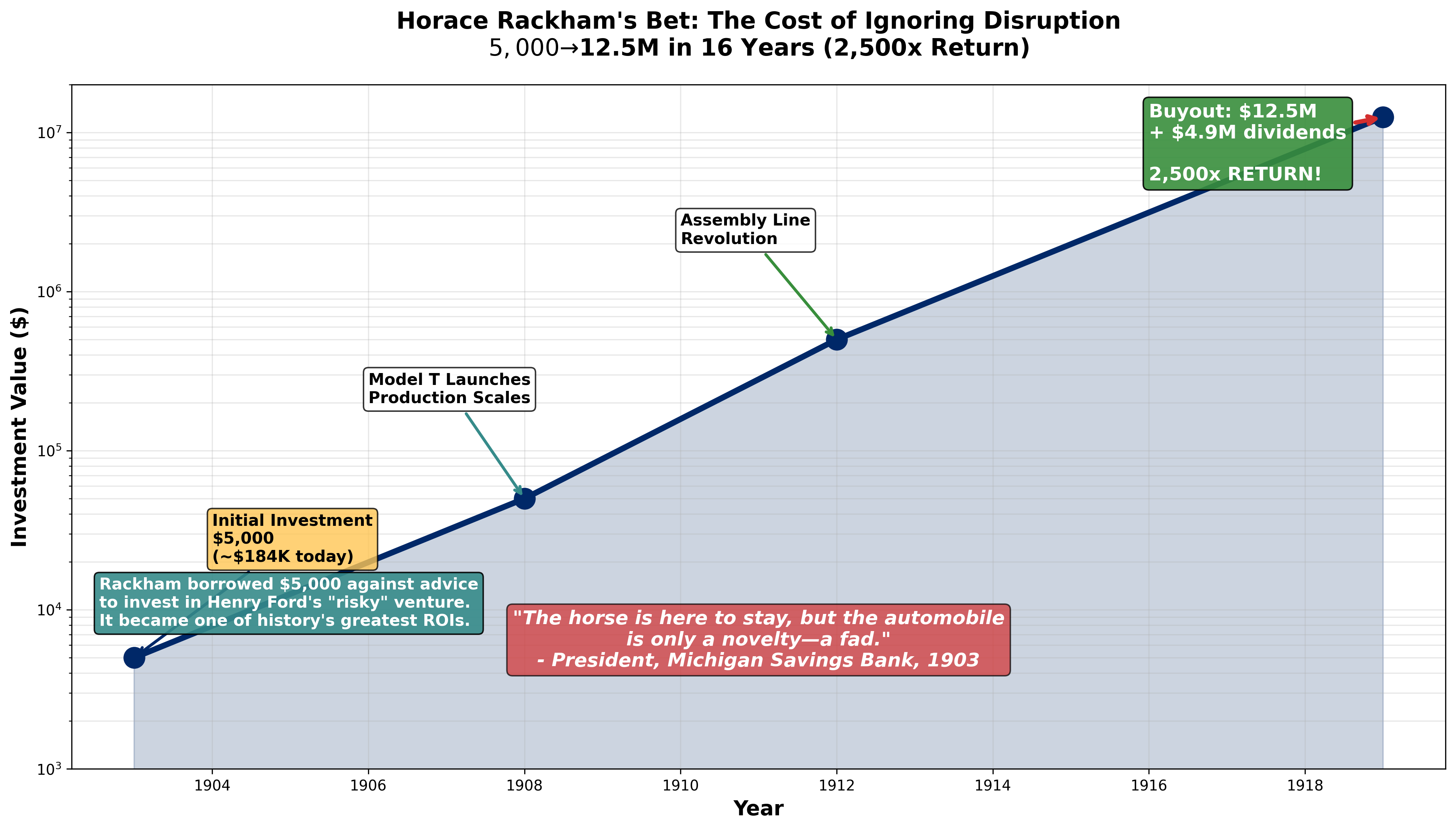
In 1903, a guy named Horace Rackham wanted to invest five thousand dollars in Henry Ford's new automobile company. His banker told him: "Don't do it. The automobile is a fad. The horse is here to stay."
Rackham ignored him and made the investment anyway.
Sixteen years later, Ford bought him out for twelve and a half million dollars.
"Okay," I said. "Great story. What does this have to do with my electric bill?"
Glenn smiled. "We're living in 1903 right now. For electricity."
That's when he said the thing about my bill dropping seventy percent.
I did not believe him.
The Week I Tried to Prove Glenn Wrong
Look, I like Glenn. He's been on my podcast multiple times—Episodes 86, 80, 75, and 67—always about systems, patterns, and how nature's principles apply to organizations. Smart guy. Systems thinker. Usually makes sense.
But "70% cheaper electricity"? Come on.
I know organizational transformation. I know how to break down silos in Fortune 50 companies. I know leadership systems inside and out.
Energy markets? Not my thing.
So after we hung up, I did what you do when someone says something that sounds crazy: I went looking for evidence that they're wrong.
I started with batteries because Glenn had mentioned them and with his encouragement, I went and did the research.
First search: battery costs over time.
And... okay, that's interesting. There's this Bloomberg tracker showing lithium-ion batteries cost twelve hundred dollars per kilowatt-hour in 2010. By 2025 they're at one hundred and eight dollars.
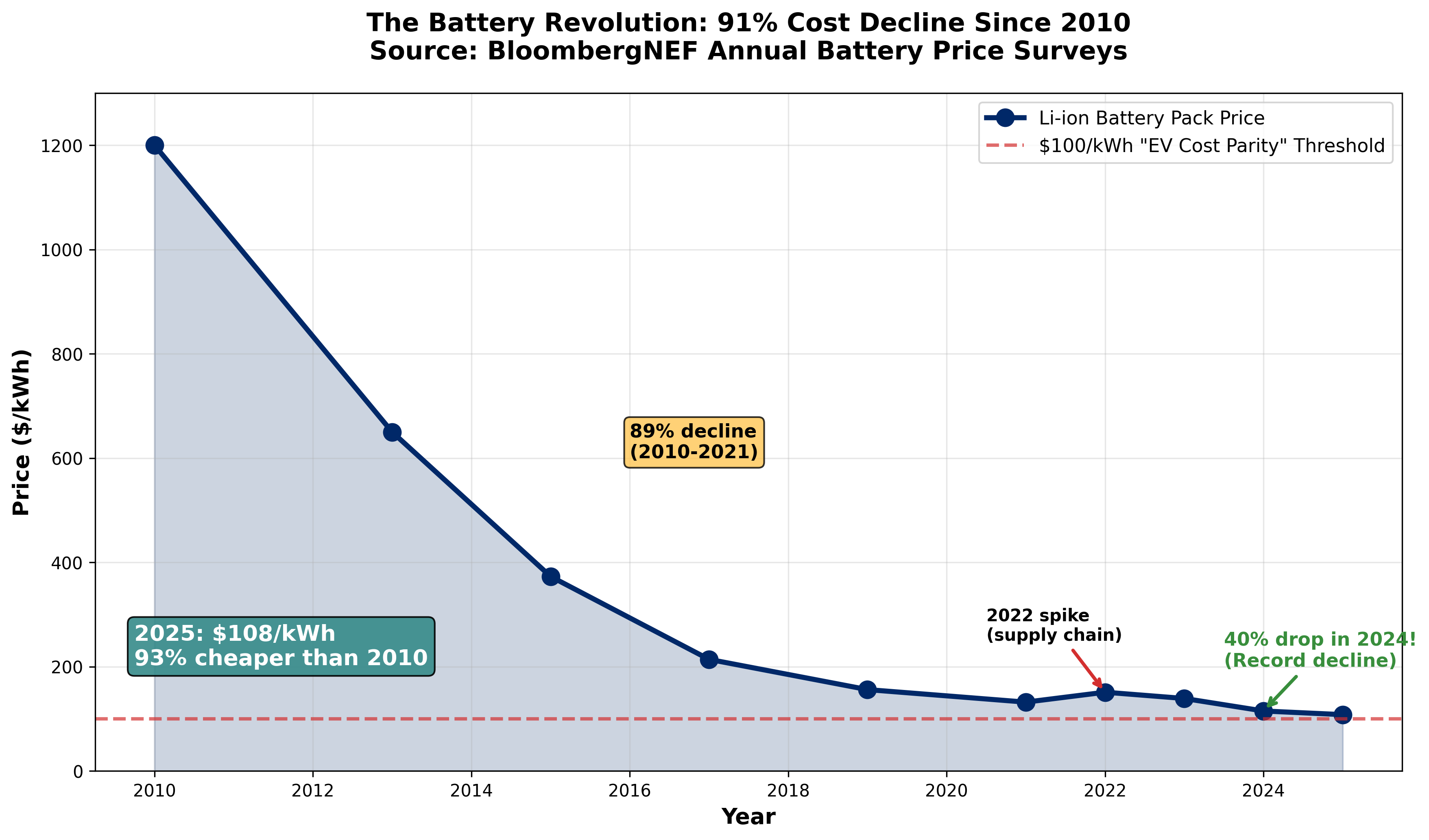
That's a ninety-one percent drop.
But that could be a one-time thing. Some breakthrough. Doesn't mean it continues.
Second search: why are battery costs falling?
That's when I found the MIT study. Turns out there's this thing called a learning curve. Every time you double production of something, costs fall by a consistent percentage. For batteries, it's about twenty percent per doubling.
And production doubles every three to four years.
Okay. So that's... predictable. Not a fluke.
Third search: solar panel costs.

Same pattern. Down ninety-one percent since 2010. Global average now forty-three dollars per megawatt-hour.
I sat back from my laptop.
Glenn might actually be onto something.
The Banker's Letter Arrives
Then, the next morning, I saw an article.
It was in RealClearEnergy, published recently: "We Didn't Just Get Expensive Electricity. We Built a System That Makes It Inevitable."
Perfect. This was exactly what I needed. Someone with actual energy expertise explaining why Glenn was wrong.
I opened it expecting validation.
The article laid out the case methodically:
"Wind and solar generation increased fourfold between 2011 and 2020, reaching record output by 2024. These sources have advantages. But they also have a basic limitation: they don't produce power all the time. So utilities must build backup systems. Extra transmission lines. Extra capacity. None of this redundancy is free."
See? I thought. The intermittency problem. Solar doesn't work at night. You need backup. That costs money. Glenn's missing this.
The author continued, explaining how regulatory structures like Construction Work in Progress (CWIP) shifted financial risk from investors to consumers. How layers of mandates and subsidies created an "upward, inflationary tilt" in the system.
It was well-reasoned. Data-driven. Written by someone who clearly understood electricity markets better than I did.
And then I realized something.
I was reading the banker's letter from 1903.
The Same Argument, Different Century
Think about what that banker would have written in 1903 if asked to explain why automobiles would never replace horses:
"Automobiles have advantages. But they also have basic limitations: they require expensive infrastructure. Paved roads. Refueling stations. Repair facilities. Each automobile must be hand-built by skilled craftsmen. Production is slow. Costs are high. None of this infrastructure is free."
Every word of that would have been TRUE in 1903.
Automobiles DID require infrastructure. They WERE hand-built. They WERE expensive.
The banker wasn't stupid. He was analyzing static costs.
He couldn't see the production line Henry Ford was about to build.
The RealClearEnergy article was making the exact same argument about solar and batteries:
Look at current costs. Look at current infrastructure needs. Therefore, expensive electricity is inevitable.
Static analysis. True today. Completely wrong about tomorrow.
Because they're missing one thing: Wright's Law.
The Question That Kept Me Up
Here's what didn't make sense about the RealClearEnergy argument: solar doesn't work at night. Everyone knows that. It's the whole problem with solar, right?
So I searched: solar plus battery storage costs.
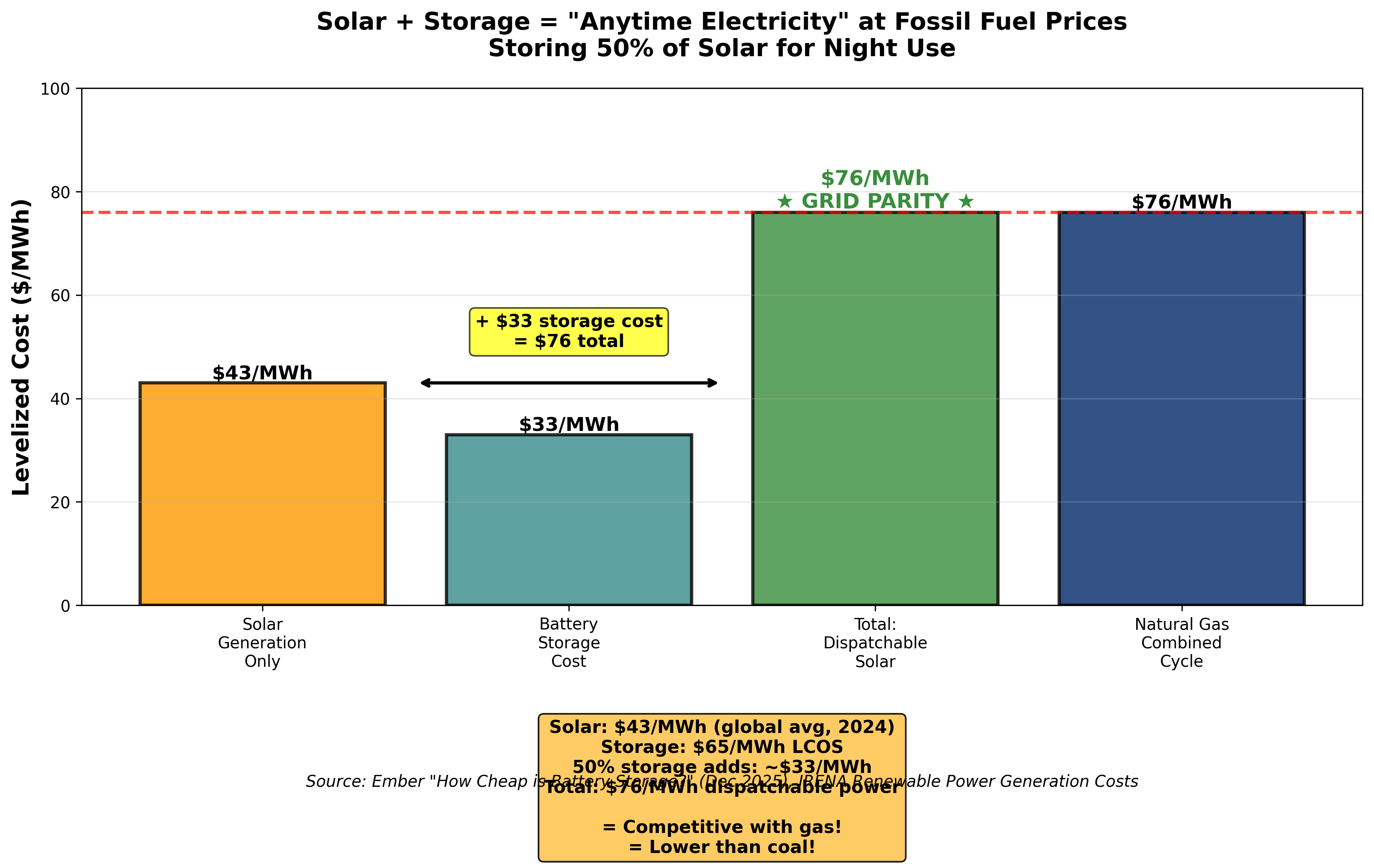
What I found: you can combine them. Solar generates during the day for about forty-three dollars per megawatt-hour. Batteries store it and release it at night. Storage adds about thirty-three dollars.
Total: seventy-six dollars per megawatt-hour for electricity you can use anytime.
Natural gas plants? Also seventy-six dollars per megawatt-hour.
I stared at that for a long time.
Solar plus batteries cost the same as fossil fuels. For electricity that works 24/7.
The intermittency problem... was solved?
But wait. The RealClearEnergy article was published recently. They're analyzing current data. They KNOW about batteries.
Why are they saying expensive electricity is inevitable when batteries already solve the backup problem at grid parity?
It was almost midnight. I should've gone to bed.
Instead, I went down a rabbit hole.
The Thing I Couldn't Stop Thinking About
There's this principle called Wright's Law.
Guy named Theodore Wright studied airplane manufacturing in the 1920s. Discovered that every time you double production, costs fall by a fixed percentage. Not because of magic. Because you get better at making things.
And here's the part that got me: the percentage stays consistent.
For solar panels, researchers have tracked this for forty years. Every time production doubles, costs drop twenty to twenty-four percent. Like clockwork.
Solar production doubles every two and a half years.
I did the math: that's about eight percent cheaper every single year. Predictably.
By 2035—just nine years from now—solar will cost around twenty-four dollars per megawatt-hour.
Batteries will cost about thirty-eight dollars per megawatt-hour for storage.
Put them together for round-the-clock power: forty-three dollars per megawatt-hour.
Then I thought: what about nuclear? Everyone's talking about nuclear for AI data centers.
That's when things got weird.
The Graph That Shouldn't Exist
I found this 2016 study tracking nuclear construction costs across seven countries from 1960 to 2010.
Before 1970, nuclear was crushing it. Costs falling twenty-three to thirty-five percent per doubling. France, USA, everyone seeing economies of scale.
Then the line on the graph does something that defies Wrights Law.
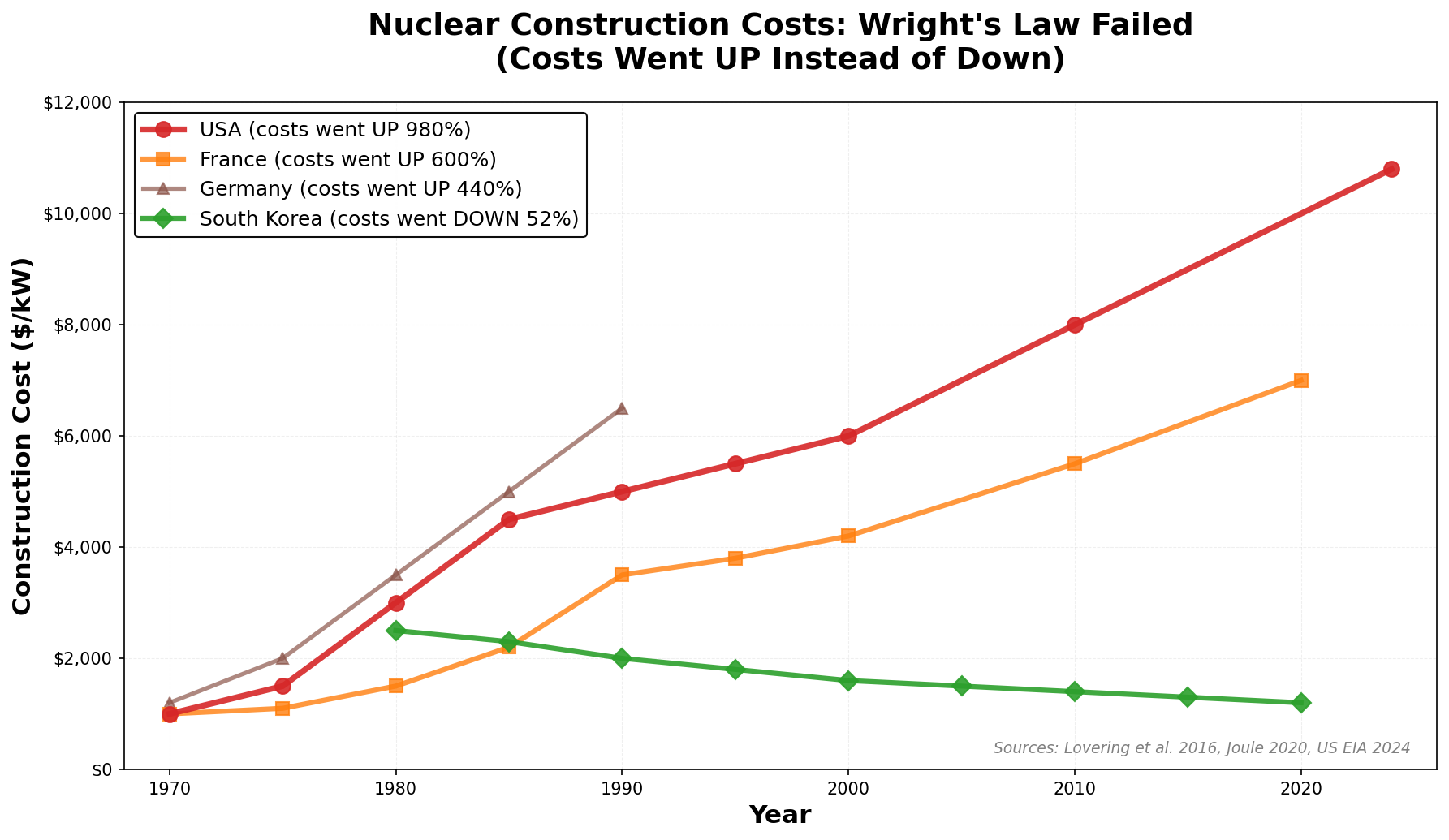
It goes up.
After 1970, nuclear's learning rate went negative. In the USA, costs nearly doubled every time they doubled capacity. Germany, France, Japan—all the same pattern.
The only exception was South Korea.
I kept reading. Three Mile Island happened in 1979, sure. But the problems started earlier. Every new safety requirement made plants more complex. Every regulatory change mid-construction. Every plant became custom instead of standardized.
The learning disappeared.
Construction times told the same story. 1960s average: around six years. The latest US plant that just came online in Georgia? Fourteen years.
Fourteen years to build something we've been building since the 1950s.
Meanwhile solar farms go up in twelve to eighteen months.
I looked at global nuclear capacity. Took fifty years to go from two hundred gigawatts to four hundred.
It hasn't doubled in half a century.
Solar doubles every two and a half years.
Glenn wasn't crazy. The data was insane.
The RealClearEnergy Article Got One Thing Right
I went back and reread the article the next morning with fresh eyes.
They were absolutely right about one thing: the electricity system IS broken. Regulatory structures DO shift costs to consumers. CWIP IS a scam where you pay for projects that don't exist yet.
But here's what they missed:
Those problems existed when renewable costs were HIGH.
When solar was $300/MWh and batteries were $1,200/kWh, yes, building backup systems was prohibitively expensive. The "redundancy problem" WAS real.
The article is analyzing 2015-2020 economics and projecting them forward forever.
That's like analyzing 1903 automobile economics—hand-built cars, no production line, $800 per vehicle—and concluding "automobiles will always be too expensive for mass adoption."
They can't see that battery costs have dropped ninety-one percent and are still falling eight percent per year.
They can't see that by 2035, solar + battery for 24/7 dispatchable power will cost $43/MWh while nuclear costs $113/MWh.
The "redundancy problem" disappears when the redundancy becomes cheaper than the alternative.
That's Wright's Law.
The article is written from 1903, looking at expensive hand-built cars, saying "automobiles require too much infrastructure and will never scale."
They're missing the production line being built right in front of them.
The Microsoft Question
But okay, here's what I still didn't get: if solar and batteries are so much cheaper and getting cheaper every year, why is Microsoft spending a billion and a half dollars to restart Three Mile Island?
Why are Meta and Google and Amazon all signing nuclear deals?
Are they stupid? Do they not see what I'm seeing at three AM on a Tuesday?
I spent the next day reading everything I could find about AI data centers and power.
That's when I discovered the bottleneck nobody talks about.
Right now, there are fifteen hundred gigawatts of renewable projects—solar and wind farms—sitting in queues waiting to connect to the US power grid. Some are waiting to be built. Some are built and waiting for permission to plug in.
Average wait time: three to seven years.
Three Mile Island? Already connected. Has been since 1979. Just restart the reactor.
Timeline: four years total.
Solar plus battery: one to two years to build, then three to seven years waiting in the connection queue.
Microsoft needs power in 2028, not 2032.
Nuclear wins on speed. Not economics. Speed.
The second thing: scale. These AI data centers are massive. The Stargate project is planning five-gigawatt facilities. That's more power than the entire state of New Hampshire uses.
Five gigawatts of solar needs ~25 square miles (using today’s technology - think Wright's Law!).
Five gigawatts of nuclear? Five square miles.
If you're Microsoft and you need a gigawatt right next to your data center in the next four years, nuclear actually makes sense.
For now.
But here's what the Goldman Sachs analysis I found said: this works for 2024 to 2028. By 2030, when the connection queues clear and solar plus battery is half the price, the economics flip completely.
Microsoft isn't betting on nuclear long-term. They're solving an urgent short-term problem.
The Conversation I Had to Have
Next morning, I called Glenn back.
"You were right," I said. "I spent two days trying to prove you wrong and I can't."
"Did you find Wright's Law?"
"I found everything. The learning curves, the nuclear disaster, the interconnection queues, all of it."
"And?"
"And I think I've been the banker."
There was a pause.
"What do you mean?"
"The banker in 1903," I said. "The one who told Rackham the horse is here to stay. He wasn't stupid. There weren't many cars. Mass production hadn't been invented. His assessment made sense based on what was visible."
"But he was wrong."
"He was blind to exponential change. He couldn't see it because he was sitting in the middle of it."
"And now?"
"I'm sitting in the middle of the electricity transformation and I didn't see it either. I've been focused on AI and organizational transformation and leadership systems. Energy seemed like... not my thing."
Glenn laughed. "It's not about energy, Kumar. It's about seeing exponential change when you're living through it. That's what you teach. Pattern recognition."
He was right.
In Episode 152, I literally discussed with Sanjiv Augustine how organizations repeat the same transformation mistakes from Agile to AI.
I teach executives how to spot disruption in their industries. How to recognize when the game is changing. How to see around corners.
And I'd completely missed this one.
Even worse: when I found an article that confirmed my skepticism—the RealClearEnergy piece—my first instinct was relief. "See? Someone credible agrees with me."
I almost stopped there.
That's the banker's mistake. Finding evidence that supports what you already believe and stopping.
What This Actually Means
Let me make it concrete.
Your electric bill right now has two parts. About forty-five percent is generation—actually making the electricity. About fifty-five percent is transmission and distribution—the wires and poles that deliver it.
With rooftop solar and a battery, your generation cost goes to essentially zero. You made it yourself.
You just pay for the grid connection. Like paying for internet service, not per gigabyte.
A two-hundred-dollar monthly bill becomes fifty dollars.
That's not happening in some distant future. Duke Energy in Florida is doing it. Added solar and batteries. Lowered rates.
Texas tripled its solar additions from 2023 to 2024, installing 12 gigawatts—enough to power 2 million homes. Not because of environmental mandates. Because in 1997 they deregulated their electricity market with one rule: buy power from whoever's cheapest.
Economics picked solar. Not ideology. Economics.
By 2035—nine years from now—solar plus battery will be half the price of nuclear for the same round-the-clock power.
Electric vehicles will charge from your rooftop panels for free.
The entire energy system will have transformed.
And people will look back and ask why nobody saw it coming.
But here's the thing: the RealClearEnergy article will still be there. Published February 23, 2026. Explaining with perfect logic why expensive electricity is inevitable.
Just like there's a banker's letter somewhere from 1903 explaining why the horse is here to stay.
The Uncomfortable Truth
Here's what keeps me up now:
In every conversation I have with executives about transformation, I talk about pattern recognition. Seeing the future before it's obvious. Not being the banker who said "the horse is here to stay."
And I almost missed this.
If Glenn hadn't brought it up on our fireside chat, I'd still be oblivious.
The scarier realization: I found a well-written, data-driven article that confirmed my skepticism, and I almost used it as an excuse to stop researching.
That's how the banker's mistake happens. It's not stupidity. It's confirmation bias dressed up as prudent analysis.
How many other exponential changes am I sitting in the middle of right now and can't see?
How many are you missing?
The data is there. The learning curves are clear. Wright's Law has been working for forty years in solar. The math is brutal for nuclear.
But most people don't see it yet because 2026 is like1903.
The production line is running. The transformation is happening. The exponential curve is already underway.
By 2035, it'll be obvious.
The question is: will you be Horace Rackham or the banker?
What I'm Doing About It
I'm not an energy expert. That's not changing.
But I plan to call my state representative's office and ask for three (maybe four) things:
- Competitive procurement—let the cheapest technology win, like Texas did.
- Remove regulatory barriers to rooftop solar.
- Fix the permitting process so solar and batteries don't sit in queues for seven years.
- Bonus: allow balcony solar “as an appliance” like Utah did - no electrician, no permit
That's it. Three(ish) things.
Texas proved this works. In 1997 they had no idea solar would win. They just created fair competition.
By 2024, solar was dominating on pure economics.
I'm also putting solar on my roof. Not (only) to save the planet. To save seventy percent on my electric bill.
And I'm paying attention differently now.
Because if I missed this—me, the guy who teaches pattern recognition for a living—what else am I missing?
What articles am I reading that sound smart, that have good data, that confirm what I already believe... but are analyzing static costs in a world of exponential change?
The Real Question
This isn't really a story about energy.
It's about exponential change and why smart people miss it.
The banker in 1903 wasn't stupid. He looked at the world around him—mostly horses, a handful of hand-built cars—and made a logical assessment.
He was wrong because he couldn't see the exponential curve starting.
The RealClearEnergy author isn't stupid either. They looked at current renewable costs, current backup requirements, current regulatory structure—and made a logical assessment.
They're wrong because they can't see the exponential curve that's already running.
By 2035, when the Model T production line—I mean, when solar + battery is half the cost of nuclear and dominating the market—it will be obvious.
But in 1903? In 2026?
You have to be willing to look crazy. Like Horace Rackham. Like Henry Ford. Like Glenn.
We're in 1903 for electricity right now.
The curve is already running. Has been for forty years. The data is there for anyone willing to look past the articles that confirm what they already believe.
Most people aren't looking.
Are you?
Listen to the original conversation with Glenn that started this whole obsession
Take the Disruptor Quiz: Find out if you're positioned to see the next disruption before your competitors.
More episodes exploring these themes:
Systems Thinking with Glenn:
- Episode 86: Ecosystem Thinking for Innovation
- Episode 80: Designing Connected Ecosystems
- Episode 67: From Permaculture to Agile Organizations
Pattern Recognition in Transformation:
- Episode 152: From Agile to AI - Avoiding the Same Mistakes
- Episode 150: Top-Down vs Bottom-Up Transformation
Kumar Dattatreyan, ICF PCC
Co-Founder, Agile Meridian
Host, The Meridian Point Podcast
P.S. - If you're reading this and thinking "Kumar's lost it, energy isn't his thing"... you might be right. But go look at the battery cost data yourself. Then the solar data. Then Wright's Law. Then tell me I'm wrong. I'll wait.
Key Sources for the Curious:
I'm not citing every number in the story because this isn't a research paper. But if you want to verify what I found:
- BloombergNEF tracks battery costs
- MIT study on battery learning curves
- IRENA solar cost data
- Wright's Law explained by ARK Investment
- Nuclear construction cost study (Lovering 2016)
- Goldman Sachs on AI data center power
- Our World in Data: Why renewables got cheap
Everything I found is real. Go check for yourself. That's what I did.