Robust Theme
Dec 09, 2019 2020-04-08 7:40Robust Theme


Career Disruption Is a Skill You Build Before the Layoff
By: Kumar Dattatreyan
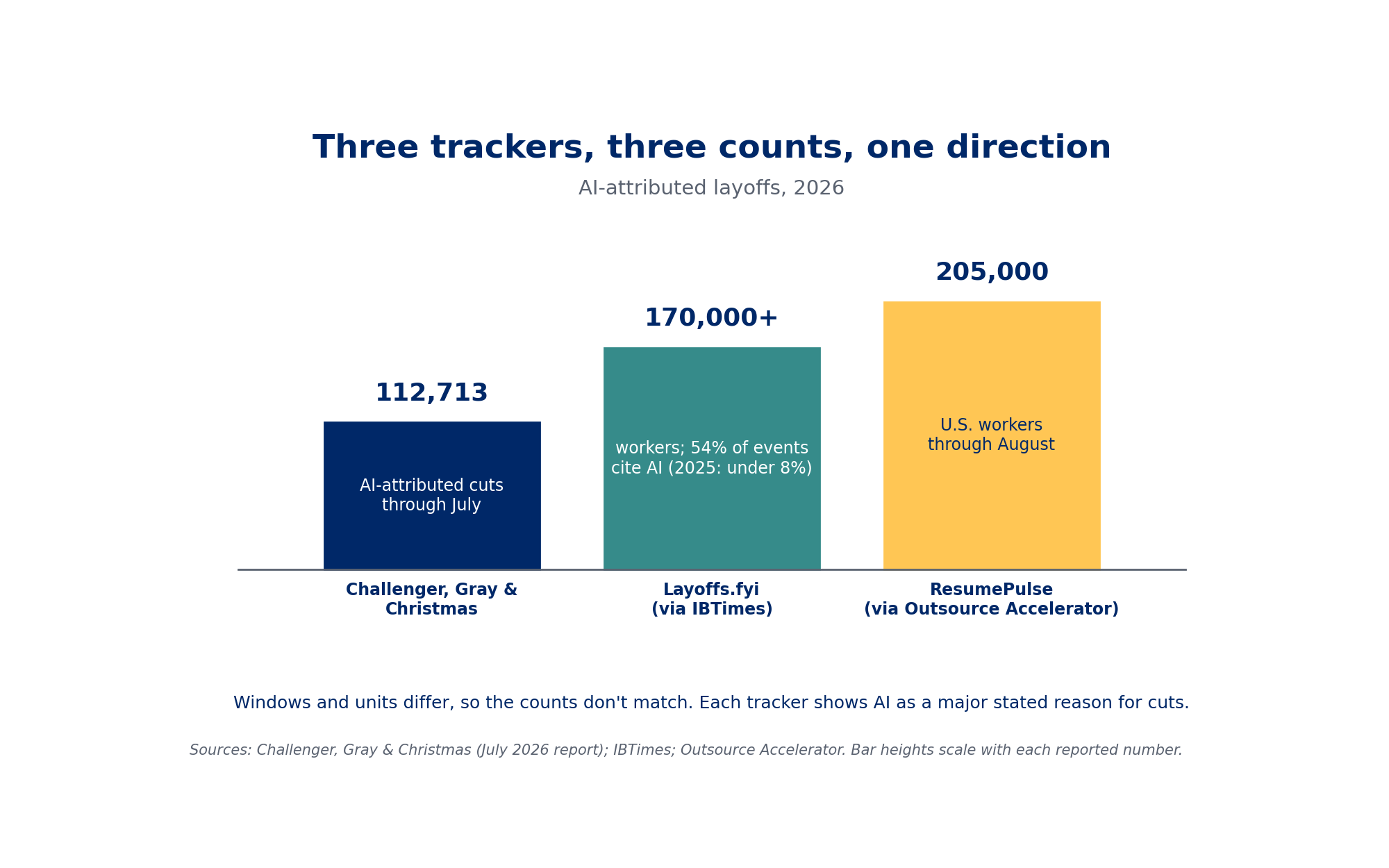
Three trackers count AI-attributed layoffs in 2026, and no two of them agree on the number. Challenger, Gray & Christmas logged 112,713 AI-attributed job cuts through July and found AI leading the stated reasons for cuts for five straight months. Layoffs.fyi, as reported by IBTimes, shows 54 percent of 2026 layoff events citing AI, automation or machine learning, against fewer than 8 percent of announcements in 2025. ResumePulse puts the U.S. total at 205,000 workers through August. Each tracker counts a different window in a different unit. All of them point the same way.
The advice that follows these headlines is usually a lie you tell yourself. You're told to see the layoff as a gift. It isn't a gift. No coach can call a loss an opportunity and make the grief smaller. But waiting for the system to fix itself isn't a plan either.
My claim is that career disruption is a skill, and it costs the least to build before you need it. Three guests on The Meridian Point each showed me a different part of the sequence, and one of them showed me what happens when the sequence gets interrupted.
The Strongest Case Against This Argument
The critics have a serious case, so it comes first.
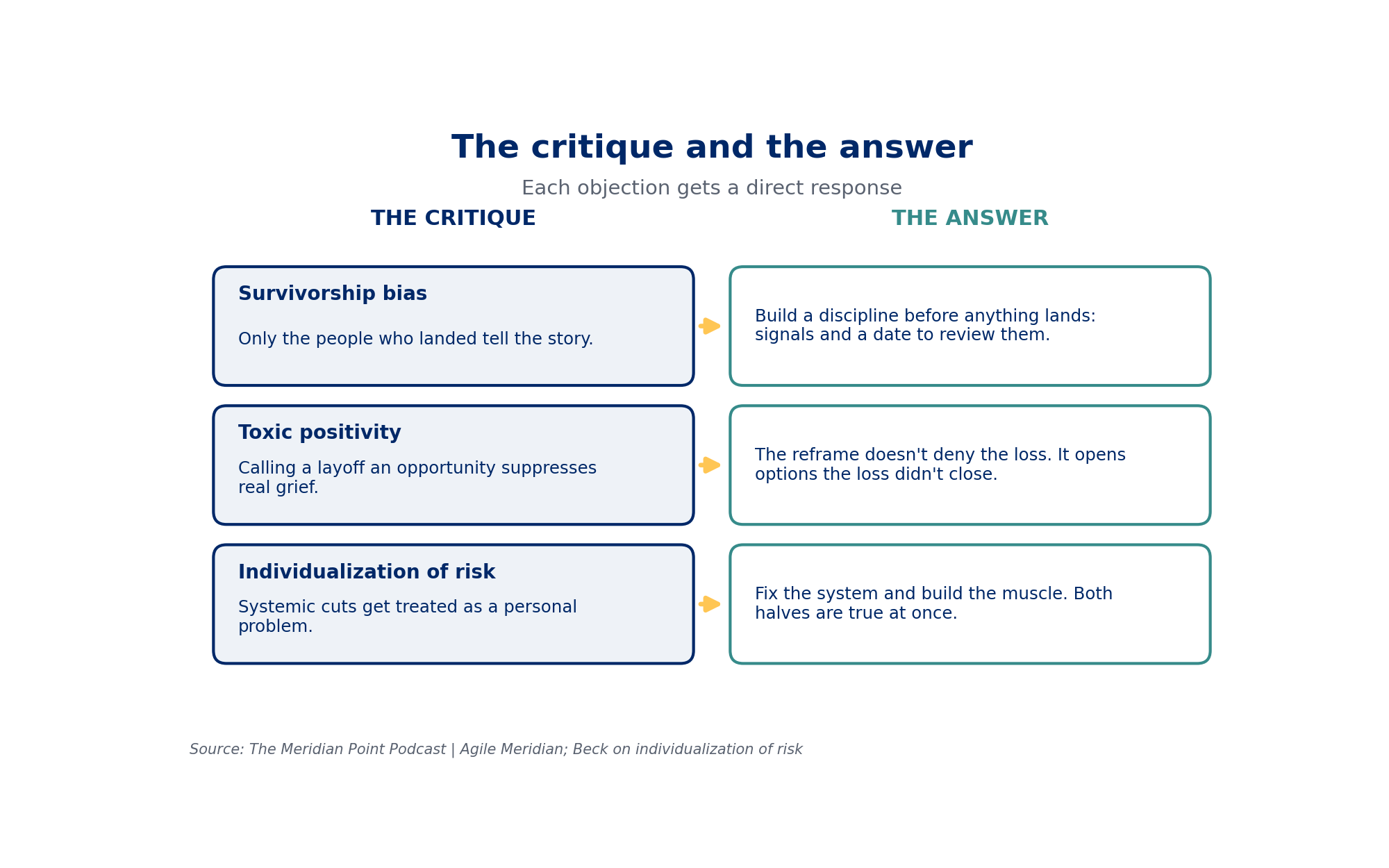
The first objection goes after the advice itself. Survivorship bias shapes every reinvention story we hear, because the people who landed tell the story and the people who didn't land never get invited on the podcast. Toxic positivity makes it worse. Telling a laid-off worker to look for the opportunity suppresses the grief, anger, and fear that the moment deserves.
The second objection goes after the structure. Sociologist Ulrich Beck described the individualization of risk, the way modern institutions push the management of risk onto individuals. Gabe Mythen examined that idea against employment insecurity in a 2005 paper in The Sociological Review. When AI-driven cuts are systemic, the critics say, personal reinvention advice makes workers responsible for a risk that moved onto them without their consent.
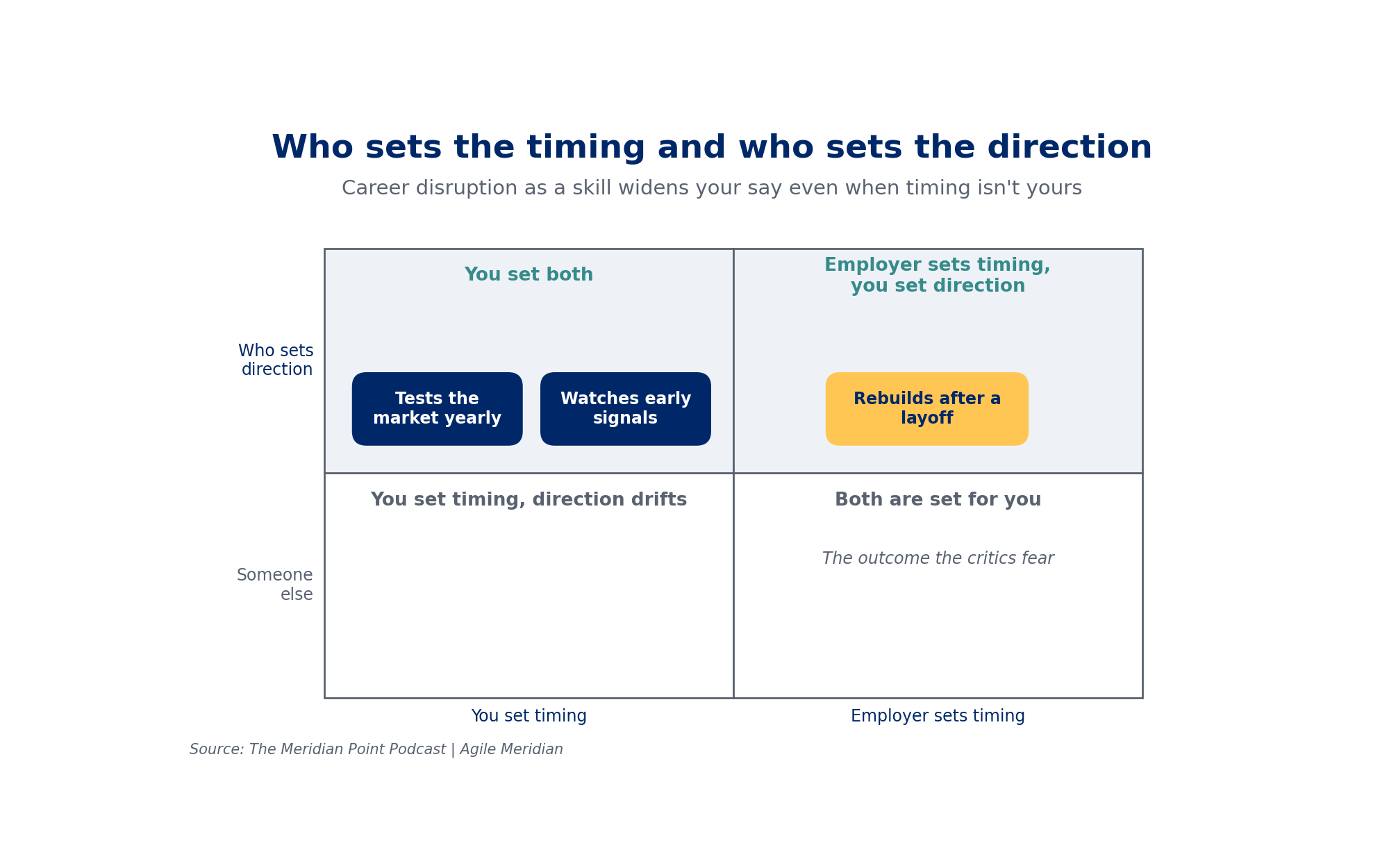
They're right on the facts. The risk did move, and the numbers show the disruption is systemic. Nobody should tell a laid-off worker the layoff was a gift. They're wrong about the conclusion. Two things are true at once. The system should carry more of the risk, and the person holding the badge still has to make the next move. Telling that person to wait for policy is its own kind of cruelty.
The honest advice refuses both lies. It won't call the loss a gift, and it won't tell anyone to wait for a fix that hasn't arrived. Each guest below tests the argument against the critics, and I'll say where it holds and where it strains.
Discomfort Is Data
Reha Malik started her career as a database administrator on the overnight shift at Freddie Mac. She worked in a basement supporting production systems, and she couldn't see how any of it connected to the bigger picture. She sums up what she did about that in one line: "discomfort became my compass."
The same compass tells her when to leave a role that's working. She doesn't wait for a review or a layoff. When she's solved the problem she was brought in to solve, her growth in the role is finished, and she says so directly: "A status quo does not do that for me."
Most retellings of that instinct stop at the resignation. The more useful part comes after it. Reha interviews with Amazon about once a year and declines the offer. She isn't trying to leave. She wants to know where her technical and people skills stand in the market and what she needs to build next. She tells the people she coaches why: "nobody is going to leave a job if they don't have options."
That sentence carries the whole strategy. Options come from continually challenging yourself, which means the runway you need in a disruption gets built during the comfortable stretch before it. A layoff punishes the people who skipped that work. They find their gaps on the day the market tests them for real.
Whitney Johnson's Disrupt Yourself, which came up in my conversations with both Reha and Todd, puts the same idea on an S-curve. A person learns fast in a new role, then the growth flattens somewhere around the two-year mark. Good leaders notice the plateau and hand people the signal early. Reha credits some of her leaders with exactly that. They told her they could no longer keep her motivated and that she should decide for herself whether to move on. When your leader doesn't hand you the signal, you have to produce it yourself, and the annual interview is one way to do it.
The Transformation Tax
Todd Kamens brought the timing question to the show. He came back from a reinvention summit in Dublin with ideas from two thinkers, and he credits both on air. Dr. Nadia Zaksymbaeva calls her idea the Titanic syndrome: the ship had radios and nearby boats that told the crew what was going on, and it didn't have to sink. Aidan McCullen builds on the S-curve, the arc every business rides from growth to peak. The question Todd relays is when to act, and he puts it in the comfortable stretch before the peak: "how do we reinvent when things are comfortable?"
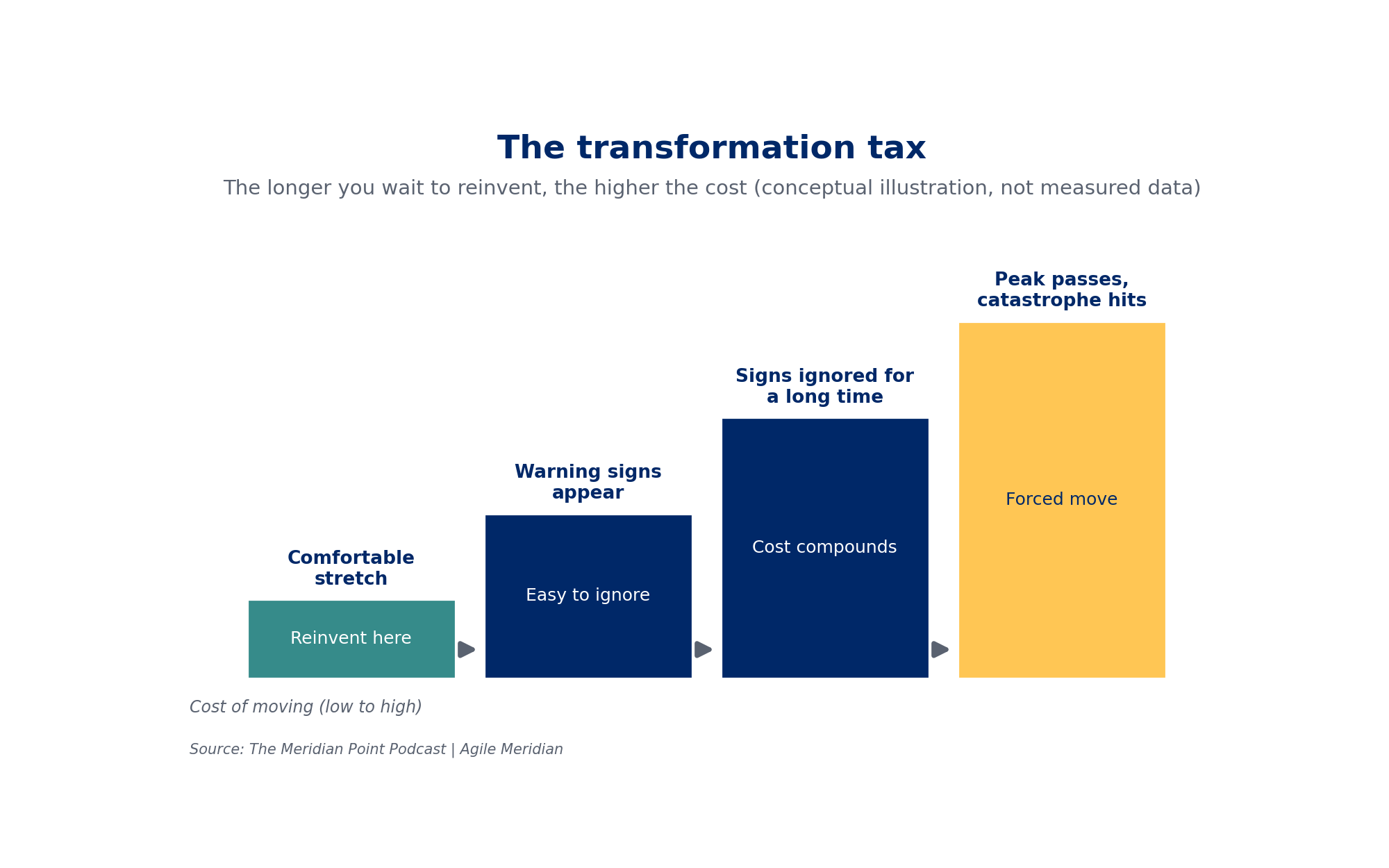
Waiting has a price, and McCullen gave it a name. Todd describes it as a transformation tax: "the longer you wait to reinvent, the higher the cost." He compares it to technical debt, which compounds while people are busy building the next shiny thing. Disruption rarely announces itself either. In Todd's words, "the disruption rarely begins with a catastrophe." It starts with warning signs that somebody ignored for a long time.
The tracker numbers I opened with are what those warning signs look like after they've hardened into events. Todd applies the same thinking to individual careers, and he built an early warning GPT to do it. A junior software developer can ask what OpenAI's Codex means for the job, and the tool walks through what to watch for and what to do at each horizon. As signals turn green, the developer starts preparing. Todd's point is that you don't wait three years to lose the job. He also notes the preparation won't hurt you in your current role, because it only leaves you better prepared.
On the show, I suggested a version of this for companies: a short list of signals and a quarterly review. The discipline works for one person too. Reha's annual interview and Todd's signal list are the same instrument at two ranges. Reha's measures your skills against the market. Todd's measures the market against your job.
This is where the survivorship charge meets its answer. A reinvention story told after a landing is a highlight reel. Todd describes a discipline that exists before anything lands: a short list of signals and a scheduled time to look at them. You can build that with nothing to show for it yet.
When the Move Gets Made for You
Kreisler Ng's story starts where the other two leave off. He spent twenty years in corporate consulting and agile coaching. His late mother-in-law was homebound, and he and his wife became her primary caregivers. Their daughter was born during that stretch. His mother-in-law died abruptly. Some time later, he was laid off. They'd also bought their first home along the way
 He says none of it was planned, and he's clear about what he expected: "I thought I was going to go back to corporate." He looked for a job for a while in a hard market, like everyone else. Then he kept returning to something his mother-in-law used to tell him, that she wanted him doing work that helped people directly, in healthcare. So he went that way.
People told him to go back to agile or start a consulting firm. He didn't want either one. He wanted something new because, in his words, he needed to force himself to do it. He opened a home care franchise, which gave him a brand and a support system while the business stayed his own.
A year in, the business isn't profitable. He's running payroll and learning labor law and the economics of who pays for home care. He describes the shift as "Going to zero and trying to build something to one." Then he adds: "I'm still rebuilding my life."
Kreisler keeps this argument honest. He didn't choose the timing, and he never calls the layoff a gift. He says it gave him meaning and made him rethink his life. He also says he wasn't fully prepared for how hard building a business would be.
What survived was agency. He couldn't control the layoff. He controlled where he'd work next and what he'd build. He credits practice for the rest: "without those twenty years, I don't know if I'd be able to get through this." Twenty years of agile work left him able to pivot at the last minute when a caregiver calls in sick and a family is scrambling.
That answers the toxic positivity charge. Nothing in Kreisler's account denies the loss. The reframe he made didn't make the layoff hurt less. It opened options the layoff hadn't closed. He'd tell you himself that he isn't there yet, and I'm not presenting him as a landing story.
Build the Muscle While Nothing Forces You
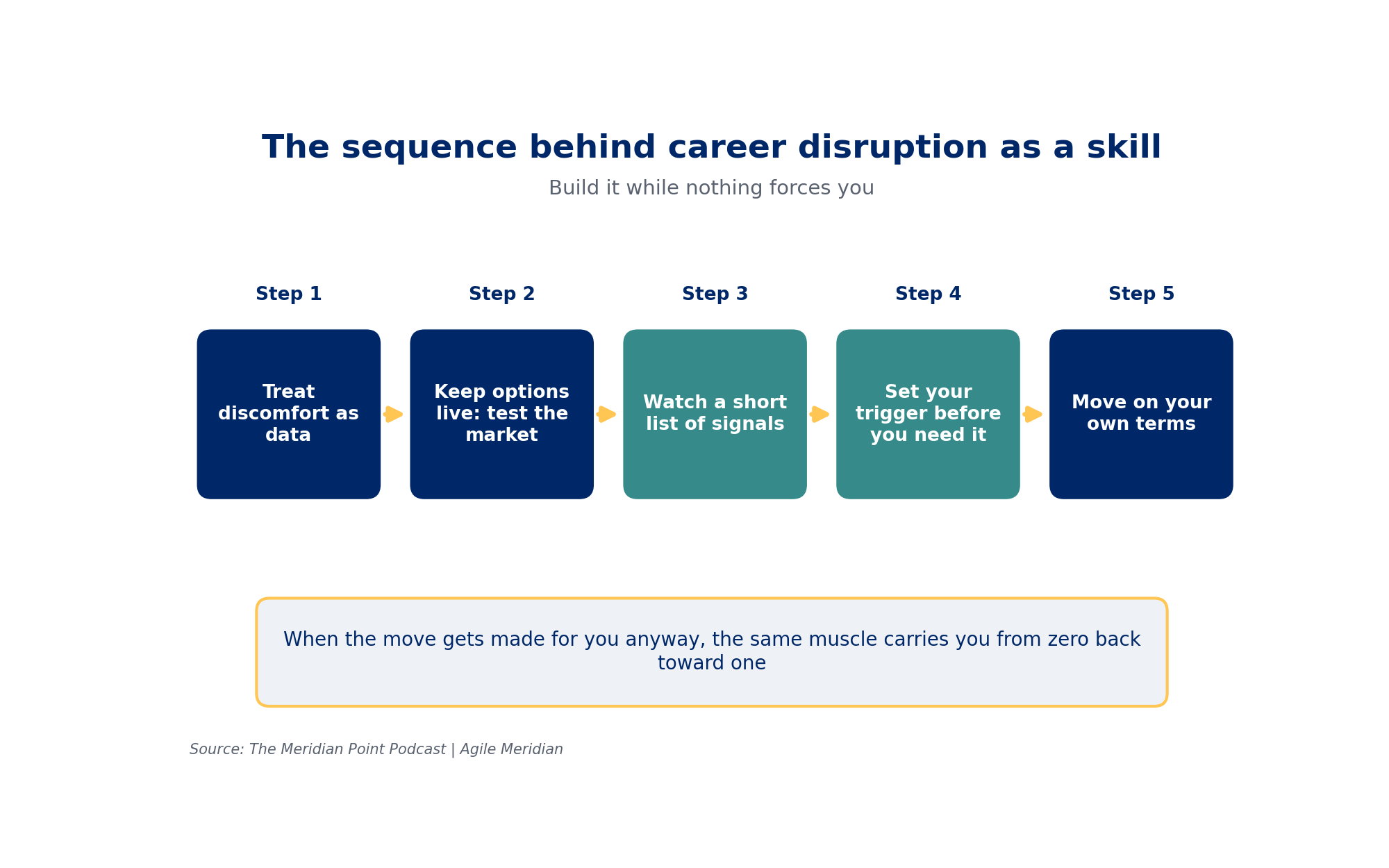
Reha's instinct works because it fires early, and Todd's tax explains why early matters. Kreisler shows what remains when early wasn't available: a hard stretch and a choice about what to build next. The skill is the same in every case. You treat discomfort as data and you act on it before it hardens into an event. When the event comes anyway, the same capacity carries you from zero back toward one.
In 2023 I wrote that adaptability is a practice you train on purpose in Embrace Change by Harnessing the Power of Adaptability. That post said adapt. This one says when. Adaptability is the muscle. Career disruption is the day you need it. The layoff numbers say more people will need it without a long runway, which is the reason to train it now.
None of this lets employers off. Leaders can give people the signal early, and companies can carry more of the cost of the transition. Those decisions belong to them. The morning the badge stops working belongs to you. So fix the system and build the muscle, because the muscle is what you have that morning.
What to Do This Month
Start with signals, not a resume. Write down a short list of the things that would change your job if they moved, such as what AI tools in your field can now do without a person. Put a date on your calendar to look at the list. A quarterly look is enough to start.
Then test the market once, the way Reha does. Interview for a role you'd decline. Leave with a list of gaps and no decision. The point is data on where your skills stand, gathered while you have a job and nothing to lose.
Then decide your trigger now, while you're comfortable. Write down what the signals and the market have to show before you move. You'll argue with yourself less on the day it matters, and you'll pay less of the transformation tax.
Related Podcast Episodes
Episode 164: Career Disruption as a Strategy, with Reha Malik. Reha treats discomfort as information and tests her market once a year so she always has options. Start here for the instinct behind this post.
Episode 151: From Agile Burnout to Reinvention Coach: Todd Kamens' Transformation. Todd brings the transformation tax and the early warning idea from the reinvention summit in Dublin. Watch it for the way he applies them to a single career.
Episode 160: Laid Off at 40, New Dad, Grieving: How I Rebuilt My Life, with Kreisler Ng. Kreisler didn't choose his timing. He tells the story without dressing it up, and he says he's still rebuilding.
Build the Capability Before You Need It
The Disruptor Method™ helps leaders and their teams see disruption early and act on it. Explore it at thedisruptormethod.com, or learn more about Agile Meridian at agilemeridian.com.
Sources
- Challenger, Gray & Christmas: Layoffs Fall, Hiring Picks Up; AI Leads For Fifth Straight Month
- IBTimes: More Than Half of Layoff Events Tracked in 2026 Cited AI or Automation
- Outsource Accelerator: AI-linked layoffs hit 205,000 workers in 2026
- Gabe Mythen, "Employment, Individualization and Insecurity: Rethinking the Risk Society Perspective," The Sociological Review, 2005