Robust Theme
Dec 09, 2019 2020-04-08 7:40Robust Theme


Line of Sight: Turn Disruption Into Advantage
By Kumar Dattatreyan
When the pandemic shut down global supply chains in March 2020, two manufacturing companies in the same industry faced identical challenges. One frantically called emergency meetings. Executives huddled behind closed doors while frontline workers waited for direction. Communication crawled up five layers of management, then trickled back down—outdated by the time it arrived. Within months, they'd laid off 30% of their workforce.
The other company? They seized the crisis.

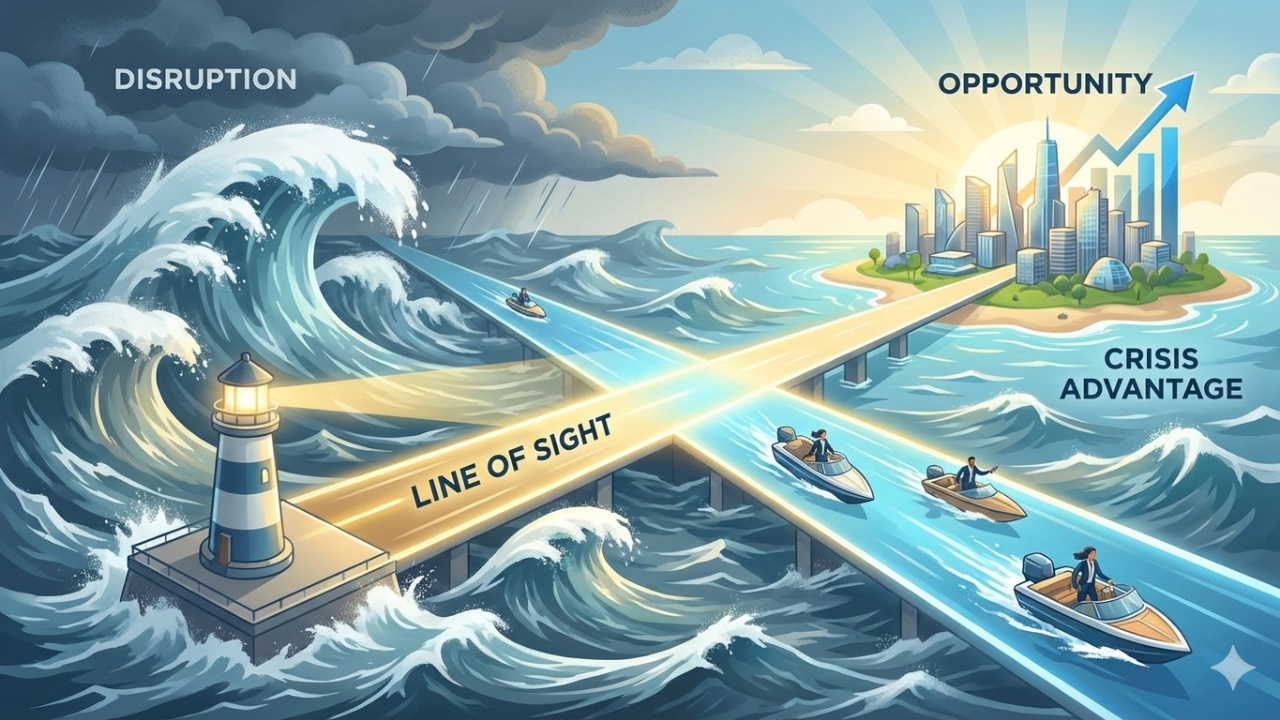
Within 90 days, they'd pivoted from servicing beverage bottling parts to manufacturing complete machines. Revenue actually grew during the pandemic. Their secret wasn't superior strategy or better technology—it was something more fundamental: direct line of sight from the C-suite to the shop floor.
Here's the uncomfortable truth most leadership teams won't admit: your ability to respond to the next crisis isn't being decided during the crisis. It's being determined right now, in how you've structured communication, decision-making, and accountability in your organization. The companies that thrive during disruption don't suddenly discover agility when crisis hits. They've built it into their organizational DNA.
The Hidden Problem: Organizational Sclerosis
Nobody likes a crisis, but as the saying goes, "a crisis is a terrible thing to waste." Yet most organizations do exactly that—they waste opportunities because their structure prevents them from seeing or seizing them.
The problem isn't leadership competence or employee capability. It's that information moves too slowly through organizational layers. By the time frontline insights reach decision-makers and directives flow back down, market conditions have already shifted. What looks like slow decision-making is actually organizational sclerosis—hardening of the communication arteries.
Think about what happens in your organization when something urgent emerges on the front lines. A shop floor worker identifies a supply chain vulnerability. A customer service rep hears consistent complaints about a product feature. A junior developer discovers a security risk. How long does it take for that information to reach someone with authority to act on it?
In traditionally structured organizations, that insight must travel: frontline worker → team lead → department manager → director → VP → C-suite. Then the response travels the same path in reverse. If you're lucky, this round trip takes days. More often, it takes weeks. Sometimes the information never makes it at all—filtered out at one of the layers as "not important enough to escalate."
Why This Happens: The Five Barriers

1. Hierarchical Filtering Each organizational layer acts as a filter, with managers deciding what's worth passing up the chain. The problem? The people closest to customers and operations rarely have direct access to decision-makers. Their insights get summarized, sanitized, and often ignored.
2. Competing Departmental Goals When leaders are rewarded based on individual departmental performance rather than collective outcomes, they optimize for their silo. Finance blocks operations. Marketing clashes with product. Sales competes with customer success. During crisis, this fragmentation becomes fatal.
3. The Control Illusion Many leaders believe maintaining tight control protects the organization. In reality, centralized decision-making creates bottlenecks. During crisis, when speed matters most, these bottlenecks paralyze response.
4. Missing Communication Pathways Organizations build reporting structures but forget to build communication pathways. Your org chart shows who reports to whom, but it doesn't show how information flows—or more importantly, where it gets stuck.
5. Risk-Averse Culture When organizational culture punishes failure more than it rewards adaptation, people stop taking initiative. Frontline workers learn to wait for direction rather than act on what they see. Managers learn to escalate rather than decide.
The Cost of Inaction
While you're reading this, your organizational structure is quietly undermining your competitive position. Every day without direct communication pathways costs you:
Speed: Competitors with flatter communication structures can pivot in days while you're still scheduling meetings to discuss scheduling meetings.
Innovation: Your frontline workers see opportunities every day. Without pathways to surface these insights, they stop sharing them. You're sitting on a goldmine of innovation that never reaches the people who could fund it.
Talent: Your best people—the ones who want to drive change—leave for organizations where they can make an impact. You're left with people who've learned to work within constraints rather than challenge them.
Revenue: During the pandemic, companies with strong line of sight captured market share from paralyzed competitors. The same pattern repeats during every disruption—technological, regulatory, competitive. The next crisis is coming. Your structure is either preparing you to seize it or ensuring you'll waste it.
Proof: The Manufacturing Transformation
Let me tell you about a client that demonstrates what line of sight actually means in practice. This was a mid-sized manufacturing firm in the beverage industry—about 200 employees across four layers of management. Before working with us, they were a parts servicing company. Machines would break, they'd source and replace the parts.
When we started the engagement, they had a traditional structure: C-suite at the top, then VPs, directors, managers, and shop floor workers. Communication flowed through formal channels. Strategy sessions happened quarterly. Shop floor workers raised issues through their managers. The C-suite heard summarized versions weeks later.
We implemented what we call the Steel Thread approach—establishing direct communication pathways from leadership to execution. Not bypassing managers, but creating forums where all levels participated in solving problems together. We started with a catalyst team: select members from the C-suite, key directors, and experienced shop floor workers.
Within the first 90 days, something shifted. The shop floor workers started speaking up about bottlenecks they'd observed for years. The C-suite heard directly about supply chain vulnerabilities they'd never known existed. Directors realized their departmental goals were creating friction rather than value.
Then March 2020 happened.
Supply chains shut down. Parts from overseas suppliers dried up. For most servicing companies, this was catastrophic. But this client had something different: they had direct line of sight from the CEO to the people doing the work.
Within a week—not months, a week—they'd identified an opportunity. The machines they serviced weren't being manufactured either. The parts they couldn't source, they could make themselves. The CEO didn't need five layers of analysis. She could talk directly to the machinists who knew what was feasible. The machinists didn't need to wait for directives filtered through management. They participated in the strategy conversation.
The pivot started immediately. From parts servicing to parts manufacturing. Then from parts to complete machines. This wasn't a CEO mandate handed down through layers. This was collaborative problem-solving enabled by line of sight.
The result? While competitors were laying off workers, they were hiring. While others were losing market share, they were expanding into new capabilities. The pandemic created the opportunity, but line of sight let them seize it.
Here's what made it work: they'd built the structure before the crisis. The communication pathways existed. The collaborative decision-making was already practiced. The trust between C-suite and frontline was already established. When crisis hit, they didn't have to build these things under pressure. They just activated what was already there.
The Solution: Building Line of Sight Leadership
Line of sight isn't about flattening your organization or eliminating management layers. It's about building communication pathways that let information and decisions flow at the speed your market demands.
Step 1: Establish Direct Communication Forums
Create regular forums—we recommend bi-weekly—where C-suite leaders interact directly with frontline workers. Not through managers, not via summarized reports, but face-to-face or video conversations.
This isn't about bypassing your management structure. Managers participate. But the conversation happens horizontally, not just vertically. A shop floor machinist can raise an issue directly to the VP of Operations, with their manager present and contributing.
Start with a catalyst team: 3-5 C-suite members, 5-7 middle managers from different departments, 8-10 frontline workers who interact with customers or create products. This cross-section ensures you hear from every layer and function.

Use the SORI framework (Strengths, Opportunities, Risks, Impediments) to structure these conversations. This gives everyone a common language for discussing challenges and opportunities.
Step 2: Implement Leadership as a Service
Traditional command-and-control leadership creates bottlenecks. But complete consensus-building is too slow for crisis response. Leadership as a Service provides the middle ground.
The concept is simple: leadership rotates based on who's closest to the decision. A product manager leads product decisions. A customer service lead drives customer experience choices. The C-suite provides strategic context but doesn't micromanage execution.
This model includes what we call the "war chief" protocol—borrowed from the Haudenosaunee governance model. Normally, decisions are collaborative and timeboxed. But in true emergencies—the building is on fire situations—one designated person can make unilateral calls. No debate, no consensus. Just decisive action.
The key is defining what qualifies as an emergency beforehand. Most decisions aren't actually emergencies. They just feel that way when you're used to treating everything as urgent.
Step 3: Create Shared Goals Across Functions
Your reward structure reveals your real priorities. If you reward individuals for departmental performance while asking for cross-functional collaboration, you're sending mixed messages.
We work with clients to establish shared goals that transcend departmental boundaries. The marketing team isn't just measured on leads generated—they're measured on how those leads convert through the full customer journey, which requires collaboration with sales, product, and customer success.
These shared goals force the kind of collaboration that builds line of sight. When your bonus depends on outcomes that require working across silos, you develop relationships and communication pathways that didn't exist before.
Step 4: Map and Measure Communication Pathways

You can't improve what you don't measure. Map your current communication flows:
- How long does information take to travel from frontline to C-suite?
- What percentage of frontline insights actually reach decision-makers?
- How many layers does a decision pass through before reaching execution?
- Where do communications get stuck or filtered out?
We use value stream mapping adapted for communication flows. It reveals bottlenecks you didn't know existed. Sometimes the solution is technological—better collaboration tools. More often, it's structural—reducing approval layers or establishing direct pathways.
Track improvement over time. If you can cut information flow time from two weeks to two days, that's measurable competitive advantage.
Step 5: Build the Steel Thread
The steel thread approach means starting small but going deep. Rather than rolling out new communication structures across the entire organization at once, establish them thoroughly with one team. Get it right. Build muscle memory. Then expand.

Your initial catalyst team becomes the model. As they demonstrate success—faster decisions, better outcomes, higher engagement—expand to adjacent teams. The original team members become coaches for the next wave.
This approach prevents the "change initiative of the month" fatigue. You're not asking the entire organization to change overnight. You're showing them what works through proof, not mandate.
Common Objections (And Responses)

"We don't have time for more meetings." Line of sight isn't about adding meetings—it's about making the meetings you have actually productive. A two-hour catalyst team session that surfaces critical insights and makes decisions beats ten hours of status update meetings where nothing gets resolved.
"This will undermine our management structure." Done right, line of sight strengthens managers by giving them better information and faster decision-making authority. Managers participate in direct forums. They're not bypassed—they're empowered to act on better intelligence.
"Our industry is too regulated for rapid decision-making." Regulated industries need line of sight even more. When regulators change requirements, companies with direct communication can assess impact and adjust faster than those waiting for analysis to filter through layers.
"This sounds expensive." What's expensive is missing opportunities because information moves too slowly. What's expensive is losing talent because good people can't drive change. What's expensive is getting disrupted by competitors who can pivot faster. Line of sight is insurance against all of these costs.
Three Immediate Actions
You don't need to transform your entire organization tomorrow. Start with these three steps:
1. This Week: Conduct a Communication Flow Audit Pick one recent decision in your organization. Map the journey: When did the need for this decision first become apparent? Who identified it? How long until someone with authority to decide learned about it? How long until the decision was made? How long until it was executed?
You'll find the delays aren't in decision-making—they're in communication flows.
2. This Month: Establish Your First Catalyst Forum Identify 15-20 people across all levels of your organization. Include C-suite, middle management, and frontline workers. Schedule a two-hour session. Use the SORI framework: Strengths, Opportunities, Risks, Impediments.
Just listen. The insights will astound you.
3. This Quarter: Define One Shared Goal Pick one outcome that requires cross-functional collaboration. Make it measurable. Make it meaningful. Tie rewards to it across all participating departments.
Watch how quickly silos dissolve when success requires working together.
The Path Forward
The next disruption is coming. It might be technological—AI reshaping your industry. It might be regulatory—new compliance requirements changing how you operate. It might be competitive—a startup with a new business model targeting your customers. It might be another pandemic, supply chain shock, or economic shift.
You can't predict what the crisis will be. But you can prepare for how you'll respond.
Organizations with line of sight don't just survive disruptions—they seize them. While competitors are scheduling meetings to discuss scheduling meetings, you're already pivoting. While others wait for analysis to filter through management layers, you're acting on real-time intelligence from the people closest to the problem.
The manufacturing company I described didn't get lucky during the pandemic. They were prepared. The structure they'd built—the direct communication pathways, the collaborative decision-making, the trust between levels—turned a supply chain crisis into a growth opportunity.
Your organization can build the same capability. It starts with admitting that your current structure, however it served you in the past, might not serve you through the next disruption. It continues with taking concrete steps to establish line of sight. And it compounds over time as you prove that direct communication and collaborative decision-making aren't just feel-good concepts—they're competitive advantages.
Crisis will come. The question isn't whether you'll face disruption. The question is whether you'll waste it or seize it.
Learn More
Want to explore these concepts further? Check out related episodes from The Meridian Point:
- Episode 150: Top-Down vs Bottom-Up: Two Transformation Methods, Same Result
- Episode 137: Organizational Silos Are Bleeding Your Revenue: The 3-Question Reality Check
- View Full Playlist: The Meridian Point
Ready to assess your organization's crisis readiness? Take our Disruptor Method Assessment to identify communication bottlenecks before they cost you the next opportunity.
Want to build organizational resilience? The Disruptor Method helps leadership teams establish direct communication pathways and collaborative decision-making structures in 90 days.
Book a call!