Robust Theme
Dec 09, 2019 2020-04-08 7:40Robust Theme


Crisis-Born Organizations: Why Disruption Is an Origin Story
By: Kumar Dattatryan
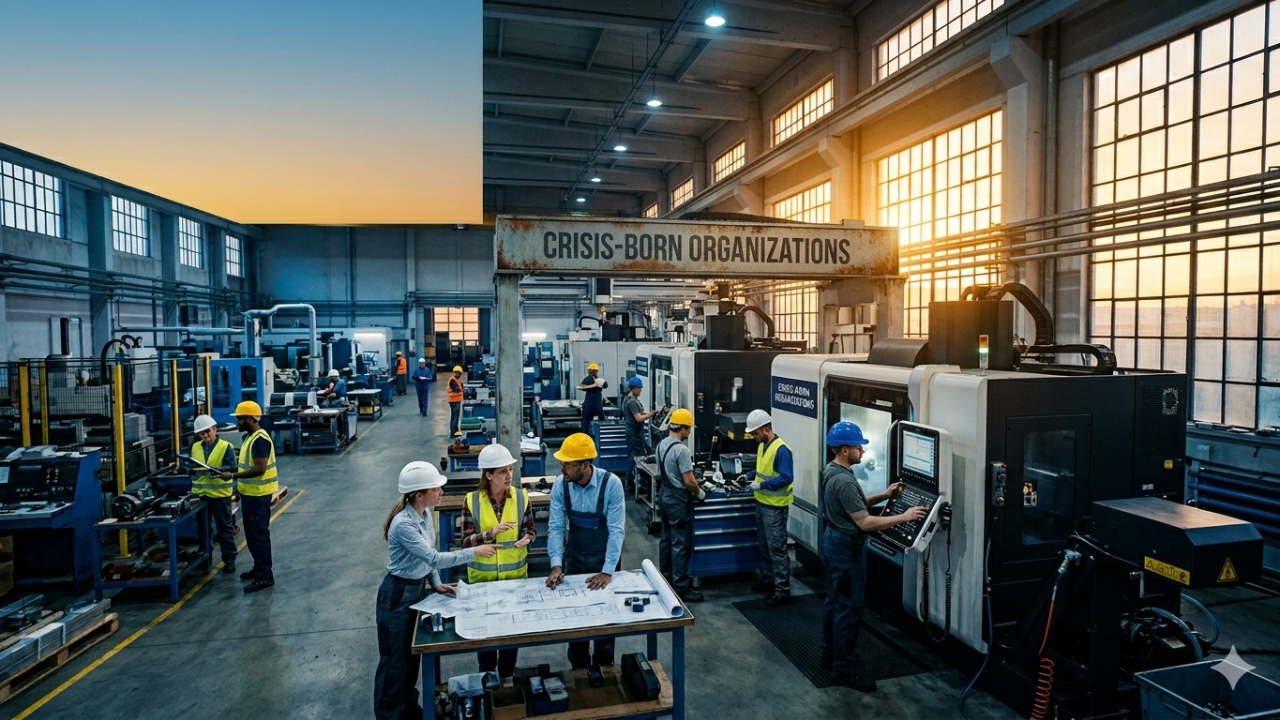
A manufacturing firm we worked with made parts for the beverage bottling industry. They serviced equipment. They didn't build it. That was someone else's job, someone overseas.
Then the pandemic shut down the supply lines.
Most companies in that position would have panicked. They would have frozen. They would have waited for the supply chain to recover and hoped they could survive the gap. This company did something different. They started manufacturing the parts that weren't coming. Then they started manufacturing the machines themselves.
They didn't pivot because someone in the C-suite had a flash of strategic brilliance. They pivoted because they had structures in place that gave them line of sight from the executive level all the way to the shop floor. The information about what was breaking, what was missing, what was possible flowed without obstruction. And when the crisis hit, that information flow became their competitive advantage.
A crisis is a terrible thing to waste. But most organizations do waste it. They survive the disruption and then revert to the way things were. The ones that don't revert, the ones that treat disruption as a founding condition rather than a temporary emergency, operate differently for years afterward. Sometimes permanently.
The Two Kinds of Organizations
There's a distinction I don't hear enough leaders make. Some organizations are built during stability. Some are built during crisis. And the difference between them isn't cosmetic. It's structural.
Organizations formed during periods of comfort develop certain assumptions. Hierarchy is fixed. Information flows upward slowly. Decisions are centralized. Risk is something to be managed, meaning avoided. These assumptions get encoded into every process, every reporting structure, every promotion decision. They become the organization's operating system.
Organizations formed during crisis never had the luxury of those assumptions. From day one, they had to move fast with incomplete information. They had to distribute decision-making because there wasn't time to wait for approval chains. They had to build feedback loops that actually worked because the wrong decision could kill them.
Here's the part that matters: five years after the pandemic, you can see the divergence clearly. The Business Agility Institute's 2025 report tracked organizations across 85 countries. The data shows consistent improvement in business agility from 2018 through 2022. Then 2023 introduced volatility. The last three years look like a stock market chart, bouncing up and down as organizations gained and then lost ground.
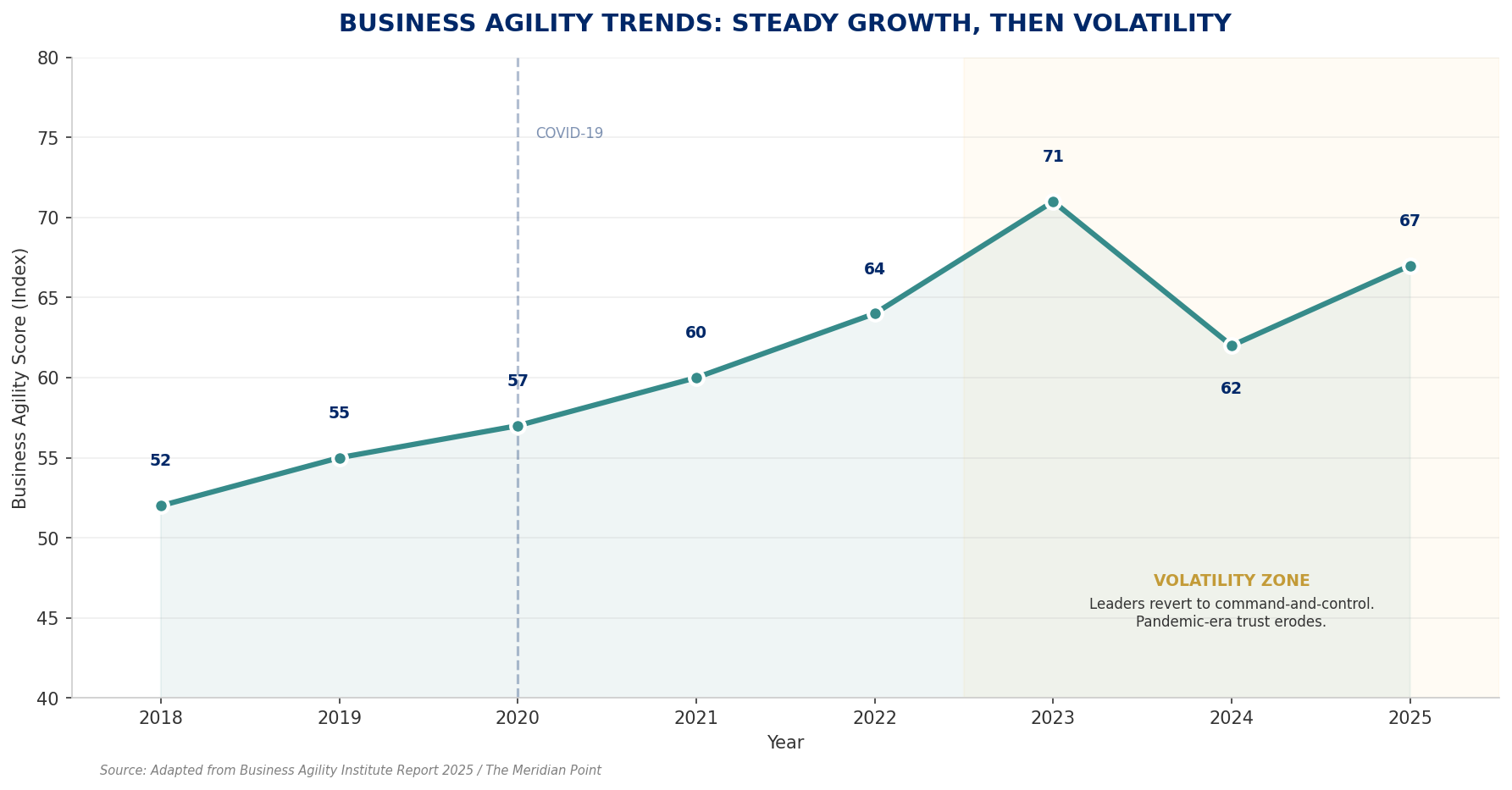
What happened? During the pandemic, companies built trust. They collaborated. They empowered people. Then economic pressure hit, and a significant number of leaders reverted to command-and-control. The trust they'd built evaporated. The collaborative behaviors they'd developed disappeared. They went back to the comfort-born operating system.
The organizations that didn't revert are the ones worth studying.
Why Most Organizations Can't Hold What Crisis Teaches Them
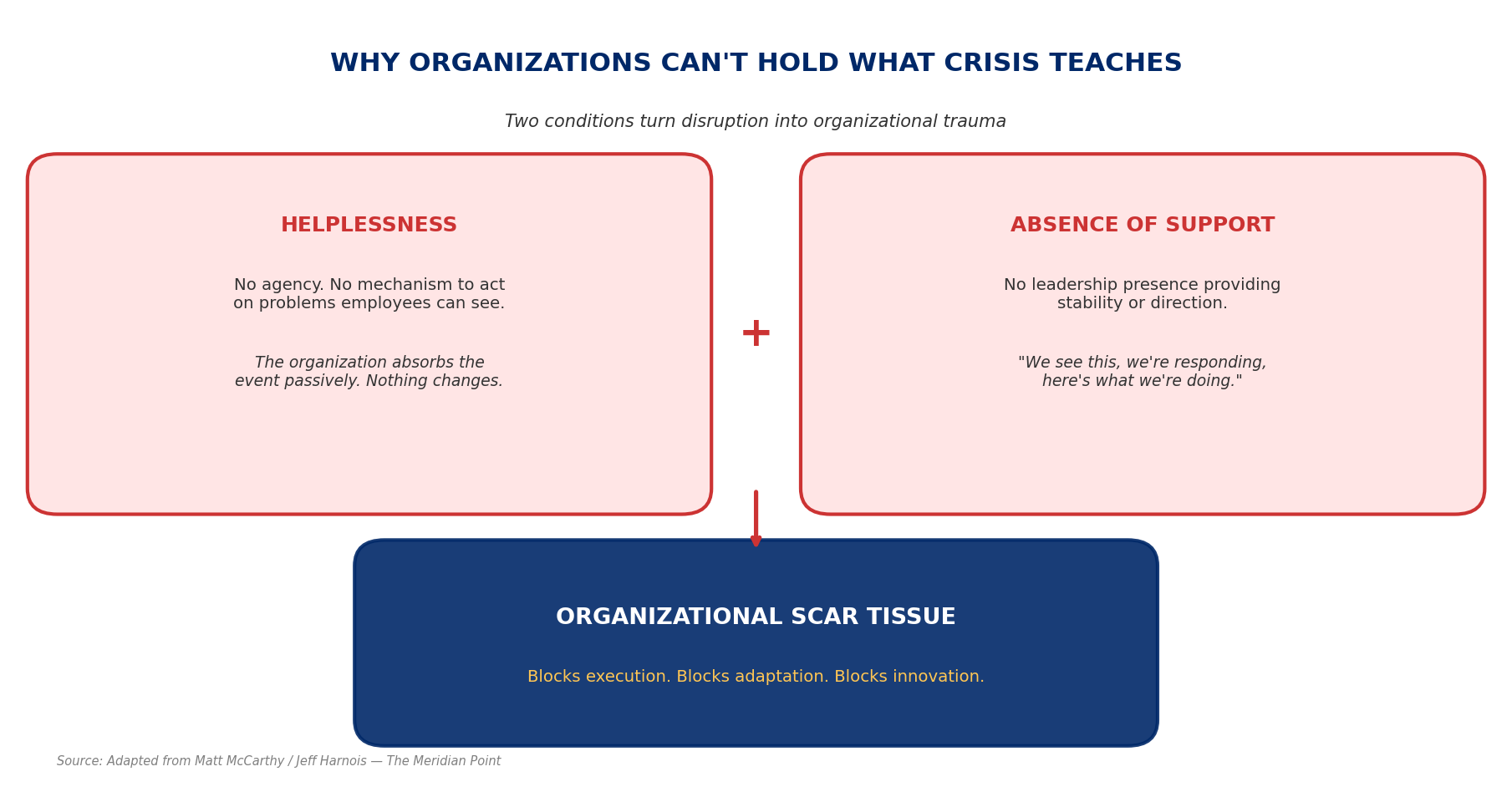
There's a framework from trauma research that maps cleanly onto organizational behavior. Two conditions turn an event into a traumatic one: helplessness and the absence of soothing.
Helplessness means no agency. You can't change your situation, you can't influence the outcome, you can't leave. In a corporate context, this shows up when employees have no voice, no mechanism to escalate what they see, no ability to act on problems they've identified. The organization absorbs the event passively. Nothing changes. The event just leaves a mark.
The absence of soothing means no one is providing support, stability or direction through the disruption. No leadership presence that says "we see this, we're responding, here's what we're doing." When both conditions are present, the event doesn't just happen to the organization. It scars it.
And that scar tissue is real. I've seen it in leadership teams that can't collaborate because they formed badly in the first place. The trust was never there. They went through the stages of team development, forming, storming, norming, performing, and they did it wrong. They skipped the storming. They avoided the conflict. Or the conflict was so destructive that it created factions that never healed.
That scar tissue blocks everything. It blocks execution. It blocks decision-making. It blocks the organization's ability to adapt when the next disruption hits. You end up with a team that looks functional on paper but can't actually move together when it matters.
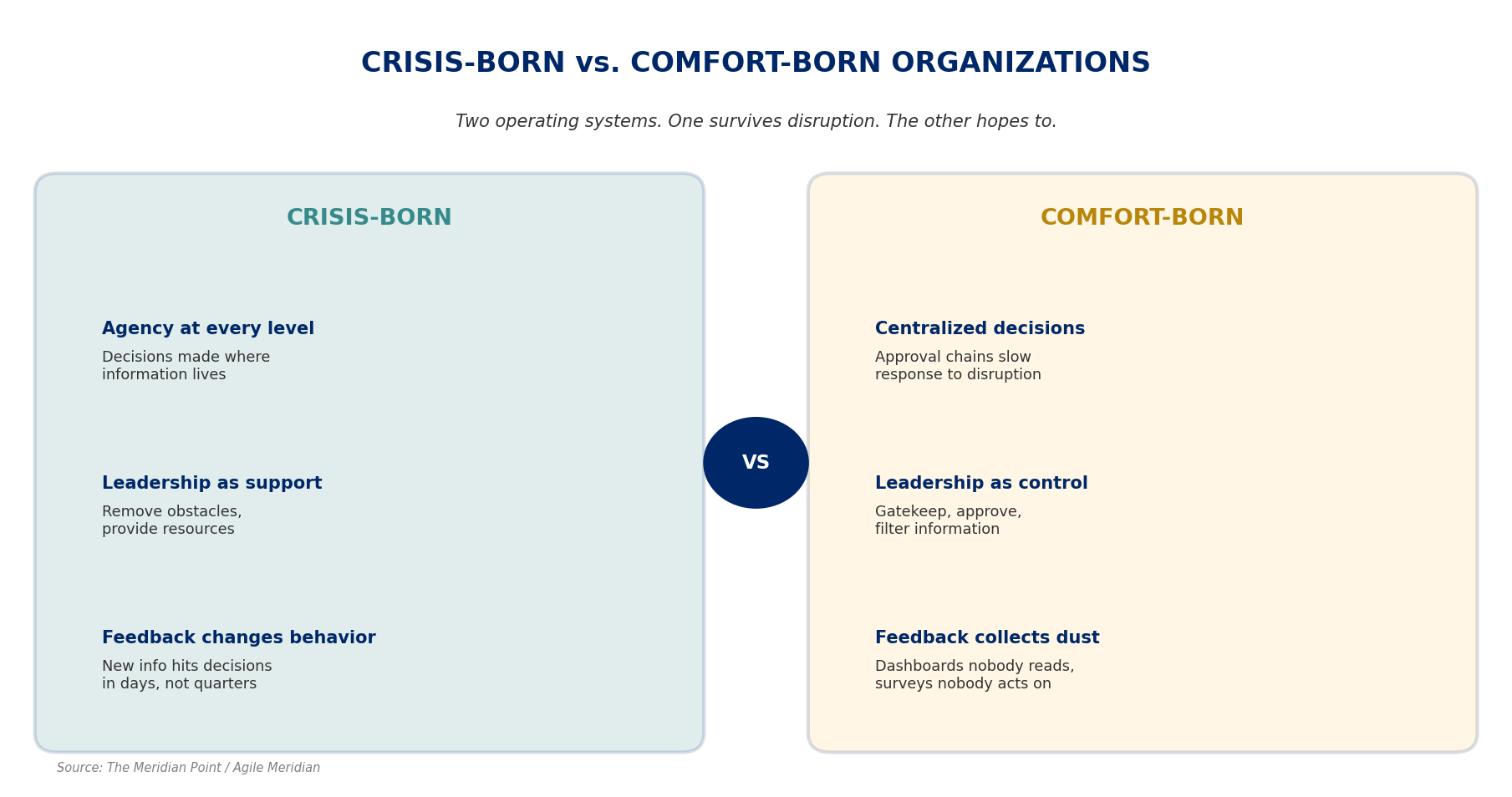
Crisis-born organizations skip most of that. When you form a team under pressure, you don't have the luxury of avoiding conflict. You don't have the luxury of slow trust-building. The trust is built in the fire or it isn't built at all. And the teams that survive that process, the ones that form correctly under crisis conditions, don't carry the same scar tissue that comfort-born teams accumulate over years of dysfunction.
The Structural Difference
So what do crisis-born organizations actually have that others don't?
It comes down to three properties baked into how they operate.
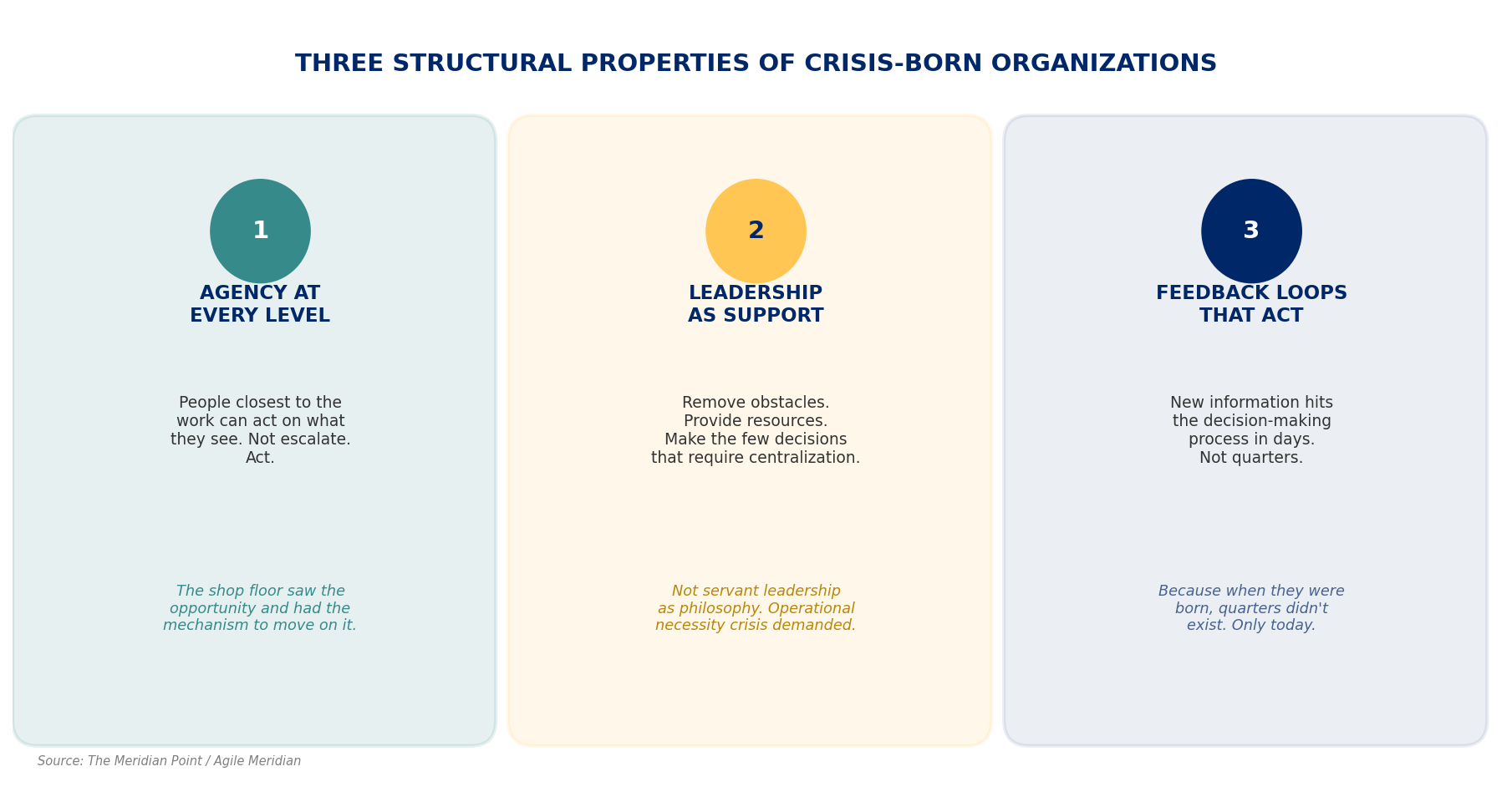
Agency at every level. People on the shop floor, in the middle of the org chart, at the edges of the business, they have the ability to act on what they see. Not the permission to escalate it. The ability to act. That manufacturing firm didn't pivot because the CEO told the shop floor what to do. The shop floor saw the opportunity and had the structural mechanism to move on it.
Leadership that functions as support, not control. In crisis-born organizations, the leadership layer exists to remove obstacles, provide resources and make the few decisions that genuinely require centralized judgment. It doesn't exist to approve, gatekeep or filter. This isn't servant leadership as a feel-good philosophy. It's an operational necessity that crisis demanded and smart organizations kept.
Feedback loops that change behavior. Most organizations have feedback mechanisms that collect information. Surveys. Reports. Dashboards. Very few have feedback loops that actually change how people work. Crisis-born organizations build loops where new information hits the decision-making process within days, not quarters. Because when they were born, quarters didn't exist. There was only today and next week.
The Cost of Waiting for Crisis
Here's the problem with crisis-forged adaptability: you can't schedule the crisis.
Most leaders I work with understand intuitively that their organizations perform differently under pressure. The decision-making speeds up. The silos come down. People who never talked to each other start collaborating because they have to. It's almost exhilarating when it happens.
Then the crisis passes. And everything reverts.
The Business Agility Institute data confirms this pattern at scale. The "empower with accountability" capability, one of their key measurements, declined in the most recent report. Leaders who built trust during the pandemic are pulling it back. The superhero CEO myth is reasserting itself. Organizations that tasted what it felt like to operate with agility are slowly forgetting how.
The cost isn't abstract. When the next disruption hits, and it will, these organizations will have to rebuild all of that capacity from scratch. They'll burn months relearning what they already knew. And during those months, the organizations that retained their crisis-born operating system will be moving.
Building Crisis Conditions Without the Crisis
This is where the work I do with Glenn Marshall and the Disruptor Method connects directly.
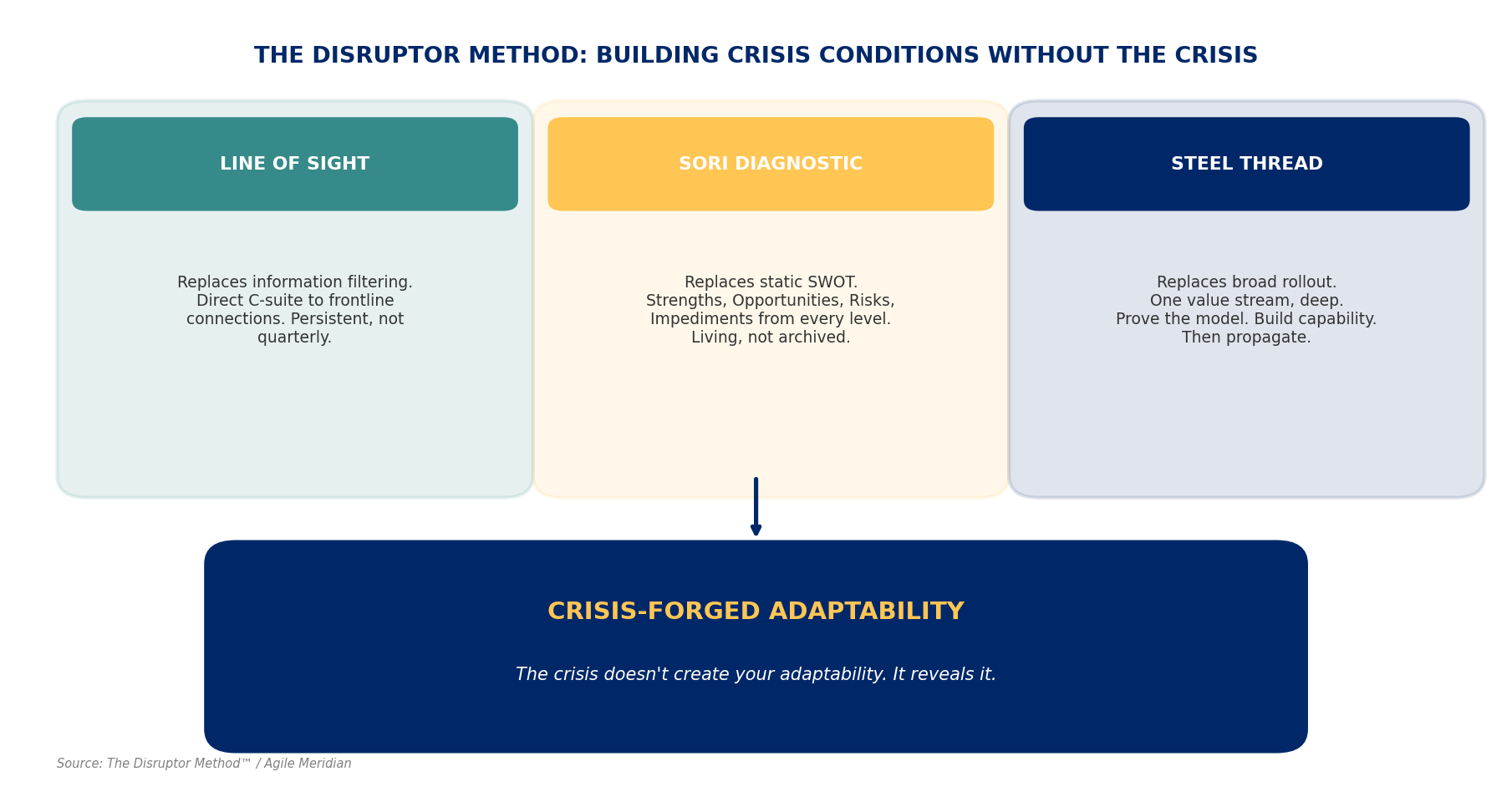
The Disruptor Method exists to create the structural conditions that crisis forces on an organization, without requiring the actual crisis. It's not a simulation. It's not a tabletop exercise. It's a structural intervention that builds the three properties I described above into how the leadership team actually operates.
Line of sight replaces information filtering. We build direct connections between the C-suite and the people doing the work. Not skip-level meetings once a quarter. Persistent structural connections that give leaders real-time visibility into what's happening and give frontline people a genuine path to influence decisions.
SORI (Strengths, Opportunities, Risks, Impediments) replaces the traditional SWOT analysis that sits in a slide deck and never changes behavior. SORI is a living diagnostic. It surfaces what the organization is actually good at, what it's missing, what's threatening it and what's blocking it. And because it comes from every level of the organization, not just the leadership team, it captures things the C-suite literally cannot see from where they sit.
Steel thread deployment replaces the broad rollout that breaks under its own weight. Instead of trying to transform the whole organization at once, you run a single thread deep through one value stream. You prove the model works. You build capability. You create internal advocates who've experienced the difference firsthand. Then you propagate.
The manufacturing firm I mentioned at the top didn't build those structures during the pandemic. They built them before the pandemic. When the supply chain collapsed, the structures were already in place. The crisis didn't create their adaptability. It revealed it.
That's the distinction. You don't wait for disruption to build the organization that thrives in disruption. You build it now.
Common Objections
"We're not in crisis right now, so this feels like solving a problem we don't have." That's the comfort-born assumption talking. The organizations that struggled most during the pandemic weren't the ones facing the worst external conditions. They were the ones that had never built the internal structures to respond. By the time you're in crisis, it's too late to build the operating system you need.
"Our leadership team works fine. We don't need structural intervention." I hear this from teams that have normalized dysfunction. The scar tissue is invisible to the people carrying it. A psychometric assessment will surface what's actually happening in the team dynamics, the avoidance patterns, the trust gaps, the communication breakdowns that everyone has learned to work around.
"We tried a transformation program and it didn't stick." Most transformation programs fail because they're imposed from the outside and abandoned when the consultant leaves. The Disruptor Method is different because it builds internal capability. The steel thread approach creates ownership inside the organization. When we leave, the structures remain because they belong to the people using them.
Three Actions You Can Take This Week
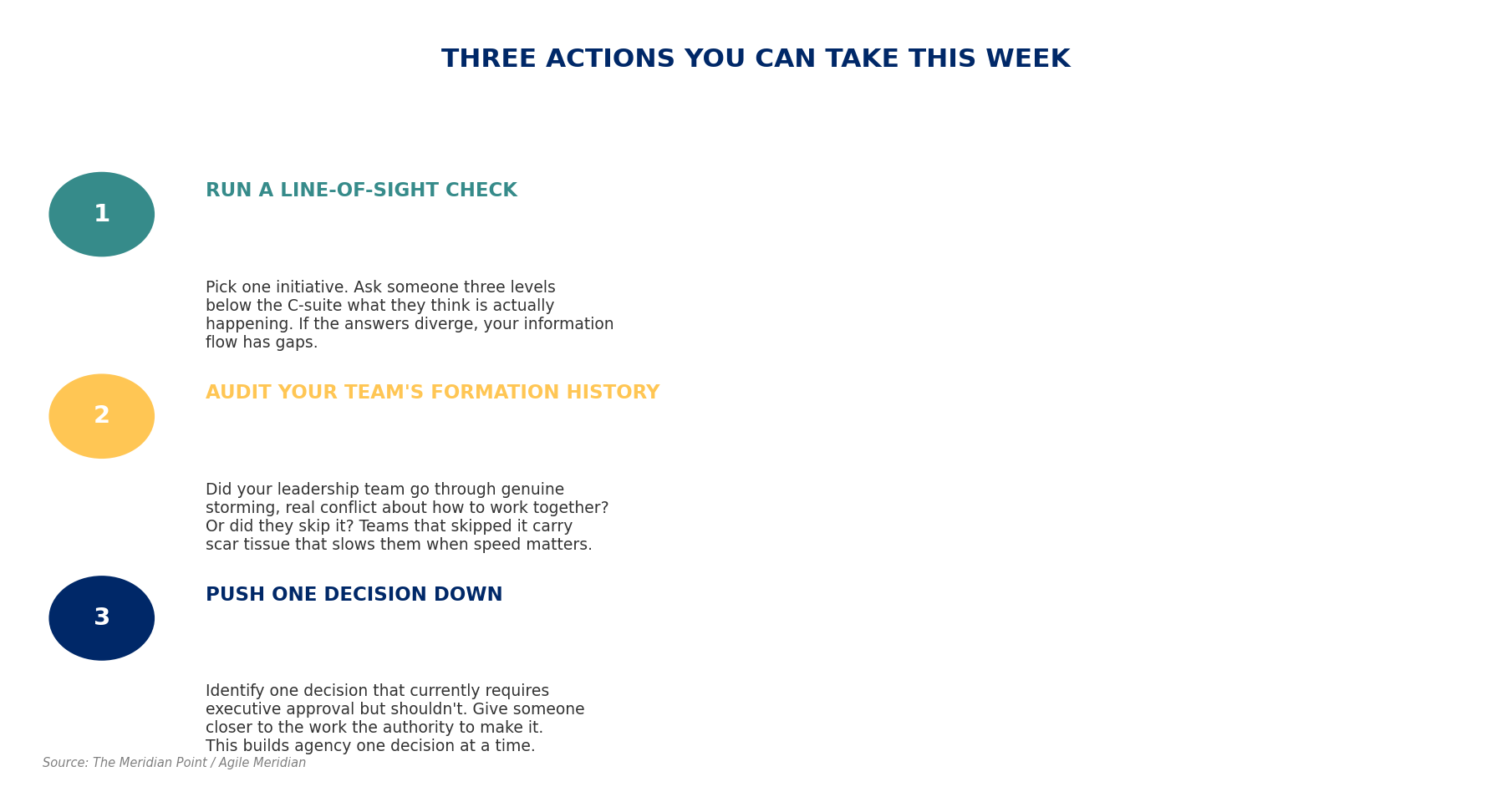
Run a line-of-sight check. Pick one initiative your leadership team is tracking. Then ask someone three levels below the C-suite what they think is actually happening with it. If the answers diverge significantly, your information flow has gaps that will become critical during disruption.
Audit your team's formation history. Think about how your current leadership team came together. Did they go through genuine storming, real conflict about how to work together? Or did they skip it? The teams that skipped it are carrying scar tissue that will slow them down when speed matters most.
Identify one decision that currently requires executive approval but shouldn't. Push it down. Give someone closer to the work the authority to make it. Monitor what happens. This is how you start building agency at every level, one decision at a time.
Related Podcast Episodes
These conversations go deeper into the ideas in this post:
Episode 167: Business Agility in Crisis: 2025 Trends with Evan Leybourn — Evan's data from the Business Agility Institute shows exactly where organizations gained and lost ground in the post-pandemic era. His Theory of Agile Constraints explains why your organization can only be as agile as its least agile function.
Episode 135: Rewiring the Leader's Brain: Healing Trauma to Create Innovation — Matt McCarthy's framework for understanding how trauma operates in corporate environments. The helplessness-plus-soothing model maps directly onto why some organizations absorb disruption and others are broken by it.
Episode 132: Tough Love Leadership: How Jobs and Musk Built Innovation Empires — Jeff Harnois on organizational scar tissue, the Tuckman model and what happens when teams form badly. His insight about trust as the core variable in team performance is essential context for understanding crisis-born vs. comfort-born dynamics.
Episode 137: Organizational Silos Are Bleeding Your Revenue — Glenn Marshall and I break down how organizational structure creates or destroys innovation capacity. The manufacturing pivot story in this post came directly from our client work together.
Ready to find out if your organization is operating with crisis-born adaptability or comfort-born assumptions? Take the Disruptor Method Assessment to identify where your leadership team's blind spots are, or book a 30-minute conversation to talk through what you're seeing in your organization.