Robust Theme
Dec 09, 2019 2020-04-08 7:40Robust Theme


Why Cross-Team Collaboration Breaks When You Reward Local Wins

By: Kumar Dattatreyan
You added a team, tightened the targets and told everyone to collaborate more. Six months on, the two teams that used to trade favors now trade tickets. Nobody's hoarding on purpose. Each team is doing exactly what its numbers reward, and helping the other team isn't in the numbers. This is a resource running out. It's the one nobody books on the balance sheet, and no reorg puts it back.
Permaculture has a principle for exactly this, the fifth. Use and value renewable resources and services. XSCALE interprets that principle for organizations as rewarding mutual benefit across business streams to reduce silos, waste and missed opportunities. Both point at the same asset. It's the energy people spend helping each other across the lines on the org chart. Like any renewable resource, it regenerates when you value it and collapses when you mine it. You can't order it back with a values slide. You change what the organization pays for, or you keep paying the bill in duplication and missed handoffs.
This principle isn't about being generous. It's about accounting.
It's also the next question after self-regulation. Principle four built the feedback loops that let each stream correct itself without routing the truth up a hierarchy and back. Principle five asks what flows between the streams once each one runs on its own. Because each stream will optimize for itself unless something rewards it for helping the next one. The loop governs the stream. The reward governs the commons between streams.
The resource nobody books
Rich Sheridan built a company around this resource. Menlo Innovations, in Ann Arbor, runs on what he calls human energy. He traces it back to Edison's lab: "the human energy of a team, the camaraderie that exists in a wide open space with people working shoulder to shoulder on wonderful, innovative projects." That's the asset. It doesn't come from the furniture, and you can't fake it with a floor plan.
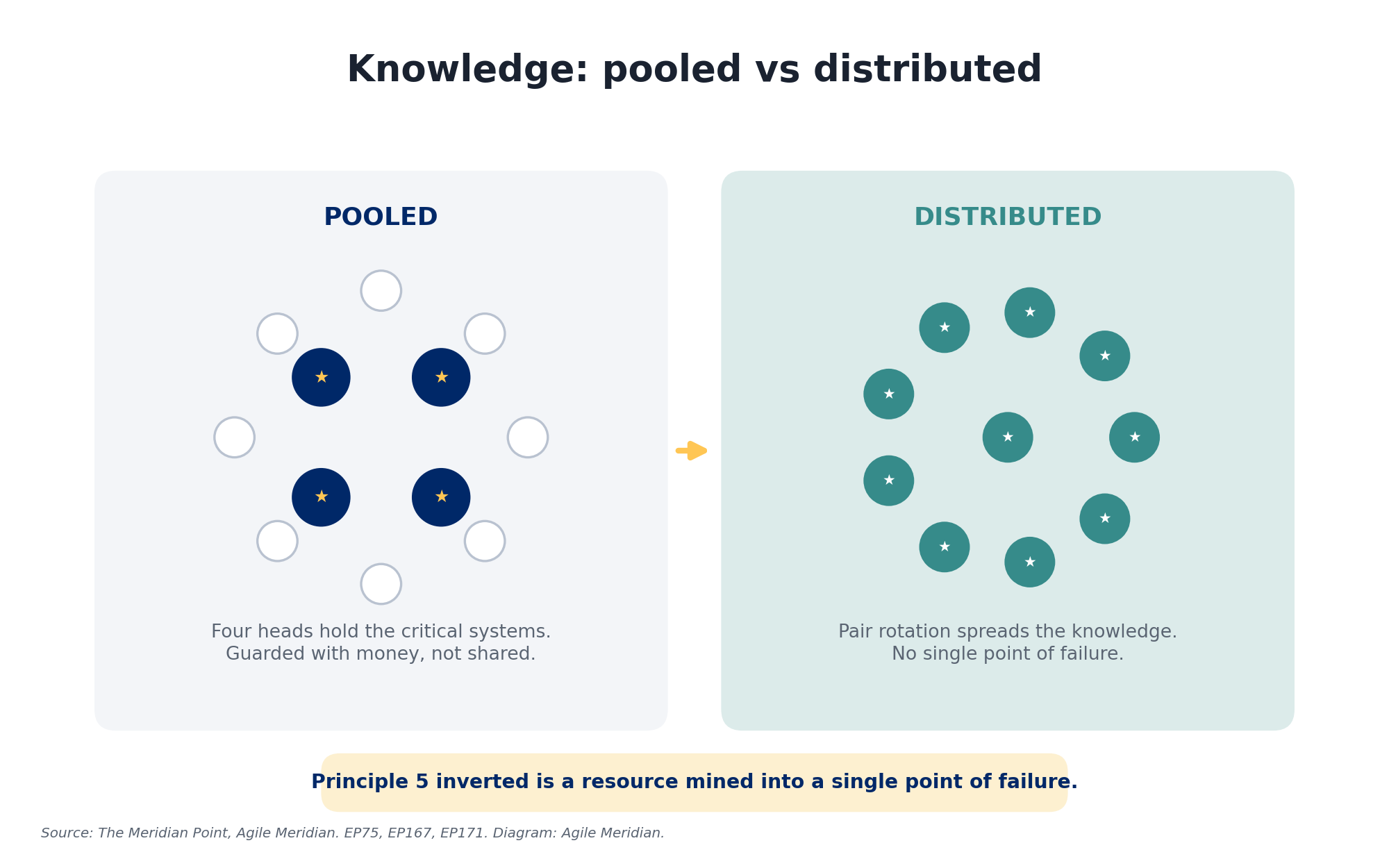
At Menlo the machinery that shares it is a pair rotation. Two people, one computer, switching pairs at least every five business days. Knowledge stays distributed across the whole team, so it never pools in a few heads. That's principle five working. Resources, services and learning move across the team instead of collecting in the people who happen to hold them.
His counterexample is the point. Rich once hosted a team from a multibillion-dollar insurance company. They told him that if four programmers left, the company would go out of business tomorrow, because those four held the only knowledge of critical systems. "An insurance company is in the risk mitigation business, and they were willing to accept that level of organizational risk. It's ridiculous." That's principle five inverted. The renewable resource got mined into a single point of failure, then guarded with money instead of shared.
Rich also knows why copying the workspace doesn't copy the result. "We didn't build an open and collaborative workspace. We built an open and collaborative culture. Our workspace is a reflection of our cultural mindset." Tear down the walls without changing what you reward, and everyone quits. The culture follows the reward. The furniture follows the culture.
You can't exhort it. You have to pay for it.
Glenn Marshall walked the fifth principle straight into the reward system when we covered it on the podcast, and he starts with the failure. "In many organizations, there's often a lack of incentive to assist colleagues in different departments or silos within the business hierarchy. This results in inefficiencies, duplicated efforts, and underutilized resources in various branches." So the duplication and the missed handoffs aren't a character flaw in your people. They're the bill you pay for the silence.
Then he points at the model to copy. "Ecosystem components work symbiotically, utilizing what others produce while providing what other components need." No central controller arranges that. The incentives do. Each part uses what others make and makes what others need, because it pays to. Glenn points at incentives that already run this way inside companies, employee ownership and open book management, where people share in the whole rather than defend a slice.
And he flags the part the ledger hides. "It's essential to consider the full cost of waste, including environmental impact, which isn't always reflected in current economic models." The full cost of hoarding never shows up on the books, so the reward keeps pointing at the local win while the real cost accrues somewhere the scorecard can't see it.
The strongest objection: shared rewards breed free riders
Here's where the pay-for-performance school pushes back, and the economics are old and real. Share a reward across a group and each person captures only a fraction of the gain from their own effort, so a rational contributor does less and lets the group carry them. Bengt Holmstrom formalized it as moral hazard in teams in 1982. Mancur Olson made the broader case in The Logic of Collective Action. Spread the reward and you weaken the line between effort and payoff. The disciplined move, the argument goes, is sharp individual accountability, clear owners and pay tied to what each person delivers. Reward everyone for everyone and you get diffuse ownership and a bench of people waiting for someone else to pull. The critique aims straight at employee ownership and profit sharing, where the individual stake is small and the temptation to coast is largest.
That critique is right about large groups. It's wrong about the design principle five actually prescribes.
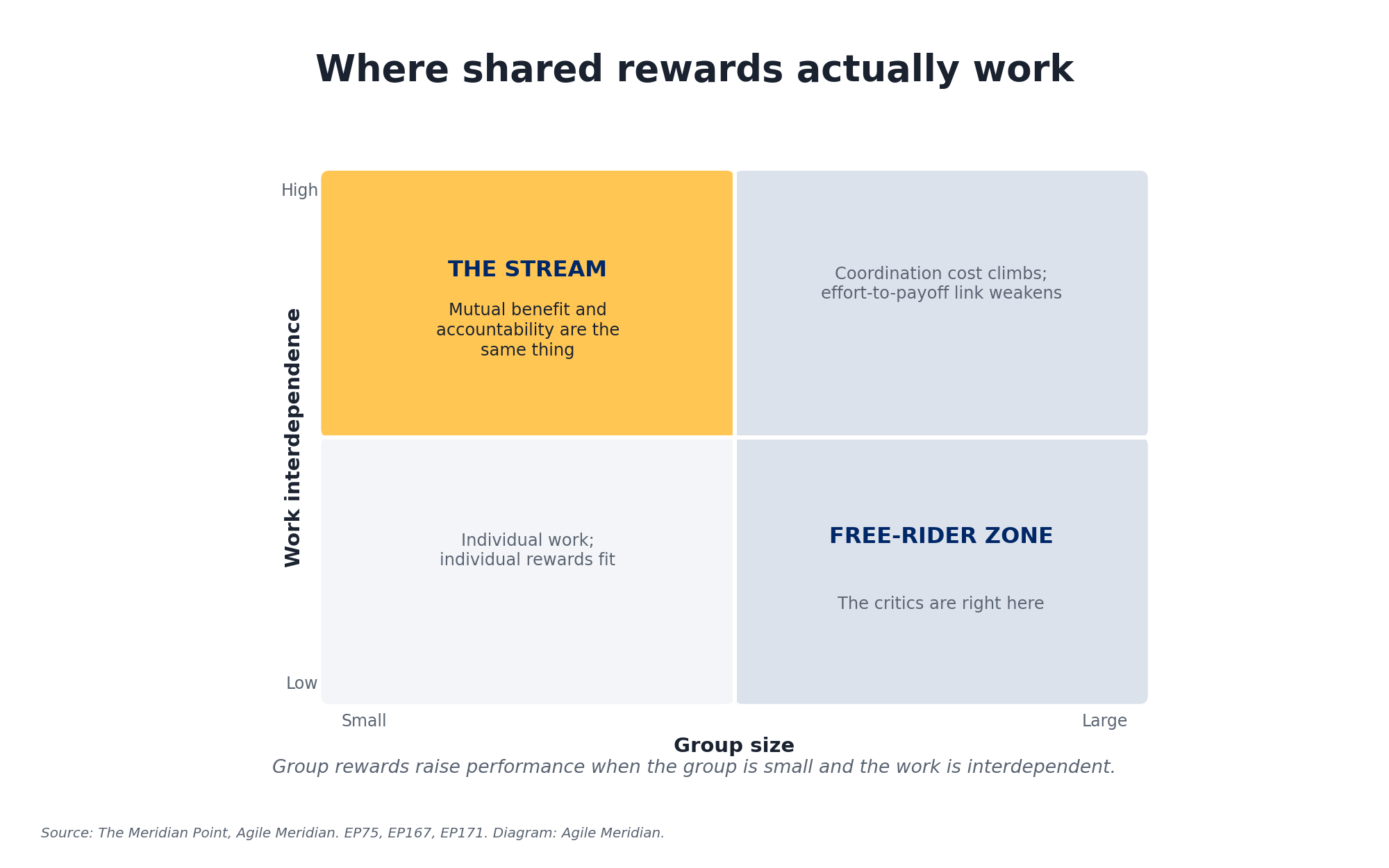
Free-riding scales with group size. It hides when the group is big. It has nowhere to hide in a business stream small enough that everyone sees who pulled and who coasted. That's the reason XSCALE aligns small groups of teams into streams instead of rewarding the whole company as one pool. The evidence lands there too. Group-based incentives raise performance when the group is small and the work is interdependent, and free-riding shrinks to noise. The renewable resource isn't a fixed pie to split either. Cross-team help builds capability that opens the next bottleneck, so mutual benefit compounds instead of dividing. The answer to free-riding isn't individual stack ranking that pays each person to defend a number. It's a smaller stream with a shared stake, where mutual benefit and accountability are the same thing.
The drain hides in governance
Evan Leybourn's diagnostic finds where the resource actually leaks. His Theory of Agile Constraints puts it plainly. "An organization can only be as agile as its least agile function." For most organizations that function isn't technology anymore. Product and software have run agile for ten-plus years. The limit moved. It sits in governance now, and inside governance Evan points at the specific drain. "If you've got performance management that's based on individual goals and not team outcomes... all of that creates constraints that prevent the organization from being agile, regardless of how good your agile practices are." That's the reward that kills mutual benefit, described as a constraint. It pays people to protect their own number while the renewable resource gets mined one quarter at a time and the dashboard stays green.
He's also honest about why it's the last thing anyone touches. "Governance is about power. It's about who has authority to make decisions. It's about who controls the money." The reward system sits closest to power, so it's the last lever anyone gives up. That's why a reorg feels safer than a redesign of the incentive. Moving boxes looks like action and changes none of it.
Design the environment, don't hire for the trait
Put the three together and the principle turns operational. Sheridan gives you the resource itself, human energy. It won't move between streams on its own, and Glenn's point is that nothing moves it without a reward for helping. What drains it back out is the mechanism Evan identifies, an individual scorecard that pays people to protect their own number. Human energy and cross-team help regenerate when you reward mutual benefit and collapse when you reward local wins. A poster that says collaborate does nothing against a bonus that pays for hoarding.
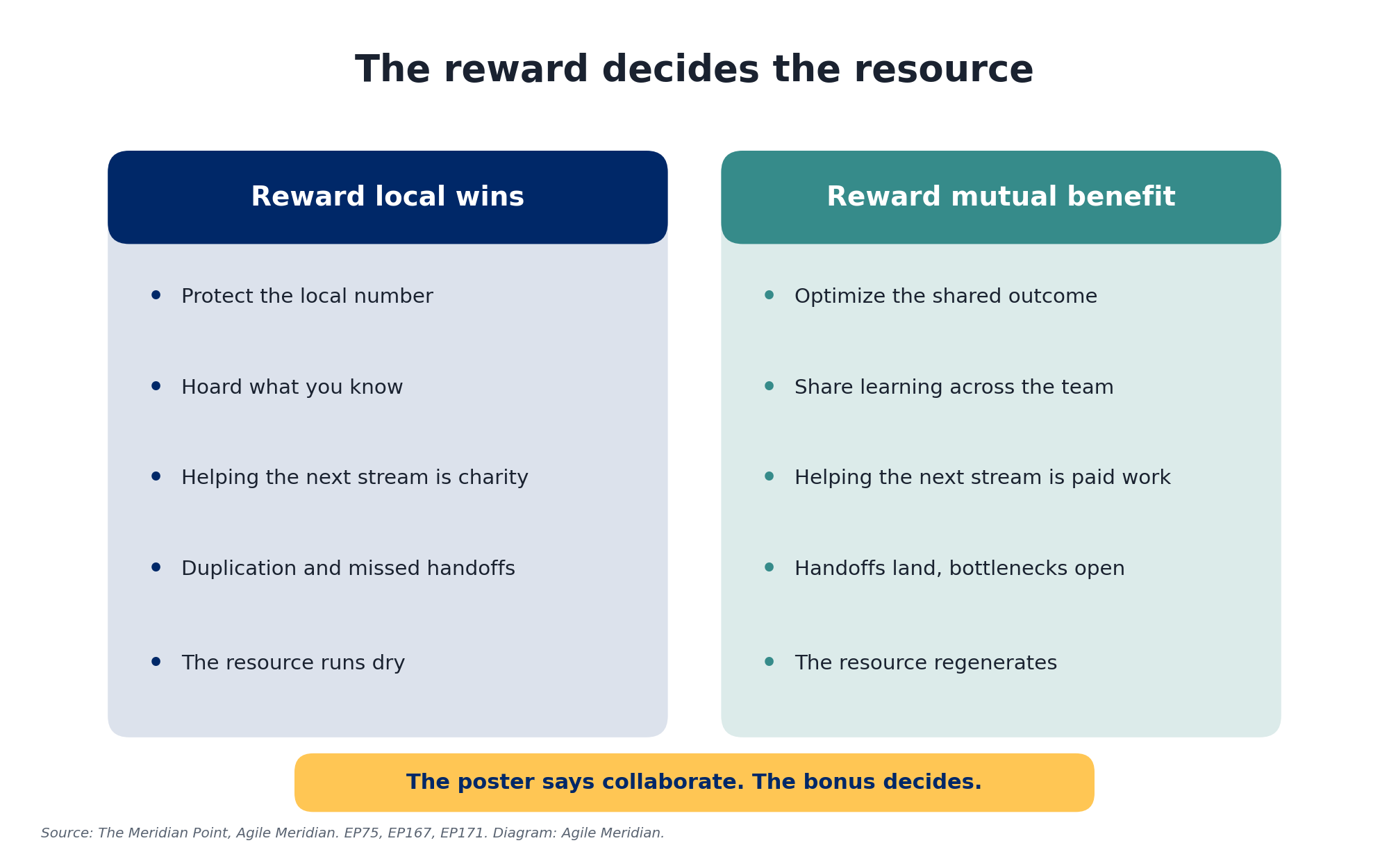
The trap is to treat cooperation as a character trait, something you hire for and then exhort. It isn't. Durable cooperation comes from trustworthy systems, not from relying on individual personalities. Culture shapes behavior the way environment shapes what a seed becomes. Build the reward and ordinary people cooperate. Rely on good people to cooperate against a reward that punishes it and you get neither.
There's a literal version of this bet worth holding in mind. Value a renewable resource and build for it, and the economics of everything downstream change. Cheap energy did that to whole industries once it got cheap enough to design around. Principle five makes the same bet, only the resource is human, and most companies haven't started designing around it.
Three moves that put the resource back
Find the reward that pays for hoarding. Start with what your performance system measures, not what your values page says. Individual goals, ranked and bonused, are the drain. If the scorecard rewards a protected local number, the help between streams comes out of someone's own time, and they'll stop giving it. Look at the incentive, not the intention.
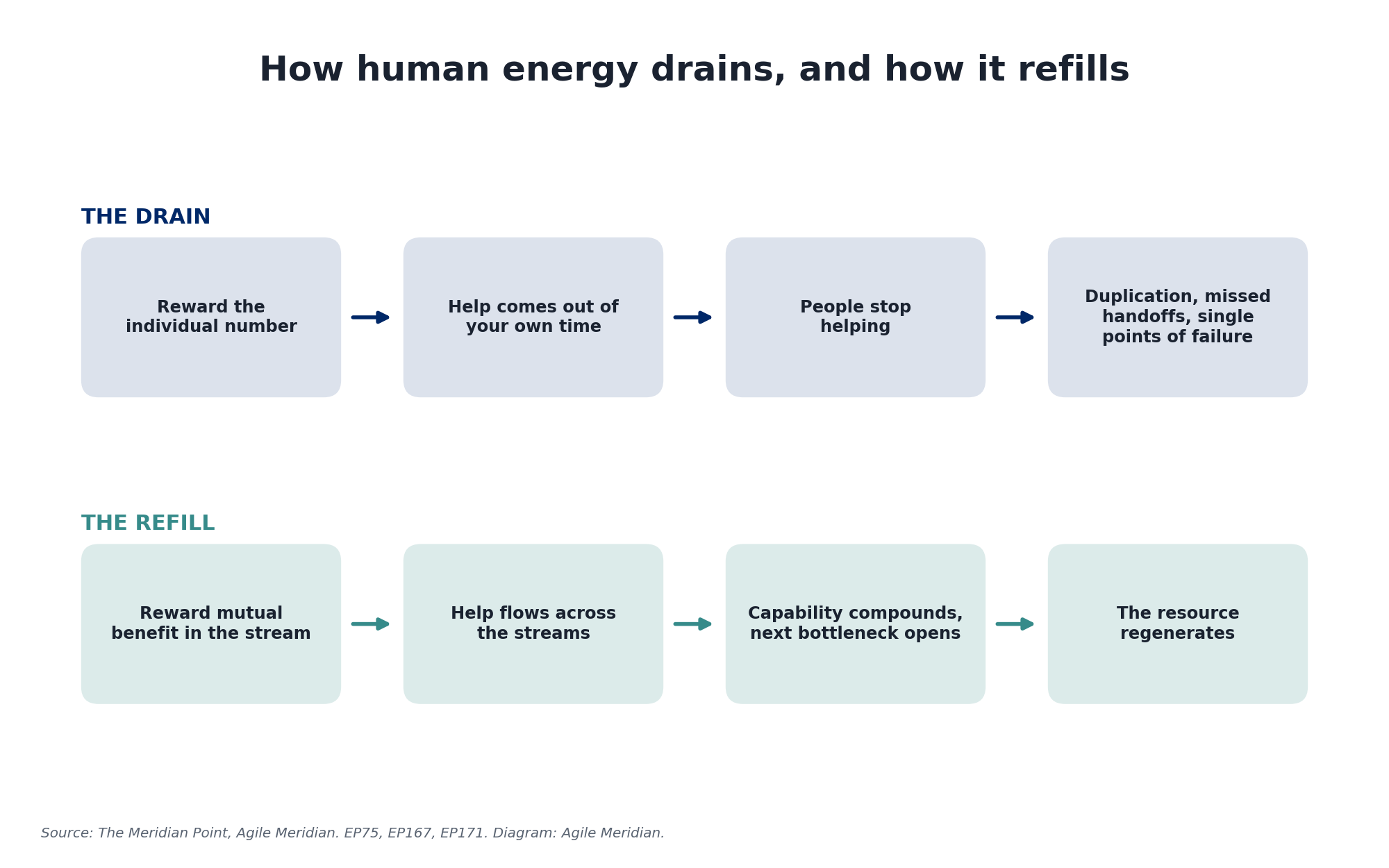
Shrink the pool to the stream. Rewarding the whole company as one pool invites the free-rider the critics warn about. Rewarding the individual invites the hoarding you started with. Reward the small stream, a handful of teams aligned to one flow of value, where everyone can see who pulled and who coasted. That's where mutual benefit and accountability stop fighting each other.
Put a price on the help itself. Reward the handoff that unblocks another stream, the knowledge shared so it never pools in four heads, the assist that opens the next bottleneck. And book the cost of not doing it. Track the duplication and the missed handoffs the way Glenn tracks the full cost of waste. When that cost shows up on the books, the reward stops pointing at the local win.
Go back to the two teams trading tickets. The reorg you're tempted to run will move them into a new box and change nothing, because the numbers each one chases will still leave the other one out. The resource that used to move between them isn't gone. It's just not paid for. Change what you pay for and it comes back. That's the whole of principle five. Use and value the renewable resource, or keep mining it and calling the shortfall a culture problem.
Related Podcast Episodes
EP75, "Permaculture and XSCALE Principles 5 and 6," with Glenn Marshall. Glenn and I walked the fifth and sixth permaculture principles straight into the reward system, and this episode is the spine of the whole series. He makes the ecosystem case for symbiosis and points at employee ownership as an incentive that already rewards mutual benefit. Start here if you want the full permaculture-meets-XSCALE frame.
EP171, "Joy as a Strategy: Inside Menlo Innovations," with Rich Sheridan. Rich built Menlo around human energy and made pair rotation the machinery that keeps knowledge from pooling in a few heads. His insurance-company counterexample is principle five inverted, a renewable resource mined into a single point of failure and then guarded with money. Watch this one for what the resource looks like when a company actually values it.
EP167, "Business Agility in Crisis: 2025 Trends," with Evan Leybourn. Evan's Theory of Agile Constraints puts the drain where most leaders won't look, in governance and the performance system, not in the delivery teams. He's blunt about why the reward is the last thing anyone changes. If you want the diagnostic for where mutual benefit is leaking, start here.
Work with me
If your teams are trading tickets where they used to trade favors, the fix isn't another values workshop. It's the reward. I work with executive teams to find the incentive that's draining cross-team help and redesign it around the stream. If that's the problem you're sitting with, let's talk. https://tidycal.com/coachkumar/30-minute-meeting