Robust Theme
Dec 09, 2019 2020-04-08 7:40Robust Theme


Organizational Friction Is Data: Read What's Broken
By: Kumar Dattatreyan
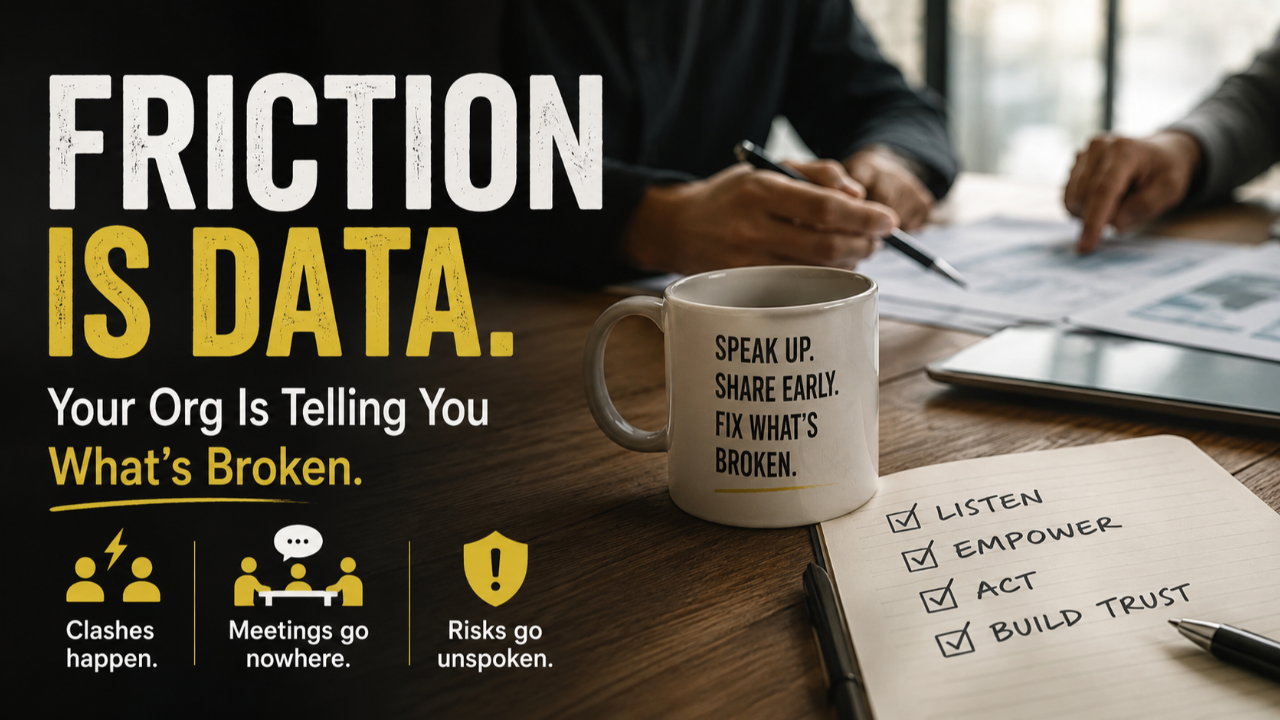
Your best people keep clashing. Your meetings decide nothing. Your last near-miss was a security gap nobody flagged.
Same problem. Nobody feels safe saying what they see.
Most executives treat those as three separate items on three separate agendas. The clash goes to HR, the meeting problem goes to an operations review, and the security gap goes to a postmortem that ends in a new tool purchase. Three owners, three budgets, and a year later all three are back.
They're back because they were never three problems. They were one problem wearing three costumes.
Friction Is Instrumentation
Every organization is already running a sensor network. It's called your people. They notice the thing that doesn't add up, the design that won't hold, the coworker who's been carrying resentment for six months. The sensors work fine. The wiring is what's broken.
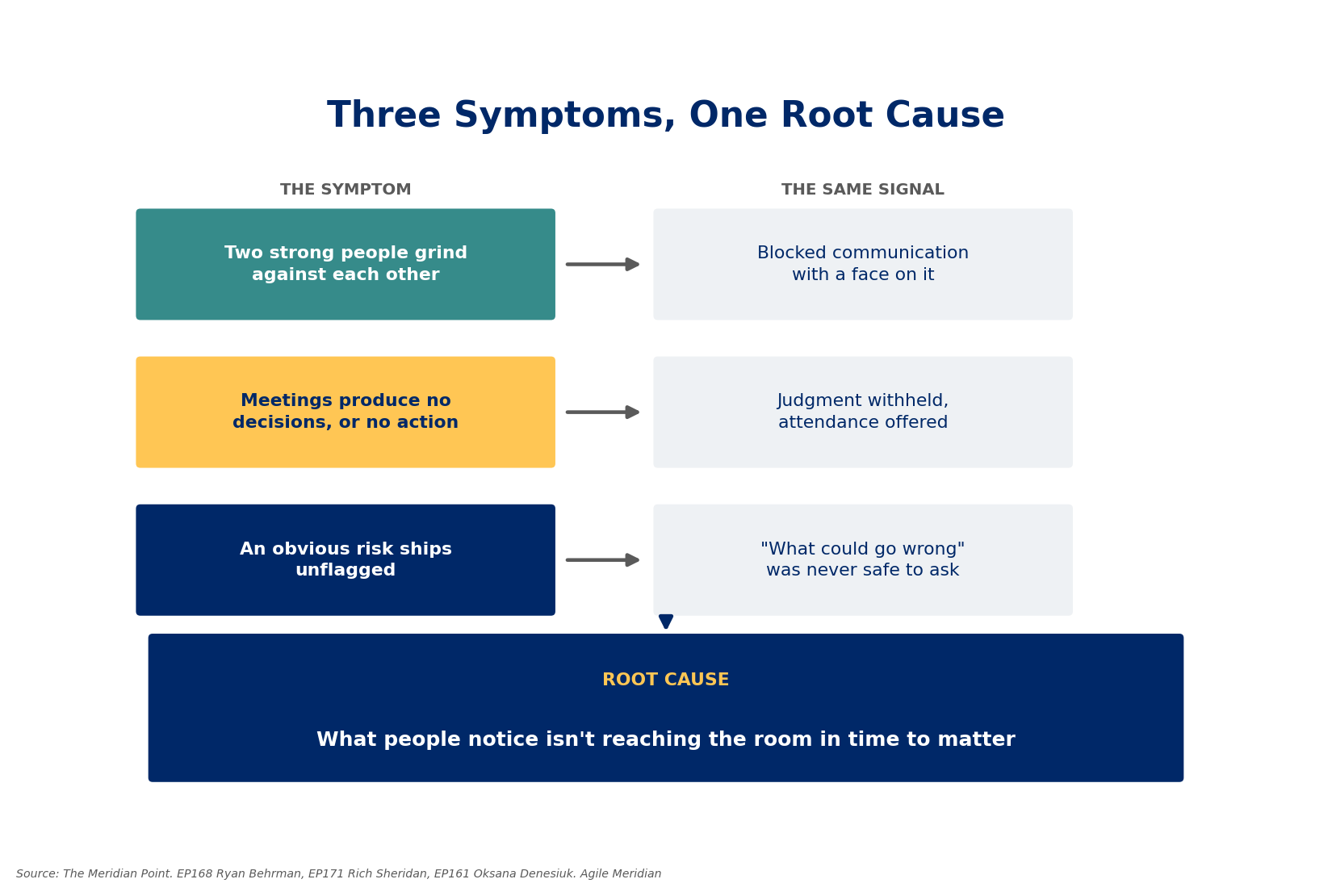
What people notice isn't reaching the room in time to matter.
So it isn't really a personality problem, and it isn't a meeting hygiene problem either. It's an information flow problem, and the thing constraining the flow isn't bandwidth or tooling. It's fear.
Read friction that way and it stops being noise. It becomes the most honest telemetry you have.
Costume One: The Clash Between Two Good People
Ryan Behrman builds a card-based team development tool called StrongSuits. On Episode 168, he described a mechanic that reframed how I look at team conflict.
Every card in the deck has a strength on the front. Flip it over and you find the overplayed version of that same strength on the back.
"Every strength at some point will become overplayed. The person who's very determined at some point will become pushy."
Think about what that actually means. Nobody added a flaw to that person. The strength they were hired for, and probably promoted for, just ran past its useful range, and nobody ever told them. So they kept doing more of the thing that used to work.
And this is where it becomes a communication failure rather than a character failure. The team saw it. They watched it happen for months and they talked about it everywhere except the one place it might have mattered, which is to the person's face, in a setting where they could actually hear it.
Ryan's point about large programs is the one I keep returning to. He works across banking, telco and government, environments where multiple organizations have to move as one. He said it's amazing anything gets done at all, given how little attention goes into how communication, alignment and coordination actually work before contracts are signed and everyone shouts go.
So the friction shows up between two strong people, and leadership reads it as a chemistry problem. But it isn't chemistry. It's blocked communication that happens to have a face on it.
Costume Two: The Meeting That Decides Nothing
Rich Sheridan runs Menlo Innovations, a software company in Ann Arbor that 3,000 people a year fly in to observe. They're not coming for the code. They're coming to see whether the culture is real.
He compares an organization to an airplane. Four forces act on it. Lift is human energy. Thrust is a clearly understood external purpose. Weight is bureaucracy. Drag is fear.
The weight part comes with a recipe, and he delivers it deadpan. If you want to suck the human energy out of your team, it's a simple three-step formula: "have lots of meetings, don't make any decisions in those meetings, and if per chance by mistake you happen to make a decision, just don't act on it."
Every executive laughs at that line. Then they go back to a calendar built exactly that way.
The drain isn't the meeting. It's the pattern the meeting teaches. When people bring an observation into a room and the room does nothing with it, they learn the observation was worthless. Do that forty times and you've trained a workforce to stop bringing observations.
Rich points at Gallup, which has been measuring engagement for decades and keeps finding 60 to 70 percent of people disengaged at work. His read is that the needle hasn't moved in fifty years, and that this is a failure of leadership to capture human energy rather than a defect in the workforce.
Then he names the drag: "Fear actually literally robs us of our humanity."
That sounds soft until you follow his argument, which is quite specific. The capacities that make us most useful against a machine, creativity and imagination and invention, are exactly the ones that shut down when we're afraid. We go to reptile brain, as he puts it, and we turn off the most interesting part of it.
Which reframes the job. Most leaders think their role in the room is to add pressure. Rich's view is the opposite. Pump as much fear out of the room as you can, because fear doesn't just make people quiet. It takes their judgment offline. You still have their attendance. Judgment was the only reason you invited them.
Costume Three: The Risk Nobody Flagged
Oksana Denesiuk spent her career at the intersection of product leadership and cybersecurity. On Episode 161, she said something that reorganized how I think about risk.
"Most of those air crash investigations and issues are people errors ... you would think it would be technical, but it's really people errors."
Breaches follow the same shape. Somebody built a feature and never asked what could go wrong with it, and they didn't ask because in their organization the person who raises that question becomes the person slowing down the roadmap. So the question doesn't get asked, and the gap ships.
Oksana's fix is that security can't live in a silo and still work. It needs advocates sitting inside product teams whose actual job is to raise the uncomfortable question early. That sounds like a staffing recommendation, but it's really a candor recommendation with a job title attached to it.
A product team that never learned to ask "what could go wrong" ships the gap. Not because they're careless. Because in their environment, raising a risk gets you labeled as the person who slows things down. So the risk stays in someone's head until it's an incident report.
The One Thing Underneath All Three
Here's the pattern I want you to sit with.
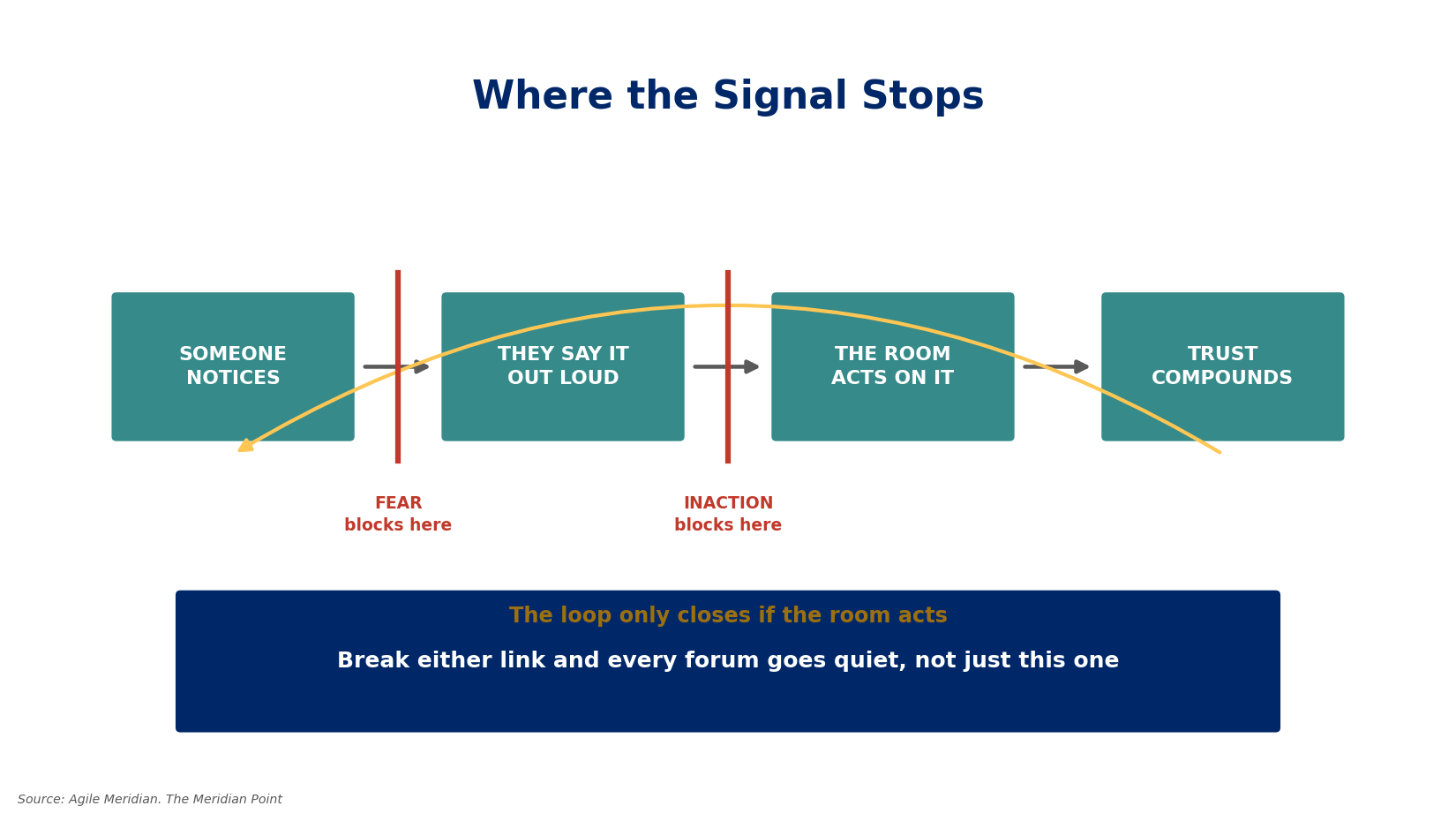
A leader convenes a retrospective. Someone says the hard true thing the retrospective was designed to surface. The leader gets defensive, and the person who spoke up pays for it, quietly, over the following weeks.
That leader thinks they closed one loop. What they actually did was teach the whole organization that no forum is safe. Because if candor gets punished in the one room that was built for candor, nobody is going to run the experiment anywhere else. They don't need to. They already have their answer, and so every other room goes quiet too.
The clash, the dead meeting and the missed risk are downstream of that single moment.
Why the Usual Fixes Fail
Executives reach for tools and structure because tools and structure can be purchased. A new collaboration platform, a meeting policy, a security awareness module, or a reorg that moves the two clashing leaders into separate reporting lines. I see this all the time.
None of those change the cost of speaking up. And the cost of speaking up is the actual variable.
Rich made this point about the visitors who tour Menlo, get inspired, go home and tear down all the office walls. Then everyone quits. His line: they didn't build an open workspace, they built an open culture, and the workspace is a reflection of the mindset. Copying the artifact without the mindset is cargo cult work.
Reorgs are the same move. You're rearranging the furniture in a room where it isn't safe to talk.
Make Candor Cheap. Then Act On It.
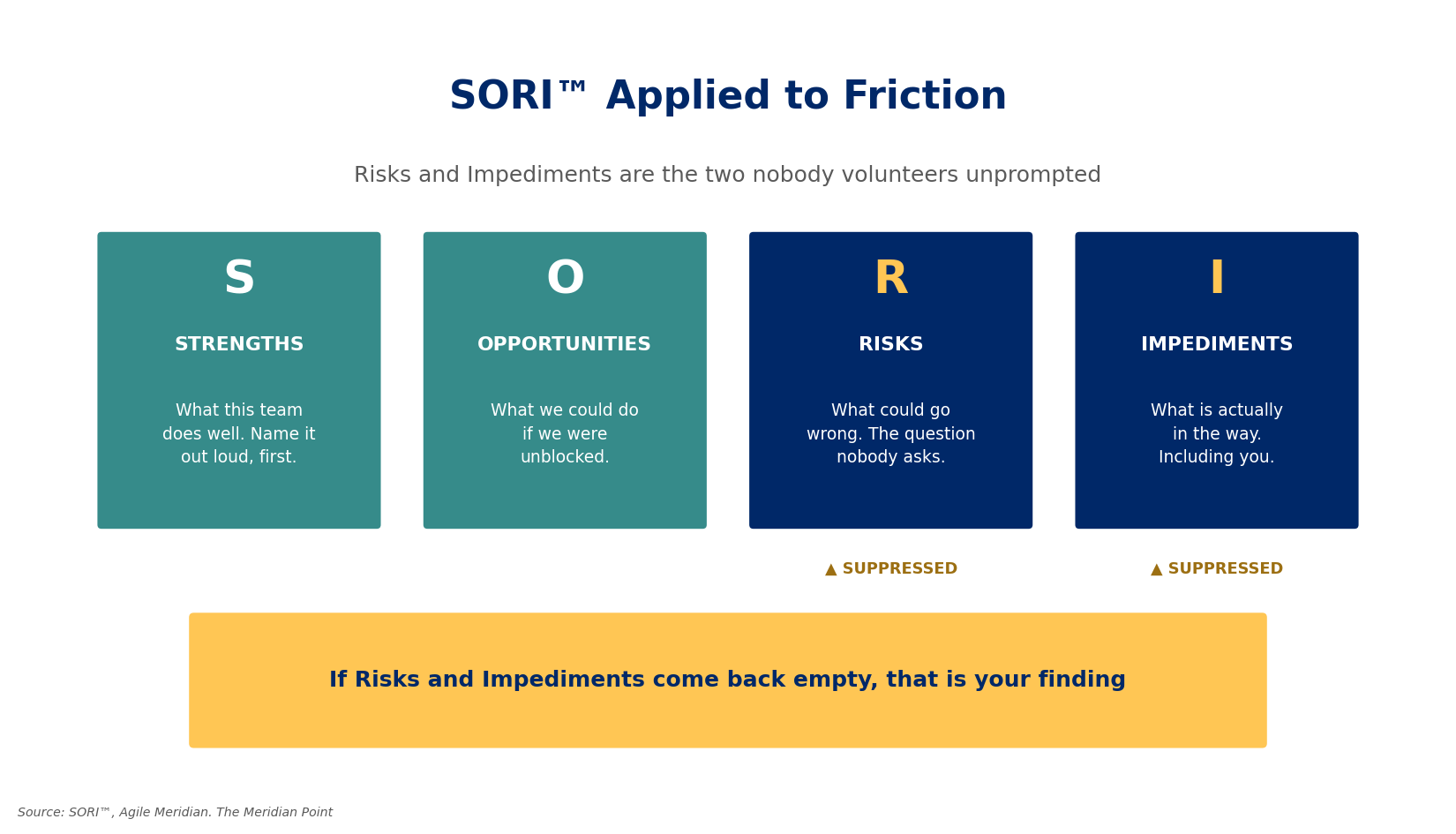
We use SORI™ with leadership teams to structure exactly this conversation: Strengths, Opportunities, Risks, Impediments. It works here because it gives people a legitimate container for the two categories they've been sitting on. Risks and impediments are the things nobody volunteers unprompted.
So how do you actually fix it?
Lower the price of the signal
Stop asking "any concerns?" at the end of a meeting when the decision is already made and everyone's packing up. That's theater and people know it.
Ryan's approach works because the card carries the message, and it's a lot easier to speak to an object than to a colleague's face. So find your version of the card. It might be a rotating role whose explicit job in every design review is to ask what could go wrong, so that the question belongs to the chair and not to the person sitting in it. The specific mechanism matters less than whether it takes the individual out of the line of fire.
Act on one thing visibly, fast
The signal isn't what you say about candor. It's what happens to the first person who uses it.
Take one item somebody raised that's genuinely uncomfortable. Fix it. Say publicly where it came from, if they're willing. Nothing you say in a town hall about psychological safety will move the needle as much as one visible instance of an inconvenient truth changing an outcome.
Of course, this only works if you actually change the outcome. People can tell the difference between being heard and being handled.
Name the overplayed strength before it becomes a liability
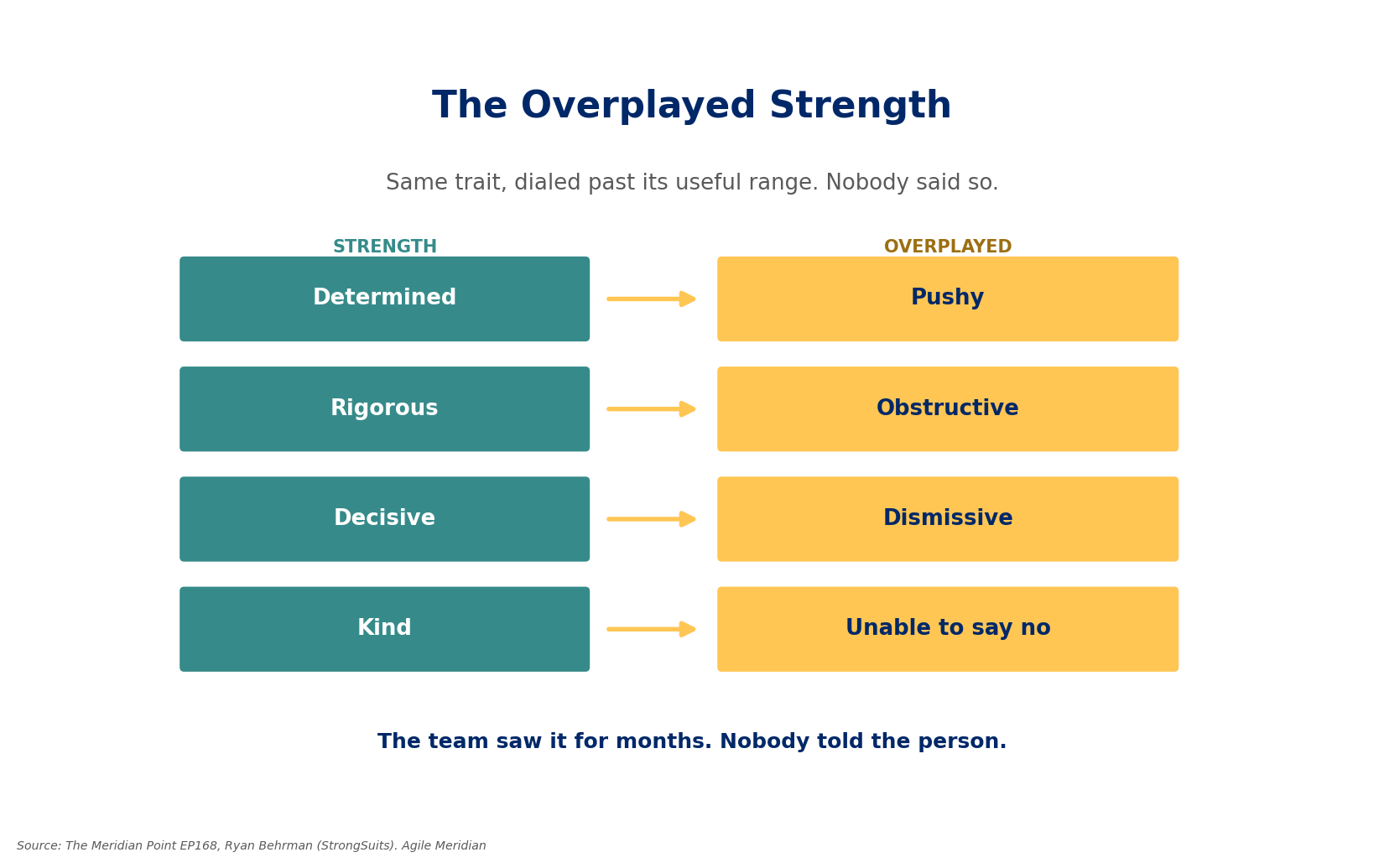
Behrman's model gives leaders a clean script. You don't tell someone they're difficult. You tell them what strength you value in them, and then you ask whether that strength ever gets in their way.
Determined becomes pushy when it's dialed past its range. It's the same trait, and that's why the conversation works. Once you've genuinely acknowledged the strength, naming the overplay is a gradual step rather than an ambush.
Run that with your two clashing leaders, and don't do it as a mediation. Do it in a room where you name what each one is good at first, in front of the other one.
The Objections I Hear
"My people can speak up. Nobody's stopping them." Nobody's stopping them and nobody's rewarding them. Those aren't the same. Ask yourself what happened to the last person who told you something you didn't want to hear.
"We already run retrospectives." So does the org I described above. The forum isn't the mechanism. What happens after the forum is the mechanism.
"This is soft stuff. I have a delivery problem." You have a delivery problem because the information about why delivery is failing is sitting in the heads of people who've decided it isn't worth the risk of saying it. That's not soft. That's your P&L.
Three Things You Can Do This Week
Pick your last incident, the near-miss or the breach or the launch that went sideways. Ask who knew, and how early. Not to find someone to blame. To find out where the signal stopped.
Take the two leaders who keep grinding against each other. Name the strength each one brings, out loud, in front of the other. Then ask each of them where that strength gets in their own way.
Find one thing somebody raised in the last quarter that you quietly buried. Unbury it. Do something about it and tell people why.
The Read
Friction isn't the enemy of a high-performing organization. Silence is.
The friction is the readout. It's the only place the organization gets loud enough for you to hear what it's been trying to tell you.
Your people already know what's wrong. The question is whether you've built a place where saying it costs them anything.
Related Episodes
Episode 168: Why Your Best People Keep Getting in Each Other's Way with Ryan Behrman
Watch here Ryan is the source of the overplayed strength model that anchors this post. We got into why the friction between two capable people is almost never about capability, and why the standard personality assessment misses it. If you lead a team where two strong performers keep grinding, start here.
Episode 171: Joy as a Strategy: Inside Menlo Innovations with Rich Sheridan
Watch here Rich built a company that 3,000 people a year travel to observe, and he's blunt about what most of them get wrong when they go home and try to copy it. His line about fear robbing us of our humanity is the mechanism underneath everything in this article. This one will change how you look at your calendar.
Episode 161: Cybersecurity as Culture Change with Oksana Denesiuk
Watch here Oksana makes the case that your breach exposure is a culture number, not a tooling number. She's seen cyber conflict up close and she still says the fix is organization-wide conversation and advocates embedded in product teams. Worth watching if you think you bought your way out of this risk.
Episode 169: Co-Intelligence: Why Learning Together Beats Knowing Together with Diana Larsen
Watch here Diana's work on leading without blame is the direct predecessor to this argument. She explains what happens physiologically when a team shifts from a learning posture to a defensive one. This is the episode behind our earlier post on blame culture.
Find out where your organization is stuck. Take The Disruptor Method™ assessment and get a read on the constraints holding your transformation back.
Want to talk it through? Book a 30-minute conversation.