Robust Theme
Dec 09, 2019 2020-04-08 7:40Robust Theme


AI and Middle Management: What Flattening Destroys

By: Kumar Dattatreyan
Gartner says 20% of organizations will use AI to eliminate more than half their middle management positions by the end of this year. Jack Dorsey laid off 4,000 people at Block in March and published an essay with Sequoia's Roelof Botha titled "From Hierarchy to Intelligence." Amazon cut 14,000 corporate employees to, in Andy Jassy's words, "reduce bureaucracy." Shopify, Klarna and Duolingo followed the same playbook.
They're calling it the Great Flattening.
The logic is seductive. Hierarchy exists to route information. AI can route information faster, cheaper and without office politics. So remove the middlemen, connect leadership directly to the frontline, and let AI handle everything in between.
I've spent the last two decades helping organizations fix their leadership structures. And I can tell you: the logic is right about the problem and wrong about the solution.
The Problem Is Real
Let me be clear. The coordination work that middle managers have done for decades is going away. Reporting, status aggregation, data compilation, scheduling: AI handles all of it faster than a human ever could.
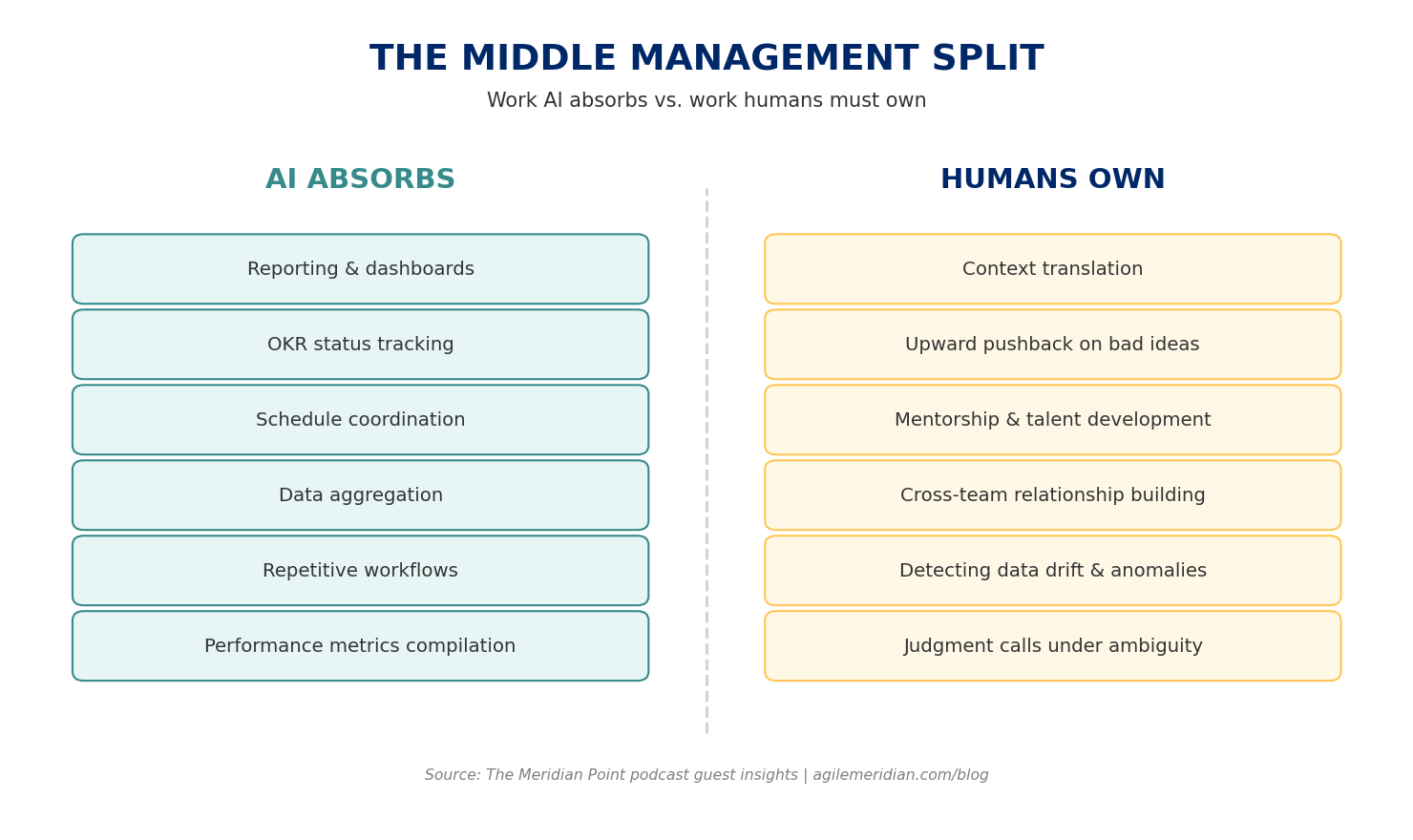
One of my recent podcast guests, Sevak Markarian, built AI agents that automatically scrape project management tools and surface OKR status in real time. No manager needed to compile that report. The data just appears. Another guest, Johanna Rothman, put it bluntly: she's still doing manual currency conversions from six different Amazon royalty spreadsheets because the right bot doesn't exist yet, but she knows it will. "I will even get my spreadsheet fixer at some point. I will. I know this."
The coordination layer is dissolving. Pretending otherwise is denial.
But They're Cutting the Wrong Thing
Here's what Dorsey and the flattening advocates miss. The hierarchy was never just an information router. It was a translation layer, a judgment layer, a trust layer.
I see this all the time in my consulting work. I'll walk into a company and find that frontline people know exactly what's broken. They've known for months. But they can't act because leadership owns the decision. Glenn Marshall, a frequent collaborator of mine, described it perfectly: "Many times I've seen people on the front line who have the information and know what to do, but they're not empowered to do it, so all they do is throw it up the chain."
That's not an information problem. That's a judgment and empowerment problem. And AI doesn't solve it.
Middle managers, when they're functioning well, do things AI can't replicate. They translate executive strategy into language teams can act on. They push back on mandates that are operationally impractical. They notice when someone is struggling before it shows up in the metrics. They carry institutional memory that no knowledge base captures. They catch what Suzel Wyvill-Jones, who ran a $120 million portfolio, calls "data drift," where AI keeps producing results that look right but aren't, because the model hasn't been retrained. A dashboard won't flag that. A human who knows the domain will.
Remove that layer and you don't get a leaner organization. You get a CEO making decisions with no buffer, no translation and no pushback.
The Heroic CEO Illusion, Version 2.0
Evan Leybourn, CEO of the Business Agility Institute, traced this pattern back to Frederick Taylor's scientific management in the 1890s. The idea that one person at the top can see everything, decide everything and control everything. Evan calls it the heroic individualist model of leadership, and he's watched it fail for years.
"When things get tough, when the environment gets uncertain, when the pressure is on, it's very easy for leaders to revert back to that heroic model because it gives them a sense of control, even if it's an illusion," he told me.
The Great Flattening is that illusion wearing new clothes. Instead of a CEO surrounded by loyal deputies, you have a CEO surrounded by AI agents. The deputies are gone. The illusion of control is stronger than ever. And the people doing the actual work are more disconnected from leadership than they were before the "transformation."
Evan also flagged the trust problem. When you tell people "we trust you, we want you empowered, we want you making decisions," and then you eliminate their managers, their mentors and their advocates, you've broken trust. People update their resumes. The best ones leave first.
What Augmentation Actually Looks Like
Diana Larsen, co-author of Lead Without Blame, gave me a different vision. She described future teams composed of a few humans working alongside AI agents, where the charter defines what each agent does and how it supports human thinking. Not AI replacing humans. Humans and AI learning together.
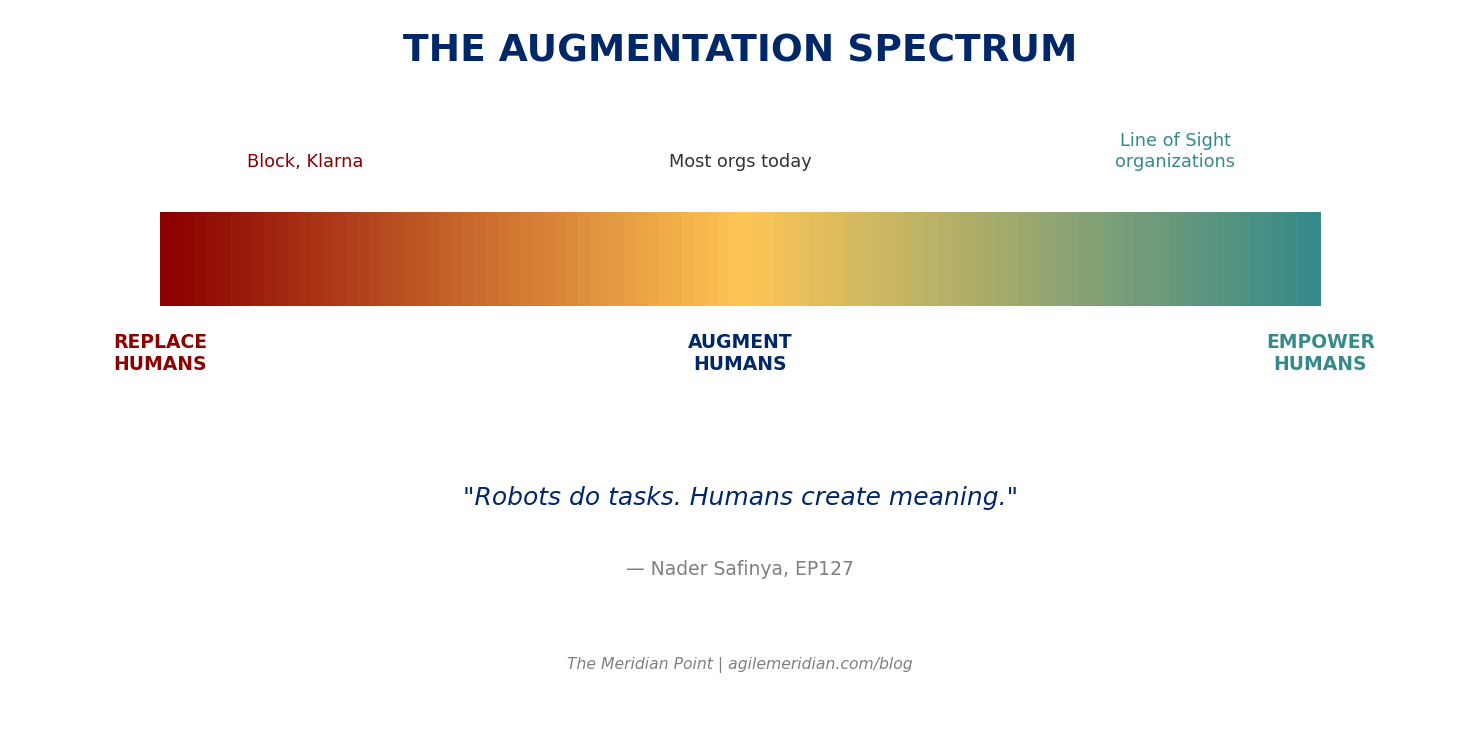
"Instead of saying, 'We have a great workforce with a lot of institutional knowledge, how can we implement AI in a way that helps them all learn more together,' organizations are saying, 'We'll get rid of those people and let AI do their work,'" Diana told me. "That's a big mistake."
Johanna Rothman framed it as augmented intelligence rather than artificial intelligence: AI amplifying what humans already do well instead of replacing the humans entirely. "We are trying to offload the wrong things right now," she said. She described vibe coding that produces output fast but leaves messes that humans have to clean up. The pattern holds beyond coding. Organizations are offloading the visible, measurable work to AI and losing the invisible work that held everything together.
Nader Safinya, founder of the culture branding agency Black Ribbit, put the distinction simply: "Robots do tasks. Humans create meaning." His consulting work takes him from the custodians to the C-suite in every engagement. He interviews everyone. That floor-to-ceiling visibility is line of sight by another name. And it's the first thing the Great Flattening destroys.
The Three Shifts Middle Managers Need to Make
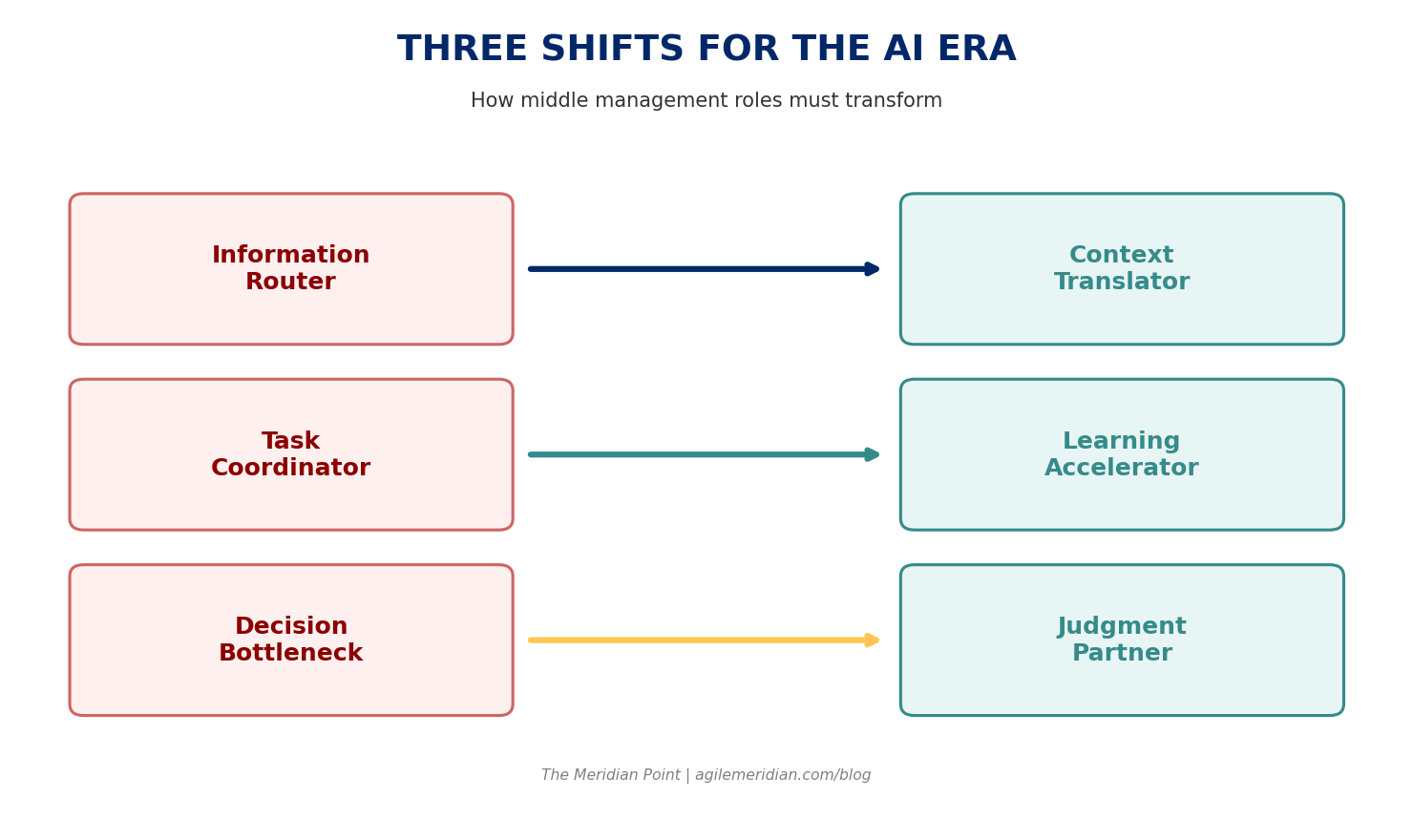
AI is going to absorb the coordination work. That's settled. The question is what the human role becomes. Based on what I've seen in my own practice and across dozens of podcast conversations, the middle layer doesn't disappear. It transforms.
From information router to context translator. AI can surface the data. It can't explain what it means for this team, on this project, given what happened last quarter. Translation is a human capability. It requires understanding context, history and relationships that no model captures.
From task coordinator to learning accelerator. Diana Larsen's concept of "speed to learning" is the competitive variable that nobody measures. How fast can your organization turn new insight into changed behavior? That's what middle managers should own. Not tracking who did what, but ensuring teams learn from what they did.
From decision bottleneck to judgment partner. Sevak Markarian's reframe is the right one: "Don't be successful in your role. Be valuable in your role." Working alongside AI agents, reviewing their outputs, catching drift, applying domain expertise to probabilistic recommendations. That's harder than the old job. It's also more valuable.
Line of Sight, Not Fewer Layers
We worked with a manufacturing firm in the beverage bottling industry that went from servicing parts to manufacturing the full machine during the pandemic. Four or five layers of management. Not a flat organization by any stretch. But every layer had line of sight to the shop floor. Information flowed because the structure was designed for it, not because the layers were removed.
That company seized a crisis opportunity because the people closest to the problem could communicate directly with the people who could authorize the pivot. They didn't need fewer managers. They needed connected managers.
The Disruptor Method builds that line of sight. We assess leadership teams, reveal blind spots, install feedback mechanisms that connect where decisions are made to where work happens. It's not about eliminating layers. It's about ensuring every layer adds judgment, translation and trust.
Conway's Law tells us that the structure of the organization will be reflected in what it produces. A flat organization connected by AI agents will produce exactly what that structure implies: fast, efficient output with no human texture. For some companies that's fine. For most, it's a slow-motion disaster.
What to Do Next
If your organization is considering flattening, ask three questions before cutting anyone.
First: what invisible work are your middle managers doing that won't show up until it's gone? Institutional memory, mentorship, cross-team translation, early warning on problems that metrics don't capture.
Second: are you building the transparency infrastructure that flattening requires? Alan Zucker, a project management veteran, told me that fluid organizations only work when there's visibility into what's happening. "Without that transparency, it's really hard because you don't know what's going on. And so you end up with rigid structures because that's the only way you can manage it."
Third: are you redesigning middle management roles for the AI era, or just eliminating them? Because there's a version of this that works. It's the one where AI takes the reporting and scheduling, and humans do the context, judgment and trust work that AI can't touch.
The Great Flattening is a bet that information routing was the only thing the middle layer did. It wasn't. And the organizations that figure that out first will have an enormous advantage over the ones learning it the hard way.
Related Podcast Episodes
EP127: Robots Do Tasks, Humans Create Meaning with Nader Safinya Nader's culture branding work goes floor-to-ceiling in every engagement, interviewing custodians and C-suite leaders alike. His distinction between tasks and meaning is the clearest frame for what AI replaces and what it can't.
EP167: Business Agility in Crisis with Evan Leybourn Evan traces the heroic CEO model from Taylor's scientific management to today's flattening wave and explains why leaders revert to command-and-control under pressure, even when they know better.
EP169: Co-Intelligence with Diana Larsen Diana makes the case for human-plus-AI teams rather than AI-replacing-human teams, and introduces the speed-to-learning concept that separates organizations that adapt from those that just produce.
EP172: The Truth About AI with Suzel Wyvill-Jones Suzel ran a $120 million portfolio and now advises organizations on AI implementation. Her warning about data drift and the 86% AI project failure rate is required reading for anyone betting the company on flattening.
Want to find out where your organization's real bottlenecks are? Take The Disruptor Method Quiz and get a personalized diagnostic of your leadership structure.
Ready for a deeper conversation? Book a 30-minute call and let's talk about what line of sight looks like in your organization.