Robust Theme
Dec 09, 2019 2020-04-08 7:40Robust Theme


Joy at Work Is Infrastructure, Not a Perk

By: Kumar Dattatryan
Dr. Pamela Larde told me a story four years ago that I haven't been able to shake. She's a researcher who studies joy and resilience in leadership, and she described the experience of being genuinely overjoyed about something and expressing it openly. Leaping. Dancing. Letting it out. And getting a stern look in response. The unspoken message: calm down.
That moment is so small. And it's everywhere.
I've watched it happen in boardrooms with my own clients. Someone gets energized about an idea, their voice picks up, their body language opens, and the room sends the signal: dial it back. Be professional. Compose yourself.
What we don't talk about is the cost of that signal over time. When leaders learn to mask enthusiasm, they learn to mask everything else too. Anxiety goes unaddressed. Unease gets buried under a performance of competence. People stop bringing their full energy to the room because the room has taught them not to.
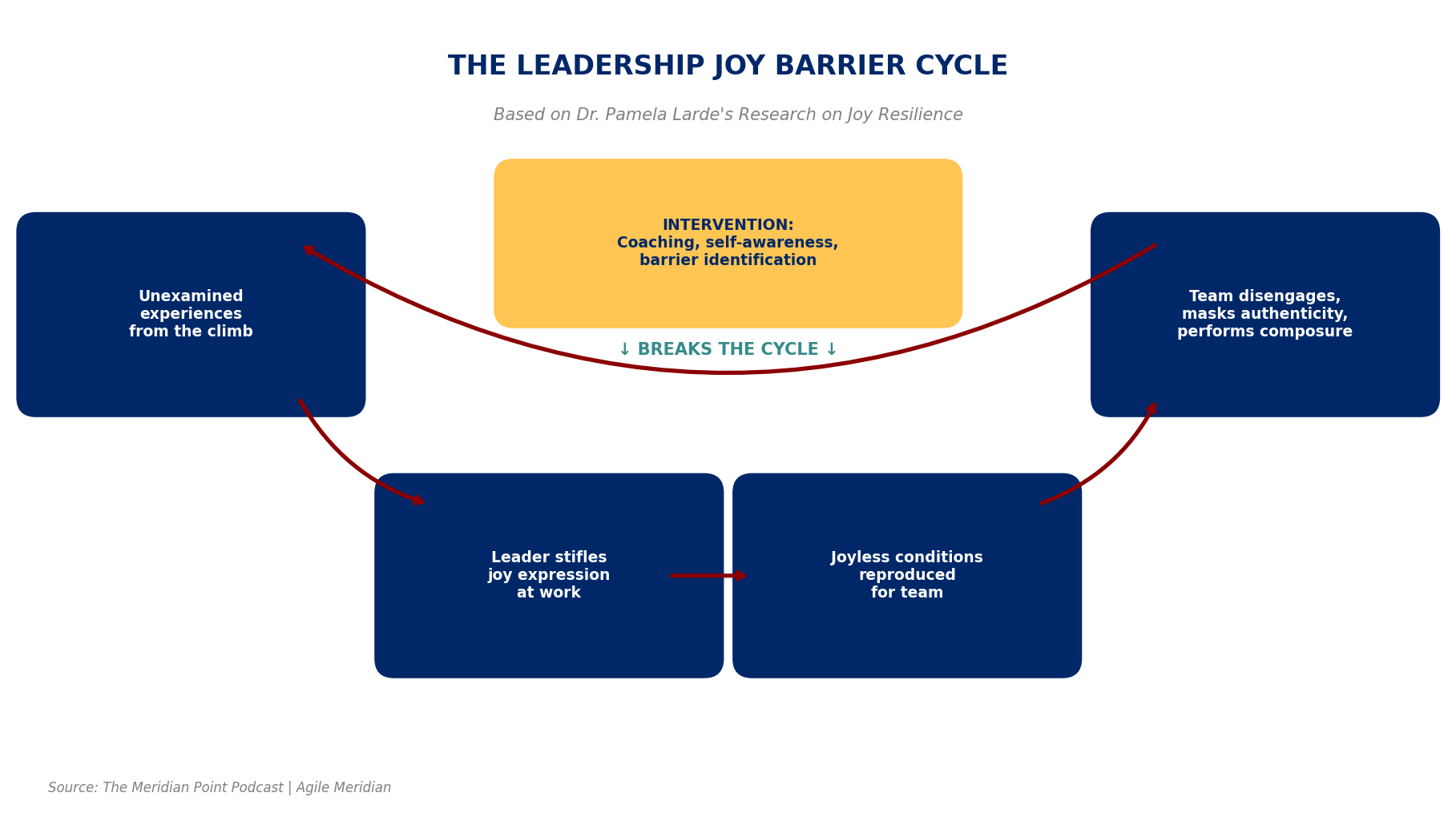
Dr. Larde's research goes deeper than the moment itself. She's found that the barriers to joy in leadership are often unprocessed experiences from the climb. The verbal abuse tolerated on the way up. The moments where authenticity got punished. Leaders don't recognize they're carrying it. They don't recognize they're passing it on. They reproduce joyless conditions for everyone around them without knowing why.
That's not a soft observation. That's a structural problem disguised as a personality trait.
The Word Nobody Wants to Use in a Boardroom
I coach Fortune 500 leadership teams, and the word "joy" does not come up naturally in those conversations. What comes up is engagement scores. Retention rates. Productivity metrics. Culture surveys with net promoter questions.
But joy is the thing underneath all of those metrics. It's the condition that produces the outcomes everyone is measuring.
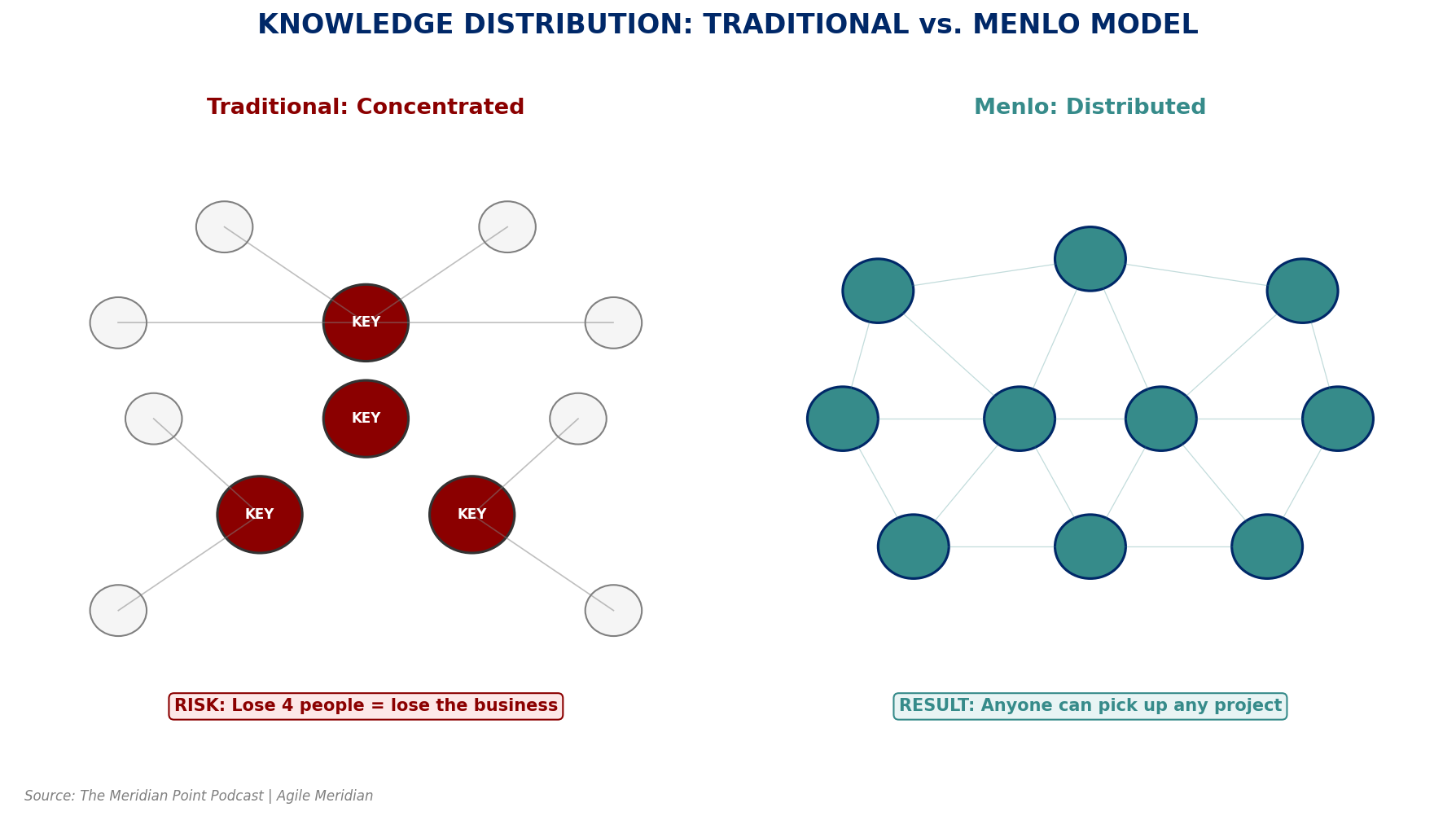
Rich Sheridan spent over two decades proving this. Menlo Innovations is a software company where 3,000 people a year travel from four continents just to watch them work. Not to learn about code. To witness a culture deliberately designed for joy. And the results speak: no single points of failure, no knowledge silos, no one burning out while hoarding expertise.
When I interviewed Rich on The Meridian Point, he described how he got here. By his mid-thirties, he had the VP title, the promotions, the stock options. And he was dying inside. The teams he led were delivering poor quality. End users were frustrated. Deadlines were missed. Budgets were blown. He said he was literally contemplating running a canoe camp in Minnesota as a career alternative.
What changed wasn't a technology upgrade or a new methodology. It was a fundamental reframe. He stopped asking "how do I build better software?" and started asking "how do I organize humans more effectively?" That question led him to Edison's original Menlo Park lab, to Extreme Programming, to design thinking. It led him to build a company where pair programming rotates every five days, where High-Tech Anthropologists sit alongside developers observing actual end users, and where the culture is the product, not the code.
Joy Produces Results. The Same Conditions Create Both.
Joy isn't just a personal leadership quality. It's a systemic condition. The same conditions that produce joy also produce learning, collaboration and high performance.
Diana Larsen has spent 30 years working at the intersection of team learning and organizational design. She co-authored Lead Without Blame with Tricia Broderick, and the core argument is simple: blame is the enemy of learning, and therefore the enemy of resilience.
When I talked with Diana on the podcast, she described the physiology of it. When people are learning, their eyes are wide open. They're gathering data, sharing it, building on each other's thinking. When blame enters the room, the posture closes. People armor up. They withdraw. They stop engaging. You can't add enthusiasm or creative thinking into that mix.
She told me about walking into an organization to give a talk and being told beforehand that no one would ask questions afterward. The reason: everyone had been hired for being the best and brightest, and asking a question would expose areas of ignorance. That story still sits with me. An entire organization where curiosity was treated as weakness.
Compare that to Menlo, where two people share one computer all day, every day, rotating partners every week. Where asking for help isn't a signal of weakness but a structural requirement of how the work gets done. Where knowledge silos literally can't form because nobody works alone long enough to create one.
That's not a coincidence. Sheridan didn't build a nice workplace and happen to get good results. He built a system where the conditions for joy and the conditions for distributed learning are the same thing.
Your Best People Are Getting in Each Other's Way
Ryan Behrman works with teams through a card-based assessment called StrongSuits, and when I interviewed him on The Meridian Point, he identified something I see constantly: the very strengths that make your best people valuable are also the source of their greatest friction with each other.
A person who's exceptional at big-picture thinking will clash with someone wired for detail. Not because either one is wrong, but because cognitive diversity creates tension. And most organizations don't have the language or the mechanisms to surface that tension productively.
Ryan's framework looks at overplayed strengths, the flip side of what makes someone great. When a strength gets overplayed, it becomes the thing that blocks the team. And the system around the team, the processes, reward structures and leadership behaviors, either enables people to do their best work or gets in their way.
Here's how I think it connects to joy: when people are constantly navigating friction they can't name, when the system around them creates obstacles they can't see, joy evaporates. Not because the work is hard. Because the environment is working against them.
The question Ryan asks is the right one: how do we stop getting in people's way so they can do the best thing they can do, in the best way, every day?
That's a joy question. Even if it doesn't use the word.
The Cargo Cult Trap
Sheridan shared something on the show that I think every leader needs to hear. He's watched thousands of visitors come through Menlo, get inspired, go home, and try to replicate what they saw. And the single biggest mistake they make is this: they tear down the walls, pull people out of offices, put them in a big open room, and then everyone quits.
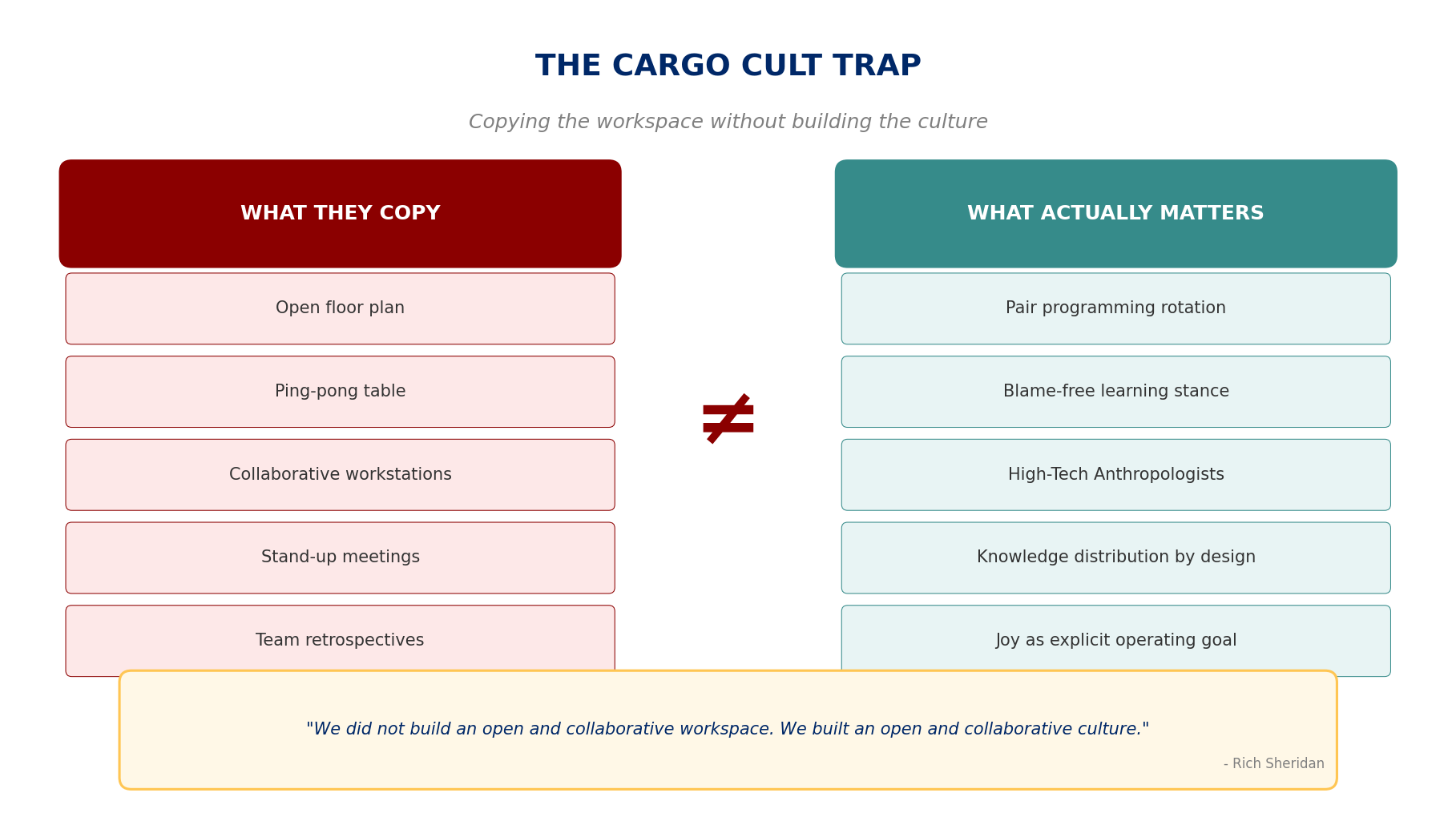
The lesson: Menlo didn't build an open and collaborative workspace. They built an open and collaborative culture. The workspace is a reflection of the cultural mindset. Copying the physical environment without building the underlying culture is cargo cult thinking. It looks like the real thing from the outside but produces none of the results.
I've seen this exact pattern play out in agile transformations. A company adopts the ceremonies, renames the titles, rearranges the teams, and nothing changes. Because they changed the surface without changing the system underneath.
Joy works the same way. You can't install it. You can't mandate it. You can't buy it with free snacks and ping-pong tables. You build the conditions for it: psychological safety, distributed knowledge, purposeful collaboration, room for people to express what they're actually experiencing. Then joy emerges as a byproduct of a system that actually works.
What This Looks Like in Practice
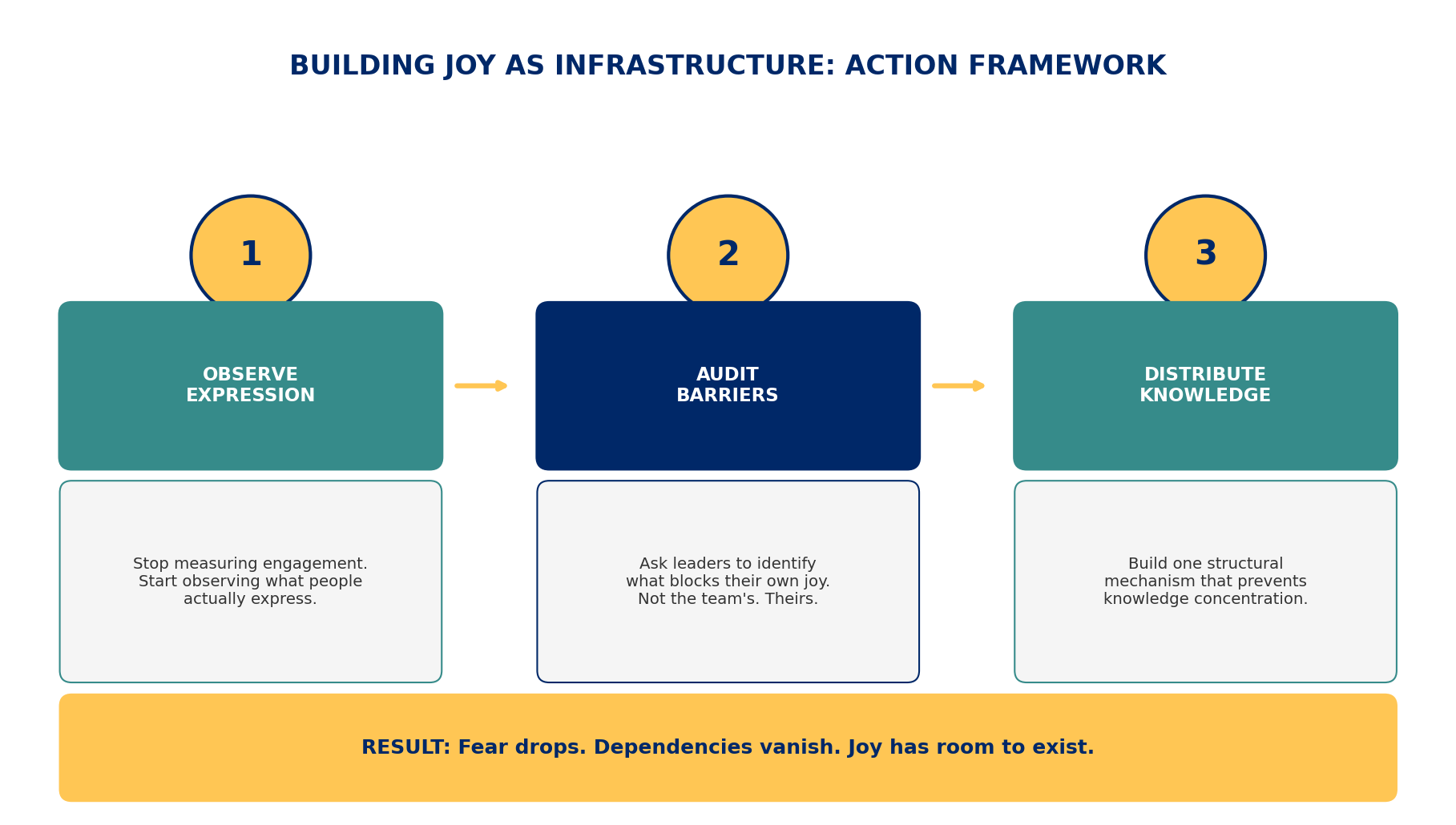
If you're a leader reading this and wondering where to start, here's what I'd suggest.
Stop measuring engagement and start observing expression. Engagement surveys tell you what people are willing to report. Observation tells you what's actually happening. Walk through your organization and notice: are people expressing energy, curiosity, even frustration openly? Or is everything performed through a filter of professional composure? The filter itself is the problem.
One of our course attendees, Laura Sorano, said something at the end of a course that stuck with me. She said that as a coach, one of the things she always looks for is whether people are having fun. Are they smiling? Are they laughing? Are they engaged? She said it tells you so much. And she was right. You can read a room faster through expression than through any survey instrument. The presence of joy is visible. So is its absence. If you're paying attention, you don't need a dashboard to tell you whether your teams are thriving or performing.
Run a barriers-to-joy audit with your leadership team. Dr. Larde's research points to a powerful exercise: ask leaders to identify what's blocking their own joy. Not their team's joy. Their own. Because when leaders haven't examined their own barriers, they reproduce them structurally. The patterns from the climb to leadership become the patterns of how they lead.
Build one structural change that distributes knowledge. Sheridan rotates pairs every five business days. That's one mechanism among many. The point isn't to copy Menlo's specific practice. It's to build at least one structural mechanism that prevents knowledge from concentrating in single individuals. When knowledge is distributed, dependency drops. When dependency drops, fear drops. When fear drops, joy has room to exist.
The Real Competitive Advantage
The irony of joy in the workplace is that the organizations most resistant to the concept are usually the ones that need it most. They measure everything except the condition that produces their best outcomes. They invest in tools, processes and systems while ignoring the human operating environment those tools run on.
Rich Sheridan found this at his lowest point. He wasn't failing because he lacked intelligence or technical skill. He was failing because the human system around him was broken. When he fixed the human system, everything else followed.
Dr. Larde puts it simply: look at the extent to which joy can manifest in the work you're doing. If it can't, you're in the wrong place, or you haven't built the right conditions yet.
Joy isn't the soft side of leadership. It's the infrastructure. And the organizations that figure this out first will have a competitive advantage that no tool, framework or restructuring can replicate.
Related Podcast Episodes
Episode 171: Joy as a Strategy: Inside Menlo Innovations with Rich Sheridan Rich walked me through 25 years of building a company where joy is the operating system. His origin story of dying inside with a VP title is one of the most honest moments I've recorded.
Episode 169: Co-Intelligence: Why Learning Together Beats Knowing Together with Diana Larsen Diana co-authored Lead Without Blame and co-created the Agile Fluency Model. Her argument that blame shuts down learning connects directly to why joy and high performance are the same conversation.
Episode 168: Why Your Best People Keep Getting in Each Other's Way with Ryan Behrman Ryan's work on overplayed strengths and cognitive diversity reveals how the friction that kills joy often comes from your most talented people working against each other without knowing it.
Agile Shorts: Authenticity and Joy in the Workplace with Dr. Pamela Larde Dr. Larde's research on joy resilience and the distinction between feeling joy and expressing it changed how I think about what leaders carry from the climb to leadership.
Ready to find out how disruption shows up in your leadership? Take the Disruptor Method Quiz and discover where you fall on the disruption spectrum.
Want to explore how joy as infrastructure applies to your organization? Book a 30-minute conversation and let's talk about what's possible.