Robust Theme
Dec 09, 2019 2020-04-08 7:40Robust Theme


Knowledge Work vs Learning Work in the AI Era

By: Kumar Dattatryan
I was in a session recently where a group of smart, experienced professionals spent fifteen minutes discovering they all meant something different by the phrase "executive presence."
Everyone walked in with their stored definition. Everyone defended it. Nobody asked what anyone else actually meant.
That is knowledge work in miniature. You accumulate something. You apply it. You defend it. You never question whether it still fits.
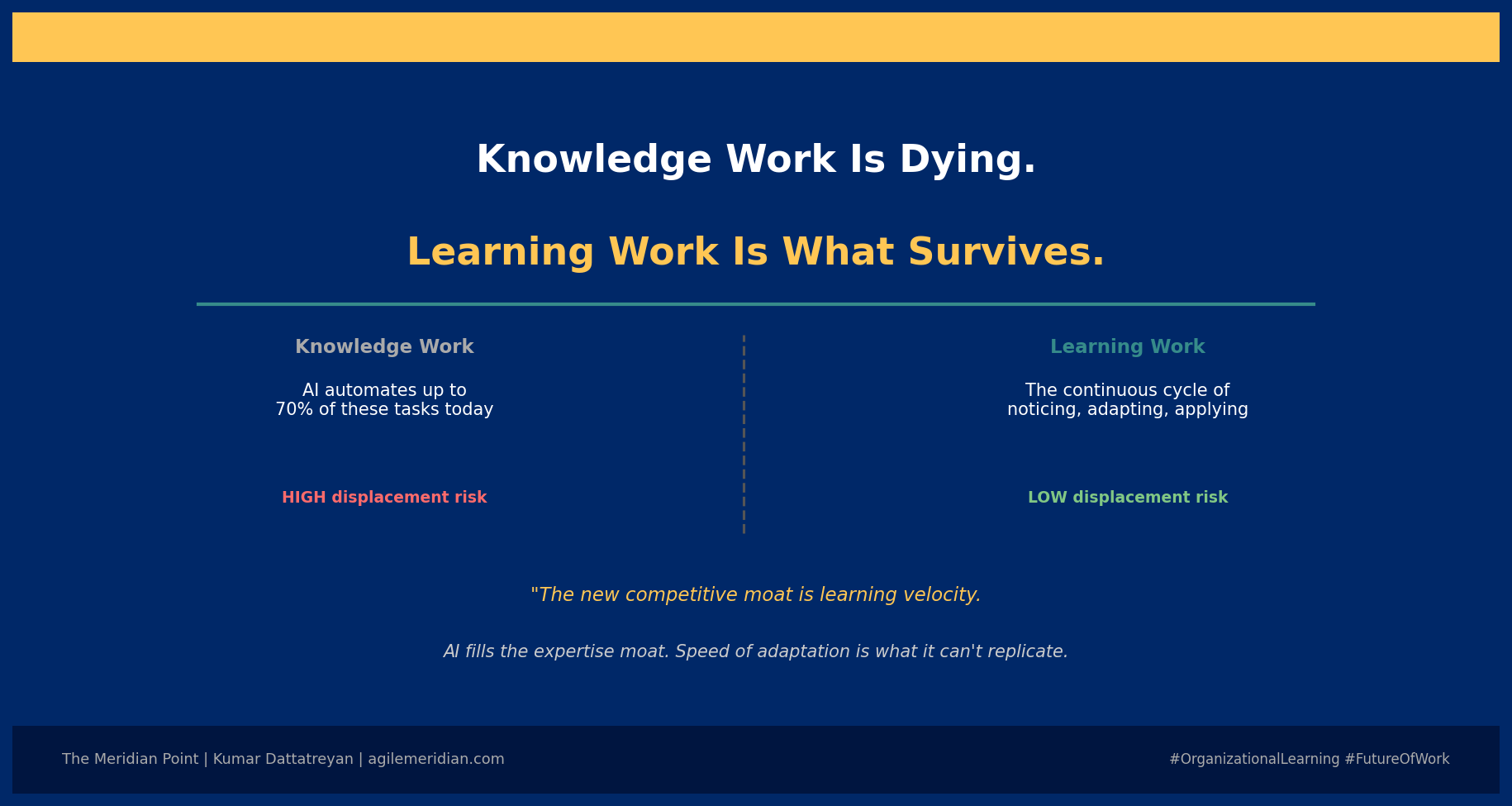
That is also why knowledge work is dying.
The Recipe Problem
Frederick Winslow Taylor built his scientific management theory on a single premise: there is one best way to do things, and the job of management is to define it, document it, and hand it to workers as a recipe. Thinking was concentrated at the top. Executing happened at the bottom. The people who knew things were called managers. The people who did things were called workers. The system was not designed for them to overlap.
That model delivered massive productivity gains in the early industrial era. It still shows up today in job descriptions that itemize every task a person is expected to perform, in org charts that put decision-making authority three levels above the person closest to the problem, and in the reflexive response that has become a kind of organizational immune reaction: "that's not my job."
The world that made Taylorism effective no longer exists. Customers no longer accept imposed products. They have choices, and they exercise them instantly. Their needs change faster than any recipe can be updated. The call center agent who follows a script when a customer is furious will lose the customer. The one who reads the room, adjusts, de-escalates, and solves the actual problem will keep them. That second person is not following a recipe. They are learning in real time.
Every role now requires that capacity. Not just engineers and analysts. Waiters, cashiers, and frontline healthcare workers. The organizations that have not figured this out yet are running a 19th-century operating model inside a 21st-century market. The gap is widening every quarter.
The Distinction Worth Making
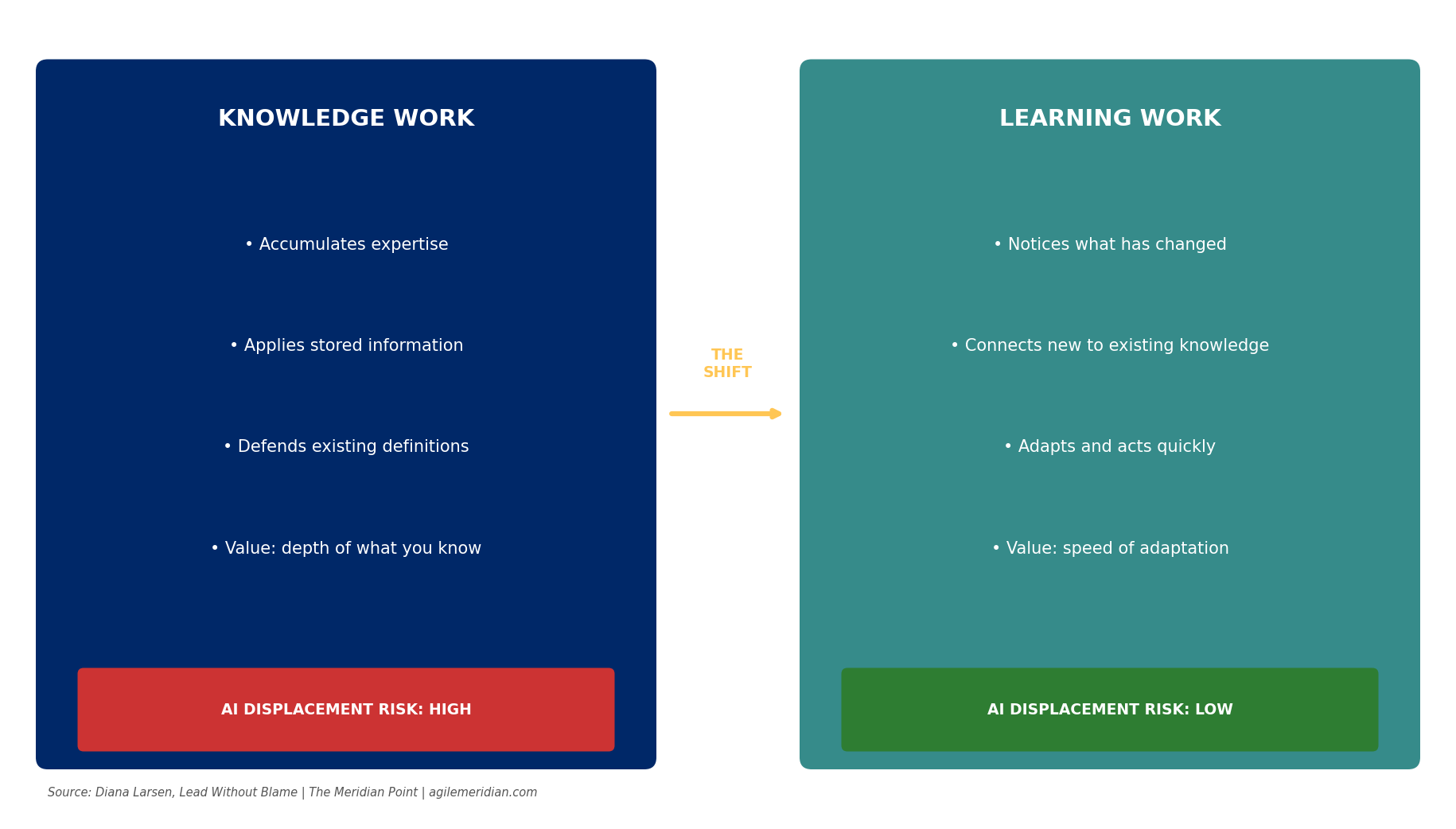
Peter Drucker coined the term "knowledge work" in the mid-20th century. He meant mind work: the accumulated expertise of lawyers, accountants, analysts, and other professionals who create value by manipulating information they already possess. The accountant's value lay in their depth of knowledge of the tax code and regulatory structure. The analyst's value was their command of data. The attorney's value was their mastery of precedent and statute.
AI does that work faster and cheaper every quarter. The McKinsey Global Institute estimated that generative AI could automate tasks accounting for up to 70 percent of what knowledge workers do today. Not someday. Now.
So if knowledge work is what most of your organization runs on, you have a structural problem.
What replaces it is not a new category of expertise. It is a different orientation entirely. Issame El Kharbili, whose consulting firm helps organizations move from job-based to responsibility-based structures, puts it precisely: stop asking people what their job is and start asking what they are responsible for. A cashier whose job is to process transactions will walk past a disorder in the store and say, "That's not my job." A cashier responsible for ensuring every customer has the best possible experience will fix it, because that is within their scope. Same person. Completely different relationship to learning and adaptation.
That shift, from knowing to being responsible for outcomes, is what separates knowledge work from learning work. Learning work is not training. It is the continuous cycle of noticing what has changed, connecting new information to what you already know, adapting, and acting. Then doing it again.
What I Saw at Carfax
I spent time at Carfax in a period when they were practicing something most organizations would find alarming: promiscuous pairing. Not the weekly rotation that Menlo Innovations runs. Pairs shifted every few hours.
Two people, one problem, one screen. Then the pairs dissolved and reformed around something new. Knowledge never had a chance to settle into silos. There was no "the person who knows that system." There was just the team, and the team knew everything the team knew.
It went further than that. Teams were responsible for hiring and firing their own members. Not HR. Not managers. The people doing the work. They ran speed dating-style feedback sessions where every team member gave and received direct input from every other member on a regular cadence. Not performance reviews. Not annual check-ins. Constant, real-time feedback loops baked into how the work happened.
What that created was not chaos. It was learning infrastructure. The pair rotation forced knowledge to move continuously. The team-led hiring meant cultural fit and learning capacity were assessed by the people who would actually work alongside the new hire, not by someone screening resumes two levels removed. The speed dating sessions meant no one accumulated unspoken feedback, no one was surprised at review time, and the team's ability to work together got sharper every cycle.
I didn't fully understand what I was watching at the time. I understood it later, after seeing what happened in organizations that had the opposite: expertise concentrated in a few people, feedback given annually if at all, teams assembled by someone who had never worked with any of them. The contrast is not subtle.
What Rich Sheridan Built
Rich Sheridan did not set out to build a learning organization. He set out to stop producing bad software. By his mid-thirties, he had the VP title, stock options, and promotions, and he was delivering poor quality, missing deadlines, and leading a team of frustrated people who hated their jobs.
His turnaround started not with a new framework but with three old books: Tom Peters' In Search of Excellence, Peter Drucker on management, and Peter Senge's The Fifth Discipline: The Art and Practice of Building a Learning Organization. All three said the same thing: the challenge he was facing was not technological. It was about how to organize humans to keep learning together, not just apply what they already knew.
That reframe became the foundation of Menlo Innovations. Twenty-five years later, 3,000+ people a year travel from four continents to watch them work. Not to learn about code. To watch a culture that has operationalized learning as a daily practice.
Sheridan tells a story that stops people cold. A multibillion-dollar insurance company visited Menlo. They saw the pair programming model and the weekly rotation. And they told Sheridan that if four programmers left their organization, just four, they would go out of business tomorrow. Those four people were the only ones who understood how certain critical systems worked.
An insurance company, in the business of risk mitigation, had accepted catastrophic single-point-of-failure risk in its own operating model. The only way they survived it was to pay those four people so much they could never afford to leave. Which meant those people were trapped in jobs they had outgrown, building quiet resentment for years.
At Menlo, pairs rotate every five business days. Knowledge stays distributed. Silos cannot form. Single points of failure disappear. Anyone can pick up any project. People take vacations without their laptops. The structure makes learning unavoidable because it was designed that way from the start.
The Restaurants Connection
Before I got into agile and professional coaching, I ran restaurants.
I never gave my wait staff scripts. My servers knew the menu, understood why certain items were on it on the nights they were on it, knew the specials, knew the entertainment coming in on weekends, knew our food cost and our labor cost, and what our customers were saying about us. They could have a real conversation with a customer about the food, upsell a Friday night jazz event, and understand that the experience they delivered had a direct line to the top-line numbers that kept everyone employed.
Our restaurants outperformed competitors. Not because the food was dramatically better. Because the experience was better, and customers told other people about it.
What I was doing, without the vocabulary for it at the time, was building learning workers. People who understood the full picture of what they were responsible for, not just the narrow task list in a job description. The knowledge of what was in stock, what the kitchen was running low on, what our regulars liked, how to read a table that was in the weeds, how to turn a bad experience around before it became a review: that was not a recipe I gave them. That was a learning orientation I tried to cultivate.
The same principle ran through everything I later did at Carfax, and everything I now do with clients. The recipe is always already obsolete. What you need are people who can learn faster than the recipe can be rewritten.
The Cargo Cult Warning
Here is where most organizations go wrong when they try to build what Menlo or Carfax built.
Sheridan has watched it happen for twenty-five years. People come to Menlo, get inspired, go home, tear down office walls, put everyone in an open room, and watch everyone quit. The lesson they drew was wrong. Menlo did not build an open and collaborative workspace. They built an open and collaborative culture. The workspace reflects the cultural mindset. Copying the environment without the orientation produces nothing except a noisier open-plan office.
The same error runs through how organizations approach learning. They install the artifacts: a learning management system, an annual training calendar, a LinkedIn Learning license, a retrospective template. None of it changes behavior because the underlying orientation is still knowledge-hoarding. People complete training to check a box. Retrospectives become complaint sessions. The knowledge sits in documentation that nobody reads.
The artifacts of a learning culture are not the culture. Menlo's pair rotation makes knowledge distribution unavoidable. Carfax's pair switching every few hours made knowledge distribution constant. The speed dating feedback sessions made learning loops structural. None of that happens because people feel inspired after a training. It happens because the process is designed so that learning cannot be avoided.
The AI Acceleration Problem
Vijay Luthra, who has spent two decades helping public sector organizations navigate transformational change, draws a distinction that most AI conversations miss. Every previous industrial revolution asked humans to adapt to new technology. This one, for the first time, gives us the ability and the foresight to adapt technology to humans instead. That is not a philosophical preference. It is a practical claim about where the real competitive advantage lives.
Organizations that treat AI adoption as a knowledge problem will keep losing ground. They train people on specific tools, document best practices, build internal use-case libraries. Six months later the tools have changed, the use cases have shifted, and the organization is scrambling to update its knowledge store again.
Evan Leybourn, whose Business Agility Institute tracks organizational performance across more than 7,000 members in 85 countries, frames this through constraints theory. The bottleneck in most organizations has moved. It is no longer delivery speed. It is governance and the speed at which people can absorb new knowledge and change how they actually work. You can release software in 33 seconds. If it takes your organization six months to learn from a failure, you are still slow.
AI is not a one-time disruption. It compounds. What your organization knows about AI today will be partially obsolete in six months. The organizations that survive this are not the ones with the best current AI strategy. They are the ones that can learn their way through the next change, and the one after that.
Three Things to Do Before the End of This Quarter
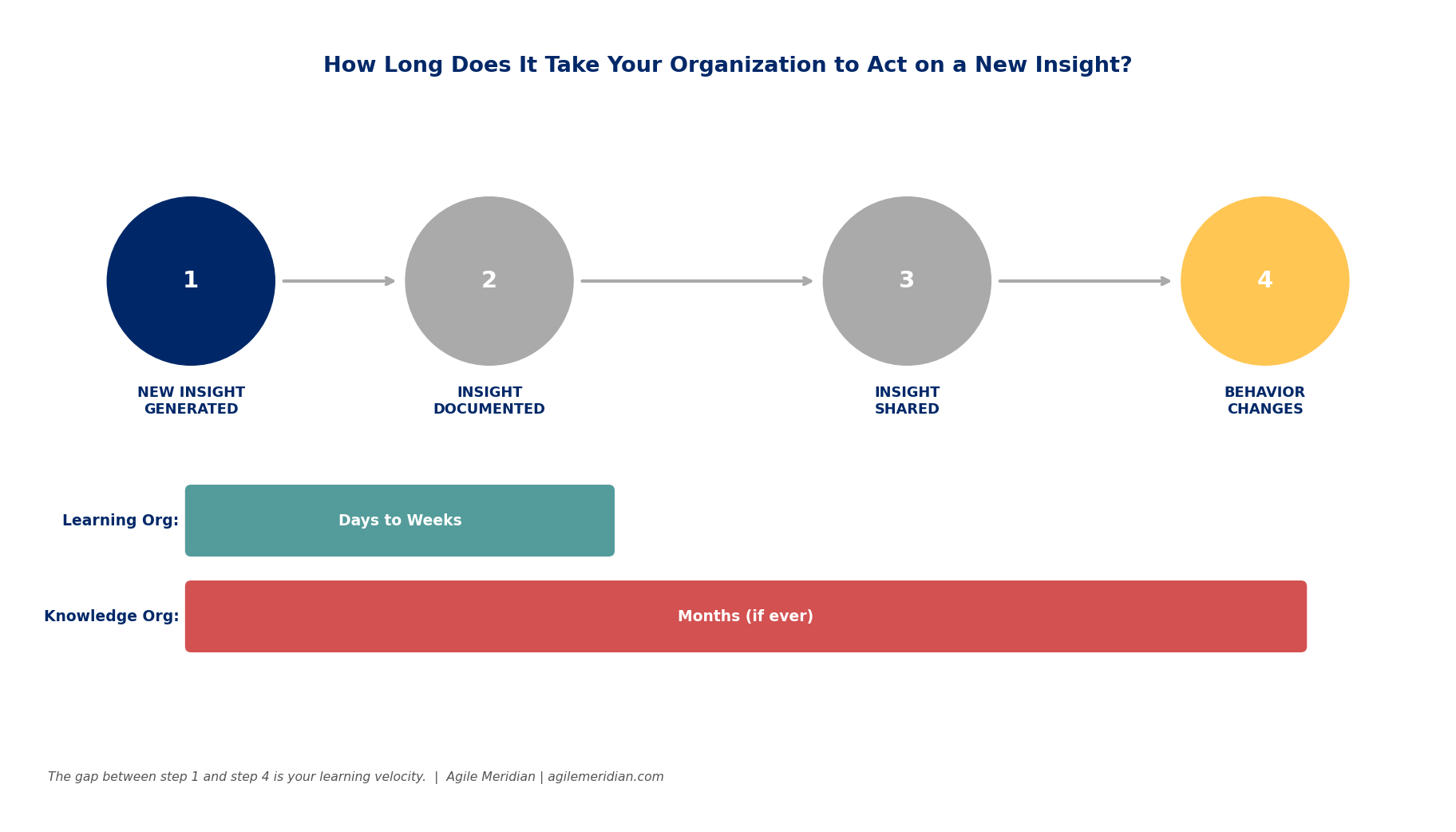
Run the learning velocity diagnostic. Pick one important insight your organization generated in the last six months. Trace what happened to it. Did it change how people work? If yes, how long did it take? If no, find out why. You will learn more about your organization's learning capacity from this exercise than from any survey.
Redesign one process from knowledge-storage to knowledge-generation. Most organizations have a post-project review that produces a document nobody reads. Redesign it as a live learning session. Change the question from "what happened?" to "what would we do differently if we had to start tomorrow?" Run it within two weeks of project completion, not six months later when everyone has moved on.
Make learning velocity a leadership conversation. Not in L&D. In your executive team meetings. Where is the gap between new insight and changed behavior the widest? That is your bottleneck. That is where you focus.
The Real Competitive Moat
For most of the last century, competitive advantage in knowledge-intensive industries came from expertise. You accumulated the deepest knowledge and protected access to it. That was the moat.
AI is filling that moat.
The new moat is learning velocity. How fast can your organization notice what has changed, integrate it, and act differently? Menlo Innovations has been proving this for twenty-five years with a weekly rotation and a pairing practice. Carfax proved it with pairs that shifted every few hours and teams that ran their own feedback loops. The restaurants I ran proved it with wait staff who understood the whole picture, not just their script.
The pattern is consistent across industries and decades. Organizations that stop protecting what they know and start investing in how fast they can learn are the ones that compound their advantage over time.
The Disruptor Method exists precisely for this transition. The alignment work at the leadership layer, the steel thread from strategy to execution, the cadence of accountability that surfaces learning in real time, all of it is designed to build organizations that do not just absorb disruption. They generate it.
If you want to know where your organization stands on this transition, the assessment takes about ten minutes and gives you a clear picture of where your biggest constraints are.
Related Episodes:
- Episode 171: Joy as a Strategy: Inside Menlo Innovations with Rich Sheridan
- Episode 169: Co-Intelligence: Why Learning Together Beats Knowing Together
- Episode 167: Business Agility in Crisis: 2025 Trends with Evan Leybourn
- Episode 152: From Agile to AI: Avoiding the Same Transformation Mistakes
- Episode 139: The 5th Industrial Revolution: Why 40% of Jobs Will Disappear
- Episode 99: Lessons from Naturally Nimble Organizations
- Episode 47: Knowledge Debt
- Give Knowledge Workers a Leading Role with Issame El Kharbili
Kumar Dattatreyan is co-founder of Agile Meridian and co-creator of The Disruptor Method. He works with Fortune 500 companies on organizational transformation. Book a conversation: https://tidycal.com/coachkumar/30-minute-meeting