Robust Theme
Dec 09, 2019 2020-04-08 7:40Robust Theme


The Middle Manager Trap: Strategy vs Reality

By: Kumar Dattatryan
Every transformation I have worked on has a graveyard. You don't see it on the org chart. It doesn't show up in the project plan. But it's there, sitting in the space between the executive suite and the frontline teams. That is where strategies go to die.
I am talking about the middle management layer.
And before you assume this is a critique of the people in those roles, please read on. The people are not the problem. The architecture is.
The Pattern I Keep Seeing
Here is how a typical transformation unfolds. Leadership aligns around a bold new direction. There is a kickoff. There are slide decks. There are commitments made in conference rooms. Then the initiative hits the middle layer of the organization, and something shifts.
The pace slows. The message dilutes. Teams hear fragments of the original vision filtered through interpretation. Executives wonder why the strategy is not landing. Frontline teams wonder why priorities keep changing. And the middle managers in between are doing their best to survive the crossfire.
I see this constantly. In large federal agencies, in Fortune 500 companies, in organizations that have been through multiple transformation cycles and still can't figure out why it keeps stalling in the same place.
The answer is almost always the same. Nobody designed a role for middle management in the change. They got a memo. Not a mandate.
Order Takers, Not Decision Makers
Glenn Marshall and I have had this conversation more than once on The Meridian Point. He put a name to the pattern that I think is exactly right. He called them order takers.
Senior leadership decides something. They push it down, break it up a little, and hand it off. And the people receiving it are expected to execute rather than contribute. The structure does not exist for them to weigh in, push back, or surface what they are actually seeing on the ground. So the information that would change the strategy never reaches the people who set it.
Glenn described it plainly: the people on the front line who have the information and know what to do are not empowered to act on it. So all they do is throw it up the chain. And up the chain, people are busy. They deprioritize. Nothing happens. The organization cannot respond to what it cannot see.
The warning sign I look for in any client engagement is when senior management is too far away from daily problems. When line managers are struggling and their morale is low. When people at that level start saying things like "leadership doesn't really listen to what I have to say." That is not a personnel problem. That is a broken information system. The decisions are being made by people who are insulated and isolated from where the problems actually are. So they do not know the problems. And because they do not know the problems, they do not know how to fix them.
It still astounds me how common this is. And how predictable the outcome is once that pattern takes hold.
The Memo, Not the Map
One of the most honest accounts of what it actually feels like to be in that middle layer came from Mosongo Moukwa when he joined me on the show. Mosongo spent thirty years in senior R&D leadership, eventually becoming VP at SC Johnson. But he started somewhere very different.
He had just finished his PhD. He was a postdoc at Northwestern, excited to do research and file patents. Then the VP of R&D called him in and told him he was going to be a manager. No training. No transition. No framework. Just a new title and a room full of expectations, he had no map for.
"I was a brand new manager with no management experience," he told me. "I had to figure things out. I was more or less on my own."
That is not an unusual story. I hear versions of it constantly. John Maxwell created a leadership assessment based on the "levels of leadership". Mosongo was a level 1 leader; a leader by title only. Someone is good at their technical job, so the organization promotes them into management and assumes the skills transfer. They do not. And so the person does what any rational human does when the system gives them no good options: they manage what they can see, which is activity. They track tasks. They run status meetings. They look busy.
What they are not doing is leading. Because nobody showed them how, and the structure they are sitting inside does not reward it.
Mosongo eventually figured out the distinction himself, through trial and error and a few costly experiments. His framing is one I have used many times since: "Leadership is not a solo venture." It is not about how far you progress. It is about how far you help other people progress. That shift in orientation is everything. And most organizations never explicitly ask for it from the managers they put in the middle.
The Cost Accounting Trap
There is a structural reason why middle managers default to tracking individuals instead of optimizing outcomes. Johanna Rothman, author of more than twenty books on management and a guest on The Meridian Point, names it precisely.
Cost accounting. Every organization measures individual output because cost accounting demands it. Managers have to report in those terms. The system is built around knowing who did what and how long it took. And so managers manage to that. They focus on who is the expert, who is delivering, and whether each person on their team is sufficiently busy.
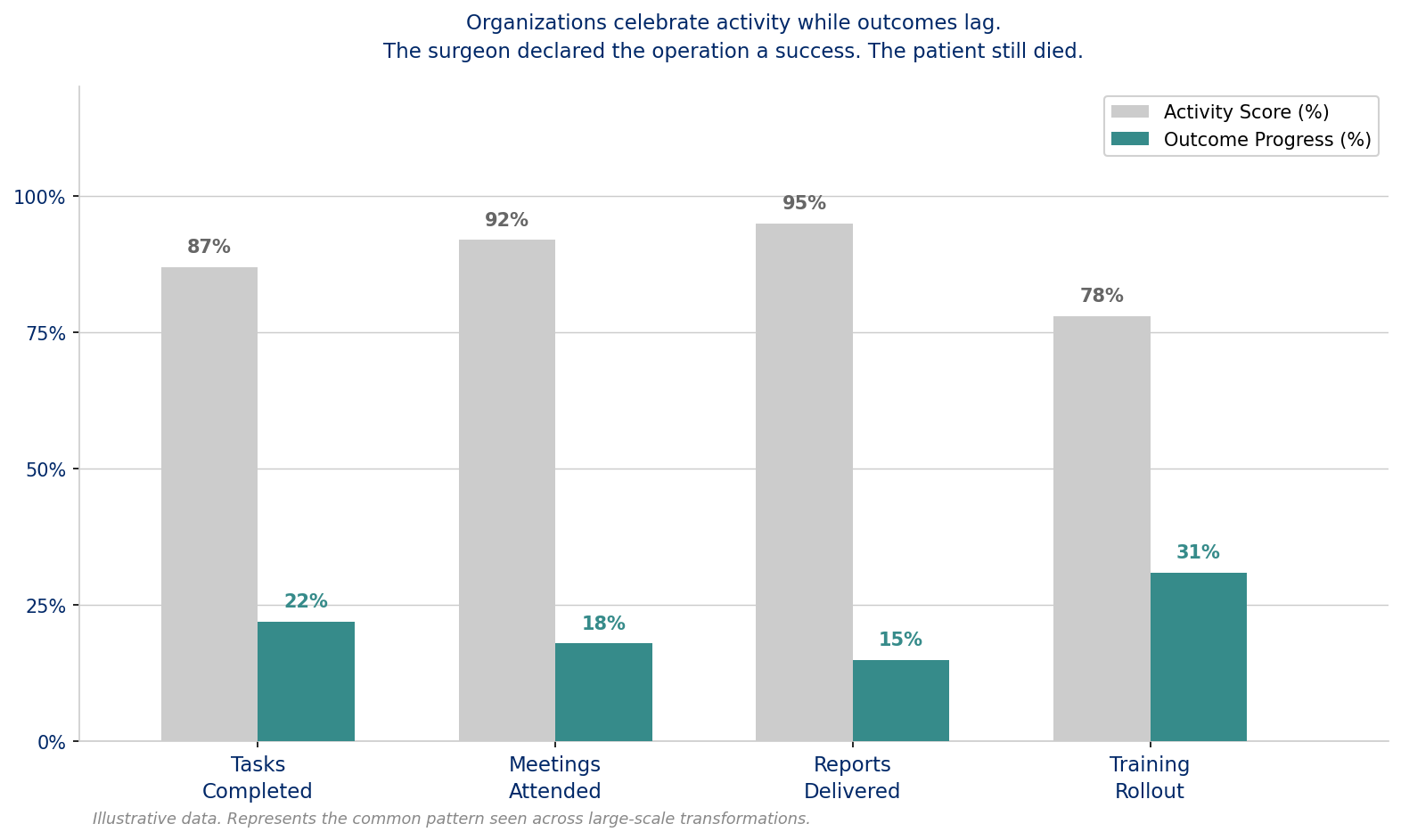
What that measurement system kills is flow. When you are optimizing individual utilization, you are not optimizing what the team actually produces. Johanna put it simply: "The wait time in organizations really outweighs any of the work time." Managers are sitting in back-to-back meetings waiting for information, waiting for estimates, waiting for decisions to be scheduled. Teams are being interrupted to provide status on work that has not started yet. Everyone is moving. Nothing is flowing.
The middle manager is usually at the center of this. They are the ones who generate the meetings, request the estimates, and write the reports. Not because they want to. Because the system evaluates them on whether they have that information, not on whether the information led to anything useful.
Managing with cost accounting logic and leading with outcome clarity are two completely different jobs. Most organizations have collapsed the distinction and handed it to one person with no guidance on which one actually matters.
The Two-Way Problem
Here is the architectural failure at the core of the middle manager trap. Transformation requires information to travel in both directions. The strategy has to be clear. Reality has to move back up accurately.
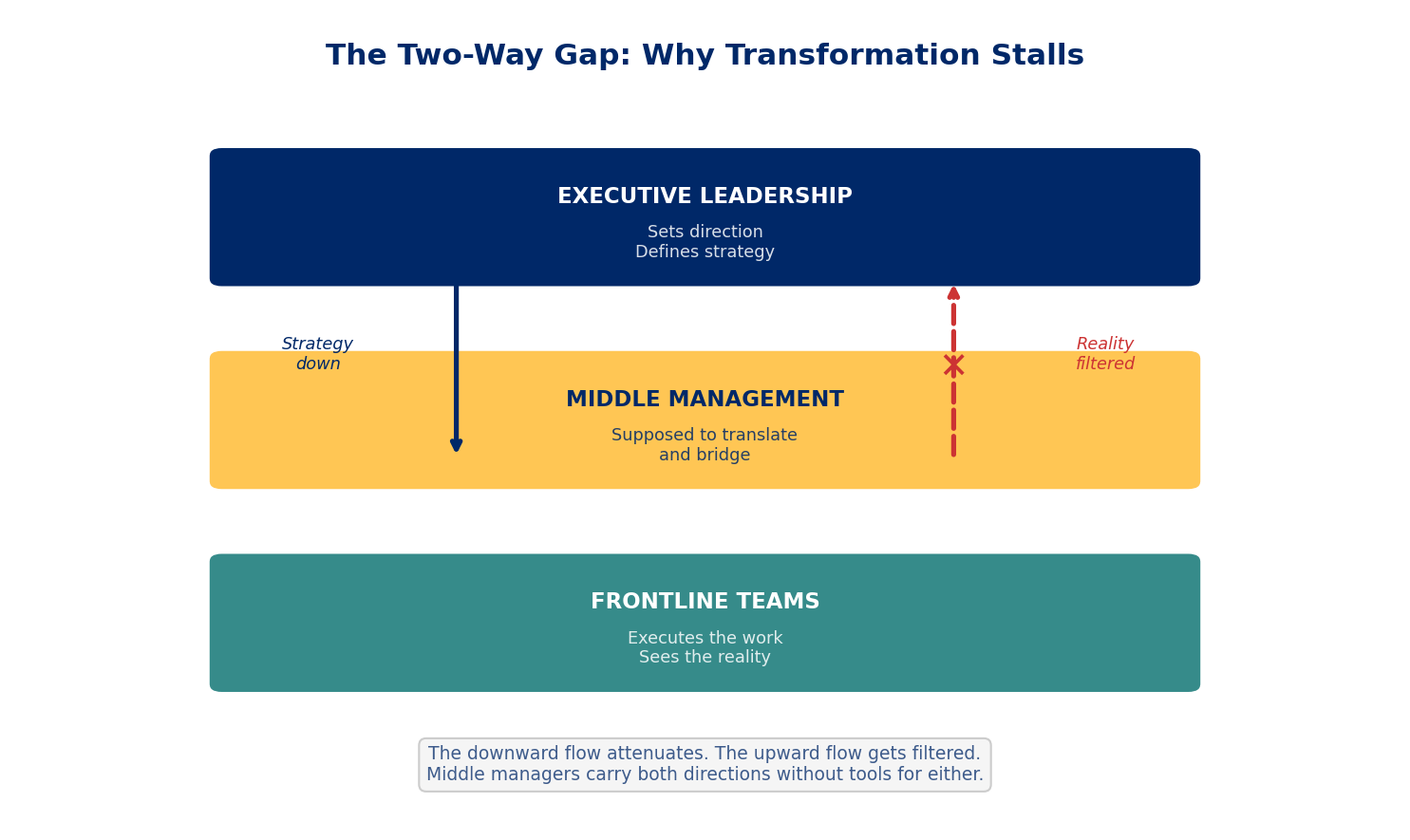
The downward flow is imperfect, but it functions. Executives set direction, cascades happen, communications go out. Something arrives at the team level, diluted but present.
The upward flow is where it breaks. By the time ground-level reality reaches the executive suite, it has been filtered and softened. Problems become risks. Failures become learnings. The message that the strategy is not working gets translated into a request for more time.
Middle managers are doing that filtering. Not because they are cowardly, but because the system penalizes the messenger. They have learned that bringing bad news up the chain without a solution attached tends to end badly. So they protect information. They manage optics. They become a source of friction in the very system that needs transparency to function.
Mosongo's story about the technology transfer from Japan is a precise illustration of this. For fifteen years, his organization had failed to secure a critical technology from its Japanese parent company. The explanation everyone had settled on was that the Japanese team was uncooperative. Nobody was traveling to Japan. Nobody was sitting with the actual problems. When Mosongo went, he found friendly people with legitimate constraints that had never been surfaced or understood. The upward flow had been broken for fifteen years, and everyone had interpreted the silence as obstruction.
The real issue was that nobody had built the structure for honest two-way communication. Once Mosongo did so, the technology was transferred within two years.
This is what the middle manager trap actually costs. It is not just slow execution. It is decisions made on wrong information, strategies built on misread reality, and fifteen years of spinning because nobody fixed the signal chain.
What Changes When You Fix the Structure
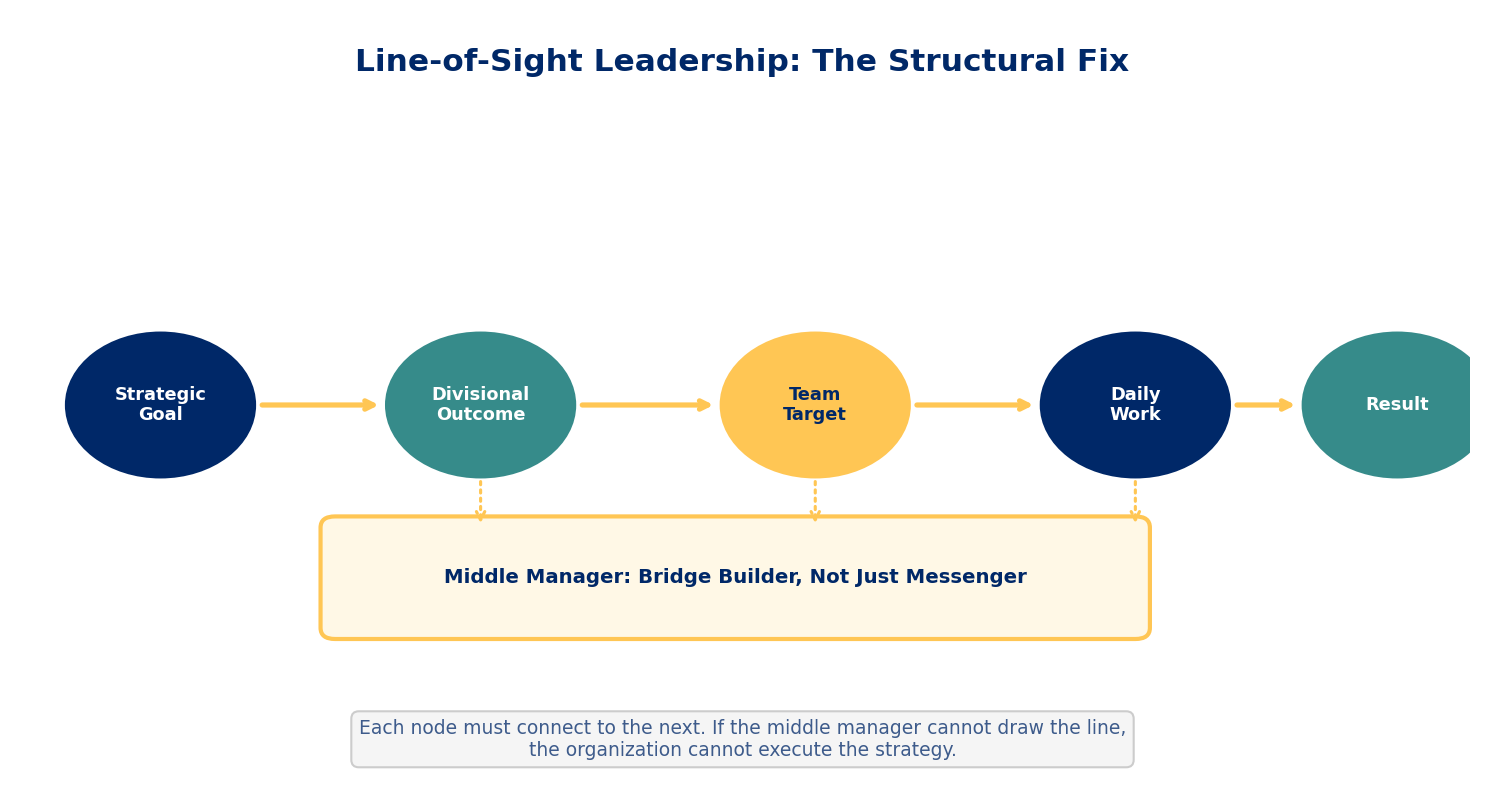
The organizations that break out of this pattern do one thing differently. They build explicit line of sight from the executive goal all the way to the daily work of every team. Not a conceptual connection. A specific, named, measurable thread.
In the Disruptor Method, this is the first structural question we ask. Can every person in this organization draw a direct line from what they are doing today to the outcome the leadership team is chasing? If the answer is no, or if it requires guessing, the transformation will stall at the middle layer regardless of how strong the strategy is.
When that line exists, middle managers stop translating and start navigating. They know what success looks like at their level. They can make real decisions without waiting for permission on every judgment call. They can surface problems because the structure protects them in doing so, rather than penalizing them.
Glenn made the point in one of our conversations that took me a long time to fully appreciate. The doers in an organization are not disengaged because they do not care. They are disengaged because the structure does not allow them to act on what they know. Fix the structure, and the engagement follows. It is not the other way around.
Three Places to Look
Run the line-of-sight test. Pick any middle manager and ask them to connect their team's current priorities directly to the top three strategic goals. Specifically. With numbers. If they hesitate or guess, the line of sight is not there. That is not a reflection on them. It is a gap in the architecture.
Separate activity from outcome. Middle managers should be evaluated on whether their team's work moves the needle on defined outcomes, not on whether the work gets done. Most organizations measure the latter and wonder why the former does not improve.
Build the upward flow deliberately. Create a regular cadence where middle managers are expected to surface what is not working. Not as a complaint channel. As a signal system. The executive team needs that information. You just have to make it structurally safe to provide it.
So What Do You Do About It
The middle manager trap is not a talent problem. It is an architectural one. Organizations ask the middle layer to carry the weight of transformation without the tools, the clarity, or the authority to do it well.
The spinning you see is not evidence that the people are not trying. It is evidence that the system has not given them a clear direction to run in.
That is fixable. But it requires leaders to stop pointing down and start looking at the structure they built.
If you want to dig into what it actually looks like to build line-of-sight leadership in your organization, let's talk. Book a 30-minute conversation, and let's chat about how to build line-of-sight leadership.
Related Podcast Episodes
These conversations shaped this post directly.
Trial by Fire: Building Leaders of Significance with Mosongo Moukwa. Mosongo was handed his first management role with no training and no map. His thirty-year journey from that moment to VP at SC Johnson, and the specific lesson that leadership is not a solo venture, sits at the heart of why the middle layer breaks down the way it does.
Management Myths Busted with Johanna Rothman. Johanna's breakdown of cost accounting logic, resource efficiency thinking, and why the wait time in organizations dwarfs actual work time is essential context for anyone trying to understand why middle managers default to managing activity instead of outcomes.