Robust Theme
Dec 09, 2019 2020-04-08 7:40Robust Theme


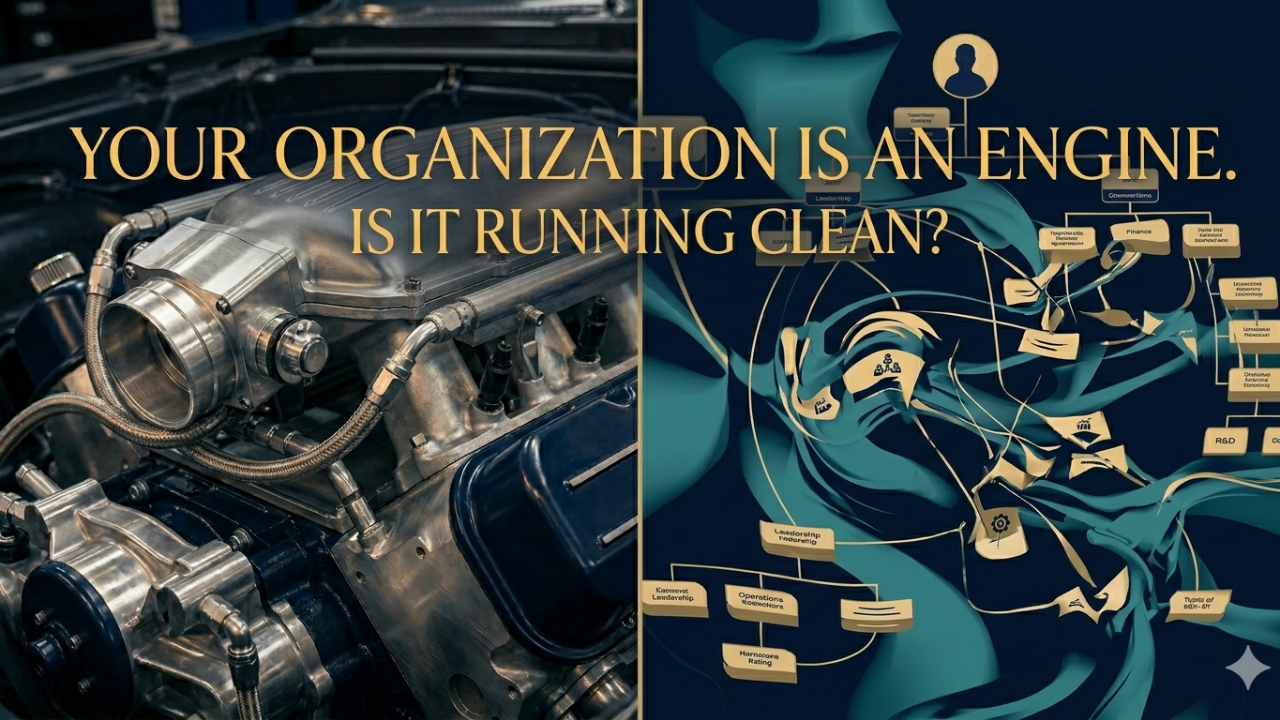
Is Your Organization Running Clean? A Health Check
By: Kumar Dattatryan
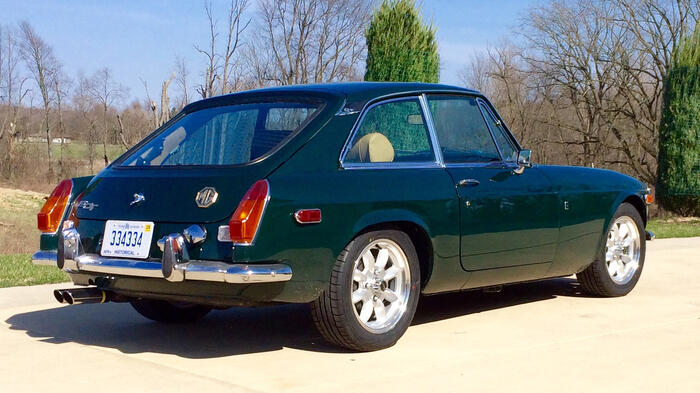
My first car was an MGB GT. British racing green, 1.8-liter inline four, about as far from fast as you can get while still calling yourself a sports car. But I loved that thing. I learned more about mechanical systems from that car than from anything I read in a classroom. When it ran right, everything felt connected. When it didn't, you knew immediately. Not from a dashboard light. From the sound. From the feel.
I have been a gear head ever since. Today I ride a Ducati Multistrada, drive a modified MX-5, and yes, I also own a Tesla Model 3 Performance. Different machines. Different philosophies. But the same underlying truth: a well-tuned system tells you it's running right before any instrument does. And a poorly tuned one tells you that too, whether you want to hear it or not.
Chevrolet just announced the 2027 Corvette Grand Sport, built around a next-generation LS6 6.7-liter V8 producing 535 horsepower and 520 lb-ft of torque. Naturally aspirated. No turbochargers, no superchargers. Just large displacement, high compression, tunnel-ram intake, and 70 years of Small Block refinement. The engineers at GM described it simply: large displacement, modern technology, and proven heritage working together. Every system aligned. No wasted energy.
I want to talk about what that has to do with your organization. Because the parallel is not metaphorical. It is diagnostic.
The Engine That Should Not Make This Much Power
On paper, the LS6 should not be this impressive. It is a pushrod V8, an architecture that goes back to 1955. It has no variable valve timing in the exotic sense, no twin-scroll turbines, no hybrid assist at its base configuration. What it has is airflow that is precisely managed, a lubrication system engineered for sustained high-load operation, compression ratios that demand premium fuel and return maximum combustion efficiency, and components sized to handle the stresses of 6,600 RPM without complaint.
The best engine builders in the world, despite having access to sensors and telemetry that would have seemed like science fiction a generation ago, still listen for the engine. They hear turbulence in the intake. They hear the difference between clean combustion and a slight misfire. They do not wait for the data to confirm what the sound already told them.
That discipline, that willingness to listen instead of just measure, is the first lesson for organizational leaders.
What Organizational Turbulence Actually Sounds Like
Most organizations I work with do not have a shortage of sensors. They have dashboards and KPI reports and quarterly reviews and engagement surveys and OKR trackers. They have more data than they have ever had. And they are still misfiring.
The turbulence shows up in predictable ways.
Direction comes from multiple sources simultaneously. An engineering leader is asked to prioritize by the product team, by the architecture team, and by the business stakeholder, all in the same week, all with different definitions of urgent. The result is not speed. It is a team that cannot fire on all cylinders because the ignition timing is set by three different hands.
Leaders add more tools instead of listening for the knock. When a transformation initiative stalls, the instinct is to add another layer: a new platform, a new framework, an AI-powered roadmap generator. I have watched leaders spend months building interactive applications to model what a roadmap might look like instead of simply sitting down and writing one. The tool becomes the distraction from the diagnosis.
Information does not flow where it needs to go. People on the floor, whether that is a factory floor or a software development team, know where the problems are. They have known for months. But the structure of the organization blocks that information from reaching the people who make decisions. By the time it arrives, it has been filtered, softened, or shelved. The engine is knocking but no one in the cockpit can hear it.
These are not separate problems. They are the same problem expressed at different points in the system. Competing direction, sensor addiction, and blocked information flow are all symptoms of an organization that has lost its airflow.
The Grand Sport X Warning
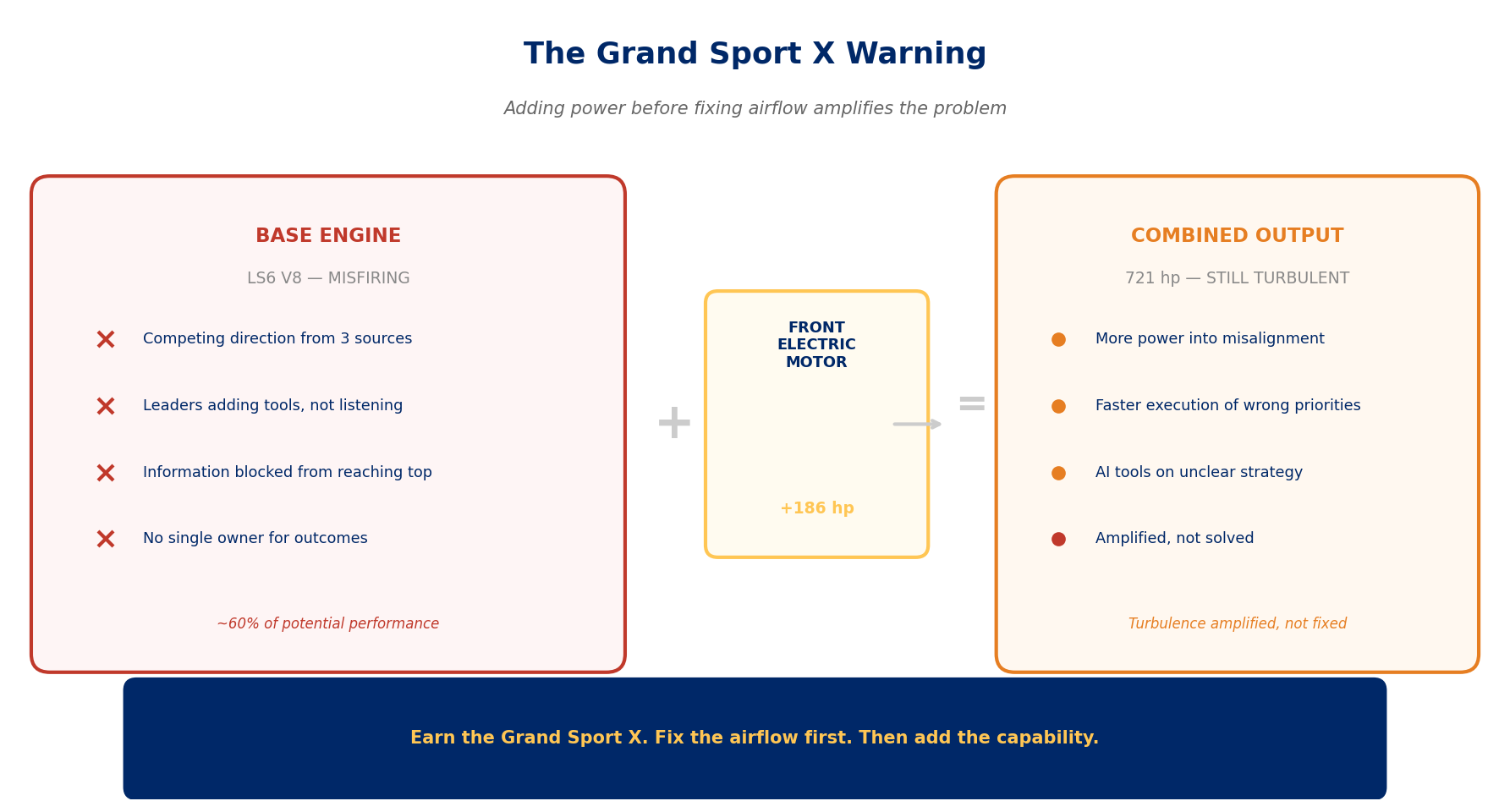
Chevrolet also announced the Grand Sport X alongside the base Grand Sport. It pairs the same LS6 V8 with a front-axle electric motor for a combined 721 horsepower and all-wheel drive.
It is extraordinary. It is also the wrong choice if the V8 underneath is not sorted.
The electric motor adds power and traction at the front axle. What it cannot do is fix turbulence in the base engine. If the V8 is misfiring, 186 additional horsepower from the front will not solve it. It will just make the problem faster.
This is the trap that organizations fall into consistently. They add AI tools to a strategy process that has not clarified its objectives. They implement new agile frameworks on teams that do not have clear ownership. They hire consultants to accelerate a transformation that does not yet have internal momentum. More power into a misaligned system does not fix the misalignment. It amplifies it.
I am not against the Grand Sport X. It is a remarkable machine. But you earn it. You start with the LS6 running clean, and then you add the capability on top of it.
What a Well-Tuned Organization Actually Looks Like
The LS6 produces its power through three aligned systems. Precise airflow through a large throttle body and high-velocity intake ports. Sustained lubrication engineered for extended high-load operation. Combustion geometry that demands everything be in the right place at the right time.
Translate that to organizational terms and you get three aligned systems as well.
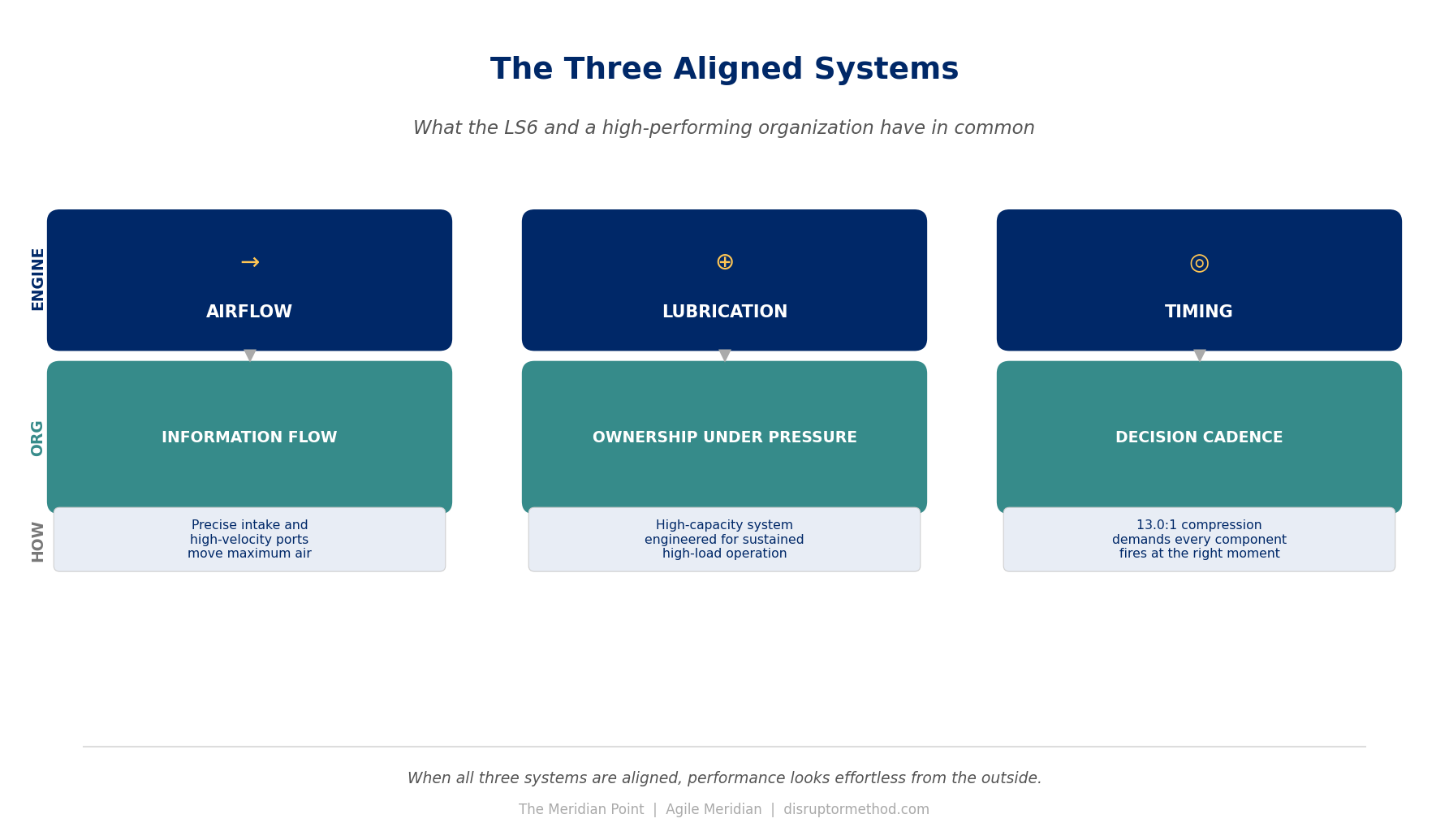
Information flow. Leaders who are close enough to the work to hear what is actually happening, not just what gets reported upward. In the organizations I work with through the Disruptor Method, we call this line of sight. It is not about surveillance. It is about building the structural conditions for unfiltered information to move from where the work happens to where decisions are made. The SORI framework, which stands for Strengths, Opportunities, Risks, and Impediments, exists specifically to surface what the organization already knows but has no formal mechanism to surface. It is not a discovery tool. It is a listening tool.
Ownership under pressure. The LS6 does not shed horsepower under sustained load. Its lubrication system is specifically engineered for high-temperature, high-stress operation. Organizations fail at exactly this point: when the pressure increases, ownership collapses. Accountability diffuses. The DRI, the Directly Responsible Individual, is the organizational equivalent of that lubrication system. Not a committee. Not a consensus. One person who owns the outcome and makes the call when consensus cannot be reached. Simple. Not easy. But non-negotiable if you want sustained performance.
Timing. The LS6 runs at 13.0:1 compression. At that level, everything must fire at the right moment. Leadership decisions made too late are just as damaging as decisions made without information. The organizations that move fastest are not the ones with the most resources. They are the ones that have built a cadence of accountability: regular rhythm, short cycles, clear decisions, rapid feedback. The cadence is the timing system. Without it, the compression is working against you.
The Diagnostic Most Leaders Skip
Engine builders listen before they tune. They do not assume. They do not consult the sensor data and conclude the engine is fine because no warning lights are on. They listen.
The equivalent in organizational leadership is the willingness to sit with the people who are actually doing the work and ask a simple question: what is getting in your way? Not in a town hall. Not through a survey. In a room, or on a call, without an agenda other than genuine curiosity.
What I have seen consistently across the organizations I work with is that the people closest to the work know exactly where the turbulence is. They have known for a long time. They stopped volunteering the information because no one acted on it the last time they did. Rebuilding that channel, creating the conditions for honest information to flow upward, is not a cultural initiative. It is an engineering task. You build the structure that makes it possible and then you protect it.
Three Immediate Actions
If your organization is misfiring, the path forward is the same as it is for an engine running rough.
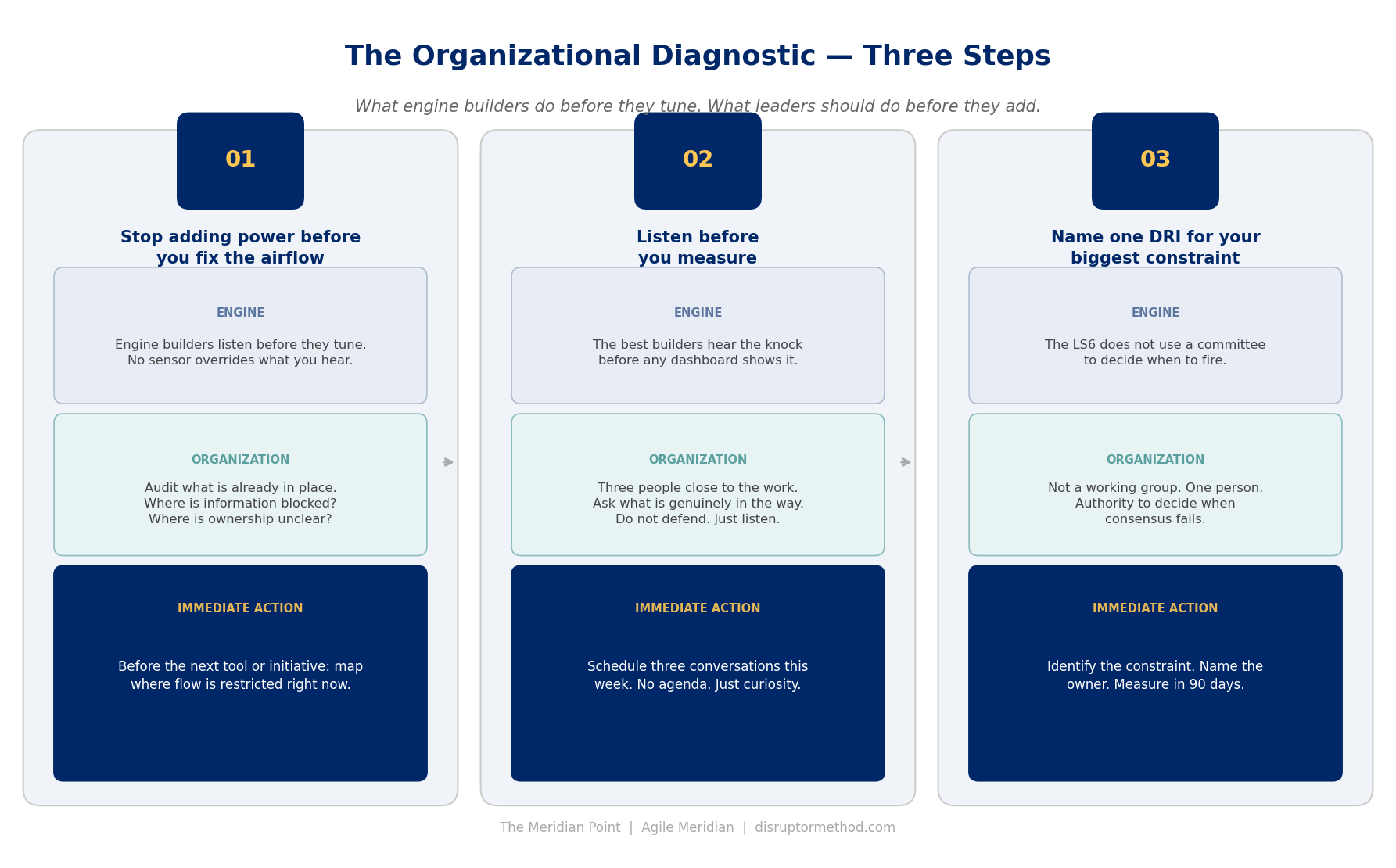
Stop adding power before you fix the airflow. Before the next tool, platform, or initiative, audit what is already in place. What is not flowing? Where is information getting blocked? Where is ownership unclear? Identify the restriction before you increase the fuel.
Listen before you measure. Pick three people close to the work, people who are not on your leadership team, and ask them what is genuinely getting in their way. Do not defend. Do not fix in the meeting. Just listen. What you hear in those conversations will be more diagnostic than any dashboard.
Establish one clear DRI for your most pressing organizational constraint. Not a steering committee. Not a working group. One person. Give them the authority to decide when consensus fails. Measure the outcome in ninety days.
The Machine You Are Building
The Corvette Grand Sport is not a compromise. It is a deliberate choice. You could have a supercharged engine. You could have more cylinders. Chevrolet chose displacement, compression, and airflow because those fundamentals, done right, produce extraordinary results without complexity.
Your organization can work the same way. Not by being simple, but by being aligned. When information flows cleanly to where decisions are made, when ownership is clear and held under pressure, when the rhythm of the organization is calibrated to how fast the work actually moves, you get performance that looks effortless from the outside.
From the inside, it sounds exactly like a well-tuned engine running at 6,600 RPM.
I have not owned a Corvette yet. But I understand exactly what it takes to make one run right.
Related Episodes
The themes in this post have come up across dozens of conversations on The Meridian Point. These four go deepest on the same territory.
Ep. 137 — Organizational Silos Are Bleeding Your Revenue The airflow problem in concrete terms. Silos restrict information flow the same way a choked intake restricts combustion. If your organization's information is traveling through too many filters before it reaches the people who need it, this is where to start.
Ep. 150 — Top-Down vs. Bottom-Up: Two Transformation Methods, Same Result Competing direction from multiple sources is one of the two core pain points this post addresses. This episode digs into why it happens and what it costs, regardless of which direction the pressure is coming from.
Ep. 35 — Leadership as a Service / Reducing Knowledge Debt The DRI model and Leadership as a Service are the ownership and timing systems described in this post. This episode covers how to implement both and what gets in the way.
Ready to Find Your Turbulence?
If this post resonated, the next step is a conversation. Not a sales call. A diagnostic. Thirty minutes to identify where your organization's airflow is restricted and what it would take to clear it.
Or take the Disruptor Method assessment first and bring the results to the conversation: thedisruptormethod.com
Kumar Dattatreyan is the co-founder of Agile Meridian and the co-creator of the Disruptor Method. He works with Fortune 500 and Fortune 50 leadership teams on organizational transformation.