Robust Theme
Dec 09, 2019 2020-04-08 7:40Robust Theme


Treat Your Organization Like a Living System

By: Kumar Dattatreyan
Here's an uncomfortable question to sit with before your next leadership meeting: if your organization were a living organism right now, would you say it's healthy?
Not growing. Not profitable. Healthy.
There's a difference. I've worked with organizations generating strong revenue while operating in a state of chronic illness — teams walled off from each other, decisions made floors away from where the work actually happens, people executing tasks with no idea why. These organizations function the way a body functions on adrenaline. Impressive in the short term. Unsustainable in any other way.
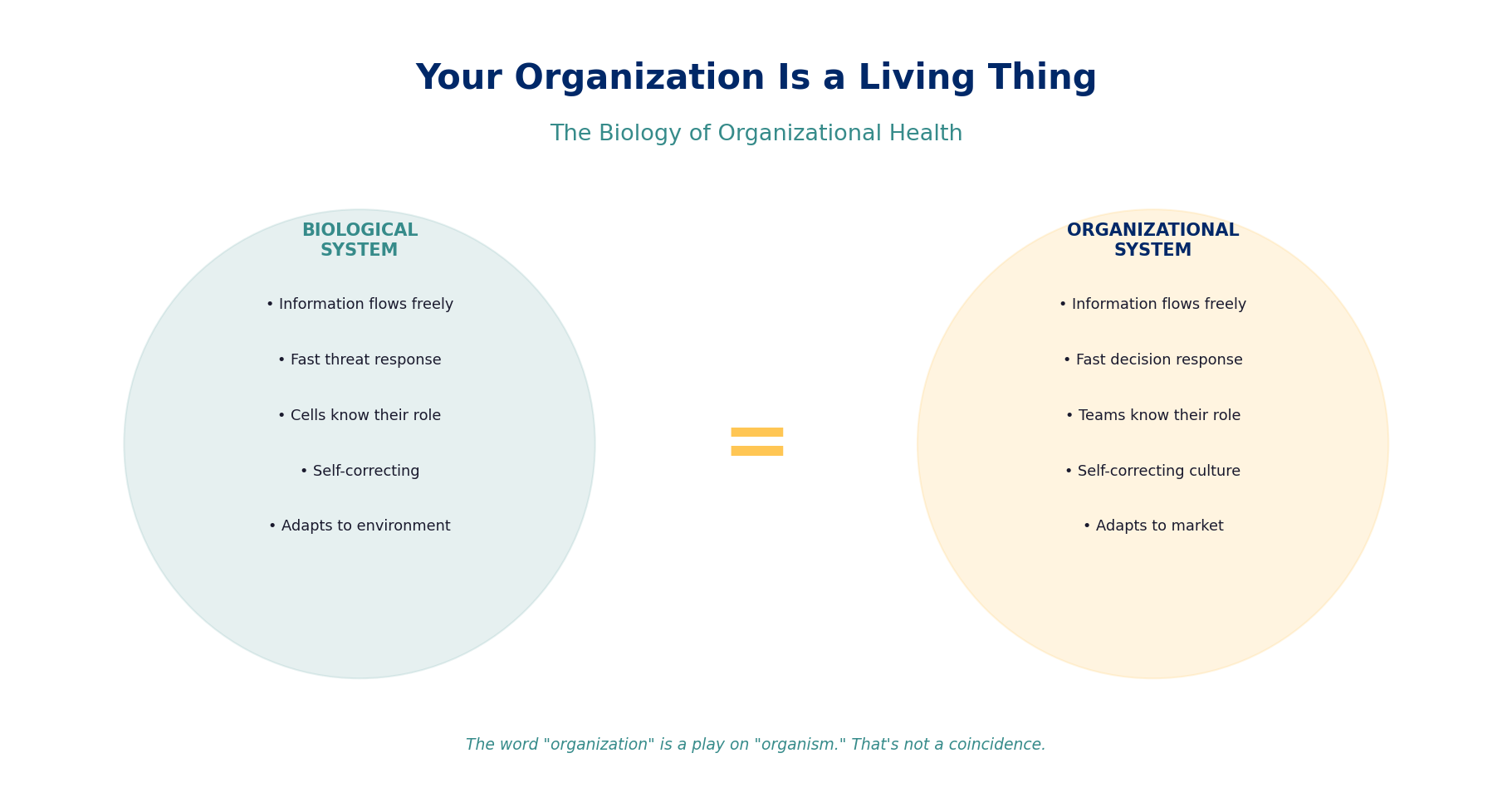
The word "organization" is itself a play on "organism." That's not a coincidence. And once you start seeing your company through that lens, the familiar symptoms of dysfunction map cleanly onto biological disease — and the interventions that actually work start to make a lot more sense.
The Biology of How Organizations Actually Work
The human body contains trillions of specialized cells. Red blood cells carry oxygen. White blood cells defend against threats. Neurons process and transmit information. No single cell knows what every other cell is doing — and yet the system as a whole functions with breathtaking precision.
Why? Because information flows where it needs to go, without constraint. When a threat appears, the right cells mobilize. When something goes wrong, signals travel. The body senses, responds, learns, and adapts — usually faster than conscious thought.
Organizations work on the same principle. Or they're supposed to.
The difference is that most organizations are, by this measure, chronically ill. Not because their people lack talent or motivation. But because the information flow — the lifeblood of the system — is obstructed.
Silos are organizational arterial blockages. When departments can't communicate freely, the system can't respond to what it's sensing. The information exists — it just can't get where it needs to go.
What Dysfunction Looks Like Through This Lens
Once you apply the biological frame, the familiar symptoms of organizational dysfunction stop looking like people problems and start looking like system problems.
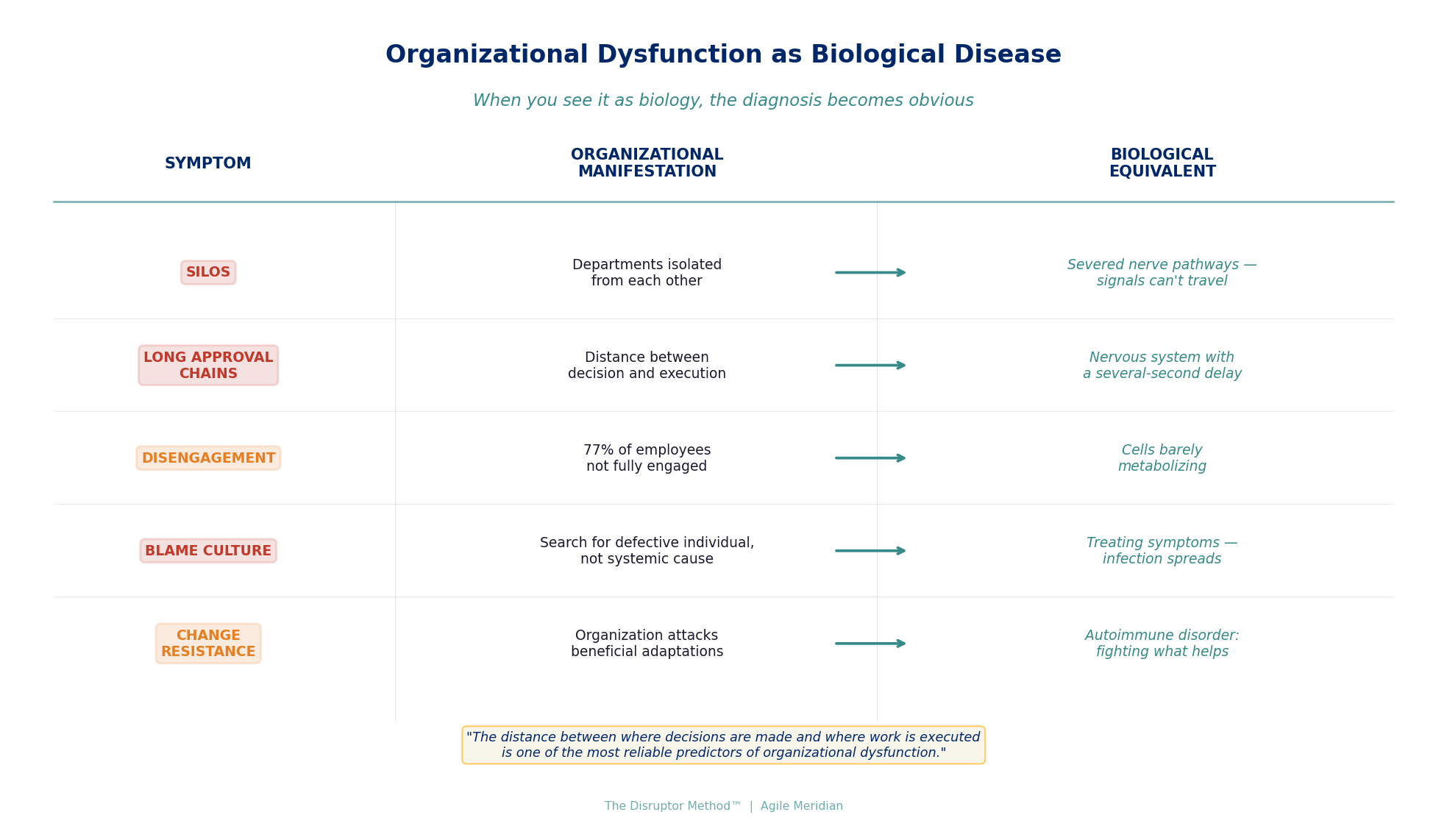
Silos — departments walled off from each other — are the organizational equivalent of severed nerve pathways. Long approval chains mean the distance between where decisions are made and where work happens is so great that by the time approval comes through, the context has changed. Like a nervous system with a several-second delay.
Disengagement is cells going through the motions without understanding the organism's goal. Globally, only about 23% of employees report being fully engaged in their work. The other 77% are, in biological terms, barely metabolizing.
Blame culture is the organizational equivalent of treating symptoms rather than root causes. When something goes wrong, the organization searches for a single defective cell rather than examining the information flow that failed. The infection spreads. The root cause goes untreated.
And resistance to change? That's an autoimmune disorder — the organization attacking the very adaptations that would help it survive.
Here's the diagnostic test I use: if it took your body hours to decide it was cold, you'd die of exposure. The same logic applies to organizations facing fast-moving markets, shifting customer needs, or emerging competitive threats. Speed of response is a function of information flow. Information flow is a function of how safe and connected your system is.
The distance between where decisions are made and where work is executed is one of the most reliable predictors of organizational dysfunction.
Why Psychological Safety Is Not a Soft Concept
Google's Project Aristotle set out to find what distinguished their highest-performing teams. They studied thousands of teams across every variable imaginable — skills, experience, seniority, personality composition.
The single most important predictor of team performance was psychological safety.
Not skills. Not IQ. Not experience. Safety.
Through the organism lens, this result isn't surprising — it's obvious. Psychological safety is the condition that allows information to flow freely within a team system. When people feel safe to speak, to question, to flag problems, to admit mistakes, the team can sense and respond to its environment. When they don't, the signals get suppressed. The team loses its ability to self-correct.
I've seen this play out exactly as the biology predicts. A team of highly skilled, highly intelligent people, operating in a low-safety environment, will consistently underperform a team of average-skilled people operating in a high-safety one. Because collective intelligence is only as good as the information that can circulate within the system.

You can assemble eight people with exceptional individual talent and, with no psychological safety between them, get collective output that doesn't reflect any of it. Safety isn't a nice-to-have — it's load-bearing infrastructure.
This is precisely why the best transformation work we do through The Disruptor Method™ doesn't start with process redesign or framework implementation. It starts with safety. Because without it, you're optimizing a system that can't hear itself.
What a Healthy Organizational Organism Actually Looks Like
The best team I ever worked with operated out of a small office in Missouri. Six people, no titles — just engineers, in the truest sense. They tested, developed, analyzed, and designed. Their product manager was remote, but connected through a live camera feed, permanently available to answer questions, validate ideas, and sense what the team needed.
Every quarter, she gave them a set of outcomes: increase site visits by X%, improve NPS from 7 to 8, grow average sale per visit. That's it. No feature list. No prescribed solution. The team decided what to build.
They deployed multiple times a week. They ran live experiments on real users. They learned from what worked and killed what didn't, quickly, without drama. They were doing in 2009 what most organizations are still talking about doing today.
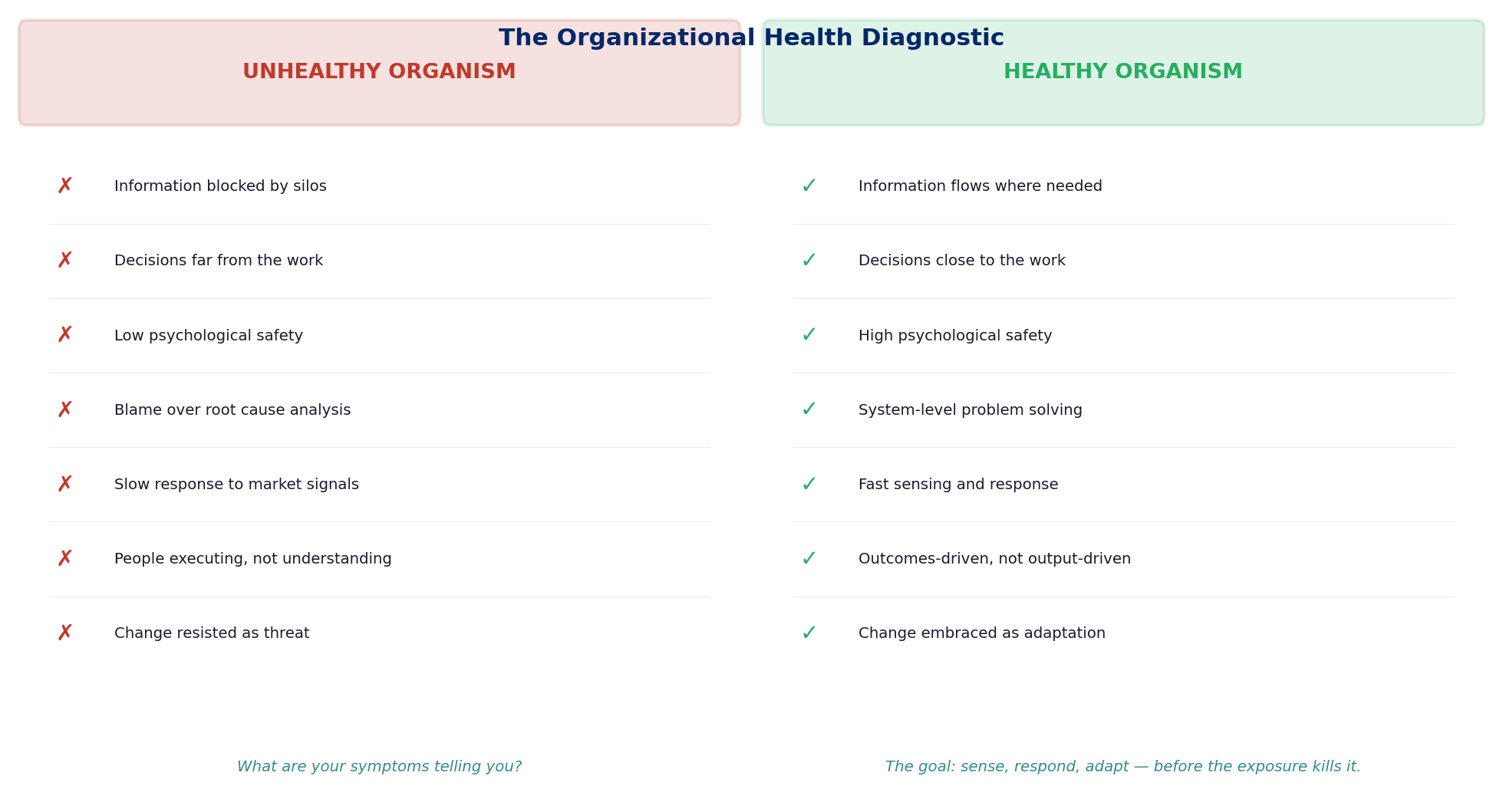
What made them exceptional wasn't their individual talent. It was the system they operated in. Information flowed. Decisions were made close to the work. Safety was high enough that no one sat on a problem hoping someone else would notice it. They were, by every biological measure, a healthy organism.
Not every organization needs to look like this team. But every organization can learn from what they got right: short lines of communication, outcomes instead of outputs, and a culture where the truth travels faster than politics.
The Hidden Cost of Organizational Illness
Most leaders underestimate the cost of their organization's dysfunction because it shows up in ways that are hard to attribute. Decisions that take weeks instead of hours. Projects that get handed off five times before anyone takes ownership. Innovation that dies in committee because no one wants to be accountable for a risk that doesn't land.
In our work with Fortune 50 clients, we see this pattern constantly. An organization will have a genuinely good strategy — clear direction, sound logic, real market opportunity. But the structure is fighting the strategy. The information flow is blocked. The teams closest to the customer don't have the authority to act on what they're hearing.
The result isn't failure. It's perpetual mediocrity dressed up as stability.
A biological system in this state is vulnerable. Not to a single catastrophic failure, but to the slow accumulation of threats it can't respond to quickly enough. Competitors who move faster. Customers who drift. Talent who leaves for environments where they can actually breathe.
The question isn't whether this is happening in your organization. The question is whether you're willing to diagnose it honestly.
Three Diagnostic Questions for Your Organization
If you lead a team or an organization, try applying this lens to what you're seeing right now:
Where is information not flowing? Who isn't talking to whom, and what's the cost of that silence? Think about the last time you were surprised by something your team already knew. That gap is the diagnosis.
How long is the distance between where decisions are made and where work is done? What does that gap cost you in speed, accuracy, and engagement? A useful proxy: how many approval steps does it take for a frontline team member to try something new?
If your organization were a living organism right now — would you say it was healthy? What are the symptoms telling you? Not what people say in surveys or offsites, but what the actual behavior of the system reveals?
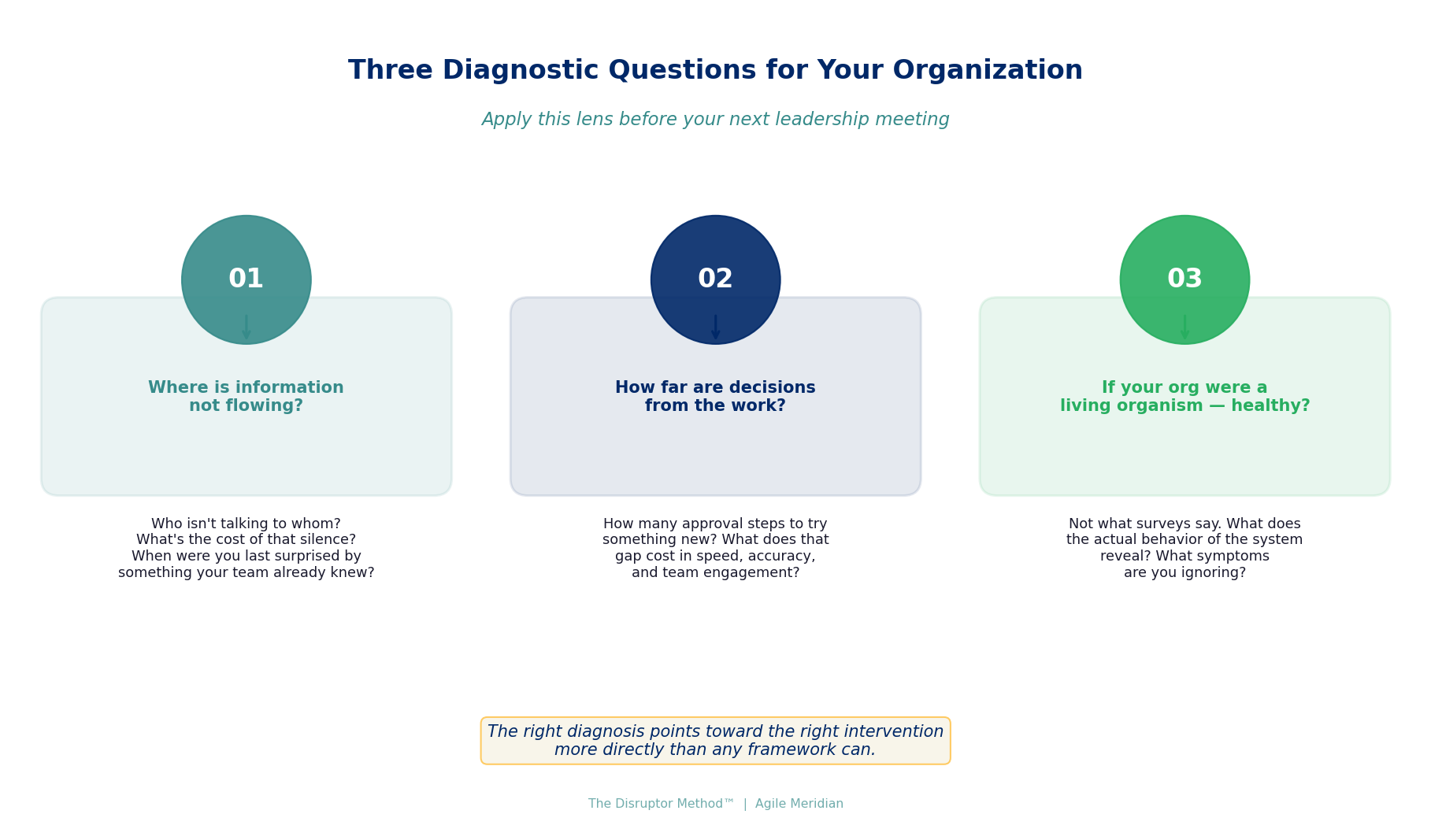
The answers tend to be clarifying. Not because the solutions are simple, but because the right diagnosis usually points toward the right intervention more directly than any framework or methodology can.
The Goal Isn't a Better Process
Every tool, methodology, and framework in the transformation universe — Scrum, OKRs, psychological safety assessments, team charters, retrospectives, the Disruptor Method™ itself — is, at its best, an attempt to approximate what a healthy organism does naturally.
The goal isn't to implement the right process. The goal is to build a system where information can move freely, where decisions can be made close to the work, where people feel safe enough to tell the truth, and where the organization can sense its environment and respond before the exposure kills it.
Not every cell needs to know what every other cell is doing. But the information still needs to flow where it needs to go — without gates, without fear, without delay.
That's not an agile transformation. That's basic biology.
Take the next step. If you're curious where your organization's health is breaking down, start with a structured conversation about information flow. Which teams aren't talking? Which decisions are made too far from the work? Where are people afraid to tell the truth? The answers are in the room. They usually have been for years.
Want to explore these concepts in depth? Listen to related episodes of The Meridian Point:
- Episode 151: Organizational Silos Are Bleeding Your Revenue
- Episode 148: Meeting Culture as a Mirror: How 30 Minutes Reveals Your Company's DNA
- Episode 122: Collaboration vs Control: Stress-Testing Leadership Dilemmas
- Episode 118: Servant Leadership vs Leadership as a Service
- View Full Playlist: The Meridian Point
Book a call to discuss further.