Robust Theme
Dec 09, 2019 2020-04-08 7:40Robust Theme


Psychological Safety Theater: When the Term Is a Shield

By: Kumar Dattatreyan
Last week I ended a coach's engagement with my team. She was smart. She was resourceful. She had more raw technical chops than most people I have worked with in the last five years. And she could not do the job.
I want to be honest about what the week leading up to that decision actually looked like, because I think the honest version is more useful than the dramatic one. I did not lose sleep. I thought about it a lot. There is a difference. I had multiple coaching conversations with her that went nowhere. I talked to members of the team, the product owner, and the senior leadership who worked with her. The feeling was pretty unanimous. I consulted HR on how best to handle the logistics of ending a contractor engagement cleanly. And once the picture was fully in view, I moved quickly.
The part that sat with me longest was not whether the decision was correct. It was that I never got to have the conversation with her directly. She was a contractor, placed through a vendor, and company policy routes that message through the vendor relationship, not through the person whose work she was actually doing day to day. I understand the reasoning. Contracting arrangements have their own legal and relational architecture. But the part of coaching that I take most seriously is the part where you look someone in the eye and tell them what you see, even when what you see is hard. Being asked to route that through an intermediary felt like being asked to leave a piece of the work unfinished.
A colleague of mine, who knew what I was carrying, sent me a message I keep coming back to. He told me that if I owed her anything at this point, it was to sit silently for a few minutes and generate some positive energy to send her way. I read it four times. It caught me off guard because it was the only thing anyone said that week that treated the moment as what it actually was, which was the closing of a chapter for a person I had tried to help, not a transaction to be executed cleanly.
I am leading with all of this because everything else I am about to say gets easier to dismiss if you think I made this decision lightly, or in anger, or in isolation. I did not. This was a decision I thought through, consulted widely about, and arrived at with a settled mind.
Here is what happened, and here is why I think it matters far beyond this one situation.
The Word That Stopped Meaning Anything
Psychological safety is one of the most important concepts organizational research has produced in the last twenty years. Amy Edmondson's work at Harvard defined it, Google's Project Aristotle made it mainstream, and every leader I work with now knows to say the words. That is the problem.
The phrase has gotten so saturated in consulting decks and leadership offsites that it has started to lose its operational meaning. It has become something you assert rather than something you practice. And in the last two or three years I have seen a shift that nobody in my field likes to name out loud. The language of psychological safety is increasingly being used not to describe a missing condition on a team, but to deflect from an accountability conversation.
I need to be careful here, because the risk of saying this is that it gets weaponized in the other direction. Someone reads this and decides that every time an employee raises a safety concern, they can be dismissed as performing victimhood. That is not what I am arguing. Genuine safety problems exist. Genuine fear of retaliation exists. Real harm is done by leaders who punish the messenger. None of that goes away because the language also gets misused.
What I am arguing is narrower. There is a pattern I now see often enough that I can describe it. Someone in a role they cannot perform starts describing every friction with a senior stakeholder as a safety issue. Every piece of feedback becomes an attack. Every request for clarity becomes a threat. The word gets invoked to freeze the accountability conversation before it can happen. And the organization, terrified of appearing insensitive, allows it.
This is psychological safety theater. And it is just as corrosive as the agile theater Johanna Rothman described on episode 153, where JIRA boards and daily standups are present but nothing about how work actually happens has changed. The form is there. The function is not.
What Happened, Without the Names
I am not going to describe the specific situation in detail. The coach in question deserves her privacy and this is not the place to relitigate the decision. But I can tell you the shape of it.
A senior stakeholder and the coach had one brief interaction that went sideways. Not a meeting. Not an ongoing conflict. One question, one response, a few minutes, and both people walked away upset. The stakeholder said something flippant in a chat thread afterward. The coach interpreted that as being targeted. My suggestion was the most basic one available in our profession. Go have a conversation. Clear the air. Understand where the reaction came from.
The response was that meeting with this stakeholder would be dangerous. That giving her more time would give her more ammunition. That this was not a conflict to resolve but a threat to avoid.
I sat with that for a long time. Because a coach whose default response to a difficult senior stakeholder is withdrawal framed as self-protection cannot actually do the job I hired her to do. The job requires the opposite. A team coach has to be able to have hard conversations with senior people. Not in spite of the power differential. Because of it. That is the job.
Evan Leybourn put it well on episode 167. Organizations that develop genuine resilience are not the ones that protect people from friction. They are the ones that build the capacity to metabolize friction into learning. The same is true for coaches. The distinction between a coach and a manager is that a coach holds space for the friction and helps the team move through it. A coach who avoids the friction is something else. What she is, exactly, I have not decided. But she is not a coach.
Why This Is a Fit Problem, Not a Safety Problem
The distinction I had to hold in my head that week was the most important part of the decision.
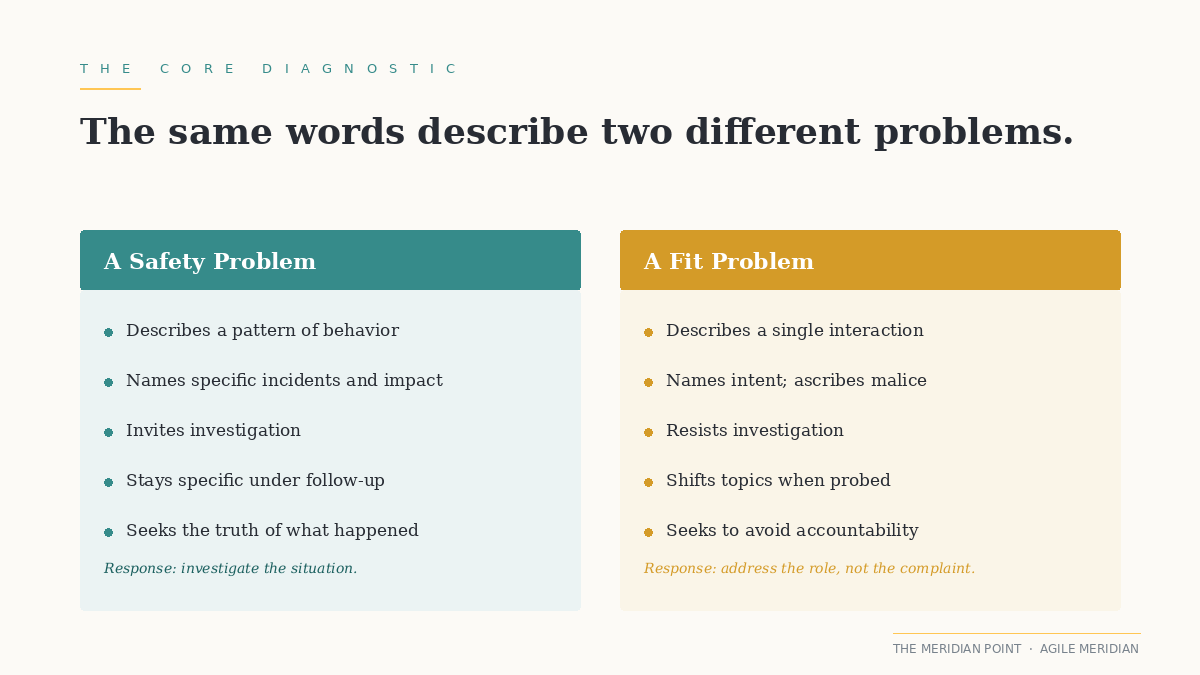
A safety problem looks like this. Someone raises a legitimate concern about how they are being treated. You investigate. You find that the treatment is genuinely out of line. You address the person doing the treating, or you remove the target from the situation, or both. You do this regardless of where the person sits in the hierarchy. You treat the complaint as a signal about the environment.
A fit problem looks like this. Someone in a role cannot perform the core requirements of that role. They may be a wonderful person. They may have real skills. The organization may have made a mistake in placing them there. But the gap between what the role requires and what they can currently offer is wide, and closing it would take more time and investment than the business can reasonably give.
The confusion between these two things is where the damage happens. If you treat a fit problem as a safety problem, you end up investigating innocent colleagues, damaging their standing, and protecting someone in a role they cannot do. If you treat a safety problem as a fit problem, you end up removing targets and preserving predators, and your organization becomes worse for everyone. Both mistakes are common. Both are devastating.
In this case, I had to decide which one I was looking at. The senior stakeholder had been working productively with dozens of people in the organization for over a year, including people junior to her, including people who had challenged her, including people I trusted deeply. She was not a pattern. She was, on this one occasion, flippant and probably emotional. The coach, within a few weeks of joining, had also had friction with the product manager, the tech lead, and at least two of her peers. That is a pattern. Not a pattern I could dismiss as the team resisting a hard truth. A pattern of an inability to build relationships with the very people she was hired to coach.
Once I saw that clearly, the decision was still awful, but it was no longer ambiguous.
What I Am Actually Arguing
I am not arguing that psychological safety does not matter. I am arguing that it matters too much to let it get used as a shield for things it was never meant to describe.
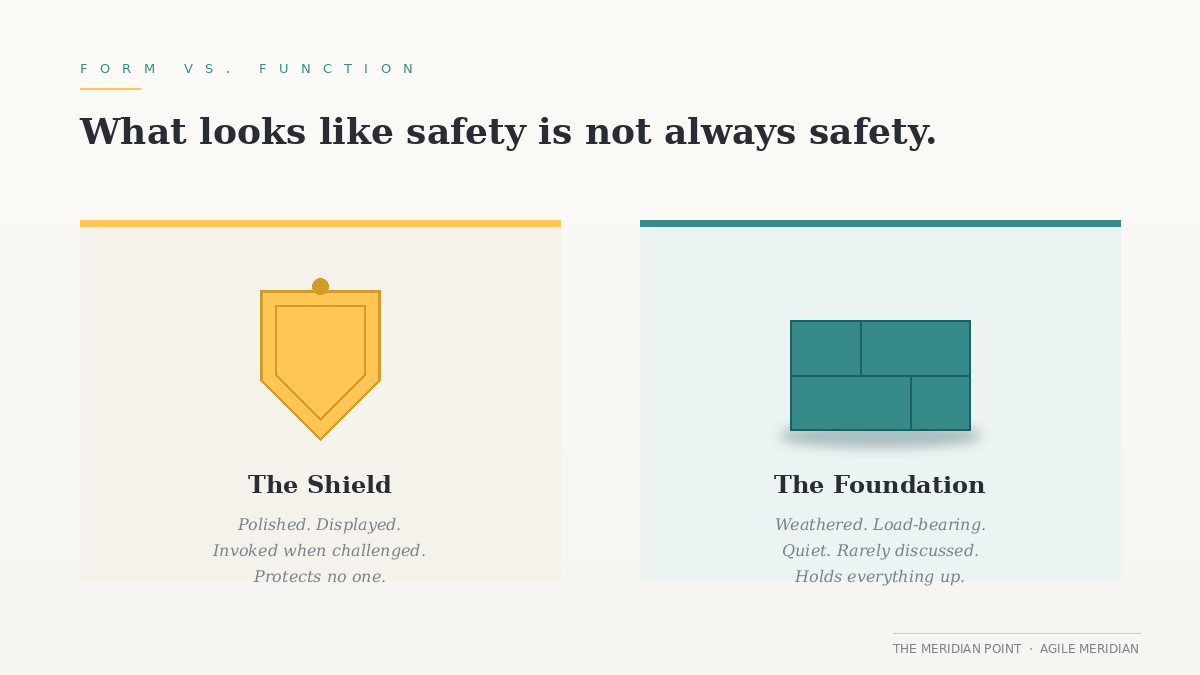
Amy Edmondson's original definition was specific. Psychological safety is the shared belief that the team is safe for interpersonal risk-taking. It is about the team's capacity to handle candor, disagreement, bad news, and admission of mistakes. It is a property of a team, not a weapon a member can aim at a stakeholder. And Diana Larsen's work with Tricia Broderick in Lead Without Blame, which we dug into on this week's episode of the podcast, sharpens this further. Psychological safety is the condition that makes learning possible. It is not a trump card that ends conversations. It is the soil that lets them grow.
When the word gets used to avoid conversations rather than enable them, something has gone badly wrong. And leaders who cannot hold that distinction end up with teams that have all the vocabulary of safety and none of the capacity for candor.
What I Now Look For When Hiring a Coach
The most concrete thing I took from this week is that my hiring criteria for coaches had a gap. I had been filtering heavily for technical knowledge, framework fluency, and communication skill. All necessary. None sufficient.
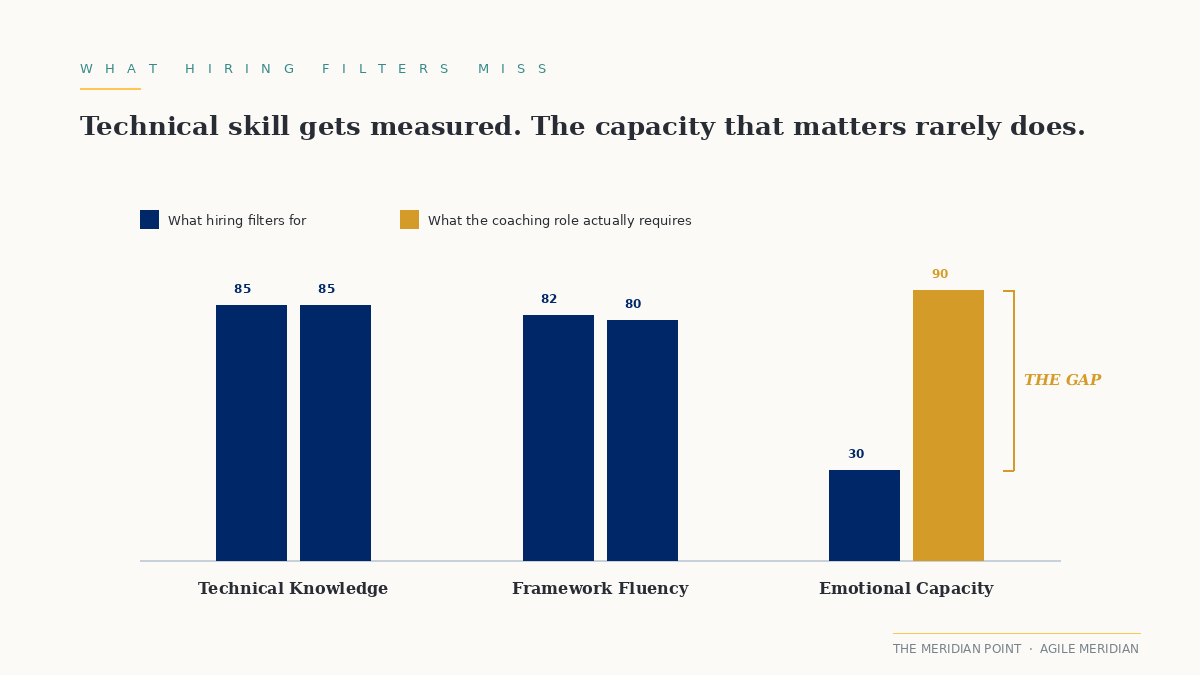
What I should have been filtering harder for is the specific emotional capacity that makes coaching work. Not EQ as a generic credential. Something narrower. The ability to stay in a difficult conversation with a senior person without either collapsing into deference or retreating into righteousness. The ability to receive sharp feedback from a stakeholder without reframing it as an attack. The ability to build trust with the people who most need the coaching, which is almost never the team members who already like you, but the senior leaders who do not yet see why they should.
A coach who can only coach people who agree with them is not coaching. A coach who experiences stakeholder pushback as persecution is not coaching. A coach who invokes safety language to avoid the very conversations the role requires is not coaching. These are not capability gaps that coaching training fixes. They are prerequisites for the training to even stick.
In future hires I am going to ask different questions. Tell me about a time a senior stakeholder pushed back hard on you. What did you do? Tell me about a piece of feedback that stung. How did you sort what was true from what was the delivery? Tell me about a relationship with a difficult stakeholder that you rebuilt. Not that you navigated around. Rebuilt.
If the answer is a story of avoidance framed as self-protection, that is the wrong candidate for a coaching role, however technically strong they are.
The Other Two Questions Worth Asking
I promised to touch briefly on two related questions, because they came up in the week I spent working through this.
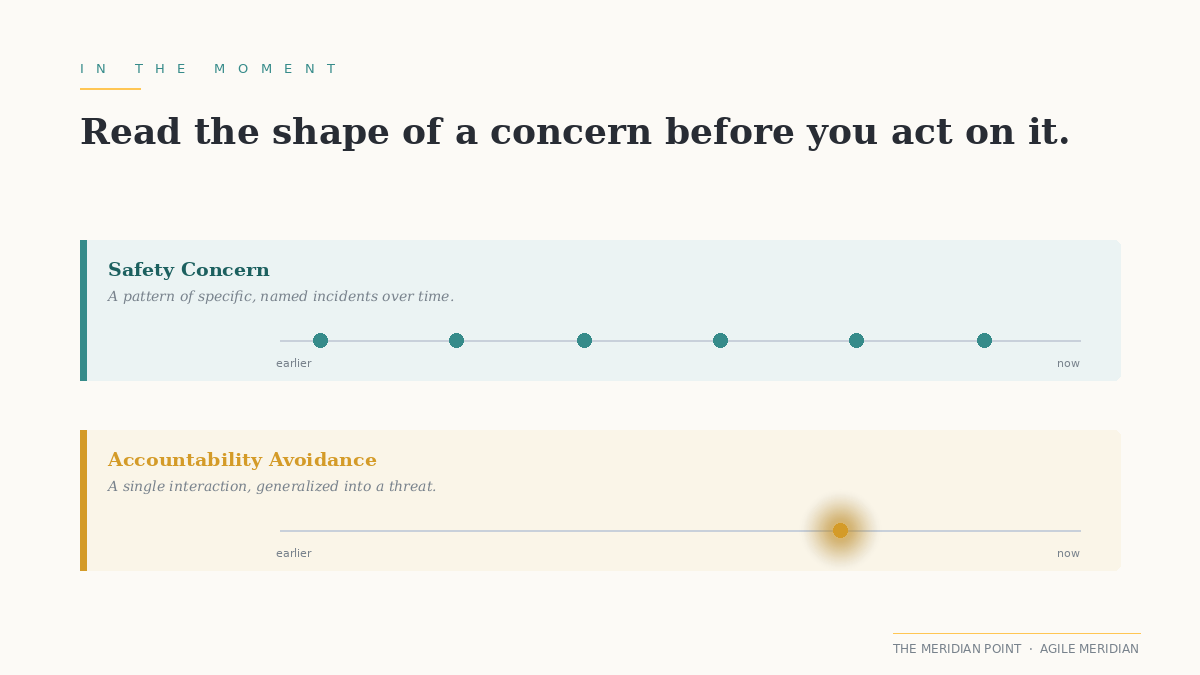
The first is how to distinguish safety concerns from accountability avoidance in the moment, before you have the benefit of hindsight. The honest answer is that it is hard, and anyone who tells you it is easy is selling something. But there is a test that has helped me. Safety concerns describe a pattern. Accountability avoidance describes a single interaction and generalizes. Safety concerns name specific behaviors and the impact of those behaviors. Accountability avoidance names intent and ascribes malice. Safety concerns invite investigation. Accountability avoidance resists investigation because investigation risks revealing that the complaint does not hold. The language is sometimes identical. The response to being taken seriously is where they diverge.
The second is the harder decision model question. When someone raises a difficult interpersonal concern about a colleague, do you investigate immediately or do you sit with it? I used to think the answer was always to investigate immediately. I no longer do. The right answer depends on whether you are looking at a pattern or an incident, whether the complainant has a track record of specific and accurate observations, and whether the accused has a track record that aligns or conflicts with the complaint. Speed of response is not the same as quality of response. Sometimes the responsible thing is to slow down.
Where This Leaves Me
I am writing this a week later, and the team she was coaching is already recovering. The product owner and tech lead are working more closely than they have in months. The senior stakeholder is occasionally sharp, often flippant, and consistently engaged. The team has told me they feel lighter. I believe them.
And I still think about that coach, because she was not a villain. She was a smart person in the wrong role, who had developed some habits I could not help her out of in the time I had. Somewhere, in a role that is not this one, she is probably going to do excellent work. I hope that is true. I hope the version of the message that reached her gave her enough to work with, even if it was not the version I would have delivered myself.
I also think about my colleague's message, because it keeps pointing back to what this post is about. He did not tell me I was right. He did not tell me I was wrong. He named what the moment actually was, and he gave me something useful I could do inside it. That is what real psychological safety sounds like when it shows up in a leader. It does not perform comfort. It does not freeze hard conversations. It meets the difficulty, acknowledges it, and helps you find the next honest step. It is a property of how people show up for each other, not a word you invoke to protect yourself from feedback.
What I am left with is this. The language of psychological safety is not going to stop being misused. The best I can do as a leader is keep the original meaning alive in my own practice. Build the conditions. Resist the performance. Name the difference when I see it. Be the colleague who sends the message that helps someone else sit quietly for a few minutes and find the human part of a hard decision. And when I have to end an engagement because someone cannot do the job they were brought in to do, tell the truth about what that looks like from the inside, so that the next leader working through the same pattern knows what to trust and what to move past.
Ready to Build a Team Coaching Practice That Holds Under Pressure?
The distinction between safety theater and genuine safety is the same distinction between transformation theater and genuine transformation. If your organization is ready to stop performing and start practicing, let's talk.
Or take The Disruptor Method assessment to see where your organization sits on the safety-capability spectrum: thedisruptormethod.com/quiz
Related Episodes
Episode 153: Management Myths Busted with Johanna Rothman: the difference between individual focus and team flow, and why organizations measuring the wrong things end up with the wrong behaviors.
Episode 167: Business Agility in Crisis with Evan Leybourn: the capacity to metabolize friction into learning, and why adaptive organizations look different from safe ones.
Episode 154: Agile vs. Traditional with Alan Zucker: psychological safety as one of three simple rules for high-performing teams, and what happens when any of them gets mistaken for its opposite.