Robust Theme
Dec 09, 2019 2020-04-08 7:40Robust Theme


Closing the Strategy-Execution Gap
By: Kumar Dattatryan
Every year, organizations pour time and money into strategic planning. Offsite retreats, cascade sessions, town halls, decks. And then, somewhere between the boardroom and the work actually getting done, something dies.
Leaders call it an execution problem. They bring in project managers, tighten the process, buy new software, layer on more oversight. And the next year, the same thing happens.
I've seen this cycle play out in Fortune 100 companies, mid-size firms, and government agencies. The language changes. The consultants change. The result rarely does.
Here's what I've come to believe after working with dozens of organizations navigating transformation: there is no execution gap. There is a leadership clarity gap. And as long as leaders misdiagnose the problem, they will keep solving the wrong thing.
The Surgeon Who Celebrated Too Soon
Sevak Markarian, a transformation leader who has worked with HP, AT&T, Chevron, and Kaiser Permanente, uses a striking analogy. Imagine a surgeon walking out to the waiting family and saying, "The operation was successful, but the patient didn't survive." Would you call that a success?
Obviously not. And yet that is exactly what happens in most organizations. Leaders celebrate the successful execution of activities. The plan was followed. The milestones were hit. The slides looked great at the quarterly review. And the business outcome the strategy was supposed to produce? That's a different conversation, often one that never happens.
Strategy dies in implementation not because people can't execute. It dies because leaders never got clear on what success actually looks like. They defined outputs: finish the prototype, launch the product, complete the initiative. They never defined the outcome: what changes for the customer, what moves in the business, what is different in the world.
The gap between activities and outcomes is not an execution problem. It's a clarity problem. And clarity lives in leadership.
Why Middle Managers Get Stuck
When I talk to mid-level managers about strategy execution, I hear a version of the same thing over and over. The direction from leadership is vague. The metrics they're given measure effort, not impact. They're evaluated on whether they delivered the plan, not whether the plan delivered results.

Johanna Rothman, author of the Modern Management Made Easy trilogy and one of the sharpest organizational thinkers I've spoken with, names this pattern directly. She calls it resource efficiency thinking. Managers optimized to measure individual output, track utilization, and manage against estimates. The system rewards keeping people busy. It does not reward the right work getting done.
And here's what makes it worse. Most cost accounting systems reinforce exactly this behavior. Finance and HR want to see hours logged, headcount justified, deliverables produced. They are not structured to measure whether customers got what they needed, or whether the organization moved closer to its strategic intent.
Sevak sees the same thing from the OKR side. Middle managers are usually the ones stuck in transformation because they're not doers and they're not askers. They sit in between the executives who set direction and the teams who do the work. If the direction is unclear, they can't translate it. If the incentives reward the wrong things, they optimize for the wrong things. And then leadership wonders why strategy doesn't make it to the ground.
This is not a middle management failure. It is a system failure. And the system was built by leadership.
What OKRs Reveal
OKRs, objectives and key results, get a lot of attention. They also get a lot of misuse. Most organizations implement them as a slightly better goal-setting tool. They end up with a list of activities dressed up in OKR language.
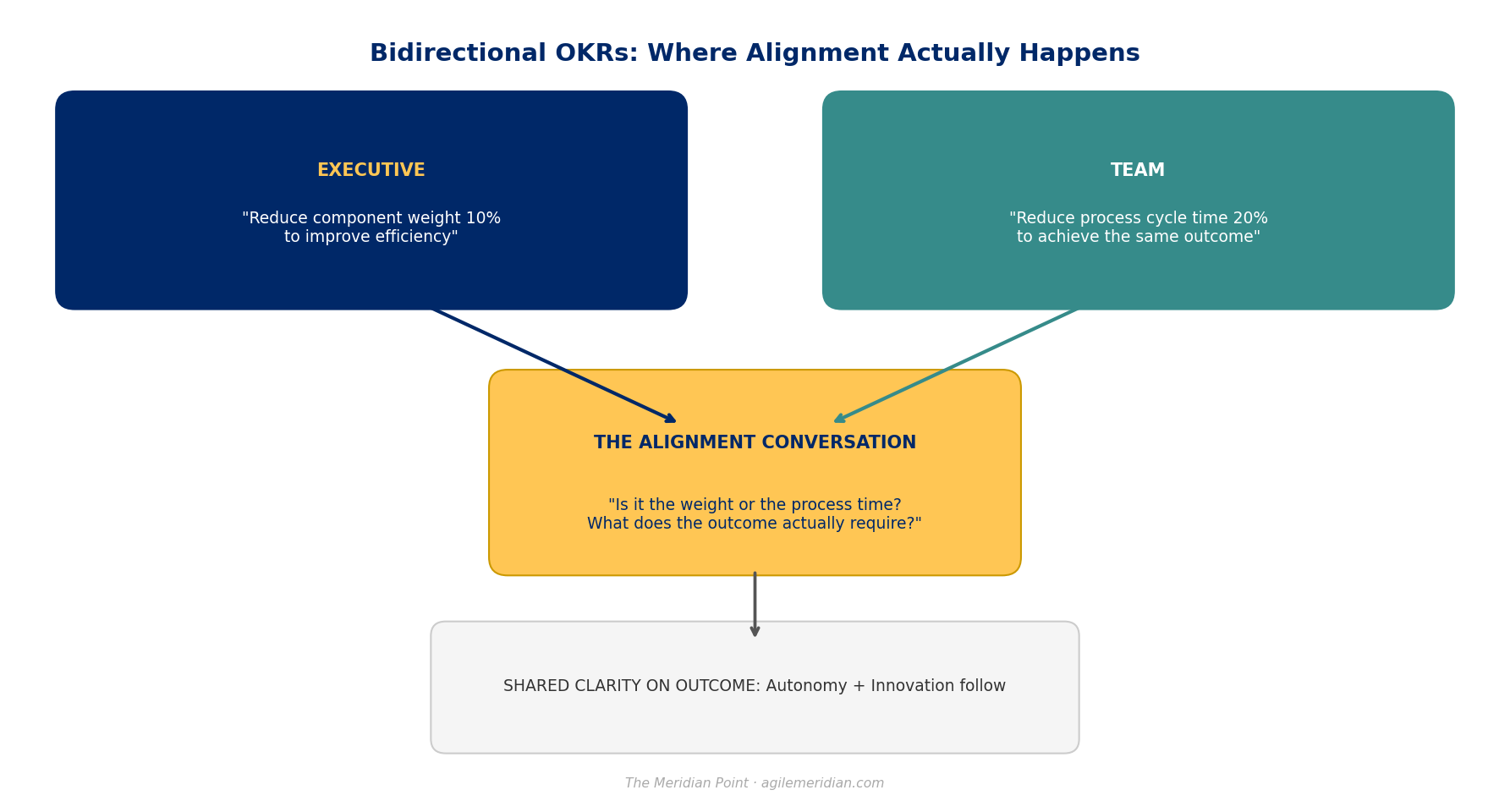
Sevak makes a distinction that cuts right to the core of this. Goals are need-driven. OKRs, done correctly, are purpose-driven. A goal says: finish the job, ship the feature, reduce the weight of the fuel pump by ten percent. An OKR says: reduce fuel cost concentration for the customer. The goal is internal. The OKR connects to why it matters.
That distinction sounds simple. In practice it requires something most leadership teams actively avoid: a direct conversation about what success actually means. Not what we're going to do. What we're going to change.
Sevak calls the most powerful version of this bidirectional OKRs. Instead of executives setting goals and pushing them down, teams create their own OKRs in response. An executive thinks the answer is reducing component weight. The team thinks the answer is reducing process time. When those two perspectives sit in the same room, a real conversation happens. That conversation is strategy getting made.
That conversation doesn't happen when leadership just issues direction. And it cannot happen if leaders are unwilling to define outcomes rather than activities.
The Wait Time Nobody Measures
Johanna offered an observation from her consulting work that I keep coming back to. She asks managers to measure two things: how long it takes their team to turn work around, and how long it takes managers themselves to make a decision. Teams, she finds, are usually faster than anyone realizes. Managers are almost always shocked by how much time they spend waiting for information and then waiting for everyone to be available for another meeting.
The wait time between decision points in an organization almost always outweighs the actual work time. But because managers are trained to measure what people produce, not how long decisions sit in limbo, the bottleneck stays invisible.
This is another dimension of the leadership clarity gap. When leaders don't have clear outcomes to point toward, every decision becomes complicated. Every tradeoff requires more discussion. Every initiative competes with every other initiative for attention and resources. The system slows down not because people are slow but because nobody is sure what they're optimizing for.
Sanjiv Augustine, who has spent over 30 years helping organizations scale from agile into AI transformation, saw this dynamic play out at the industry level. Organizations that went agile years ago, the ones that actually stuck with it, stopped calling it agile. It became how they worked. The framework fell away. What remained was clear intent, fast feedback, and autonomy at the team level to figure out how to get there. That's not a process outcome. It's a leadership outcome.
The Three Places Clarity Has to Live
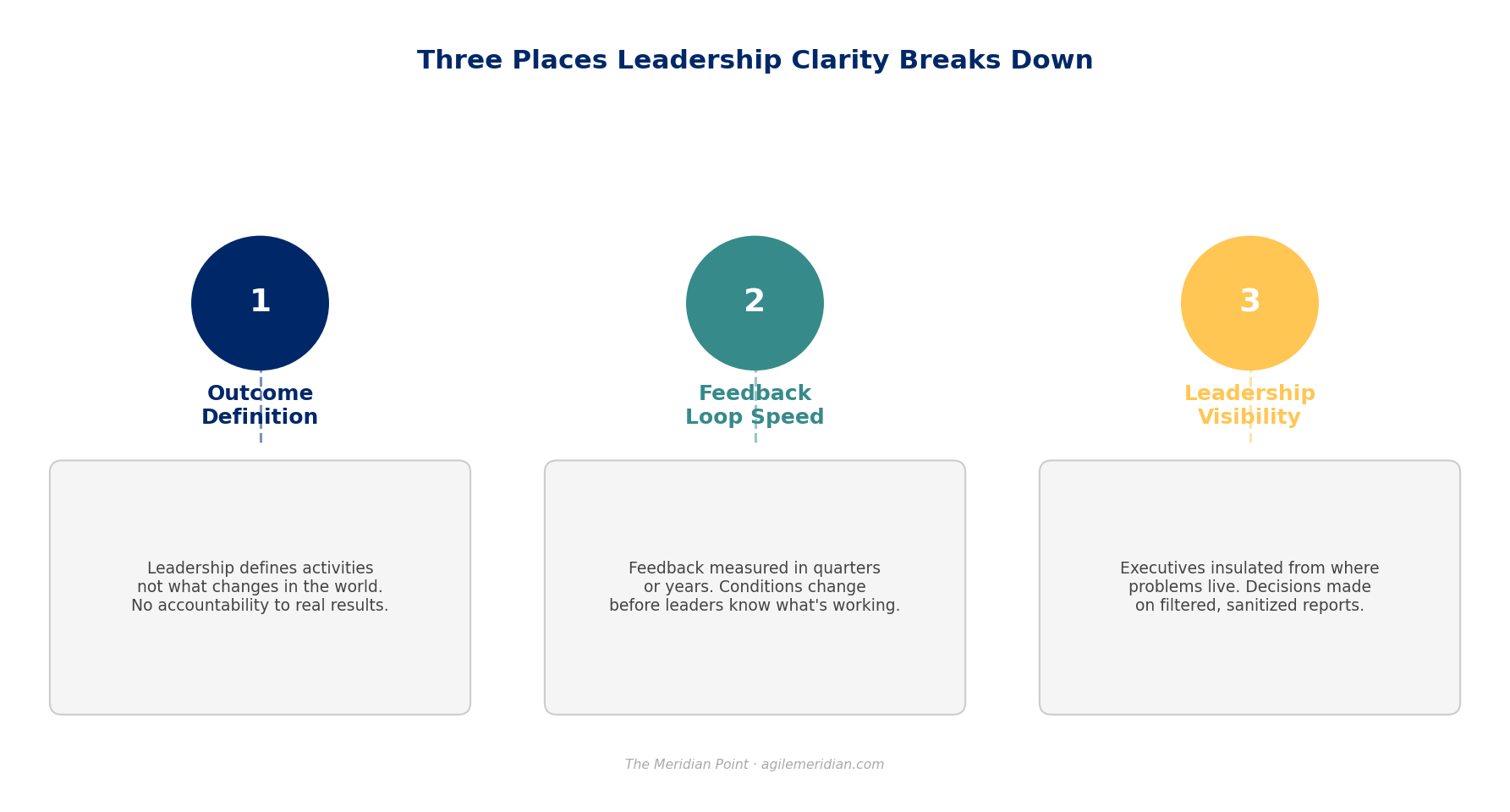
If the strategy-execution gap is really a leadership clarity gap, the question becomes: where, specifically, does clarity break down?
In my work with transformation teams, I consistently see it break down in the same three places.
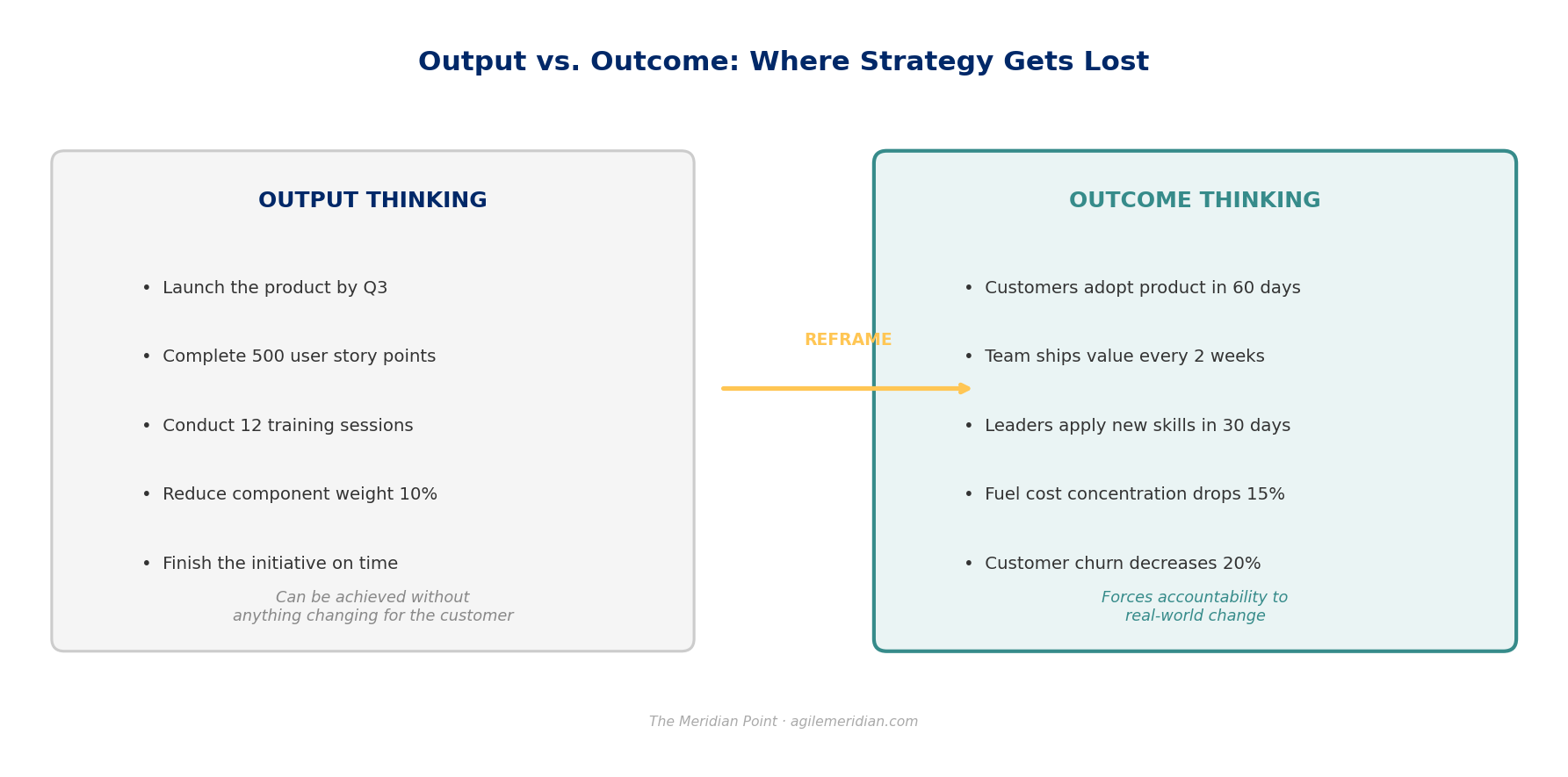
The first is outcome definition. Leadership teams are far more comfortable defining what they're going to do than defining what they're trying to change. Outcomes require accountability in a way that activities don't. If you say you'll launch the product by Q3, you can hit that goal even if the product doesn't move any numbers. If you say you'll reduce customer churn by fifteen percent, you either did or you didn't. Outcome clarity is uncomfortable. It is also the only thing that gives strategy any teeth.
The second is feedback loop speed. Johanna is precise about this: the faster the feedback loops, the easier agility becomes. Most organizations have feedback loops measured in quarters, sometimes years. By the time leadership knows whether a strategy is working, the conditions have already changed. The organizations that execute well are the ones that have built cadences of short feedback into the work, not just the planning cycle.
The third is what I call leadership visibility. Leaders who are insulated from where the problems actually live cannot solve those problems. They make decisions based on reports about reports about work. By the time that information reaches them, it's been filtered, summarized, and sanitized. When leaders have genuine line of sight to the work, to the customer, to the team, clarity flows in both directions.
What to Do About It
None of this requires a new framework or a major initiative. It requires a shift in what leadership pays attention to.
Start with your current strategic goals. For each one, ask a blunt question: is this an output or an outcome? If you can deliver it without the customer or the business actually changing, it's an output. Rewrite it until it describes a change in the world, not a change in your activity log.
Then look at how decisions flow through your organization. Not the formal process, the actual one. How long does it typically take from when a problem surfaces to when a decision gets made? If the answer is measured in weeks, the bottleneck is not your teams. It's your decision architecture.
Finally, look at where middle managers are getting stuck. If they can't translate strategy into clear direction for their teams, the problem is not their skill. The problem is what they were given. Invest in the conversation between executive intent and team execution. That conversation, the one where both levels compare their understanding of what success looks like, is where strategy either gets real or gets lost.
The Bottom Line
Execution does not fail because organizations lack discipline or talent. It fails because leadership does not do the upstream work of defining what success actually means, and then building the conditions for that clarity to reach the people doing the work.
The surgeon analogy Sevak uses is stark because it's meant to be. Celebrating a successful process while the patient dies is not a process problem. It is a definition-of-success problem.
If your strategy keeps failing at execution, don't look at your teams. Look at what you handed them. Look at whether you defined outcomes or just activities. Look at whether the incentives in your system reward throughput or just busyness. Look at whether middle managers have genuine clarity or just a deck to present.
That is where strategy lives or dies. Not in execution. In leadership.
If this resonated, you might also find this relevant: In my last piece, I looked at why the fossil fuel industry keeps losing ground despite massive resources and decades of infrastructure. The short answer is the same one: optimizing for the wrong outcome. The sun doesn't need a Navy escort, and your strategy doesn't need more governance. It needs clarity. Read it here.
Ready to find out where your organization's clarity breaks down?
Take The Disruptor Method assessment at https://www.thedisruptormethod.com/quiz and get a clear picture of where your leadership system is working and where it isn't.
Want to explore these concepts further?
Listen to related episodes of The Meridian Point:
-
Episode 156: From Strategy to Action: How OKRs Transform Fortune 100 Organizations
-
Episode 153: Management Myths Busted: Johanna Rothman on Real Organizational Change
-
Episode 152: From Agile to AI: Avoiding the Same Transformation Mistakes
Or book a conversation directly: https://tidycal.com/coachkumar/30-minute-meeting