Robust Theme
Dec 09, 2019 2020-04-08 7:40Robust Theme


AI Coaching Is a Division of Labor, Not a Cheaper Coach
By: Kumar Dattatreyan
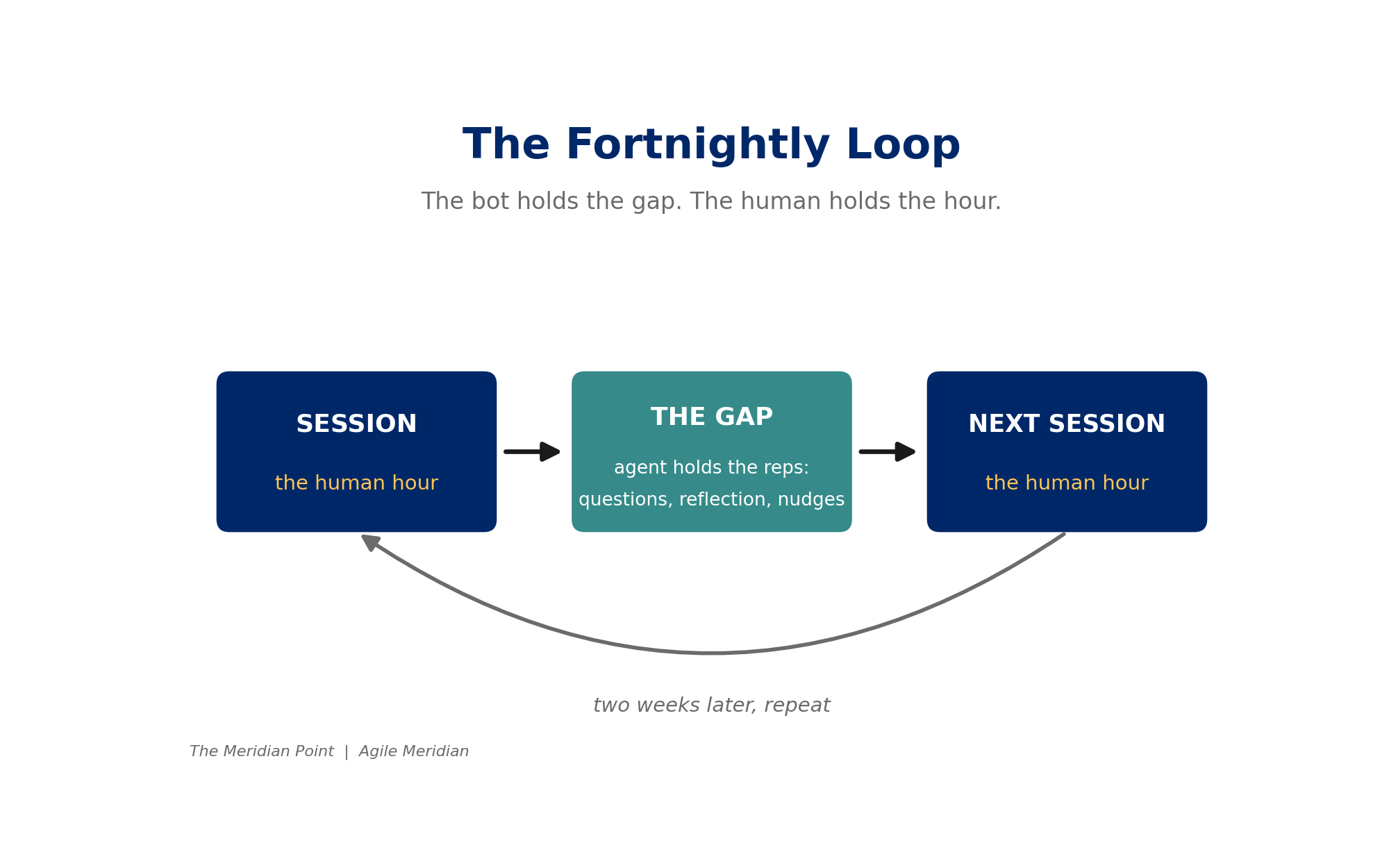
I packaged my coaching into an agent and gave it to a client. We meet every two weeks. In the gap, when a question hits him, he asks the agent, because it includes enough of my frameworks to answer close to the way I would. He called it E. Kumar. It helped. That's the part people expect me to be nervous about. I'm not.
Coaching was always two jobs pretending to be one. The first job is the reps. Ask the question again. Hold the pattern up to the light between sessions, and nudge the person on Thursday to do the thing they committed to on Monday. The second job is reading whether the person is ready to see the pattern, and deciding what it means for them inside this system. A machine does the first job now. It does it cheaply, at any hour, without getting tired of you. The second job doesn't scale, and it won't. That's the reason I'm still in the loop. The bot holds the mirror. I do the coaching.
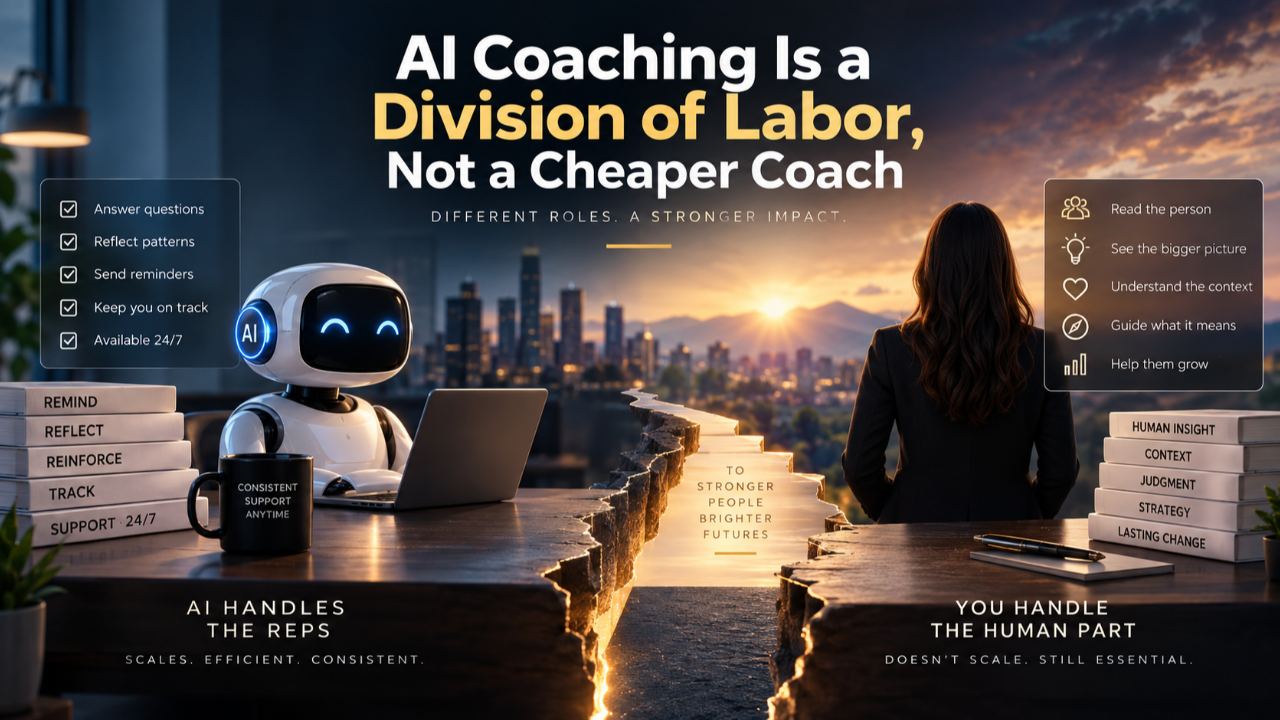
Most of the worry about AI coaching treats it as a cheaper version of the same thing. Hire a human, or rent a bot that does what the human does for a fraction of the price. That framing is wrong. AI coaching isn't a cheaper coach. It's a division of labor. Coaching is two jobs with opposite economics. Only one of them scales. So you give the machine the part that scales and you keep the human for the part that doesn't.
The reps scale. The judgment doesn't.
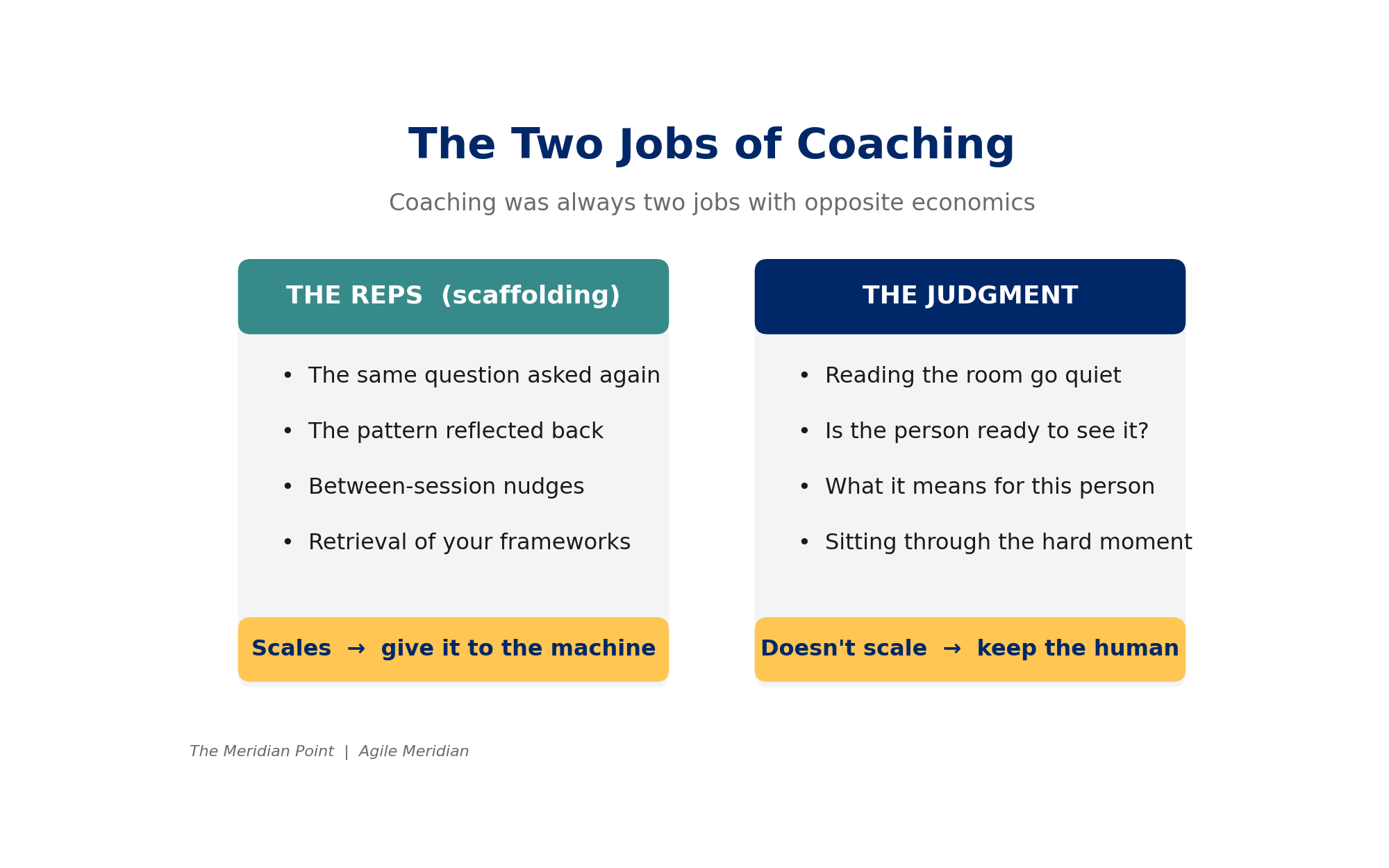
Call the first job scaffolding. It's the structure a coach builds so a person can hold themselves accountable between conversations. The question asked a third time. The pattern reflected back in the person's own words. The reminder on a Thursday to do the thing they committed to on Monday. Scaffolding is repetitive by design, and repetition is exactly what a machine is good at. A person doing it by hand is a person spending judgment hours on homework.
Call the second job judgment. It's feeling the room go quiet and knowing why. It's knowing what a pattern means for one person in one system, when the same pattern would mean something else for someone different. Judgment doesn't scale. A human coach reaches a handful of people because judgment is expensive and slow and particular.
When you stop treating the two jobs as one, the split gets obvious. The machine holds the scaffolding at scale. The human spends scarce judgment on the person in front of them. Keeping a human in the loop isn't a patch you apply because the tool isn't good enough yet. It's what the work looks like once you stop pretending the two jobs are one.
The coach who works himself out of a job
Nawaz Butt has spent years coaching inside some of Canada's largest organizations. He measures himself by how fast a team stops needing him. On Episode 175 he described an engagement where he spent two weeks with a team that had run without a manager for a year, then told leadership the team didn't need him. As a consultant, he was supposed to increase the amount of work. He recommended less.
His rule is what makes the whole division real. "My job as a coach is not to preserve my role. It's to create conditions where people can become more self-organized and self-sufficient." Sit with that for a second. If the job is to build scaffolding a person eventually doesn't need, then the scaffolding was never the point. It was the cost of getting there. And the scaffolding is exactly the thing a machine can now hold at scale.
He tells leaders to "get out of the way of the teams." A coach who protects the engagement is standing in the same spot as the manager who won't delegate. The machine doesn't protect the engagement. It has no engagement to protect. It holds the reps so the human can go do the work that actually needs a human.
The model is AI and human in the loop
Diana Larsen gave me the frame for why the human can't leave. On Episode 169 she separated knowledge work from learning work. Knowledge work is applying what you already know. Learning work is noticing the world has shifted and adapting fast. She puts AI on the knowledge-work side. "AI and human in the loop, using AI to bolster what people already know, but more importantly, to help them learn faster and adapt to whatever they need to adapt to."
Read that across to coaching. The machine handles retrieval and reflection. It replays what you already know back to you. The human handles the learning that only happens between people. Diana is precise about why the human stays. "If we're building something we expect humans to use, we still need humans in the mix. They're the ones who understand human reactions, who make judgment calls." That's the counterweight that keeps this from sliding into replacement.
She adds a caution worth keeping. "How can it be an assistant rather than an expected leader? Because the agents that exist today are very capable but very narrow." Capable and narrow is the right description of a tool that holds scaffolding. It's the wrong description of a coach. The moment you ask the narrow tool to do the wide job, you've misread what it's for.
The mirror, built as a product
Ash Seddeek coaches executives at large technology firms, and he built the mirror into software. On Episode 147 he described Mivante, a tool that surfaces a person's communication preferences at the moment you write to them, so the message lands instead of dying in an inbox. That's reflection delivered at the point of use. It's the scaffolding half turned into a product.
Ask him the biggest mistake leaders make and he'll tell you it's "assuming that communicating or sending a message is enough and it's going to be received very well, which is not always the case." The fix is clarity, and clarity compounds. "clarity will actually impact the velocity of how an organization functions."
Ash built the scalable half and kept the human half on purpose. He still spends his human hours building the relationship the tool can't build. He's the practitioner who proves the split isn't a downgrade. It's a choice about where the human belongs.
The same split, built into a program
The client agent was one-to-one. I built the same split into a program too, at a bigger scale. My leadership program runs nine weeks. Thirteen agents run inside it. One travels all nine weeks with each participant. Every week it asks two questions. What did you learn last week? What will you do next week? That's the reps of accountability: weekly reflection and a forward commitment, on schedule, without me in the room.
The other twelve are Socratic. Each one probes a different part of how a leader shows up. It presses on what the learner says and makes them look again. It gets at the truth, up to a point. That limit is the whole design. An agent can run a line of questions. It can't read when a learner has hit something real and it's time to stop. It can't tell that today this person needs a lighter touch. I built the twelve to go right up to the line where judgment takes over. Then I teach the part on the other side of it.
The strongest case against this
The relational-coaching school says the whole premise is a category error, and it has a serious case. Coaching, on this view, is a human relationship first. A hard question lands because of who asks it and the trust behind it. Pull the question out of the relationship and hand it to a machine and you're running a quiz, not coaching. The International Coaching Federation put a version of this in writing. Its AI Coaching Framework, published in November 2024, makes human-centered coaching a guiding principle and places presence and the relationship among the things AI should support rather than replace.
The school adds a harder point. An always-on agent that logs every exchange can drift from coaching into monitoring. A person can form attachment to a tool that owes them no duty of care. On this argument, splitting coaching and handing the scalable half to a machine thins the very thing that makes coaching work.
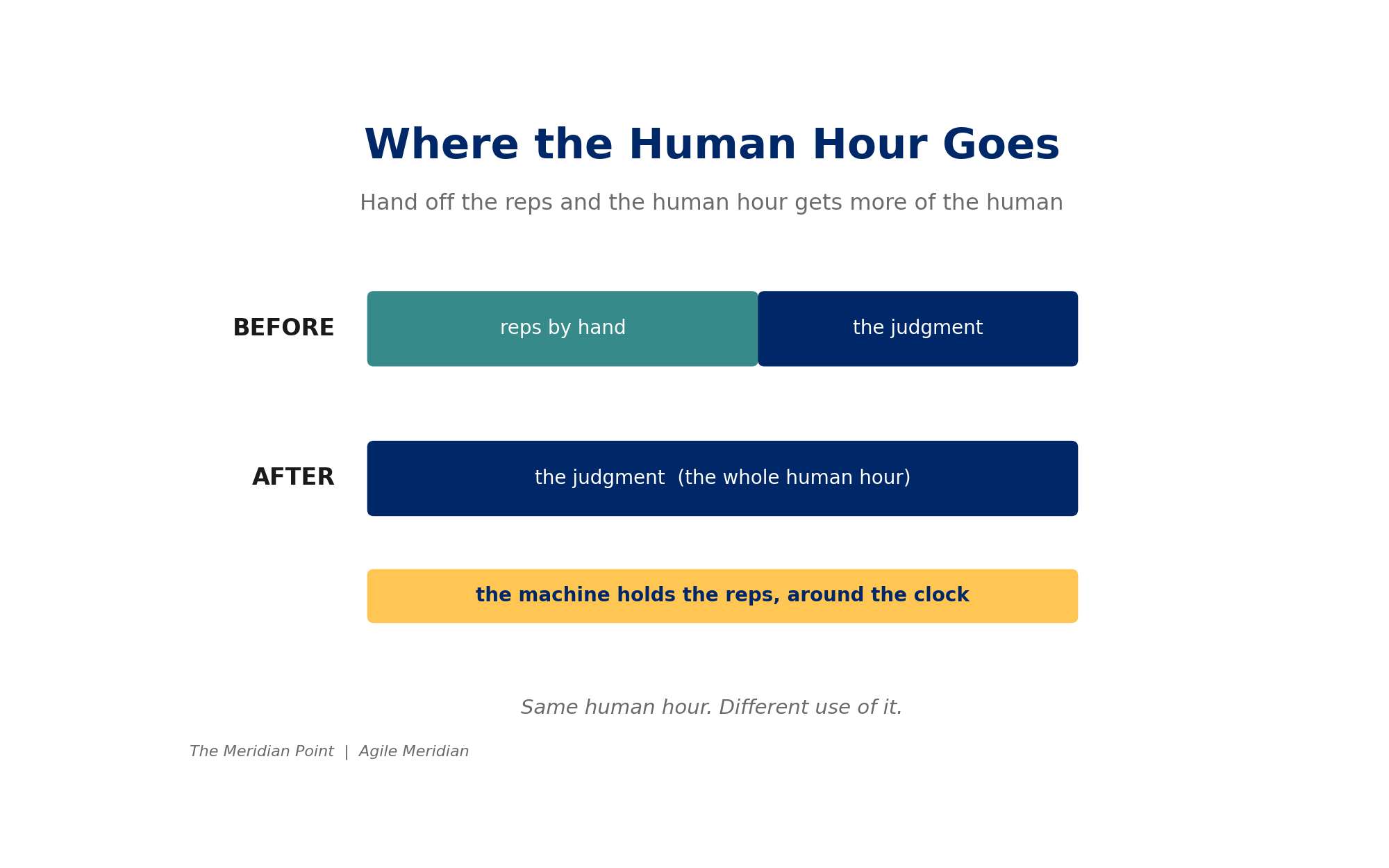
The counter is right about the relationship. It's wrong that the split thins it. Coaching already runs on two jobs. Most coaches do the reps by hand only because nothing else could do them. The between-session questions, the pattern replayed, the reminder to do what you said, that isn't the relationship. It's the homework the relationship never had time for. Hand it to the machine and the human hour stops going to things a checklist could do. The relationship gets more of the human, not less.
The ICF frame agrees with the shape of this. Its own document says a blended approach lets coaches offload the tedious activities and invest more in the high-value work of complex, human-to-human coaching. That's the division of labor stated in the framework's own words. I only make it specific. Reflection, retrieval and between-session accountability go to the machine. Reading the room, judging what the pattern means and sitting with a person through it stay human.
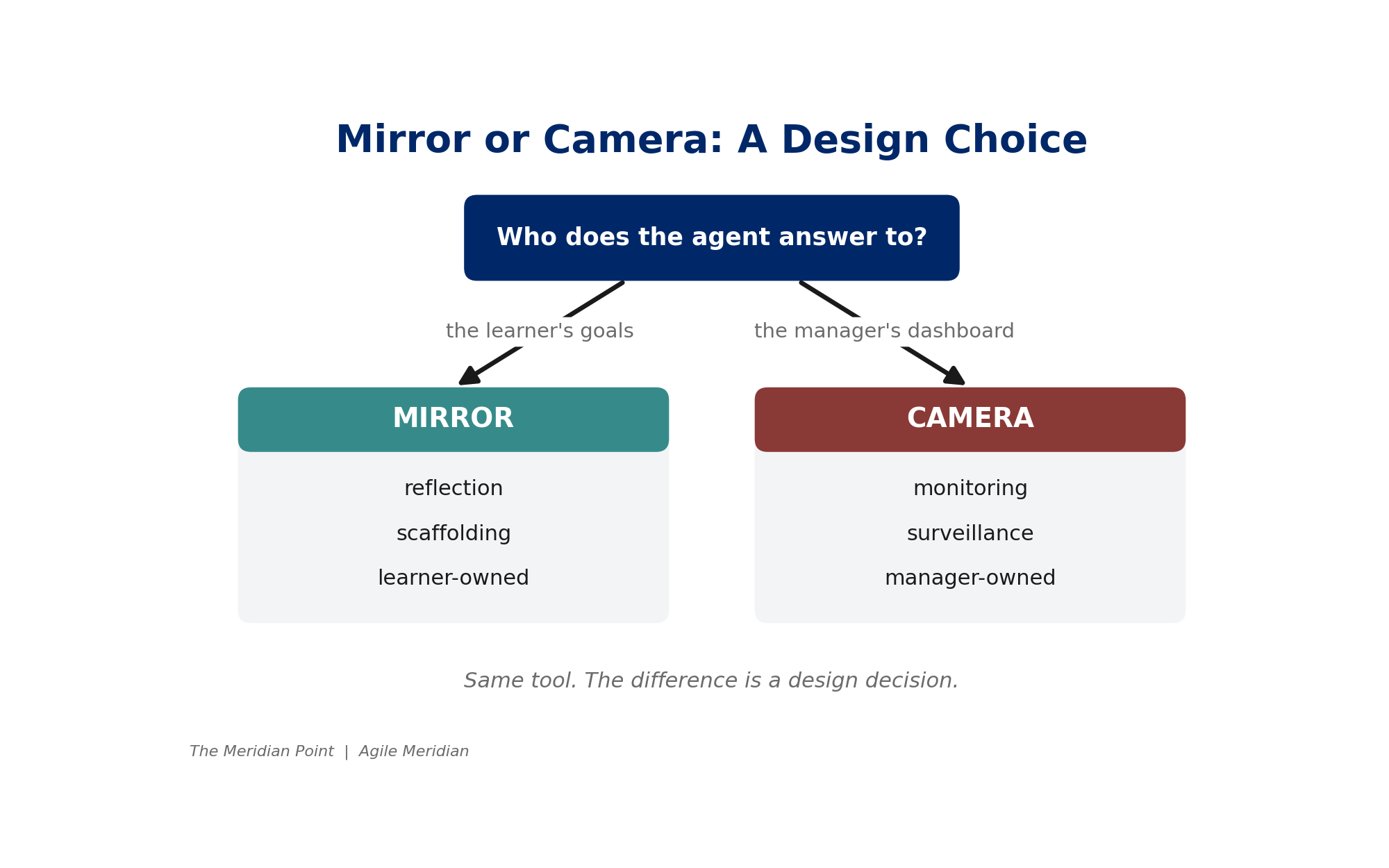
On the monitoring risk, the answer is design, not retreat. Point the agent at the person's own goals. Keep it learner-owned, not manager-owned. An agent aimed at the person who's growing is a mirror. An agent aimed at the person's boss is a camera. The difference is a design decision, and it's yours to make.
The machine, Nawaz said, "will not feel the tension in the room. It will not see the visual cues, rolling of the eyes, or somebody staring at the ceiling. At least not yet." At least not yet is doing a lot of work in that sentence. I'd keep the human there even if the tool got better at reading faces, because feeling the tension isn't the same as deciding what to do about it.
Where to stop using it
AI coaching works because it's a tireless mirror. So use it as one.
Give the machine the reps. Between-session questions, pattern reflection, accountability nudges, retrieval of your own frameworks. This is the work that scales, and it's the work a coach should have stopped doing by hand years ago.
Keep the human for the judgment. That's reading whether a person is ready to hear it, and knowing what the pattern means for them and not for someone else. Don't automate the part that needed a human in the first place.
Design the agent learner-owned. Aim it at the person's goals, not their manager's dashboard. The same tool is a mirror or a camera depending on who it answers to. Choose the mirror.
I gave my client an agent, and I didn't give away my job. I gave away the half of it that was never the point, so I could spend the hour on the half that was. In the loop isn't the AI's leash. It's the human doing the work that was always the coaching.
Related Podcast Episodes
Episode 175: Bloated Teams, Broken Delivery: The Case for De-Scaling, with Nawaz Butt. Nawaz argues a coach's job is to create the conditions for self-sufficiency, not to protect the engagement. That rule is the reason AI coaching doesn't threaten the craft. The scaffolding a coach builds to work himself out of a job is the exact thing a machine can now hold at scale.
Episode 169: Co-Intelligence: Why Learning Together Beats Knowing Together, with Diana Larsen. Diana separates knowledge work from learning work and puts AI on the knowledge side, with the human in the loop for the judgment calls. Her line about keeping humans in the mix is the counterweight this whole argument rests on.
Episode 147: How AI Is Disrupting Leadership Communication and Executive Coaching, with Ash Seddeek. Ash built the mirror into a product that surfaces communication preferences at the moment of use, and he still spends his human hours on the relationship the tool can't build. He's proof the split is a choice, not a downgrade.
And a prior blog post on how to build an AI coach
If you're deciding where an agent belongs in your own coaching or your leaders' development, that's a conversation worth having before you buy the tool. Book a 30-minute call: https://tidycal.com/coachkumar/30-minute-meeting