Robust Theme
Dec 09, 2019 2020-04-08 7:40Robust Theme


The Economics of Solar and Batteries, Explained
By: Kumar Dattatryan
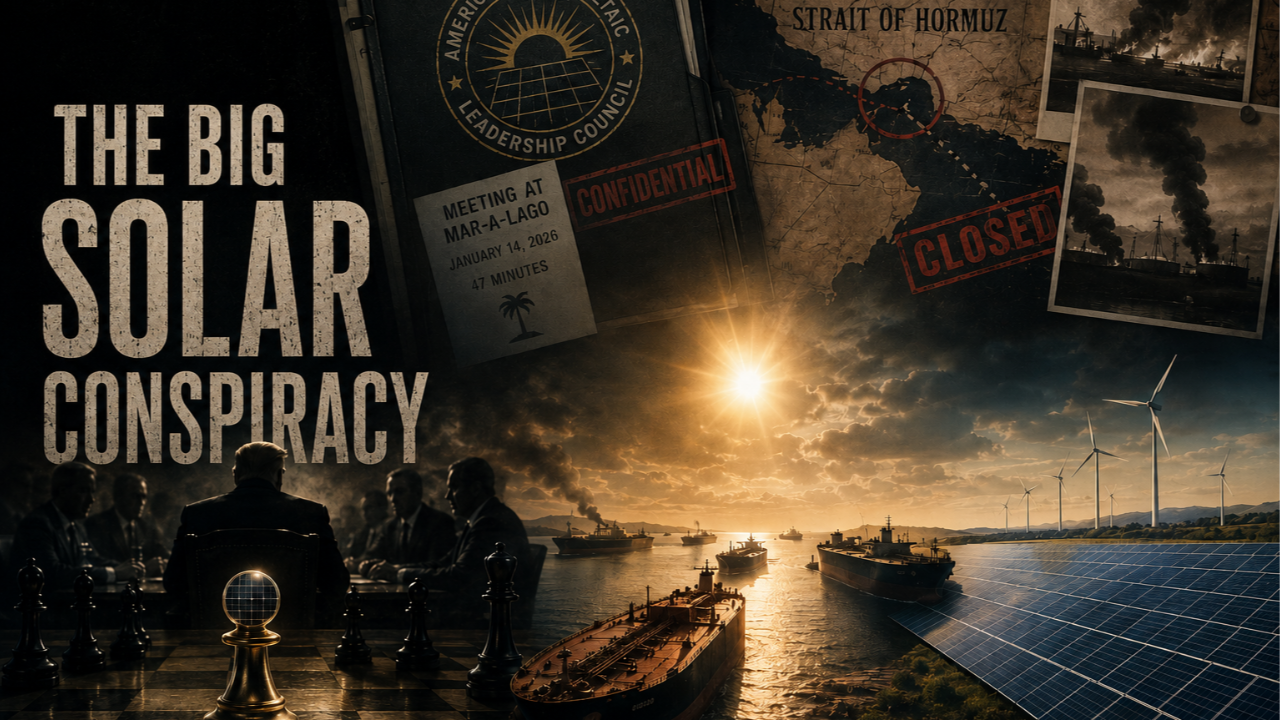
On January 14, 2026, a lobbyist for an organization that calls itself the American Photovoltaic Leadership Council registered a meeting at Mar-a-Lago. The meeting appears in no public schedule. The lobbyist's name appears on no disclosure form. The organization has no website, no board of directors, and no listed address. Its only verifiable asset is a single-page PDF filed with the Florida Secretary of State listing its purpose as "advancing American energy sovereignty through solar deployment."
The meeting lasted forty-seven minutes.
Six weeks later, the United States launched strikes on Iran.
Now. I want to be clear. There is no evidence that these two events are connected. None. Zero. The American Photovoltaic Leadership Council probably doesn't even exist. I made it up. (Or did I?)
But here's the thing about good conspiracy theories. They don't need to be true. They just need to be more coherent than the official story.
And right now, if you're looking at the global energy landscape in mid-2026, the "Big Solar secretly orchestrated the whole thing" theory explains the data better than anything else on the table.
The Case File
Let's walk through the evidence the way a prosecutor would. Hypothetically. For entertainment purposes only.
Exhibit A: The Briefcase
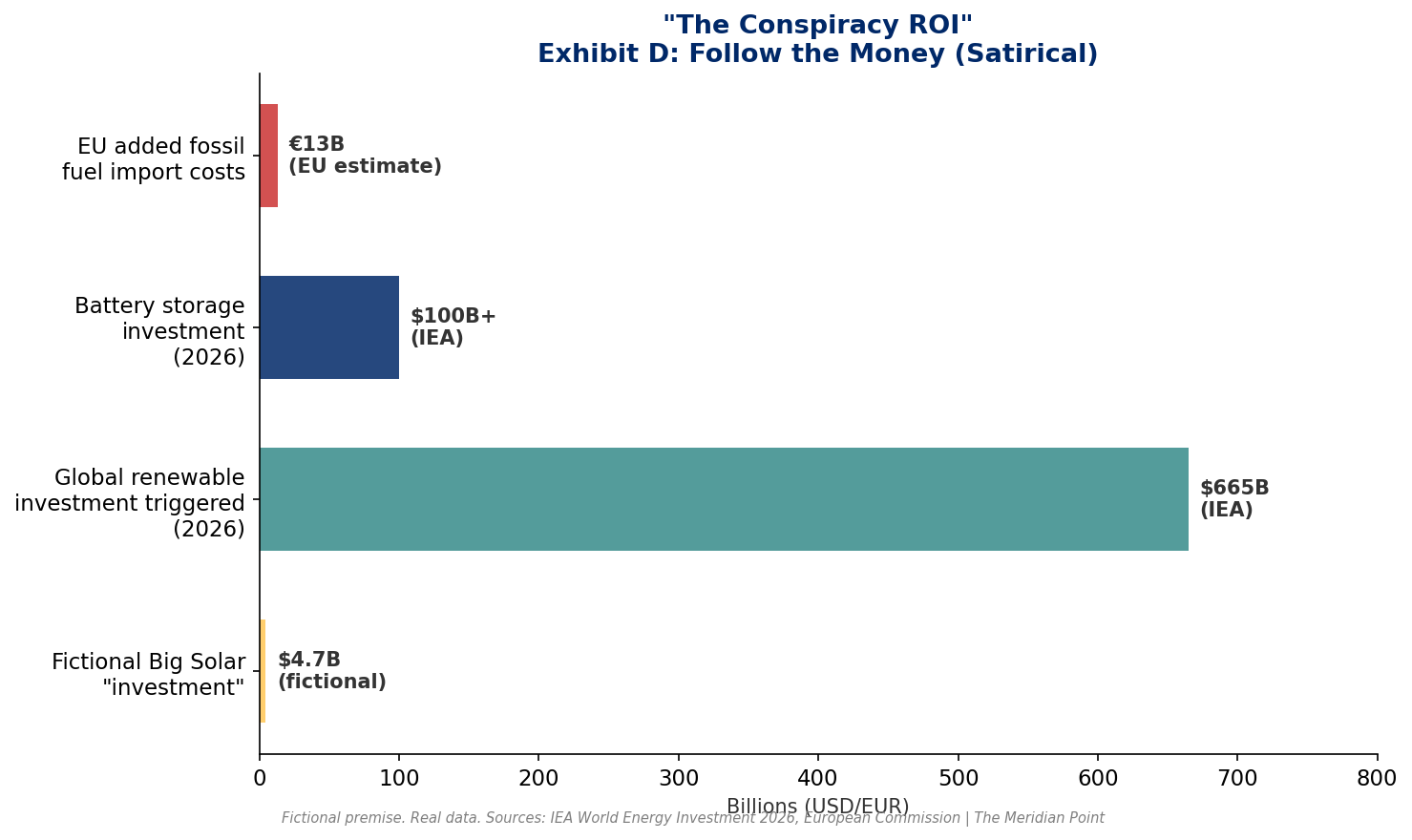
Big Oil has spent decades investing in political access. That's documented. What's less discussed is how little it would take for a rival industry to outbid them. Solar generated $365 billion in global investment in 2026 alone, according to the IEA. The industry has money. It has motive. And it had a problem: the world kept buying oil even though the math had already shifted.
In February 2026, I published an article called "We're Living in 1903 for Electricity." The core argument, built on a fireside conversation with my colleague Glenn Marshall, was that solar and battery costs were following the same Wright's Law trajectory that made the automobile inevitable. The data was unambiguous. Solar costs dropping 8 percent per year for forty years. Batteries down 91 percent since 2010. Grid parity already achieved in 2020. Solar plus battery becoming the cheapest source of new electricity on Earth by 2025.
The problem wasn't the math. The problem was that nobody was acting on the math. The world was still addicted to oil the way a gambler is addicted to the table: not because it's winning, but because it can't figure out how to stand up and walk away.
Big Solar (hypothetically) needed an intervention. Something that would force the world's hand.
Something like closing the Strait of Hormuz.
Exhibit B: The Strike
On February 28, 2026, the United States and Israel launched military strikes on Iran. Iran retaliated against Gulf energy infrastructure and effectively shut down the Strait of Hormuz.
This is not satirical. This is sourced from the IMF, the IEA, Reuters, and the Wikipedia page that is now longer than the entry for the Korean War.
Twenty percent of the world's oil supply disappeared. Tanker traffic through the strait dropped 70 percent within days, then collapsed to near zero. The IRGC announced the strait was closed to vessels traveling to or from the ports of the U.S., Israel, and their allies. Over 20,000 mariners and 2,000 ships were stranded in the Persian Gulf.
Brent crude headed toward $200 a barrel. The EU reported gas prices up 70 percent and oil up 50 percent, adding €13 billion to fossil fuel import bills. Shell's CEO warned Europe could face fuel shortages. British supermarkets ran out of diesel. Australia dusted off the Liquid Fuel Emergency Act of 1984, a law that hadn't been triggered in forty-two years.
The IEA called it the largest energy security crisis the world has ever faced. Larger than 1973. Larger than 1979. Twenty percent of global supply gone, compared to 7 percent during the oil embargoes of the 1970s.
In April, I published a follow-up called "The Sun Doesn't Need a Navy Escort." In it, I argued that the economic case for ending fossil fuel dependence wasn't political. It was mathematical. I compared the $8 trillion cost of post-9/11 wars (Brown University's Costs of War Project) to the $4.5 to $7.8 trillion estimated cost of a full renewable transition (Wood Mackenzie, Stanford). I made the case that the transition was cheaper than the wars we were already fighting to protect the supply chains the transition would eliminate.
That article was published on April 12, 2026. It was, as they say, prophetic. Not because I predicted the Hormuz closure. The closure had already happened. But because I described, in detail, the economic logic that would force a global pivot to renewables.
And then the pivot happened. Exactly as described.
Which brings us to:
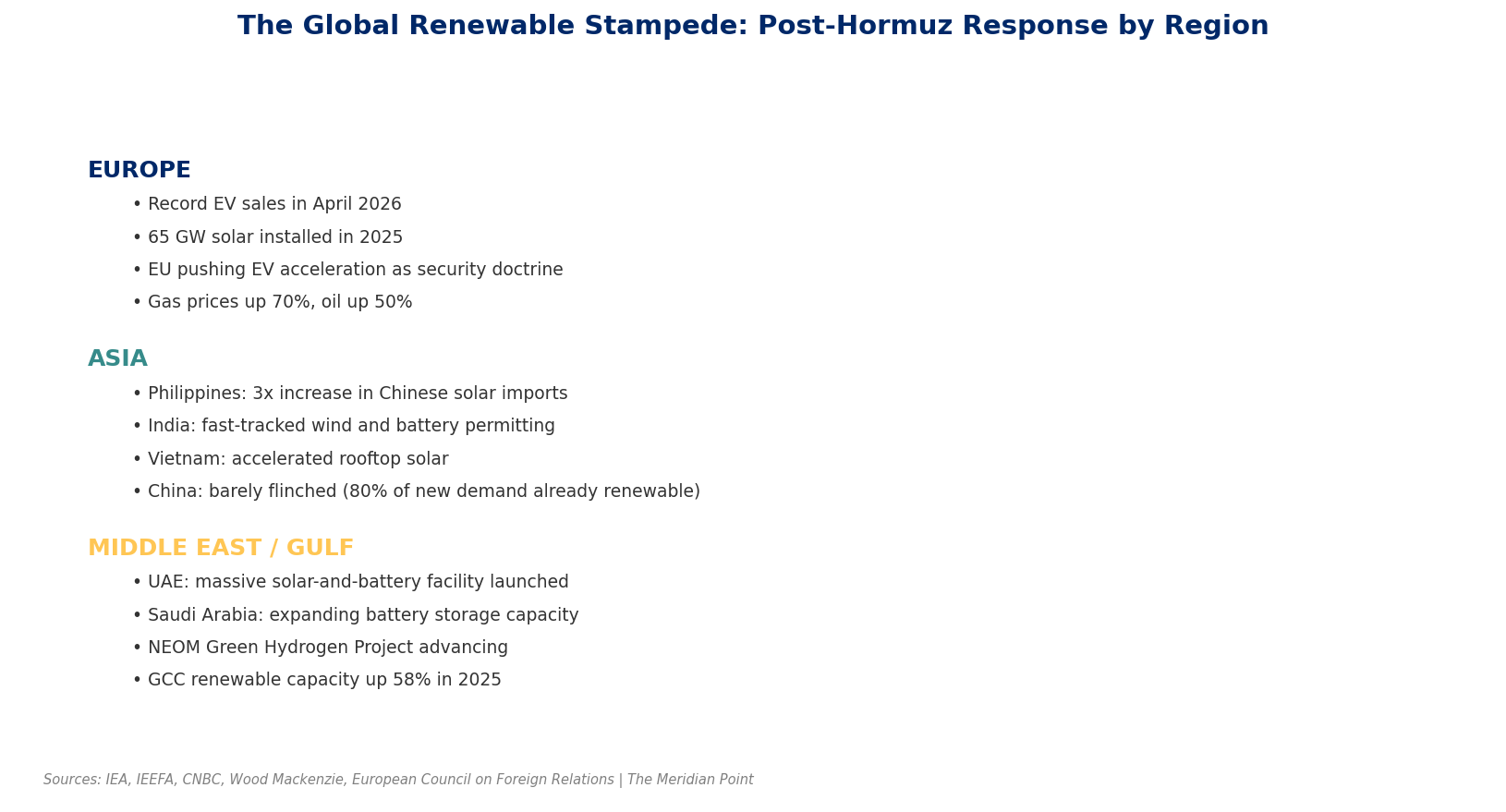
Exhibit C: The Stampede
If Big Solar had a war room (which it doesn't, because it doesn't exist), the spring of 2026 would have been champagne season.
April 2026 was the strongest month of electric vehicle sales on record in Europe. Not because Europeans suddenly found religion on emissions. Because diesel was priced like single-malt scotch.
The Philippines became the second-largest destination for Chinese solar exports in Q1 2026, with imports roughly three times higher than the same period a year earlier. India fast-tracked permitting for wind and battery storage. Vietnam accelerated rooftop solar. Pakistan embraced Chinese solar systems at scale. The IEA projected $665 billion in renewable power investment for 2026, with battery storage investment exceeding $100 billion for the first time.
China, which had been quietly electrifying its economy for years, barely registered the shock. Renewables already met more than 80 percent of China's new electricity demand in 2024. EVs accounted for over half of new car sales in 2025. Beijing had 1.4 billion barrels in strategic oil reserves and overland pipelines from Russia and Central Asia. The country everyone assumed was most exposed to a Hormuz closure turned out to be the most prepared.
Because China had already read the Wright's Law data. China didn't need a conspiracy. It just needed a calendar.
Kingsmill Bond of the Rocky Mountain Institute put the pivot in context: in the 1970s oil shocks, the world's best alternative was nuclear power, which took ten years to build and cost a fortune. This time, the alternatives are solar, wind, batteries, and electrification: huge, cheap, and ready to scale now. The technology wasn't just better. It was available.
As the IEA's Fatih Birol said: "Ten years ago, solar was a romantic story. Now solar is a business."
Exhibit D: The Motive
Here's where the conspiracy theory gets uncomfortably tidy.
Big Solar didn't need the Hormuz crisis to win eventually. Wright's Law was already running. The cost curves were already compounding. Solar plus battery was already the cheapest new electricity source on Earth.
What Big Solar needed was for the world to stop waiting.
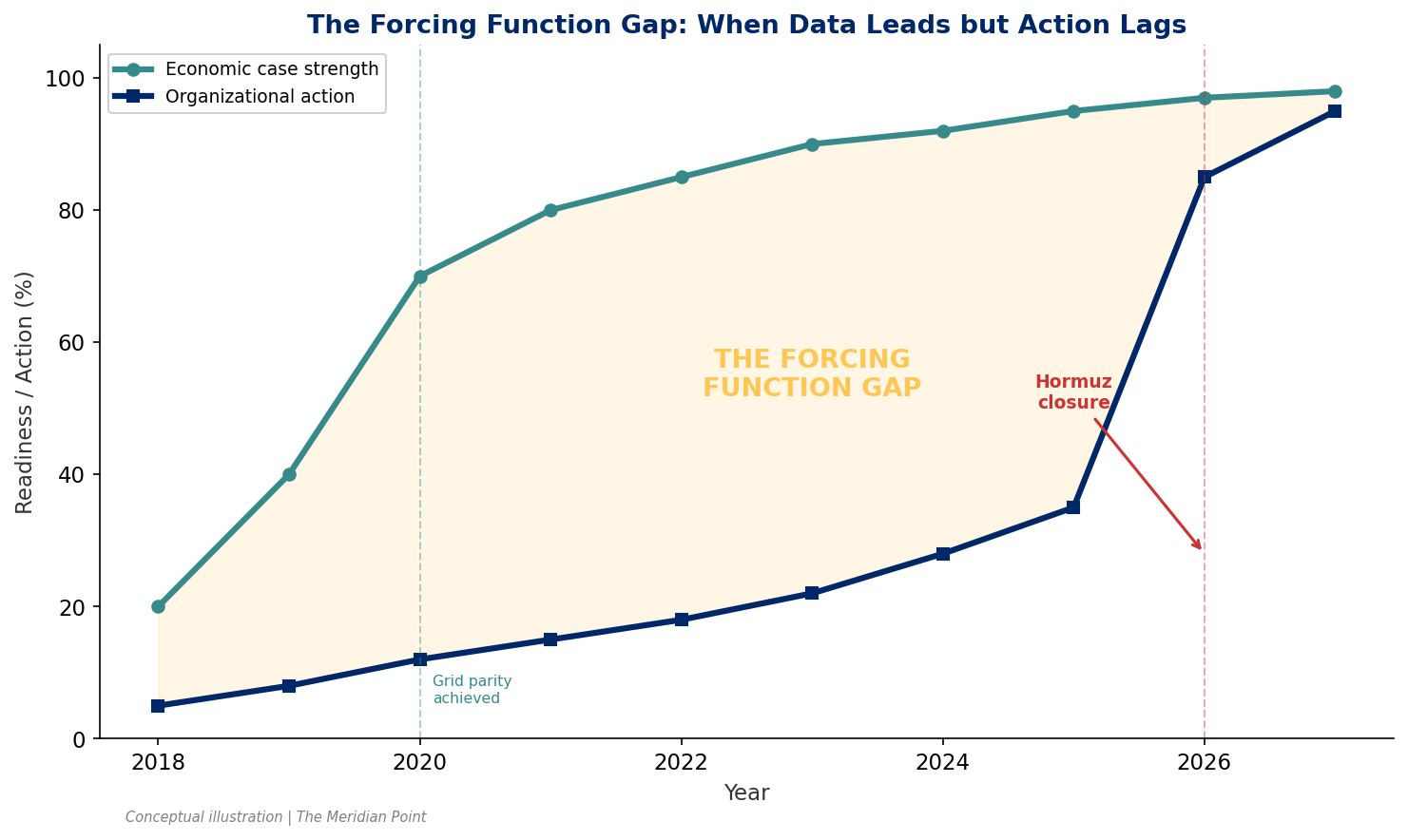
The economics were settled. The politics weren't. Governments were still subsidizing fossil fuels. Utilities were still slow-walking solar permitting. Consumers were still paying geopolitical risk premiums on every gallon of gas without connecting that cost to a policy choice.
The Hormuz closure didn't change the math. It changed the urgency.
The European Council on Foreign Relations is now pushing continent-wide EV acceleration as national security doctrine, not climate policy. Japan, which imports 84 percent of its energy, is restructuring its entire supply chain. South Korea, at 80 percent import dependence, is doing the same. The World Economic Forum called it "Asia's Ukraine moment."
If you were a fictional solar cartel, you couldn't have scripted it better.
The Verdict
Was Big Solar behind the Hormuz crisis?
No. Obviously not. That's absurd. There is no Big Solar. Solar panels are manufactured by thousands of companies across dozens of countries. There's no boardroom, no cartel, no conspiracy.
Did the Hormuz crisis produce exactly the outcome "Big Solar" would have wanted?
Every single data point says yes.
Is there a lesson here?
Several.
The first is that disruption doesn't need a conspiracy. It needs a trigger. The economics of solar and batteries were already decisive before anyone fired a missile. What the Hormuz crisis provided was the forcing function. The moment when the theoretical became urgent. When "we should probably do something about this" became "we are out of diesel and the rationing law is from 1984."
The second is that organizations and nations that invested in energy independence before the crisis were the ones least affected by it. China's electrification didn't start in 2026. It started years earlier. Spain's renewable buildout meant it was less exposed to gas price spikes than Italy. The countries that acted on the math before the crisis didn't need to panic during it.
The third, and this is the one that connects to everything I write about disruption: the signal was there for years. I wrote about it in February. Glenn Marshall was talking about it before that. The Wright's Law data has been public for decades. The pattern was visible to anyone who was looking.
Most organizations aren't looking. They're optimized to protect the current model, not to see the one replacing it. That's true in energy. It's true in every industry my partners and I work with through the Disruptor Method.
The sun doesn't need a lobbyist. It doesn't need a conspiracy. It doesn't need a naval escort. It just needs the old system to do what old systems always do.
Break at the worst possible time.
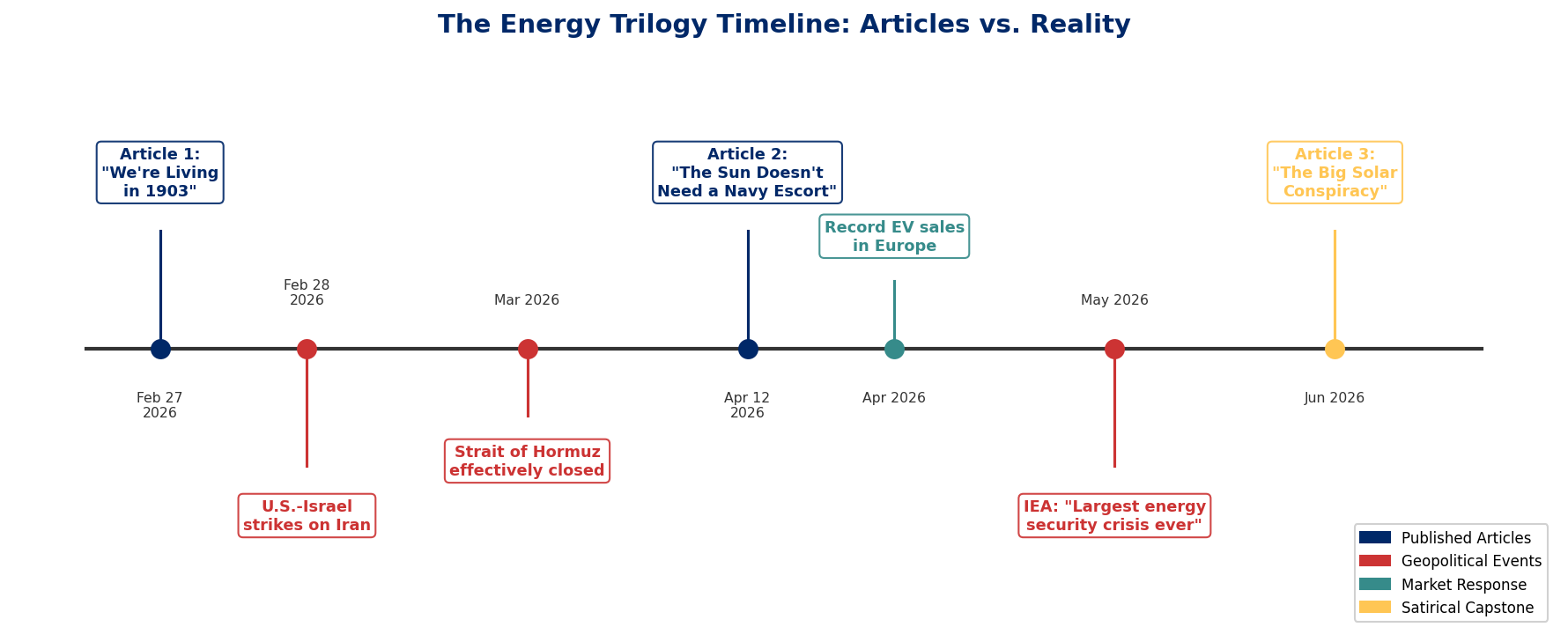
The Trilogy
This is the third piece in an unplanned series on energy disruption:
- "We're Living in 1903 for Electricity" laid out the Wright's Law foundation: why solar and battery costs are following the same exponential curve that made the automobile inevitable, and why most analysis misses it. Read it here →
- "The Sun Doesn't Need a Navy Escort" made the economic and supply chain case for ending fossil fuel dependence, comparing the cost of protecting oil supply chains to the cost of replacing them entirely. Read it here →
- "The Big Solar Conspiracy" is this piece: a satirical look at how a fictional conspiracy explains the 2026 energy pivot better than reality does, grounded in sourced data from the IEA, IMF, Wood Mackenzie, and the European Council on Foreign Relations.
Related Podcast Episodes
Want to go deeper on disruption patterns and energy transformation?
- EP165: Energy Disruption Fireside Chat with Glenn Marshall — The conversation that started this entire series. Glenn walked me through Wright's Law applied to solar and batteries, and I spent a week trying to prove him wrong. I couldn't.
- EP152: From Agile to AI — Avoiding the Same Transformation Mistakes — Why organizations keep making the same pattern-recognition failures across successive disruptions.
- EP150: Top-Down vs Bottom-Up Transformation — Two approaches to organizational change, and why the distributed model (like solar deployment) often outperforms the centralized one (like nuclear buildouts).
View the full Meridian Point playlist →
Take the Disruptor Quiz
Are you positioned to see the next disruption before your competitors? Or are you still reading the banker's letter from 1903?
Let's Talk
If your organization is still treating energy strategy, or any structural disruption, as someone else's problem, it might be time to talk.
→ Book a 30-minute conversation
Kumar Dattatreyan is the co-founder of Agile Meridian and co-creator of The Disruptor Method. He's an ICF PCC executive coach who works with Fortune 500 leadership teams to recognize disruption patterns before they become crises. He hosts The Meridian Point podcast.
#Sustainability #ClimateAction #CleanTech #EnergyPolicy #Agrivoltaics #SolarPower #TechDisruption #EnergyMyths #SatireWithAPoint #FossilFuels #FollowTheMoney