Robust Theme
Dec 09, 2019 2020-04-08 7:40Robust Theme


Blame Culture Kills Innovation: How to Break It

By: Kumar Dattatryan
Tom Stiehm spent thirty years in software development watching organizations try to change. New frameworks. New tools. New training programs. Org charts redrawn. Posters on walls. And then, twelve months later, the organization is right back where it started.
His diagnosis is simple. They changed everything except what they reward.
The incentive system stayed intact. And the incentive system told the truth about what the organization actually valued.
Here is what that has to do with innovation: you cannot build an environment where people take creative risks if the incentive system punishes failure. That is not a culture insight. It is a structural fact.
The Confusion That Gets Everyone in Trouble
Most leaders I work with will tell me they don't have a blame culture. What they have, they say, is a high-accountability culture. They mean well. But they have confused two things that look similar from a distance and are completely different up close.
Accountability means owning outcomes, learning from what happened, and improving. Blame means finding who was at fault and making sure they feel it. Organizations that confuse the two get neither. What they get is silence.
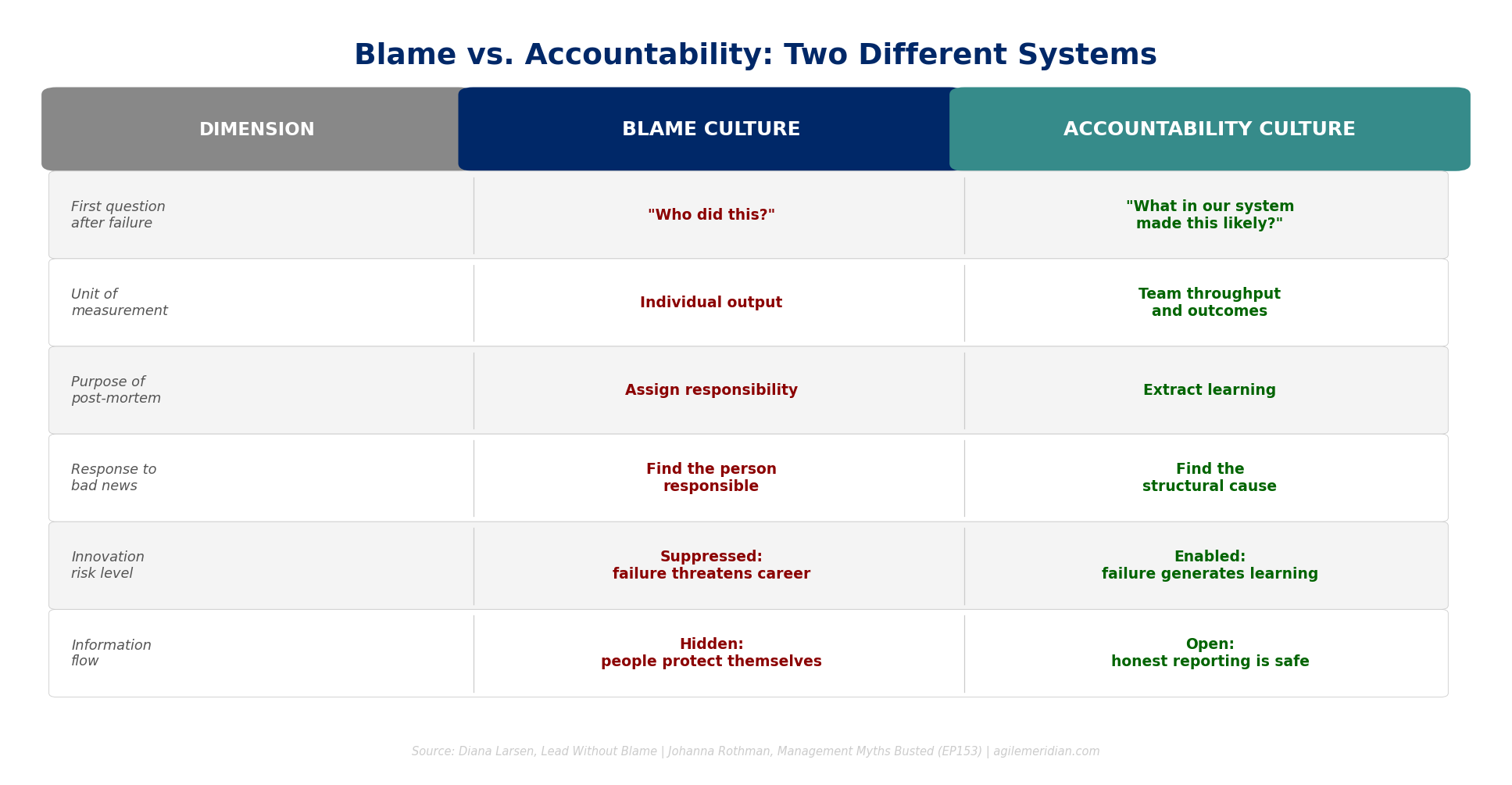
Diana Larsen, co-author of "Lead Without Blame" and one of the most influential voices in team learning and organizational agility, describes the physiological reality of this. When people are being blamed, or even when they are blaming someone else, the posture closes. Eyes go inward. Shame, guilt, and defensiveness take over. And you simply cannot add creative thinking into that mix.
This is not touchy-feely. It is physiological. Blame triggers threat response. Threat response narrows focus. Narrow focus protects the self. It does not generate the next idea.
Compare that to what Diana calls the learning stance. Someone who can say: I made a big mistake and I am really sorry. But in making this mistake, I learned something new about our system. Now we know that. Now we can build on it. That person is not hiding. They are not pretending it did not happen. They are acknowledging what happened, cleaning up the mess, and staying focused on what comes next.
That is what innovation requires. And it only happens when the environment makes it safe to say it.
Organizational Scar Tissue
Blame culture does not announce itself. It accumulates quietly.
A few leaders who respond badly to bad news. A pattern of debriefs that find fault rather than find learning. A promotion that goes to the person who never failed rather than the person who tried something new. Over time, people stop voicing ideas that might not work. They stop raising problems they are not sure how to solve. They stop taking the risks that innovation requires.
Jeff Harnois described something he witnessed at Apple in the early years that stayed with me. Under the original culture, failure was accepted and expected. If you had an idea, you could pitch it on a napkin and walk away with a million-dollar budget. You tried things. You learned. Failure was not just tolerated. It was part of how the organization found out what worked.
When the culture shifted toward business discipline and accountability for spend, the entrepreneurial types started leaving. They were replaced by people who knew how to justify ideas rather than generate them. Apple survived that transition. Most organizations do not even recognize when it is happening to them.
What I call organizational scar tissue is the residue of environments that punished the wrong things. Ideas never voiced. Risks never taken. Lessons never shared. Unlike physical scar tissue, it does not show up on any diagnostic. It shows up in the absence of the conversations that should be happening.
I see this all the time. A leadership team that says all the right things about innovation but where no one is willing to be the first person to say something might not work. That silence is the scar tissue talking.
The Aviation Case: What Actually Happened
On December 1, 1974, TWA Flight 514 crashed into Mount Weather on approach to Dulles Airport, killing all 92 people on board. The crew had misunderstood an air traffic control clearance and descended too early.
The NTSB investigation revealed something chilling. Six weeks before that crash, another airline's crew had misunderstood the exact same ATC clearance and begun the same premature descent. They barely missed the mountain. The pilots reported what happened to their own company. But there was no mechanism to share that information with any other airline. So the warning went nowhere. Six weeks later, 92 people died from the same misunderstanding.
In April 1976, NASA and the FAA established the Aviation Safety Reporting System as a direct response. The design was deliberate: voluntary, confidential, and non-punitive. NASA administers it rather than the FAA specifically so the people filing reports are not reporting to the entity that can punish them. The ASRS has collected over two million safety reports since. That data has driven the systematic improvements that make commercial aviation one of the safest activities in modern life.
The mechanism is not complicated. When the incentive system shifts from "reporting this will hurt you" to "reporting this is protected," the information starts flowing. Lessons propagate. The same near-miss stops repeating.
Amy Edmondson at Harvard Business School has spent decades studying this pattern. Her 1999 research in Administrative Science Quarterly first established psychological safety as a measurable concept. Her 2018 book "The Fearless Organization" examines how aviation's model has been applied, imperfectly and inconsistently, in healthcare and other industries. The distinction she draws is between "just culture" approaches that differentiate honest mistakes from negligence, and blame cultures that treat any failure as evidence of individual deficiency. Just culture enables error reporting. Blame culture suppresses it. Edmondson's hospital research showed that psychologically safe medical teams caught errors at higher rates and produced better patient outcomes as a result.
Healthcare has adopted this in its best organizations. In most corporations, the language has arrived but the incentive redesign has not. That combination produces something very specific: articulate silence. People who know the right words and say none of the right things.
Why the Old Models Survive
Diana Larsen has been coaching and studying organizational learning for over thirty years. When I asked her why these patterns persist despite everything that is known about their cost, her answer was direct: tradition and habit. We learn how to lead from the people who led us, she said. Not all of those experiences taught us that questions were safe, that admitting a mistake would be treated as a learning contribution rather than a career liability.
She described something she encountered firsthand. Before giving a talk at an organization, she was told that no one would ask questions afterward. The reason: everyone in the room had been hired as the best and brightest, and asking a question would expose an area of ignorance. That made her sad. But it also explains exactly how blame cultures reproduce themselves. The leaders running organizations were often shaped in environments where not knowing something was treated as a character flaw. They are now producing the same environment for the people around them.
Carol Dweck's research on growth mindset is directly relevant here. Diana named it explicitly in our conversation. The fixed mindset, where intelligence and capability are traits to be proven rather than developed, produces the organizational behavior we are describing: people hiding mistakes, avoiding challenges, interpreting failure as evidence of permanent inadequacy. The growth mindset produces the opposite. Dweck's research on how mindset shapes response to difficulty runs directly parallel to what Edmondson found about psychological safety: the environment either makes honest engagement with failure possible or it does not. And the environment is set by what leadership models and what the incentive system rewards.
The Individual vs. Team Trap
Johanna Rothman makes a distinction I find essential. The moment an organization focuses on the individual as the unit of accountability, it sets up the conditions for blame. When something goes wrong and the performance system is designed around individual output, the individual is where the blame lands. It is very hard to hold a team accountable when the entire management infrastructure is built around measuring what each person personally produced.
The alternative is team-level accountability, measured through throughput and outcomes, not individual busyness. That shift sounds incremental. It is actually a complete redesign of what the organization measures and rewards.
Think about it this way. If your performance review is based on your personal output, you have a strong incentive to make sure that when things go wrong, it does not look like your fault. If your review is based on team outcomes, your incentive is to help the team succeed. The information you were hiding becomes information you share, because hiding it hurts the team.
That is the mechanism. Not a values statement. A structural incentive.
What the Data Says
Evan Leybourn at the Business Agility Institute tracks organizational agility across six domains. Their 2025 Business Agility Report shows that organizations struggle most with governance, which includes how they fund work, measure performance, and manage compliance.
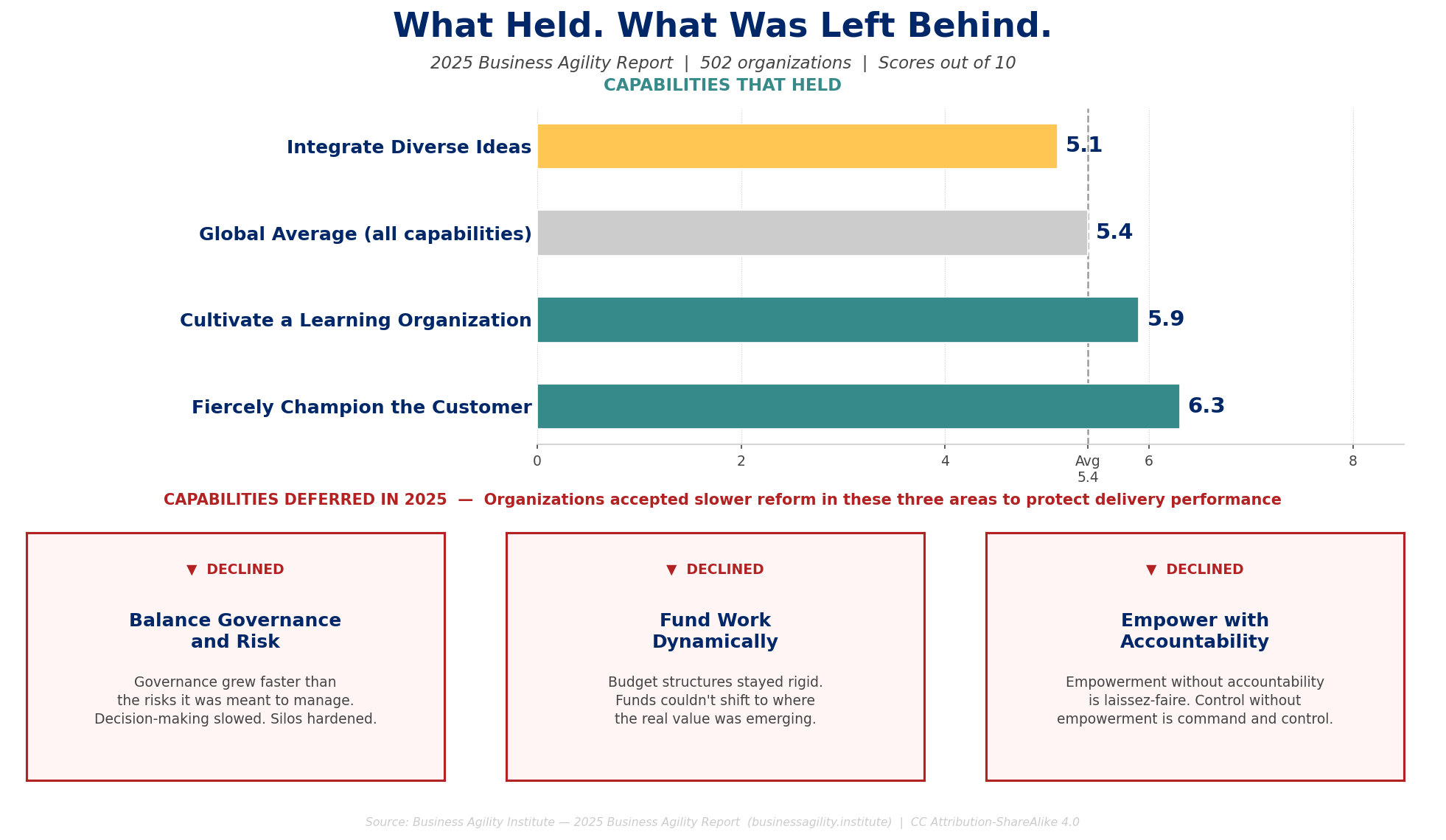
The specific governance behaviors that suppress agility: performance management based on individual goals rather than team outcomes. Annual budgets that reward resource efficiency rather than flow. Approval processes that punish the teams that try something and fail.
These are structural blame conditions. They are baked into the operating system.
Evan also notes something that connects directly to the incentive argument. Organizations that communicated "we trust you" and then followed with mass layoffs and return-to-office mandates saw their business agility scores drop. People had been watching what the organization did, not what it said. And what it did told them the truth about whether it was safe to take creative risks.
Leaders wonder why their innovation initiatives are not working while their governance structures are designed to prevent risk. The people executing those initiatives wonder the same thing. They just know better than to say so out loud.
Accountability Without Blame: What It Actually Looks Like
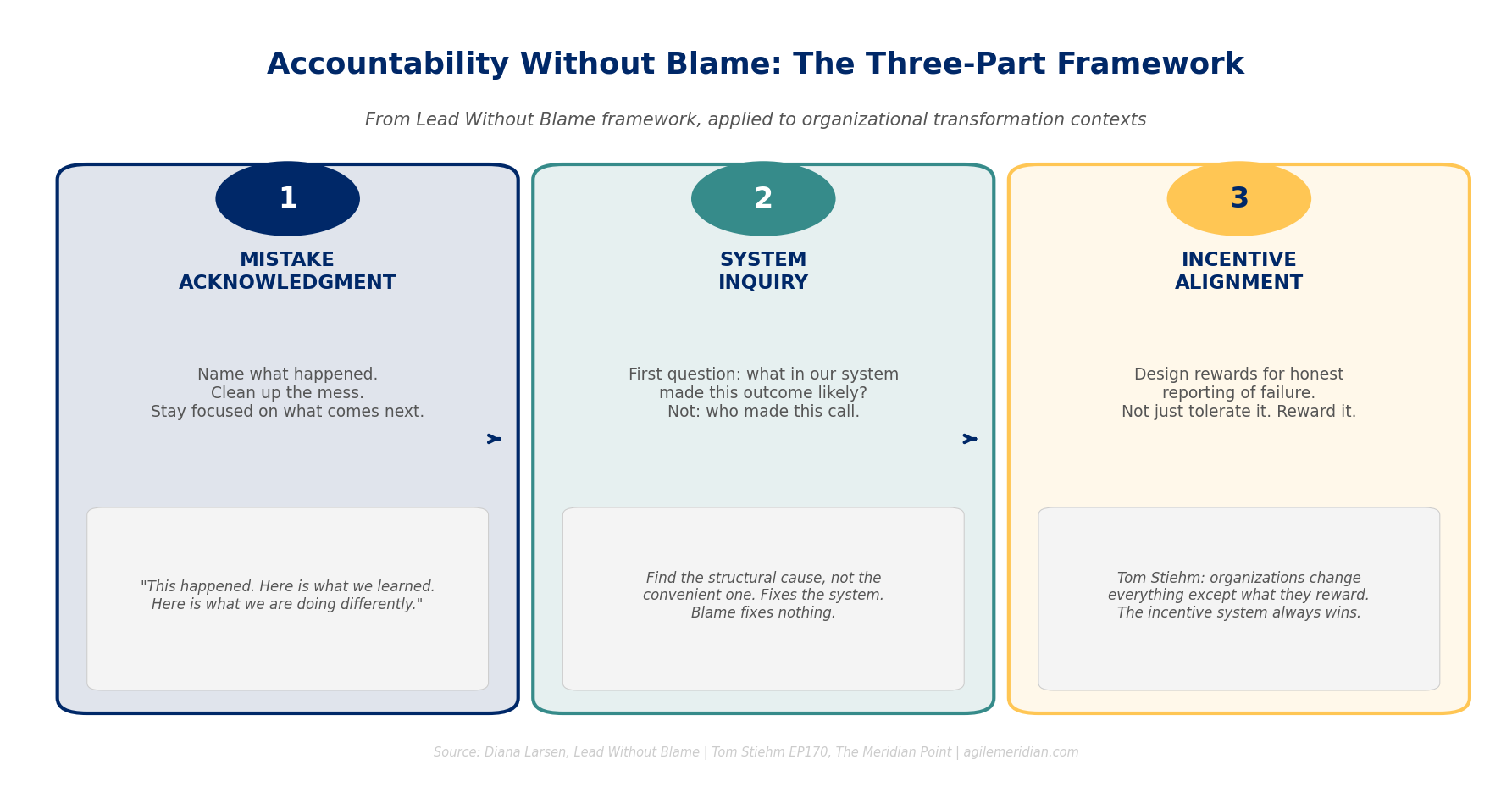
This is not softer accountability. If anything, it is harder.
It starts with the mistake acknowledgment. Diana's framework asks: can you name what happened, clean up the mess, and stay focused on what comes next, all in one breath? Not hiding. Not pretending. Not deflecting. Just: this happened, here is what we learned, here is what we are doing differently.
It moves to system design. When something goes wrong, the first question is not who did this. The first question is what in our system made this likely. That is not a way of avoiding accountability. It is a way of finding the real cause rather than the convenient one.
And it ends with incentive alignment. This is Tom's point. You can run retrospectives and blame-free incident reviews and psychological safety workshops all day long. If the incentive system still punishes failure and rewards the appearance of success, nothing changes. People respond to what gets rewarded. The workshops are decoration.
The organizations that get this right design systems where the honest reporting of failure is protected. Where the team is the unit of success and of learning. Where a mistake acknowledged and understood creates more value than a mistake hidden and repeated.
Three Things You Can Do This Week
First, audit your last three post-mortems or project reviews. Count how many questions started with "who" versus "what in our system." That ratio tells you whether you are running a blame process or a learning process. Most leaders are surprised by the answer.
Second, look at your promotion decisions from the last two years. Were they based on individual output or team outcomes? The people you promoted told your organization what you actually value. Every person watching already knows the answer. They made decisions about what to share and what to hide accordingly.
Third, design one protected space for failure reporting. Not a grand culture initiative. Just one: a standing meeting, a shared document, a channel where people can say "this almost went wrong and here is what we learned" without it becoming part of someone's performance record. Start there. One space where the incentive system says: bring the problem here. It is safe to say it.
The Bottom Line
Innovation requires people to try things that might not work. Every leader in every organization knows this intellectually. Knowing it does not make it happen.
What makes it happen is the environment. And the environment is set by what you reward and what you punish. Not by what you say in all-hands meetings. Not by what is written in the values document.
It still astounds me how many organizations are trying to run innovation programs inside governance structures designed to eliminate the risk that innovation requires. You cannot do both. One of them wins. The governance structure always wins, because it controls the incentives.
You want to know whether your organization can innovate. Look at what happens to the person who raises a problem nobody wants to hear. Look at what happens to the team that tried something, learned from its failure, and adjusted course. Look at whether that story gets told as a cautionary tale or as evidence that learning is valued here.
That is your culture. Not the poster. Not the offsite. The story that gets told after a failure.
Is it safe to bring the problem here? If people are not sure, you have work to do.
Related Podcast Episodes
EP169: Co-Intelligence: Why Learning Together Beats Knowing Together Guest: Diana Larsen Diana's conversation introduced the "Lead Without Blame" framework and the physiological case for learning-oriented leadership. This episode is the direct source for understanding why blame is not just a morale issue. It is a structural impediment to the kind of learning that drives innovation. A must-listen for anyone serious about building teams that actually improve. Watch on YouTube
EP170: AI Won't Save You If You Can't Code: Tom Stiehm's Warning Guest: Tom Stiehm Tom's thirty years in software development produced one of the most clarifying observations I have encountered: organizations change everything except what they reward, and then wonder why nothing changed. His analysis of how AI adoption is setting up to repeat every mistake Agile adoption made connects directly to the incentive design argument in this post. Watch on YouTube
EP153: Management Myths Busted: Johanna Rothman on Real Organizational Change Guest: Johanna Rothman Johanna's work on the distinction between resource efficiency and flow efficiency, and between individual accountability and team accountability, provides the structural lens this post is built on. The management myths she dismantles are the same myths that sustain blame culture in most organizations. Watch on YouTube
Ready to Find Out Where Your Culture Actually Stands?
Most leaders already sense the answer. The Disruptor Method assessment surfaces the structural patterns underneath the culture your organization presents to itself.
Take the Disruptor Method Assessment
Or if you want to talk through what you are seeing in your organization: Book a 30-minute conversation