Robust Theme
Dec 09, 2019 2020-04-08 7:40Robust Theme


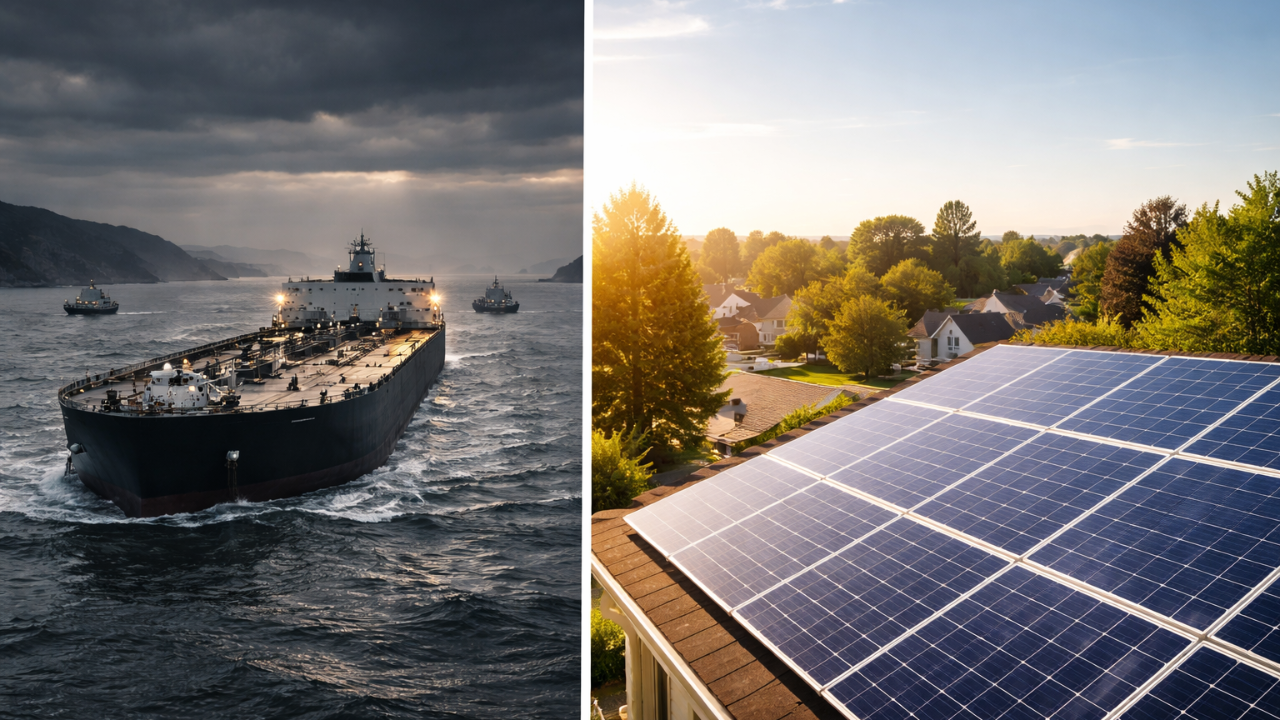
The Sun Doesn't Need a Navy Escort
By: Kumar Dattatryan
The case for ending our dependence on fossil fuels isn't political. It's mathematical. And the clock is running.
Every time there's instability in the Middle East, gas prices spike. Every time a shipping lane gets blocked, grocery bills go up. Every time geopolitical risk flares in a region most people can't point to on a map, a supply chain you depend on every single day gets strangled.
This has been true for fifty years. And we keep acting surprised.
The sun rises every morning in your zip code. It doesn't care about geopolitics. It doesn't need a navy escort. It doesn't charge a premium during election years. It just shows up, for free, with free delivery, every single day.
That's not a bumper sticker. That's an economic argument.
A few weeks ago, I wrote about why this moment in energy resembles 1903 for the automobile. The math behind solar and batteries, driven by something called Wright's Law, points to a disruption as fundamental as the shift from horse to car. If you haven't read that piece, start there: We're Living in 1903 for Electricity. And if you want to hear the conversation that first put these numbers in front of me, my fireside chat with Glenn Marshall on Episode 165 of The Meridian Point covers the full picture: The Energy Revolution: Why Your Electric Bill Can Drop 70%.
This article goes further. Because understanding the disruption is one thing. Knowing what it means for fossil fuels, and what it takes to actually finish the job, is another.
The Incumbent Always Has the Same Playbook
In every major disruption, the incumbent doesn't lose because the new technology fails. It loses because it chose its existing revenue model over the future.
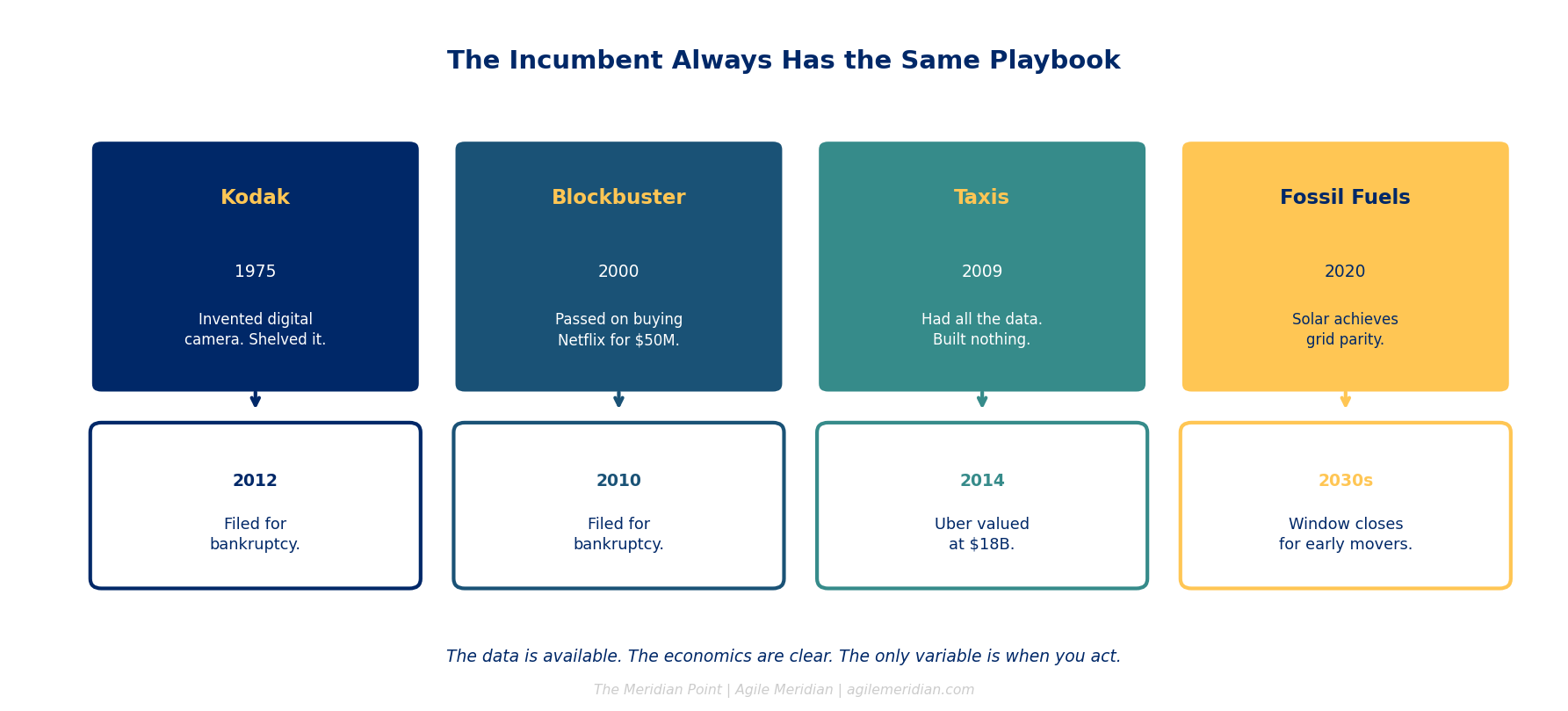
Kodak invented the digital camera and shelved it. Blockbuster had the chance to buy Netflix. Taxi companies had the data to build Uber before Uber did. The pattern is always the same: the incumbent protects what it has instead of building what's next.
Big oil is no different. The business model is built on scarcity, on the fact that energy has to be extracted, refined, transported, and sold. Every step in that chain is a revenue opportunity. Every step is also a point of vulnerability: to price shocks, to supply disruptions, to geopolitical instability, to a shipping lane that can close overnight and cost you a dollar more per gallon by morning.
Solar doesn't have a supply chain in that sense. The fuel is free. The delivery is free. Solar panels and batteries have no moving parts. They don't combust, corrode, or wear out the way mechanical systems do. Modern systems self-diagnose, self-monitor, and can automatically flag a failed panel for replacement. The operating cost of a mature solar and battery installation isn't low. It's as close to zero as any energy system ever built. That's not an incremental improvement on the old model. It's a fundamentally different business.
That's what makes this a disruption and not just an upgrade.
Why This Time Is Different
Previous energy transitions took generations. Coal replaced wood over roughly a century. Oil replaced coal over decades. Those transitions were slow because the new technology had to build infrastructure from scratch, and the incumbents had time to adapt, lobby, and entrench.
This transition is faster for a structural reason: the learning curve.
Solar costs have dropped approximately 8 percent per year for forty years. Batteries have dropped 91 percent since 2010 alone. The trajectory on both is still steep. By the time most organizations have finished debating whether to act, the economics will have moved past the argument.
The other reason this transition is different: it's distributed. Oil requires centralized extraction, refining, and distribution. You can't build your own oil well. You can put solar panels on your roof next month. That distributed ownership changes the power dynamic in ways that favor the consumer and the community, not the incumbent.
When the fuel source becomes local, the geopolitical leverage disappears. That's the real disruption. Not cleaner energy. Sovereign energy.
What About Nuclear?
It's a fair question. Nuclear is local. It doesn't run through the Strait of Hormuz. So why isn't it the answer?
Briefly: nuclear has a fuel and parts supply chain that is large, complex, and internationally dependent. More critically, nuclear has a negative learning rate. Unlike solar and batteries, which get cheaper every time you double production, nuclear gets more expensive, driven by ever-increasing safety requirements that add complexity with each new build. A major accident like Chernobyl or Fukushima costs hundreds of billions of dollars, and commercial insurance at that scale simply isn't available. Governments bear the risk directly.
Construction timelines for existing large reactor designs run approximately 15 years, and those projects are chronically over budget and late. Small Modular Reactors, the proposed alternative, have not been successfully deployed at commercial scale in any G7 country. They are projected to produce less power per dollar than large reactors, and their timelines are longer, not shorter.
Wright's Law is the reason solar wins this comparison decisively. Solar doubles production every few years and costs fall 20 percent with each doubling. Nuclear hasn't doubled global capacity in fifty years. You can't learn what you don't build.
The Barriers Are Real but They're Not Technical
If the economics are this compelling, why isn't the transition already complete?
The barriers are structural, not technological. And they're worth naming clearly.
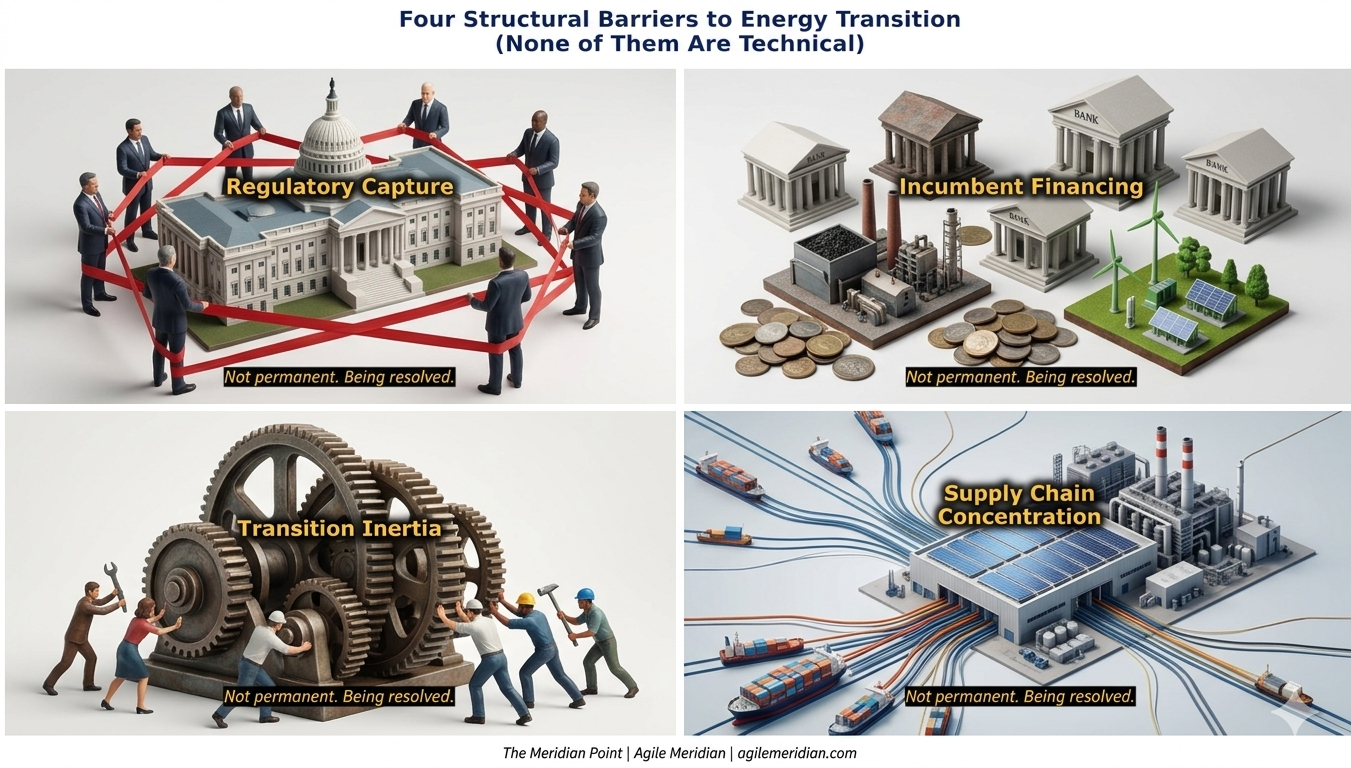
Regulatory capture. Utilities built their entire business model around selling kilowatt-hours. Every kilowatt-hour you generate yourself is one they don't sell. So they lobby for rate structures that penalize rooftop solar, fight net metering policies, and slow-walk permitting. This isn't conspiracy. It's rational self-interest from an organization that hasn't reimagined its model.
Incumbent financing. The fossil fuel industry has decades of sunk infrastructure, long-term contracts, and capital structures built around continued extraction. Stranded assets are a real financial problem, and they create a powerful incentive to slow the transition through every available lever: political, regulatory, and economic.
Transition inertia. Most organizations, whether companies, cities, or countries, make energy decisions based on the cost of switching, not the cost of staying. When you factor in the trajectory of solar and battery costs over the next decade, staying with fossil fuels becomes increasingly expensive relative to switching. But that math requires looking forward, and most budget cycles don't.
Supply chain concentration. A significant portion of solar panel and battery manufacturing runs through a small number of countries. That's a legitimate supply chain risk, and it's being addressed through domestic manufacturing investment. But it's a real friction point that slows adoption in some markets.
None of these are permanent. All of them are being worked on. The question is whether you're waiting for them to be resolved before you act, or positioning yourself ahead of the resolution.
We've Already Paid for the Transition. Twice.
Before anyone argues that moving away from fossil fuels is too expensive, consider what we've already spent not moving away from them.
According to the Costs of War Project at Brown University, the post-9/11 wars in Iraq, Afghanistan, Syria, and elsewhere have cost the United States approximately $8 trillion. That figure includes direct military operations, State Department spending, interest on war-related debt, and $2.2 trillion already set aside for veterans' care through 2050. It does not include future interest costs, which continue to compound.
The Iraq and Syria wars alone are projected to cost $2.89 trillion by the time all veteran obligations are met.
And that's before we get to the ongoing peacetime bill. The think tank Securing America's Future Energy, drawing on RAND Corporation methodology and seven independent studies, estimates that the U.S. spends approximately $81 billion per year in normal, non-wartime years just to protect global oil supply chains. Sixteen to twenty percent of the entire Defense Department base budget, every year, whether there's a conflict or not.
Now look at the other side of the ledger. Estimates of the full U.S. renewable transition cost range from $4.5 trillion to $7.8 trillion depending on scope and timeline. A note on these numbers: earlier estimates, including a widely cited 2019 Wood Mackenzie thought piece, assumed constant energy prices with no learning rate built in. That assumption is already wrong. Solar and battery costs have continued to fall steeply since those estimates were published, which means the real transition cost is lower than the figures suggest, and gets lower every year we delay the comparison. A Stanford University study calculates that savings in energy costs alone would offset the full transition investment within the decade of completion.
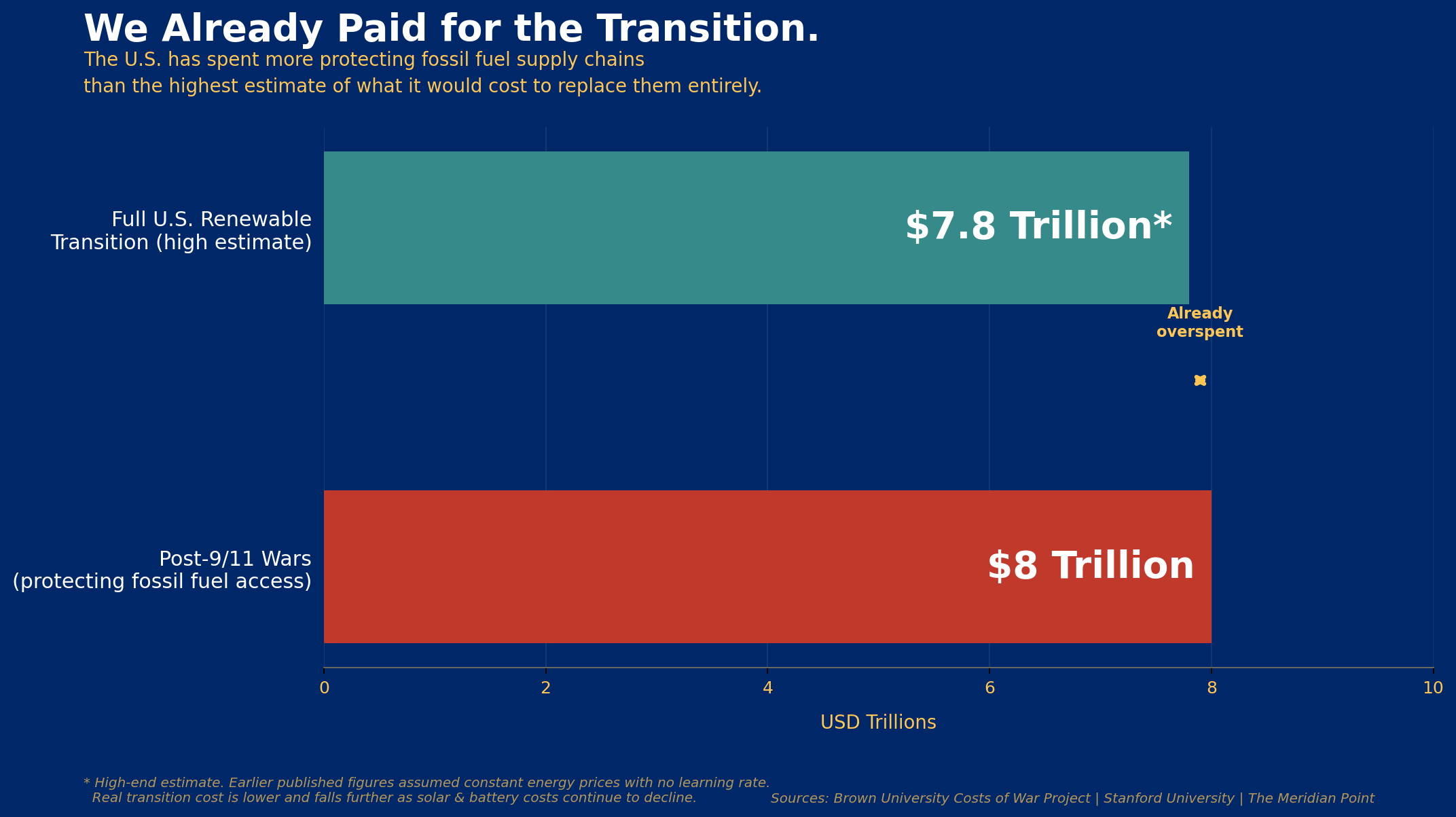
The comparison is stark. We have already spent more protecting fossil fuel supply chains than the high-end estimate of what it would cost to eliminate our dependence on them entirely. The $8 trillion in post-9/11 war costs alone exceeds every credible estimate of the renewable transition cost. And the $81 billion annual peacetime military bill keeps running regardless.
This is not an argument about whether those wars were right or wrong. That debate belongs elsewhere. This is a supply chain cost analysis. When someone says the energy transition is too expensive, the honest answer is: compared to what we're already paying, it isn't.
A Plan That Doesn't Require a Political Debate
This is not a left or right argument. You don't need to hold any particular view on climate science to find the case compelling. You just need to believe in supply chain resilience, cost trajectory, and not being held hostage by a shipping lane you don't control.
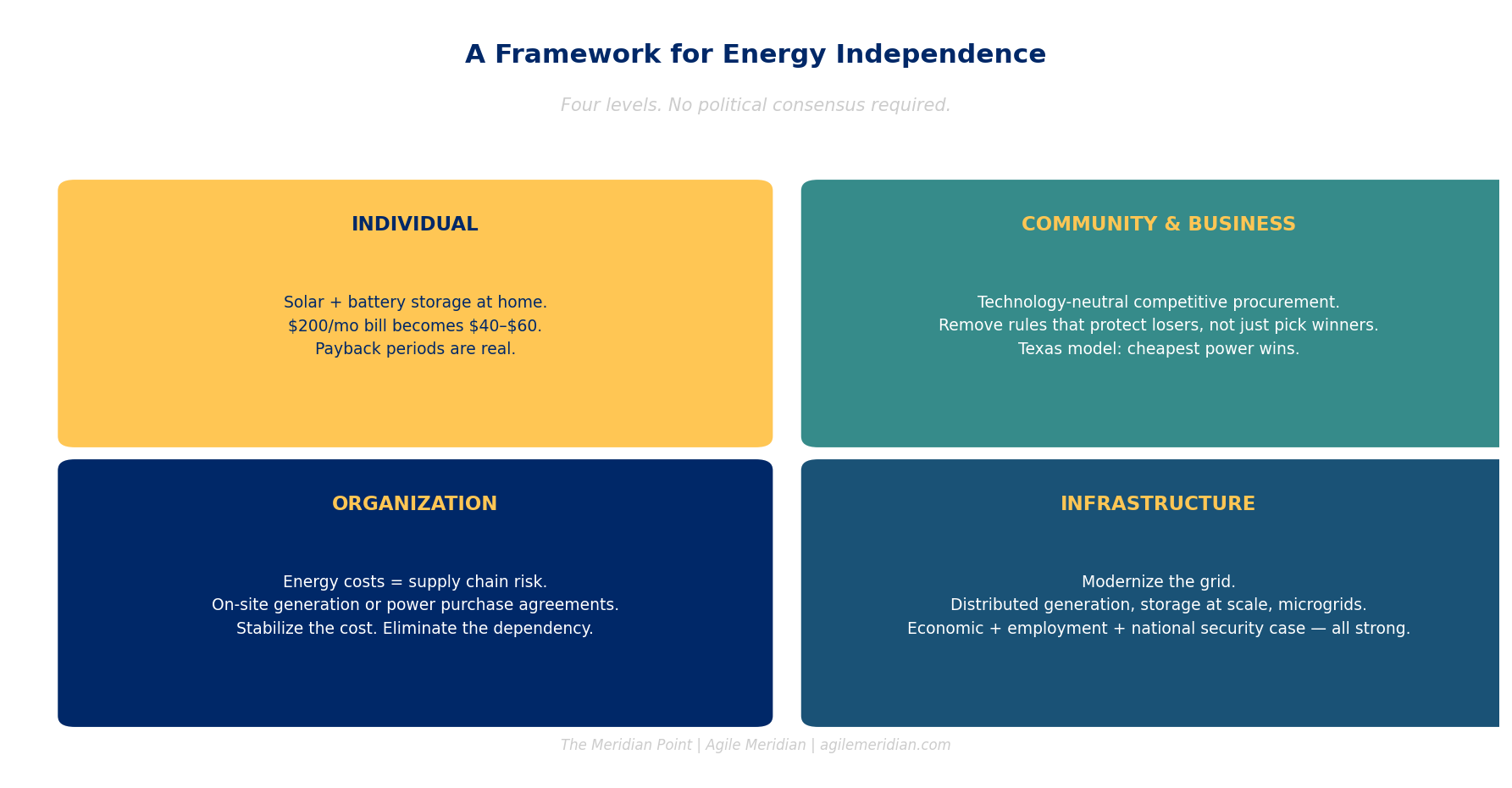
So here's a practical framework for how the transition gets done, at every level.
At the individual level: Solar on the roof, a battery in the garage. Generation cost approaches zero. A $200 monthly electric bill becomes $40 to $60. The technology is proven. The payback periods are real. This is no longer early adopter territory. If you live in a condo or apartment, balcony solar and a small battery system can still put a meaningful dent in your bill and spin your meter backwards if you install enough capacity.
At the community and business level: Push for technology-neutral competitive procurement. This is the single highest-leverage policy change available. It doesn't pick winners. It removes the rules that protect losers. Texas adopted this model not out of environmental conviction but out of economic pragmatism. The result: more renewable energy produced than any other state, driven by capitalists who wanted the cheapest power available. California has more renewables as a percentage of total energy produced, achieved through regulation rather than market competition. Both approaches are working. The point is that the policy framework matters.
At the organizational level: Your energy costs are a supply chain risk. Every facility you power through an on-site renewable system or a power purchase agreement is a cost you've stabilized and a dependency you've eliminated. On-site generation also reduces your demand on the grid, which lowers the infrastructure investment required system-wide. That's not an ESG statement. That's risk management and network economics. The CFOs who understand this are already moving.
At the infrastructure level: The grid needs modernization. But distributed generation and strategically placed storage reduce the scale of that modernization required. You don't need to double the transmission grid if enough generation moves to the edge of the network. Microgrids, smart demand management, and local storage change the math on centralized infrastructure investment significantly.
What Disrupting Big Oil Actually Looks Like
People imagine disrupting fossil fuels as a dramatic confrontation. It isn't. It's a thousand quiet decisions that collectively shift where money flows.
When a municipality signs a long-term power purchase agreement for solar instead of locking in a gas contract, that's a disruption. When a manufacturer installs on-site generation and removes itself from the grid for baseload power, that's a disruption. When a developer builds a neighborhood with solar and shared storage built in from day one, that's a disruption. When an individual stops buying gas for transportation because they charge their car on sunshine, that's a disruption.
None of these require a policy win. None of them require a political consensus. They require economics, and the economics are there.
Glenn Marshall, my collaborator and the person who first walked me through the Wright's Law data on solar and batteries, put it plainly: "My energy doesn't require a navy escort from halfway around the world. It's free, with free delivery."
That sentence contains the entire argument.
The fossil fuel model is expensive not just because of the cost of extraction. It's expensive because of everything required to protect access to it: military infrastructure, diplomatic relationships, insurance against supply disruption, price volatility built into every contract. All of that cost disappears when your energy source is local.
Free Energy. Free Delivery. Free Security. And Better Health.
There's a dimension to this transition that rarely gets included in the cost calculations: health.
Mark Jacobson and his team at Stanford University calculated that the savings in healthcare costs alone, from eliminating the air pollution produced by fossil fuel combustion, combined with lower electricity costs once the transition is complete, would pay for the entire U.S. renewable transition in approximately six years. Not over decades. Six years.
That's before you factor in what Glenn Marshall calls the compounding dividend of the model: free energy for everyone, everywhere, with free delivery, and energy security that doesn't depend on a shipping lane, a diplomatic relationship, or a defense budget.
Fossil fuel dependency is a security vulnerability. Free energy is sitting on everybody's rooftop, the way it always has been. What's changed is that this just became impossible to ignore for people who weren't paying attention before.
The Hormuz moment is the horse manure crisis of energy. The car was already here. The crisis just made the horse unbearable.
Free energy. Free delivery. Free security. No invoice. No navy. No Hormuz.
The Window Is Open. It Won't Stay Open.
The organizations and communities that move in the next five years will have structurally lower energy costs by the 2030s. That's a competitive advantage in manufacturing, in logistics, in data infrastructure, in agriculture, in virtually every sector that runs on power, which is every sector.
The organizations that wait will still be paying for energy priced by events they can't control, in a market they can never stabilize, through supply chains that remain permanently vulnerable.
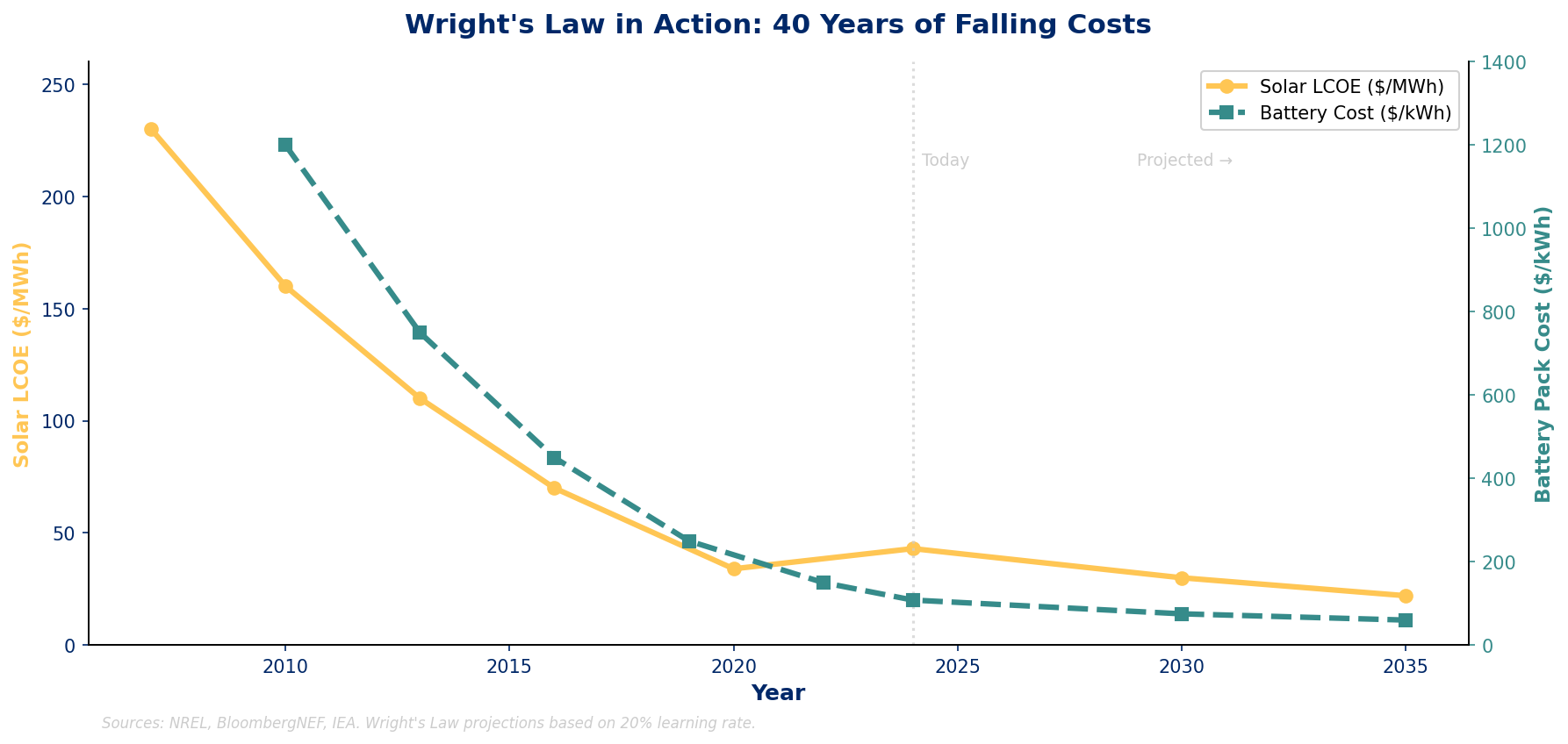
Wright's Law doesn't wait for consensus. The cost curve on solar and batteries compounds whether we're paying attention or not. The transition is happening. The only variable is who captures the advantage of being early and who absorbs the cost of being late.
The sun is already up. The question is whether you're catching it.
Go deeper:
- We're Living in 1903 for Electricity — the Wright's Law foundation this article builds on
- Episode 165: The Energy Revolution: Why Your Electric Bill Can Drop 70% — the fireside chat with Glenn Marshall where the numbers came alive
Kumar Dattatreyan is the co-founder of Agile Meridian and co-creator of The Disruptor Method. He hosts The Meridian Point Podcast, where he explores disruption and innovation with leaders across industries. If you want to explore what energy transition means for your organization's strategy, book a call at https://tidycal.com/coachkumar/30-minute-meeting