Robust Theme
Dec 09, 2019 2020-04-08 7:40Robust Theme


The Collaboration Tax: When Teamwork Slows Decisions
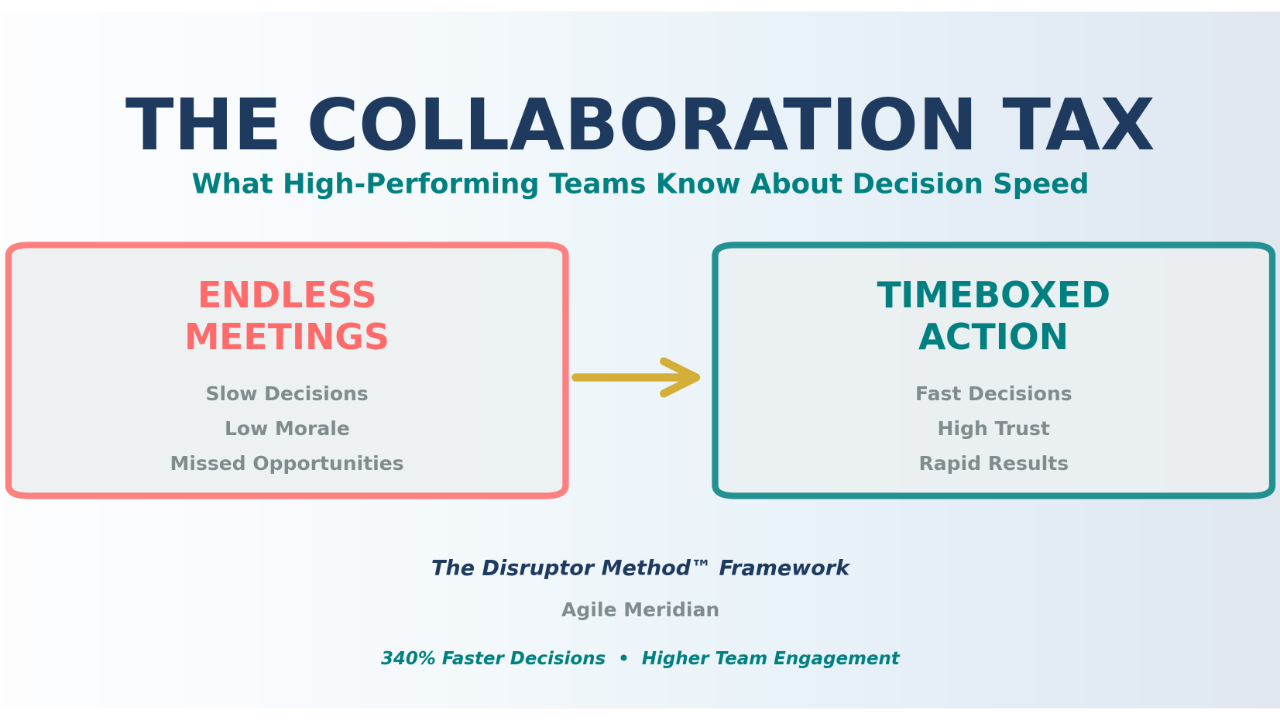
The Collaboration Tax: What High-Performing Teams Know About Decision Speed
Your leadership team spent three hours in a meeting yesterday. You walked out with two action items and a commitment to "circle back" next week. Sound familiar?
Here's the uncomfortable truth: More collaboration isn't making you more agile. It's bleeding you dry.
Every Fortune 500 company I've worked with tells me they want "more collaboration" and "better alignment." Then they wonder why decisions take weeks, why their best people are updating their LinkedIn profiles, and why that nimble startup just ate their lunch.
The problem isn't collaboration itself. The problem is collaboration without structure, without timeboxes, without a decision protocol. What most organizations call "collaborative culture" is actually decision paralysis wearing a friendly mask.
The Hidden Tax on Your Business
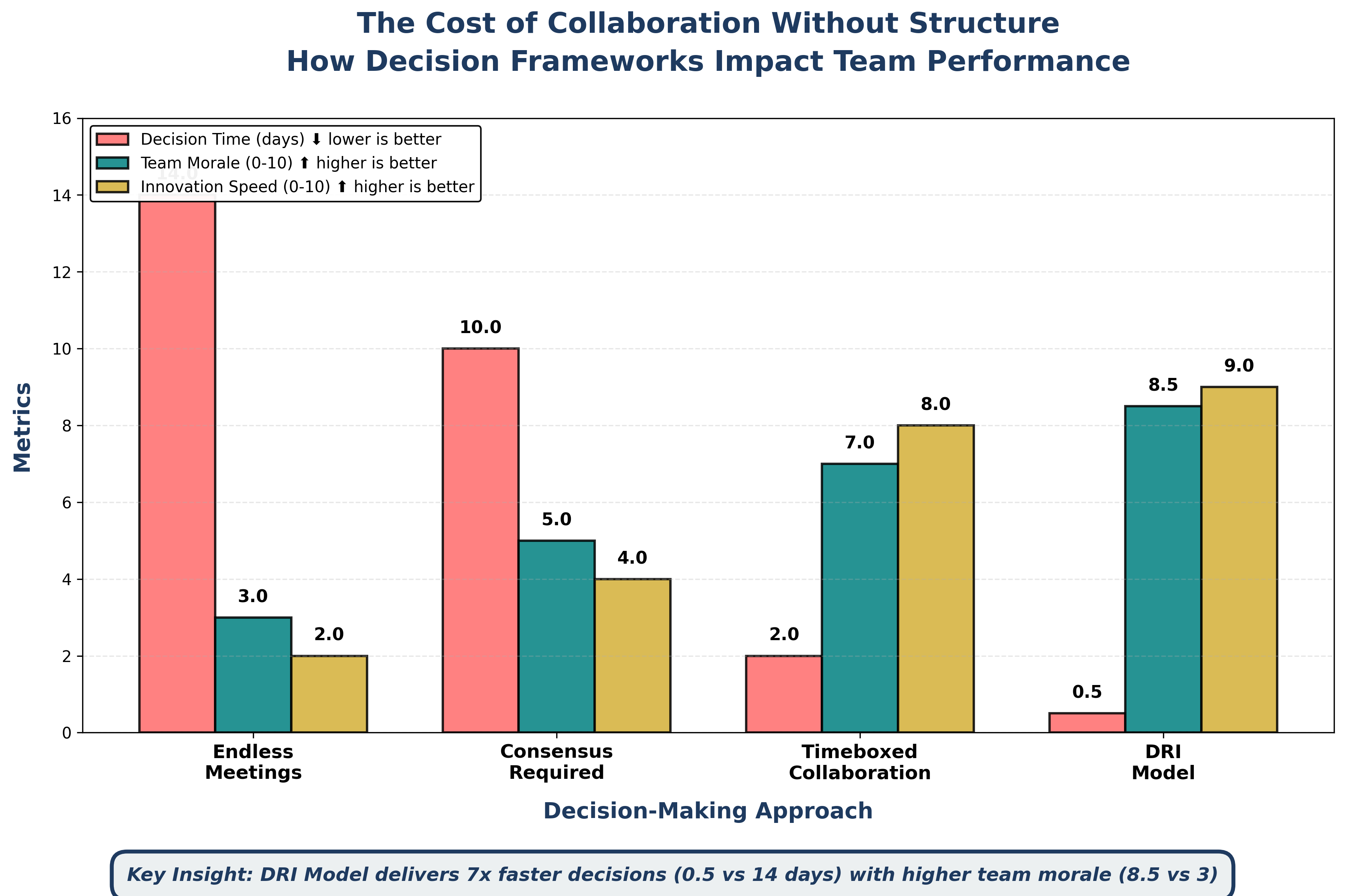
Let's talk numbers. The average executive spends 23 hours per week in meetings. For senior leaders, that climbs to 28 hours. That's 70% of a standard workweek sitting in conference rooms or on Zoom calls.
But here's what really matters: How many of those hours actually produce decisions?
In organizations without a clear decision framework, I've seen leadership teams spend six weeks deciding on a software vendor. Six weeks. Meanwhile, a competitor made the same decision in 48 hours using a timeboxed approach and moved on to implementation.
The collaboration tax shows up in three devastating ways:
Decision Delay Costs. Every day you don't decide is a day your competitor moves ahead. When it takes two weeks to schedule a meeting, another week to gather input, and a third week for follow-up discussions, you've burned three weeks on what should have been a three-hour decision.
Morale Erosion. Your high performers didn't sign up to attend seven hours of status meetings per week. They signed up to build things, solve problems, and drive results. When collaboration becomes their full-time job, they start looking for the exit.
Innovation Stagnation. Breakthrough ideas die in committee. By the time you've achieved consensus across eight stakeholders and three departments, the market opportunity has closed or someone else has seized it.
Why "More Collaboration" Backfires
The mandate comes down from the C-suite: "We need to be more collaborative." It sounds like motherhood and apple pie. Who could argue with that?
So what happens? More meetings get scheduled. More stakeholders get added to distribution lists. More sign-offs get required before anything can move forward. Decision-making authority gets diffused across so many people that nobody actually owns the outcome.
One manufacturing client told me about their "alignment meetings"—two-hour sessions where 15 people sat around a table, each representing their department's interests. Every decision required buy-in from all 15. The result? Three months to approve a process change that their competitor implemented in two weeks.
The fatal flaw in "more collaboration" thinking is the assumption that involving more people automatically produces better decisions. It doesn't. It produces slower decisions, diluted accountability, and exhausted teams.
Research from Harvard Business School found that collaborative activities have increased 50% over the past two decades, but innovation output has remained flat. More talk doesn't equal more results.
The Timebox Principle: Bounded Discussion, Unlimited Input
Here's what high-performing teams understand: Collaboration needs structure. Specifically, it needs timeboxes.
A timebox is a hard time limit on discussion and decision-making. Not a guideline. Not a target. A non-negotiable boundary that forces resolution within a defined period.
When I work with leadership teams, we implement a simple rule: Every decision gets a timebox. For tactical decisions, that might be 15 minutes. For strategic choices, maybe 45 minutes. But there's always a box around it.
Within that timebox, input is unlimited. Anyone can contribute. Every perspective gets heard. We encourage robust debate and even conflict—as long as it's productive.
But when time expires, the decision happens. No extensions. No "let's table this for next week." The decision gets made, period.
This forces teams to focus. Instead of circular discussions that revisit the same ground repeatedly, conversation becomes sharp and efficient. People come prepared because they know time is limited. The chatterers learn to be concise. The quiet ones find their voices because there's space for them.
One Fortune 50 client implemented timeboxed decisions across their product organization. Decision-making velocity increased by 340%. That's not a typo. Decisions that previously took 12-14 days were happening in 3-4 days.
The DRI Model: When Consensus Fails, Who Decides?
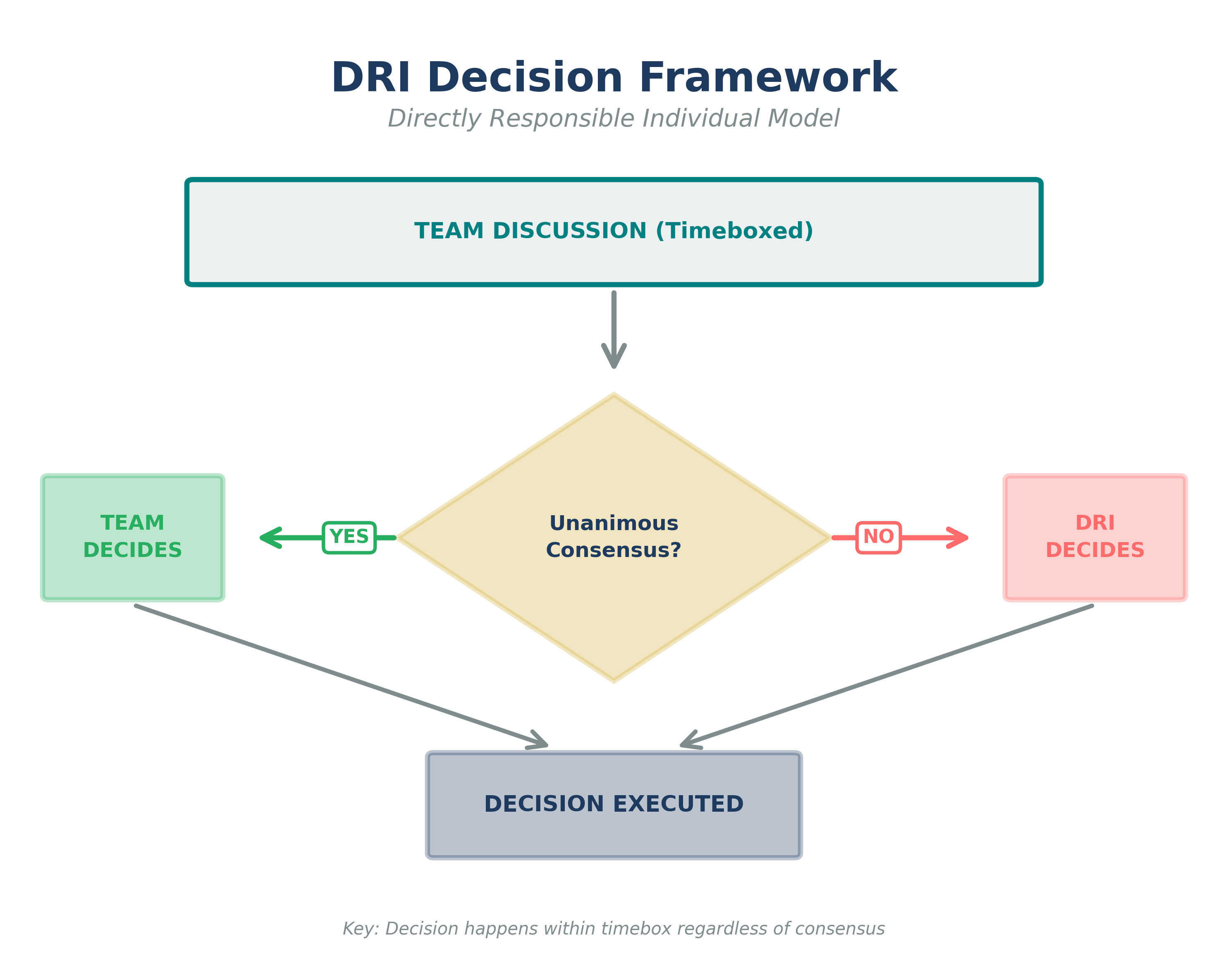
But here's the question that makes executives nervous: What happens when time runs out and the team hasn't reached consensus?
This is where most organizations fail. They extend the meeting. They schedule a follow-up. They create a task force. They do anything except make a decision.
High-performing teams take a different approach. They use the DRI model: Directly Responsible Individual.
Here's how it works:
Before any timeboxed discussion begins, the team identifies a DRI—the person directly responsible for the decision. Not the person who implements it or the person who suggested it. The person who owns the outcome.
The DRI participates in the discussion just like everyone else. They listen. They gather input. They push for consensus.
If the team reaches unanimous agreement within the timebox, great. The team's decision stands and the DRI ensures execution.
But if consensus fails and time expires, the DRI makes the call. Immediately. Right there in the room.
The key is the protocol is known upfront. Everyone understands that consensus is the goal, but the DRI has the authority to decide if consensus can't be reached. This creates a fascinating dynamic: Teams work harder to reach consensus because nobody wants to be overruled. But they also work faster because they know endless debate won't save them from a decision.
I've seen DRIs make decisions that half the team initially disagreed with, only to have those team members later admit it was the right call. Why? Because action beats perfection. A good decision executed today beats a perfect decision that happens next quarter—or never.
The Emergency Protocol: When Speed Trumps Everything
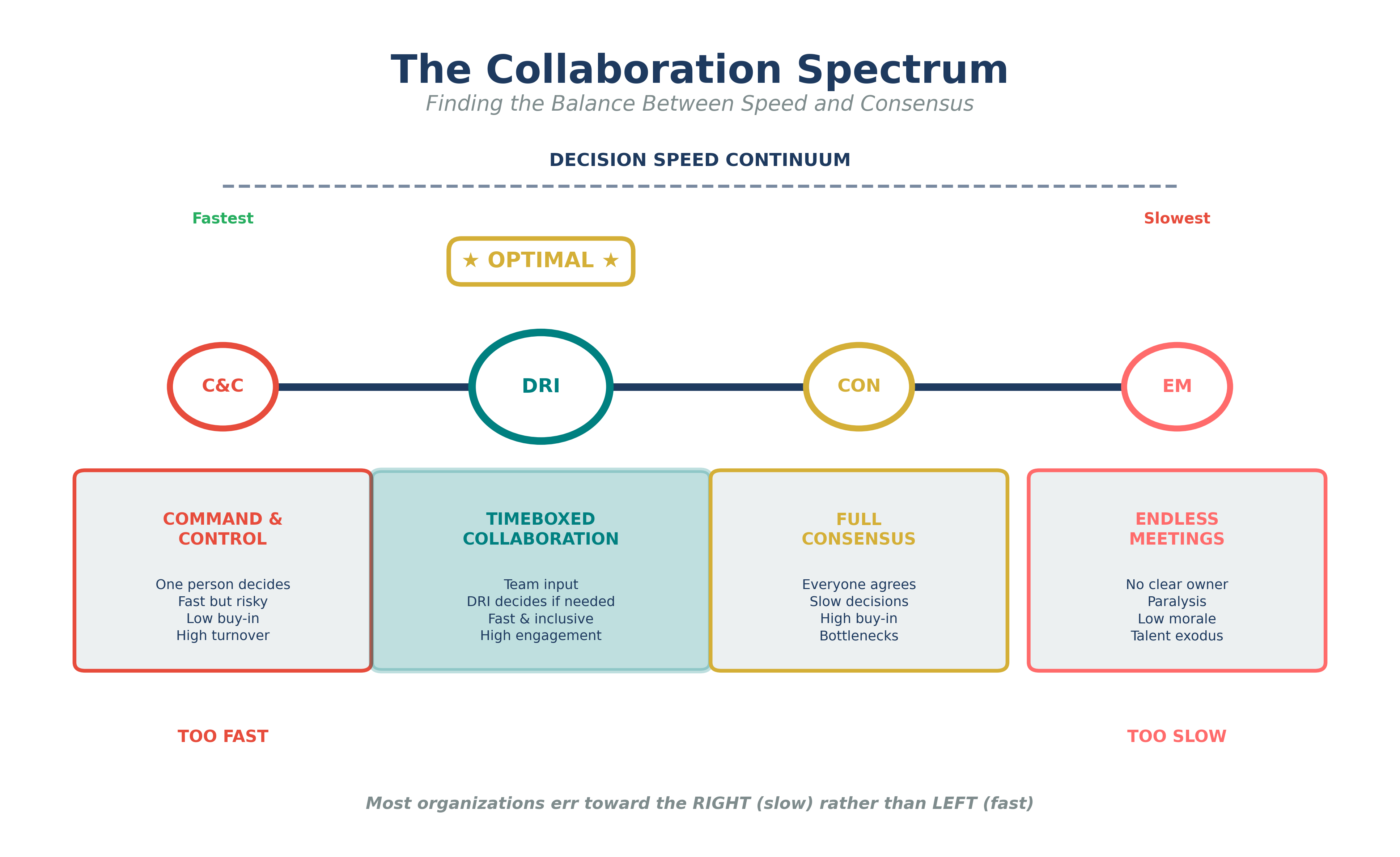
There's one more piece to this puzzle: emergency decision-making.
Most collaborative frameworks break down in a crisis. When your manufacturing line goes down, you don't have time for timeboxed discussion and DRI protocols. You need someone to make the call right now.
This is where the "war chief" concept comes in—borrowed from the Haudenosaunee Confederacy, one of the oldest participatory democracies in North America.
In normal times, the Confederacy made decisions through extensive collaboration and consensus-building. But when under attack, a designated war chief took command. No debate. No voting. Immediate action.
Your organization needs the same mechanism.
Define ahead of time what constitutes an emergency. Customer data breach? Emergency. Regulatory violation? Emergency. Quarterly planning meeting? Not an emergency.
Designate who has war chief authority for different types of emergencies. Maybe it's the CEO for company-wide crises. The CTO for technical emergencies. The head of operations for supply chain disruptions.
When an emergency hits, the war chief makes rapid-fire decisions. The team provides information and executes, but they don't debate. Collaboration resumes once the emergency passes.
I watched this play out with a client facing a critical security vulnerability. Their CISO invoked war chief protocol, made five major decisions in 30 minutes, and had fixes in production within four hours. Under their normal collaborative process, those decisions would have taken two weeks minimum.
Building the Cadence of Accountability
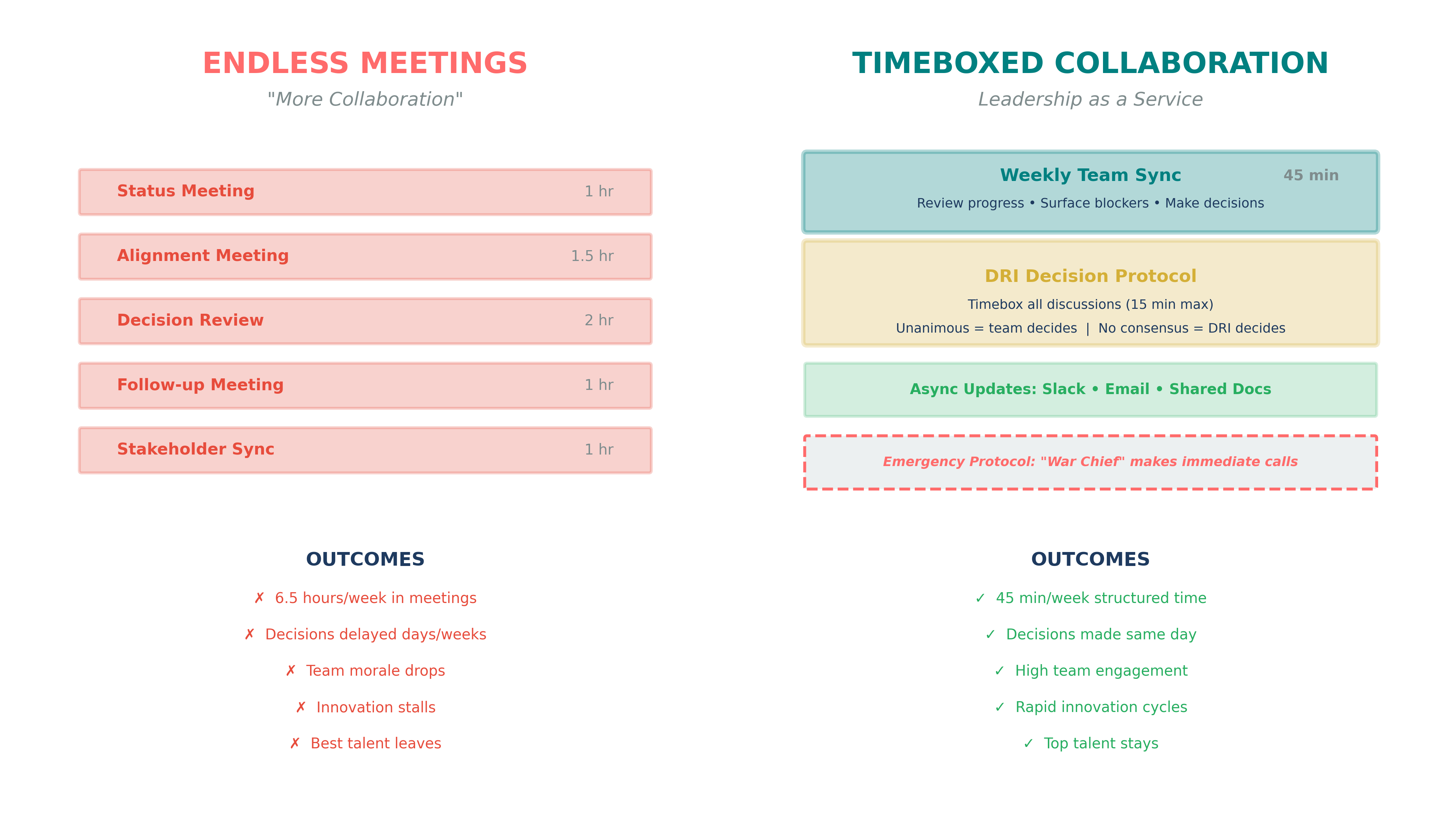
Timeboxed decisions and DRI protocols only work if you have the right meeting cadence. Too many meetings and you're back to calendar hell. Too few and decisions languish.
We typically establish weekly synchronization meetings for leadership teams—45 minutes, no more. The agenda is straightforward:
Review the Kanban board showing active initiatives and blockers. Surface any decisions that need to be made. Apply timeboxes to each decision. Make the calls. Document who owns what. Done.
Between meetings, collaboration happens asynchronously. Slack discussions, shared documents, email threads. When something needs a decision, it goes on the board for the next sync.
This cadence creates accountability without drowning people in meetings. Leaders spend 45 minutes a week in structured decision-making instead of 15 hours in endless discussions.
The transformation is remarkable. One VP of engineering told me: "I got my calendar back. I'm actually doing my job instead of just talking about doing my job."
The Difference Between Consensus and Consent
Here's a crucial distinction most organizations miss: Consensus means everyone agrees. Consent means everyone can live with it.
Consensus is beautiful when you can get it. But requiring consensus on every decision is a recipe for paralysis.
Consent is more pragmatic. It asks: Can you support this decision even if it's not your first choice? Do you have any fundamental objections that would prevent you from supporting execution?
In the DRI model with timeboxed decisions, we're really seeking consent, not consensus. The goal isn't to make everyone happy. The goal is to make the best decision possible with available information, then move forward with full team support.
This requires psychological safety. Team members need to know they won't be punished for disagreeing, but they also need to understand that once a decision is made, the debate ends and execution begins.
Common Objections and How to Handle Them
Every time I introduce these concepts to a leadership team, I hear the same objections:
"This feels too rigid. We need flexibility."
The timebox isn't rigid—it's a boundary. You're free to be as flexible as you want within it. What's rigid is the calendar full of three-hour meetings that accomplish nothing. Structure creates freedom by clearing space for actual work.
"Our decisions are too complex for timeboxes."
I've seen teams make billion-dollar acquisition decisions using this framework. I've seen them navigate regulatory compliance, competitive threats, and organizational restructuring. Complexity isn't the issue. Discipline is.
"What if the DRI makes the wrong decision?"
They will. Sometimes. And that's okay. A wrong decision you can course-correct tomorrow is better than the right decision that happens three months from now. Speed creates learning opportunities. Perfection creates stagnation.
"Our culture values everyone's input."
So does this framework. Everyone's input happens inside the timebox. What this framework doesn't value is endless circular discussion that prevents decisions. There's a big difference.
Three Actions You Can Take This Week
You don't need to transform your entire organization to start seeing benefits. Here are three specific actions you can implement immediately:
Pick one recurring meeting and apply a timebox. Choose a meeting that typically runs long and involves multiple stakeholders. For the next occurrence, establish a clear timebox for each agenda item. Watch what happens to both efficiency and decision quality.
Identify three decisions that are currently stuck. Look at your backlog of pending decisions. Pick three that have been lingering for more than two weeks. Assign a DRI to each one. Give them 48 hours to make the call using input already gathered. See how many actually needed more time versus more courage.
Create your emergency protocol. Sit down with your leadership team and define what constitutes an emergency. Designate war chiefs for different types of crises. Document the protocol. Put it somewhere visible. Hope you never need it, but know exactly what to do if you do.
The Path Forward
The collaboration tax is real. It's showing up in your calendar, your team's morale, and your competitors gaining ground while you're stuck in alignment meetings.
But you don't have to pay it.
High-performing teams have figured out that collaboration without structure is just expensive talking. They've implemented timeboxes, DRI protocols, and clear decision-making frameworks that preserve the benefits of collective input while eliminating the paralysis of endless consensus-seeking.
The question isn't whether you'll adopt these practices. The question is whether you'll do it before or after you've lost your best people and your market position.
Your next leadership team meeting is the perfect place to start. Put a timebox on it. Watch what happens.
The time you save might just be your competitive advantage.
Related Podcast Episodes:
Breaking the Leadership Bottleneck: How Organizational Structure Makes or Breaks Innovation
Servant Leadership vs Leadership as a Service: Which Comes First?
Meeting Culture as a Mirror: How 30 Minutes Reveals Your Company's DNA
Are you or is your company facing decision paralysis? Let's talk about how The Disruptor Method can transform your leadership team's effectiveness. Book a call!