Robust Theme
Dec 09, 2019 2020-04-08 7:40Robust Theme


Team Conflict as a Growth Engine, Not a Problem

Not budget constraints. Not market competition. Not even talent gaps. The quiet, polite dysfunction sitting around your conference table—that's what's killing your innovation capacity.
Here's what most executives don't realize: conflict-averse teams plateau while conflict-engaged teams innovate. The difference isn't talent, resources, or strategy. It's whether your team has mastered the art of productive disagreement.
The Silence That Costs Millions
Picture this: Your leadership team meets weekly. Everyone's professional, courteous, aligned. No raised voices. No uncomfortable moments. Decisions happen smoothly.
Sounds ideal, right?
It's actually a disaster.
Because underneath that polished surface, real disagreements simmer. Critical perspectives go unvoiced. Team members smile and nod, then return to their departments and quietly work around the decisions they never truly supported.
This is what organizational psychologists call "artificial harmony"—and it's extraordinarily expensive.
When teams avoid conflict:
- Innovation dies because challenging the status quo feels risky
- Decision quality plummets because diverse perspectives never collide
- Implementation fails because uncommitted team members sabotage subtly
- Trust erodes because people lose faith in each other's authenticity
- Talent leaves because smart people refuse to work in environments where honesty is punished
The cost? One Fortune 500 client discovered their conflict-avoidant culture was costing them 18 months on every major initiative. Eighteen months of market opportunity lost because executives were too polite to argue.
The Five-to-One Ratio: Quantifying Healthy Tension
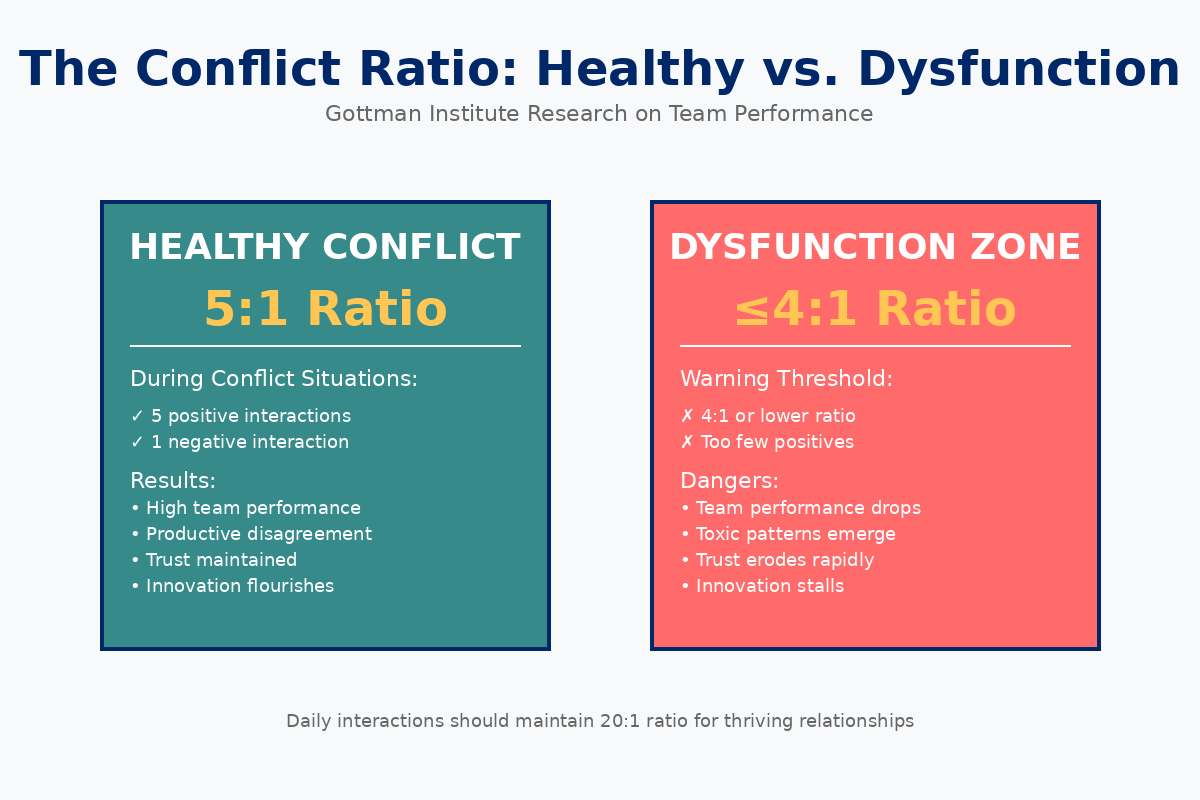
Here's the surprising science: The Gottman Institute, after studying hundreds of thousands of relationships, identified precise ratios that predict success or failure.
Twenty positive interactions to one negative interaction.
That's what thriving relationships maintain during everyday interactions. But even during heated conflict, successful couples still maintain five positive interactions for every negative one.
But here's what shocked researchers: When that ratio drops below five-to-one—approaching four-to-one—relationships begin sliding toward dysfunction. Four-to-one is the danger zone where even couples who've been together for years start heading toward separation.
The margin between high-performing relationships and toxic ones is razor-thin. Just one less positive interaction per negative can mark the difference between breakthrough and breakdown.
This applies directly to your leadership team. The teams I work with who maintain at least a five-to-one ratio during strategic debates—acknowledging contributions, showing respect, maintaining humor even in disagreement—those teams innovate relentlessly.
The teams slipping below that threshold? They're the ones calling me six months later because their transformation initiative stalled and trust has evaporated.
Conflict Isn't the Problem—It's the Symptom
When a relationship coach works with struggling couples, they don't treat the conflict itself. They treat what's underneath.
The same principle applies to dysfunctional leadership teams.
The visible conflict—whether over budget allocation, strategic direction, or org structure—is merely the symptom. The real issues live in a world most teams never access:
The Hidden Dynamics:
1. Misaligned Definitions One executive defines "collaboration" as consensus-building. Another sees it as efficient input-gathering before decisive action. They use the same word but mean completely different things. Every "collaborative" meeting frustrates both.
2. Unexamined Psychological Profiles Your CFO is deeply introverted and builds trust slowly through consistent delivery. Your CMO is extroverted and builds trust through personal connection and enthusiasm. Neither understands why the other seems cold or overwhelming. Trust never forms.
3. Competing Incentive Structures Your sales leader is bonused on quarterly revenue. Your product leader is measured on customer lifetime value. Their goals directly conflict, but nobody's acknowledged it. Every meeting becomes a subtle battle.
4. Organizational Scar Tissue Three years ago, leadership made a decision that failed spectacularly. Nobody's discussed it since, but everyone references it obliquely. New initiatives die because nobody wants to make "that mistake again"—except nobody remembers what the actual mistake was.
These hidden dynamics create what I call "the world underneath"—the unspoken patterns that determine whether conflict becomes breakthrough or breakdown.
The Tuckman Trap: When Teams Form Incorrectly
Every team goes through predictable developmental stages: Forming, Storming, Norming, Performing.
Most leadership teams never make it past Storming. Or worse—they skip Storming entirely and wonder why they never reach high performance.
Here's the brutal truth: Every time a team member leaves or a new person joins, the team cycles through these stages again. That VP you just hired? Your team just reset to Forming, whether you acknowledge it or not.
When teams form incorrectly, organizational scar tissue develops:
A group of logical, data-driven executives keeps pushing facts and figures at a more relationship-oriented COO. They interpret her requests for understanding team impact as weakness. She interprets their analysis as cold disregard for people. Trust craters. Nobody addresses it directly. The scar tissue hardens.
Five years later, the company culture is "data-driven" in name but paralyzed by unspoken resentment.
The tragedy? Both sides are right. Decision-making requires both rigorous analysis and genuine consideration of human impact. But the team never learned to productively integrate these perspectives because they formed incorrectly.
The Disruptor Method™: Rebuilding Team Foundations
Over two decades of transformation work, we've identified specific interventions that shift teams from artificial harmony to productive conflict. We've codified these into what we call The Disruptor Method™™—starting with leadership team dynamics.
Phase 1: Psychological Assessment and Awareness
Most leadership team dysfunction stems from one root cause: team members fundamentally don't understand each other.
We begin with psychometric assessment using tools like Predictive Index or DISC. This isn't pop psychology. It's systematic profiling that reveals:
How people prefer to communicate: Direct vs. relationship-building, detail-oriented vs. big-picture, fast-paced vs. deliberate
How they approach decisions: Data-heavy vs. instinct-driven, risk-seeking vs. risk-averse, individual vs. collective
How they show up in conflict: Confrontational vs. withdrawn, solution-focused vs. process-focused, emotional vs. logical
How they build trust: Through consistency vs. connection, slowly vs. quickly, by doing vs. by relating
The assessment itself isn't the value. The value comes when seven executives realize: "Oh. When I speak to you in this way, your eyes glaze over because we process information completely differently."
Or: "You've been trying to build trust with me through warmth and personal connection. But I'm deeply introverted, so I've been interpreting that as oversharing and pulling back. We've been sabotaging each other unintentionally."
These realizations are often emotional. I've seen hardened executives break down when they understand their colleague's perspective for the first time.
But awareness alone isn't enough. Teams need structure.
Phase 2: Building Collaboration Maturity
Once teams understand each other psychologically, they need a systematic way to develop their collaboration capability. This is where our Collaboration Maturity Model™ (CMM) becomes essential.
The CMM measures teams across eight elements spanning four maturity levels—from basic participation and visibility through alignment and consensus, to consistency and predictability, and finally to sustained value delivery and operationalized innovation.
Here's what's critical about conflict in this progression: Teams can't achieve true alignment (Level 2) without first establishing trust through genuine participation and shared visibility. And they can't reach consensus without learning to navigate productive disagreement.
Most leadership teams plateau at Level 1—everyone participates, visibility exists, but they can't achieve alignment because they haven't learned to handle conflict constructively. They either avoid disagreement (artificial harmony) or let it devolve into toxic patterns (destructive conflict).
The breakthrough happens when teams learn to set their conflict bar appropriately. This means finding the sweet spot where:
- Diverse perspectives collide constructively
- Respectful disagreement is normalized
- The best ideas win regardless of source
- Decisions get made without endless debate
- No organizational scar tissue forms
For conflict-avoidant teams, we need to increase productive disagreement to achieve real alignment. For teams with toxic conflict, we need to dial back destructive patterns while maintaining healthy tension.
(We'll explore the full Collaboration Maturity Model™ framework in a future article—it's the systematic approach behind sustainable organizational transformation.)
Phase 3: Building the Love Account
Here's language teams don't expect in business settings: the love account.
Relationship research shows that emotional bank accounts determine resilience. When your positive-to-negative ratio is high, you can weather storms. When it's depleted, minor issues trigger major reactions.
The same applies to leadership teams.
If your CFO and CMO have worked together for three years with minimal positive interaction, their "account" is depleted. When they disagree on budget allocation, they don't give each other benefit of the doubt. The CMO thinks: "He's such a stingy bean-counter." The CFO thinks: "She's irresponsible with resources."
But if they've invested in that account—acknowledged each other's contributions, shown genuine interest in perspectives, supported each other in meetings, celebrated wins together—they approach disagreements differently.
The CMO thinks: "He sees something I'm missing. Let me understand his concern." The CFO thinks: "She wouldn't push this hard without good reason. What am I not seeing?"
Same disagreement. Completely different dynamic.
We help teams rebuild these accounts through structured exercises:
- Acknowledging specific contributions publicly
- Understanding personal motivations beyond job titles
- Sharing vulnerabilities in controlled environments
- Celebrating team wins before individual achievements
It feels soft. It's actually hardheaded business strategy. Because teams with full emotional accounts make better decisions faster.
Phase 4: Conflict Protocols and Psychological Safety
Once teams understand each other and have built trust, they need structure for productive disagreement.
This is where frameworks like Leadership as a Service™™ become powerful.
The Leadership as a Service™™ Model:
- A Directly Responsible Individual (DRI) is appointed for each decision
- The DRI assembles a team with relevant expertise
- The team has a timeboxed period to reach unanimous consensus
- If achieved, the team's decision stands—even if it contradicts the DRI's view
- If not reached within the timebox, the DRI decides
- The decision gets executed regardless
This structure solves the "collaboration tax" problem. It enables:
- Bounded debate: Everyone gets heard, but meetings don't become endless
- Psychological safety: Unanimous override protects against authority bias
- Decisive action: Decisions happen whether consensus emerges or not
- Distributed authority: Expertise trumps hierarchy
I've watched this transform teams. The conflict doesn't disappear—it intensifies. But it becomes productive. Teams argue fiercely about the right answer, then commit fully to the decision and execute with unity.
Phase 5: Addressing the Scar Tissue
This is the hardest part. Teams have history.
Failed initiatives nobody discusses. Betrayed commitments everyone remembers. Power struggles that shaped current dynamics. Departures that were never processed.
We call it "emptying the glass." People arrive at transformation work with their glass full—of frustrations, biases, resentments, anxieties. There's no room for new approaches until we create space.
We facilitate sessions where teams surface this accumulated damage. Not to dwell on it, but to acknowledge it, understand its impact, and consciously move beyond it.
This is often where emotions emerge. Executives who've maintained professional composure for years finally express how a past decision made them feel excluded. How a colleague's behavior eroded their trust. How a structural choice undermined their department.
It's uncomfortable. It's necessary.
Because teams can't build new patterns on unacknowledged damage. The scar tissue has to be addressed, not ignored.
The Crisis Advantage: When Conflict Becomes Catalyst
Here's an unexpected pattern: teams that thrive during crisis often have mastered productive conflict.
Think about how Disney handles service failures. When a flight delay leaves a family arriving at midnight instead of mid-afternoon—exhausted, frustrated, their vacation already damaged—the front desk employee doesn't defensively explain that it's not Disney's fault.
Instead, they take ownership. "That sounds like a terrible start to your vacation. Let me make this right." Two complimentary tickets to tomorrow's dinner show. Immediate room upgrade. Breakfast delivered to the room in the morning.
The crisis didn't create Disney's service recovery capability. It revealed the foundation they'd built.
Why does this work? Because Disney had the conflict infrastructure in place long before the crisis:
- Employees trusted to make $2,500 decisions without approval
- Clear protocols for service recovery that everyone knows
- Psychological safety to acknowledge problems immediately
- Systems that enable bold solutions without bureaucratic delay
- Cultural expectation that making guests happy trumps policy
The same principle applies to leadership teams facing organizational crisis.
During the pandemic, one Fortune 500 client discovered their conflict capability determined survival speed. While competitors spent months in analysis paralysis, they pivoted strategy in weeks.
Why?
They had the conflict infrastructure in place. When market conditions collapsed:
- The leadership team could disagree intensely without breaking trust
- They had protocols for rapid decision-making under uncertainty
- They maintained the five-to-one ratio even under extreme stress
- They'd built psychological safety that enabled bold proposals
- They trusted each other enough to implement imperfect solutions fast
The crisis didn't create their capability. It revealed the foundation they'd built.
Companies that collapsed during the pandemic? Many had functional leadership teams on paper. But when pressure intensified, their artificial harmony shattered. Without real trust and healthy conflict mechanisms, they couldn't make the hard calls fast enough.
The Personal Connection: Why Relationship Skills Matter in Business
Here's what transformation professionals often miss: business relationships and personal relationships operate on identical principles.
The research on couples applies directly to leadership teams because the underlying dynamics are universal:
Safety is the foundation. When people feel psychologically safe, they contribute fully. When they don't, they protect themselves.
Connection precedes correction. Before you can challenge someone's thinking, they need to know you value them.
Conflict reveals what matters. Disagreements expose priorities, values, fears—the things worth fighting for.
Growth happens at the edge. Comfort zones don't produce breakthroughs. Constructive tension does.
One of my clients works with couples on the verge of dissolution. Her process: rebuild the love account first, then address the conflicts.
Most failing couples do the opposite. They try to solve the conflicts without rebuilding connection. It never works. The depleted emotional account means every disagreement triggers disproportionate reactions.
Business teams make the same mistake. They try to fix strategic disagreements without addressing the underlying relational bankruptcy.
Fix the relationship dynamics first. The strategic disagreements become manageable.
Three Immediate Actions to Shift Your Team Dynamic
You don't need a six-month engagement to start improving team conflict dynamics. Here are three interventions you can implement this week:
Action 1: Audit Your Positive-to-Negative Ratio
For your next three leadership meetings, track:
- Positive interactions (acknowledgments, building on ideas, expressing appreciation)
- Negative interactions (criticism, dismissiveness, interruptions, eye-rolling)
Calculate the ratio. If it's below four-to-one, your team is in danger zone.
Immediate fix: Start each meeting with specific acknowledgments. "Before we dig into the agenda, I want to recognize Sarah's work on the customer analysis—it shifted my thinking on pricing strategy."
This isn't corporate cheerleading. It's strategic emotional account building.
Action 2: Clarify Your Conflict Definition
Ask each team member privately: "On a scale of 1-10, how much conflict is healthy for our team?"
You'll discover wildly different answers. Your COO might say 3. Your CTO might say 8.
No wonder meetings feel wrong to someone.
Then facilitate a team conversation: "Where should we set our conflict bar? What does healthy disagreement look like for us? What behaviors cross the line?"
Get explicit agreement. Now you have a shared standard.
Action 3: Implement One Timeboxed Decision
Pick a real decision your team needs to make. Not huge, but meaningful.
Use Leadership as a Service™ structure:
- Appoint DRI
- Assemble team (3-5 people)
- Set timebox (30-45 minutes)
- Discuss with goal of unanimous consensus
- If not reached, DRI decides
- Execute the decision
Debrief afterward: What worked? What felt uncomfortable? What would we adjust?
Use it as a pilot. If it works, expand to more decisions.
The Ultimate Question: What's Your Team Actually Avoiding?
Here's the diagnostic that cuts through everything:
If your team could speak with complete safety and honesty, what would they say they're not saying?
In high-performing teams, the answer is: "Not much. We're pretty direct with each other."
In struggling teams, the answer reveals everything:
- "I don't think this strategy will work, but I'm not saying that."
- "I resent how decisions keep getting made without my input."
- "I don't trust three people on this team, so I work around them."
- "I think our CEO is taking us in the wrong direction."
- "I'm exhausted and considering leaving."
That gap—between what people think and what they voice—that's your innovation gap.
Every unspoken concern is a perspective that never influences decisions. Every suppressed disagreement is a blind spot you're driving with. Every relationship tension that goes unaddressed is scar tissue that accumulates.
The teams that close that gap—that create environments where difficult truths surface early and get addressed constructively—those are the teams that transform industries.
From Conflict Avoidance to Breakthrough Culture
Organizational transformation doesn't happen through better strategy or smarter technology. It happens when leadership teams learn to disagree productively.
Because once you have a team that can:
- Challenge each other without breaking trust
- Maintain high positive-to-negative ratios even during hard conversations
- Address conflicts early before they become scar tissue
- Make decisions decisively after thorough debate
- Commit fully to choices they initially opposed
...you've unlocked the hidden growth engine.
That team will out-innovate competitors with better resources. They'll execute faster than larger organizations. They'll attract and retain top talent. They'll pivot during crises while others freeze.
Not because they avoid conflict, but because they've mastered it.
The question isn't whether your team will face conflict. Market pressure, organizational growth, and change itself guarantee disagreement.
The question is whether you'll treat conflict as a problem to suppress or a breakthrough waiting to happen.
Take the First Step
Ready to assess your team's conflict dynamics?
Take our 2-minute Collaboration Health quiz to identify whether your team is conflict-avoidant, conflict-engaged, or somewhere in between.
Want to build conflict infrastructure in your leadership team? Schedule a 30-minute discovery call where we'll discuss your specific team dynamics and whether The Disruptor Method™ could accelerate your transformation.
Explore these concepts further:
- Episode 145: Relationship Coach Shares Surprising Advice - How relationship science applies to business
- Episode 111: Disrupting Teams: Building Innovative Cultures - Team dynamics and psychological safety
- Episode 133: Self-Awareness Is Broken in Corporate America - Building awareness that enables productive conflict
- View Full Playlist: The Meridian Point
About the Author:
Kumar Dattatreyan is the co-founder of Agile Meridian and host of The Meridian Point podcast. With over 20 years of coaching Fortune 50 companies, Kumar co-developed The Disruptor Method™ and the Collaboration Maturity Model™ to help leadership teams transform conflict from dysfunction into breakthrough. His approach combines psychometric assessment, relationship science, and practical frameworks to build teams that innovate through productive disagreement.