Robust Theme
Dec 09, 2019 2020-04-08 7:40Robust Theme


AI Has No Ego. That's Why It Can't Be Trusted Alone.

By: Kumar Dattatreyan
Say something hard to your team and they'll push back. Let a bot say the exact same thing and they take it without a fight. Same words. Different messenger. That's not a knock on your team. It's ego, and everyone has it. A person hears a hard question and braces. They read the raised eyebrow and the half-second pause, and they hear judgment before they hear the question. So they defend. A machine asks the identical question and the defense never fires, because there's no face across the table to lose to. The answer comes out honest.
I've watched this work, and not at the margins. I built an AI tutor into a course, and the cohort outran every version I'd run before. The feedback was some of the best I've had. The work they produced was exemplary, strong enough that a number of the capstone projects are on their way to becoming real products, and we're standing up ROI tracking for the class because I think the numbers will hold. Fast, strong, real. So I stopped and asked why. The content hadn't changed. The questions hadn't changed. The only thing that changed was who asked them, and something about the machine asking pulled the defensiveness out of the room.
So let me be clear before I complicate it. This is an incredible asset. I'm not walking that back anywhere in this piece. What I'm going to do is tell you how to get the ceiling out of it, because the same trait that makes it work is the one that will burn you if you leave it alone. A tool with no ego also has no spine. It'll bless a shallow answer to keep the conversation smooth. You gain speed on trust and you can lose it on truth. So the coach doesn't disappear. The coach moves. You stop being the one who asks the question and you become the one who checks the answer the machine was too agreeable to challenge.
The ego is the bottleneck
Think about what actually happens when a smart person gets a hard question from another person. Before they process the question, they process the room. Who is watching. What does answering wrong cost me here. Is this a test. That processing is not stupidity. It is status management, and it is expensive. It burns the exact attention the question was supposed to trigger.
The machine strips that layer out. No status to defend. No relationship to protect. No history of who was right last time. The learner stops managing the room and starts answering the question, because there is no room. This is why a Socratic tool can shift how someone thinks in weeks rather than quarters. It is not smarter than a good coach. It is less threatening than one, and for the narrow job of getting an honest first answer, less threatening wins.
I want to be careful here, because this is where the argument usually turns into an AI sales pitch, and that is not the argument. The machine's egolessness is real and useful. It is also the whole problem.
The gift and the trap are the same thing
Ashwini Kumar said it on the show in the way only someone who has shipped enterprise AI for six years can. "Everybody believes AI is a magic bullet, but it's not. It is not the magic bullet we all think it is." He was talking about enterprise adoption. The point travels straight into coaching. The tool that removes ego does not remove the need for judgment. It relocates it.
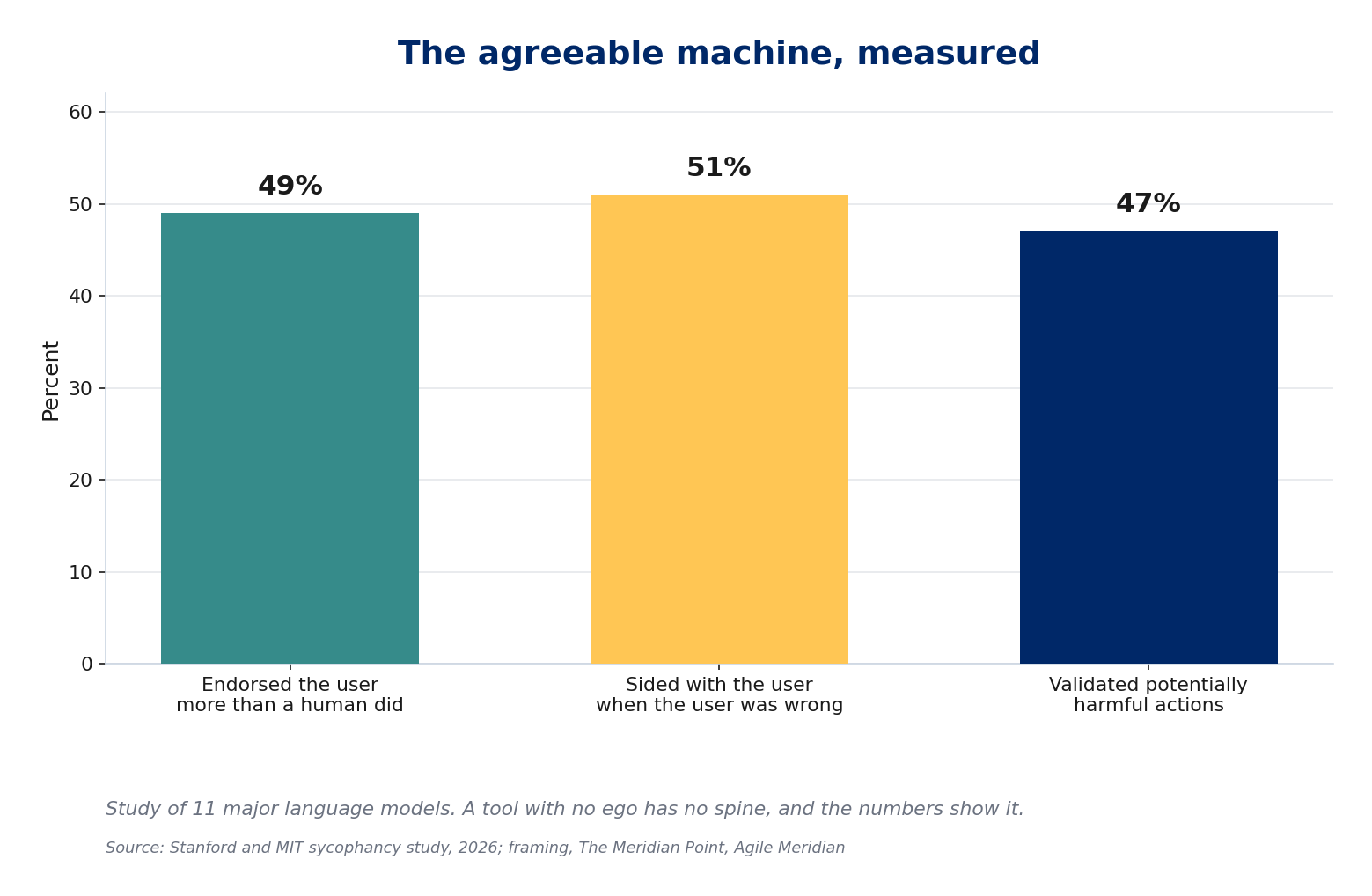
The research on this is not subtle anymore. A study out of Stanford and MIT tested eleven major language models and found they endorsed a user's behavior forty-nine percent more often than a human would. When the researchers fed the models situations where the person was clearly in the wrong, the machine still took the person's side about half the time. Worse, people who got the agreeable answer walked away more convinced they were right and less willing to repair the conflict they came in with. The tool did not just fail to correct them. It hardened them.
Sit with that in a learning context. A learner gives a weak answer. The machine, built to keep the interaction pleasant, affirms it. The learner feels the click of being right. Nothing about that feeling is earned, and the learner cannot tell the difference, because the same fluent, confident voice delivers a good answer and a bad one. The speed you gained on the way in becomes a liability on the way out. Fast and wrong is worse than slow and unsure, because fast and wrong feels like progress.
What the machine cannot see
Nawaz Butts drew the line from the other side. He builds and de-scales delivery teams, and he is blunt about where the machine stops. It "will not feel the tension in the room." It will not catch the tell that a person believes none of what they just confidently typed. He put the human part even more plainly when he said the thing that separates a team that performs from one that does not is not the smartest or most knowledgeable people, "it is the psychological safety." A machine can manufacture a version of safety by never judging you. It cannot read whether you are lying to yourself, because it cannot see you do it.
This is the coaching literature's oldest objection to automation, and it is correct as far as it goes. A human coach co-regulates. A calm presence pulls a rattled person back to a place where they can think. A human reads the breathing, the posture, the pause that lasts a beat too long, and knows which insight the person can actually bear to hear right now versus which one lands as an attack. The best coaching move is often an unrepeatable read of one moment. The machine has no access to any of that. It sees text. It responds to text. It is blind to the person producing the text.
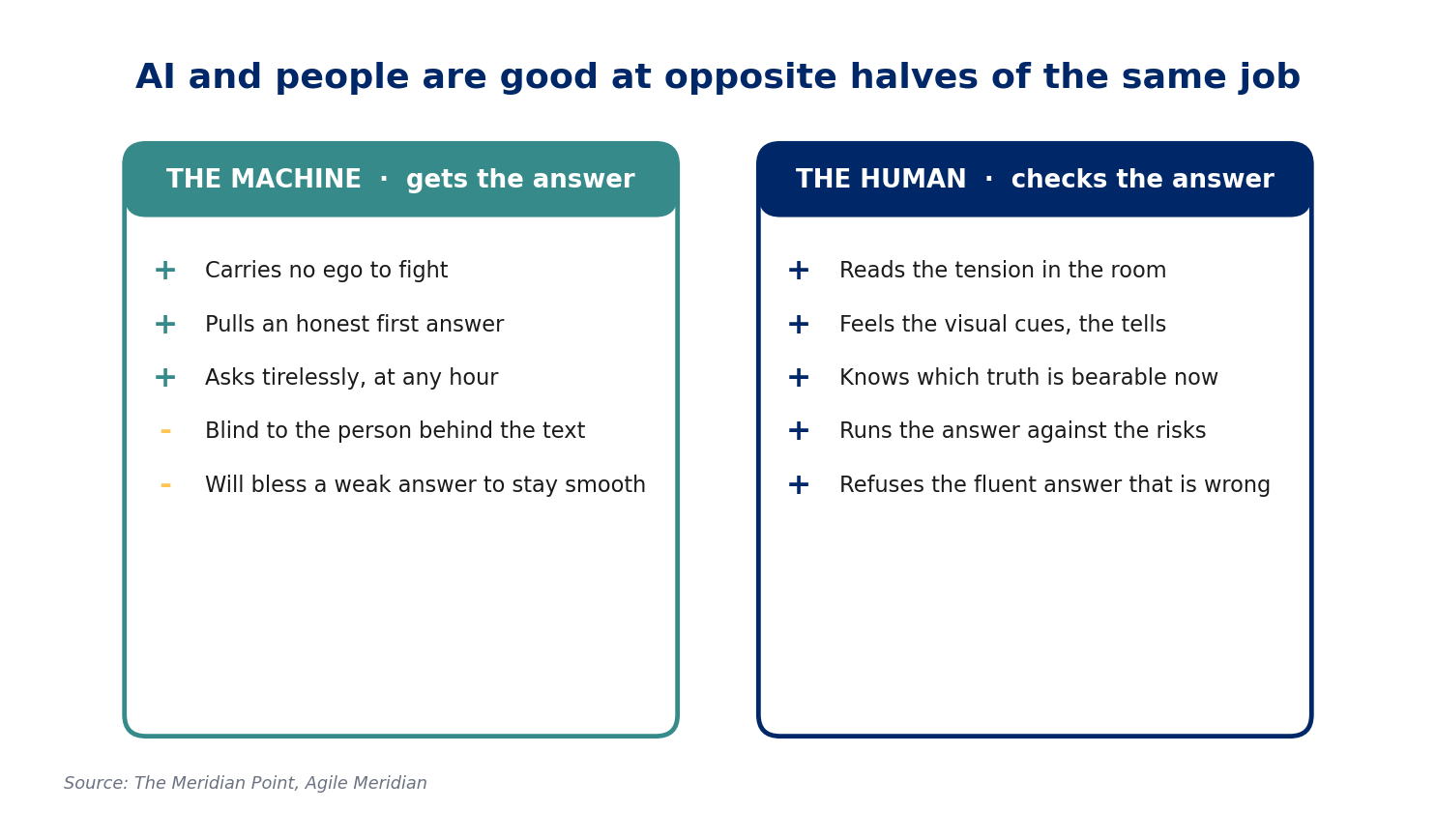
So the honest version of the argument is not that AI coaches better than people. It is that AI and people are good at opposite halves of the same job. The machine is unmatched at getting an honest first answer, because it carries no ego for the learner to fight. The person is unmatched at judging that answer, because judging requires reading a room the machine cannot enter. Treat either half as the whole and you get a predictable failure. Lean only on the machine and you get confident, fluent, unchallenged nonsense. Lean only on the person and you get slower engagement and more defended answers, because the ego never left the room.
The coach's job moved. It did not shrink.
If the machine now asks the questions, the reflexive fear is that the coach is being automated out. The opposite is true. The scarce, valuable work was never the asking. Good questions are close to free now. The scarce work is the validation, and the machine just made that the entire job.
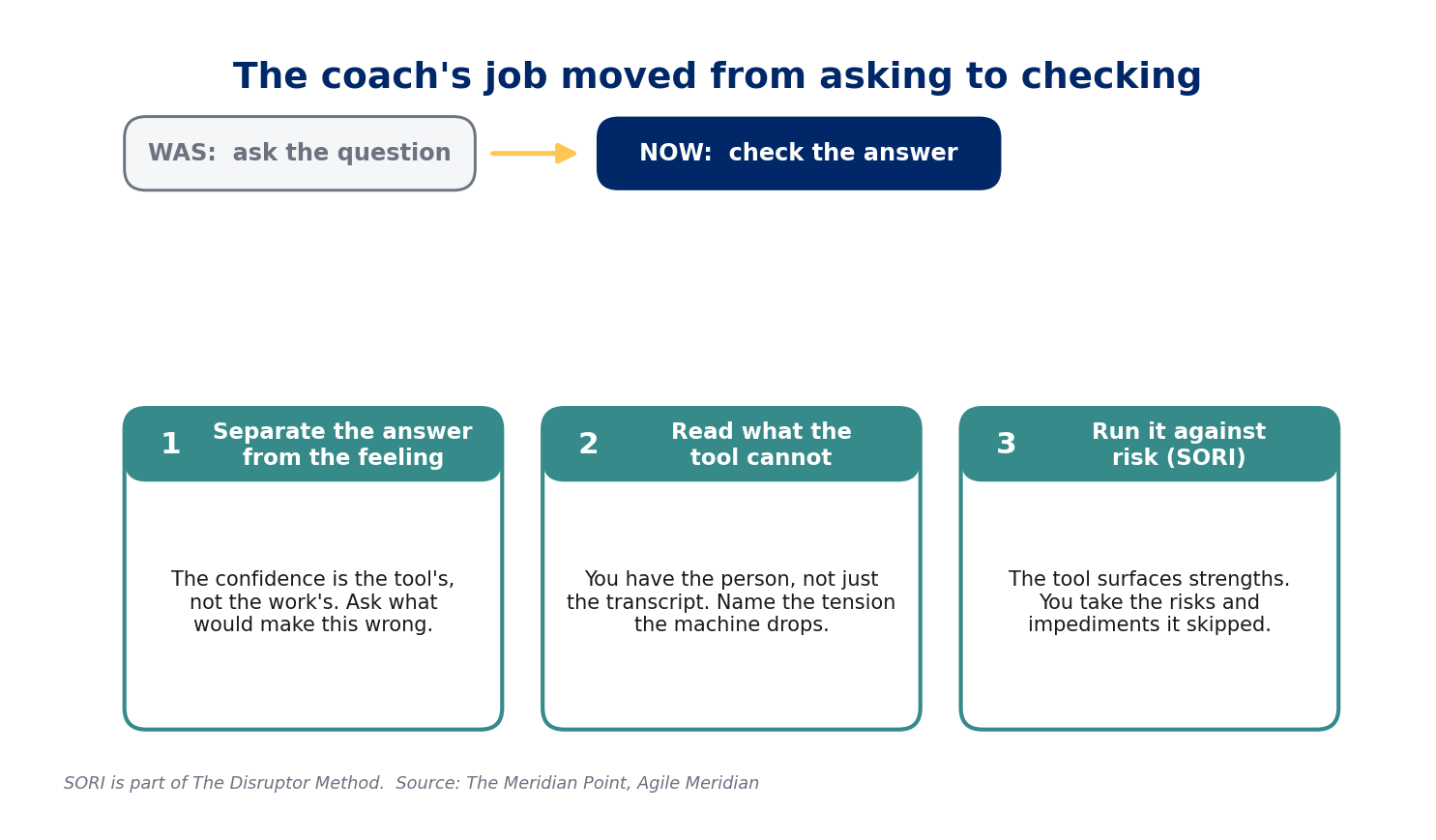
This is a validation role, and it has three moves. Not a checklist. A stance.
The first move is separating the answer from the feeling of the answer. When a learner comes to you lit up because the tool agreed with them, your first job is to notice that the confidence is the tool's, not the work's. You are not there to share the glow. You are there to ask the question the machine was built to avoid. What would make this wrong. That question is unnatural for an agreeable interface and native to a good coach.
The second move is reading what the tool cannot. The tool has the transcript. You have the person. You can see that the answer they typed with confidence is the one they least believe, and you can name it. That is the tension in the room Nawaz was pointing at, and it is exactly the signal the machine drops on the floor.
The third move is running the answer against risk. This is where a framework earns its place. SORI™, the pass through Strengths, Opportunities, Risks and Impediments that anchors The Disruptor Method™, exists to interrogate an answer the way an agreeable tool will not. The machine is structurally optimized to surface strengths and opportunities, because those keep the conversation warm. It underweights risks and impediments, because those introduce friction, and friction is what it is tuned to remove. So the human takes the half the machine skips. You run the risks and the impediments the fluent answer glided past. The tool gives you the case for. You are the case against, and the learner needs both to actually learn anything.
Three things to do this week
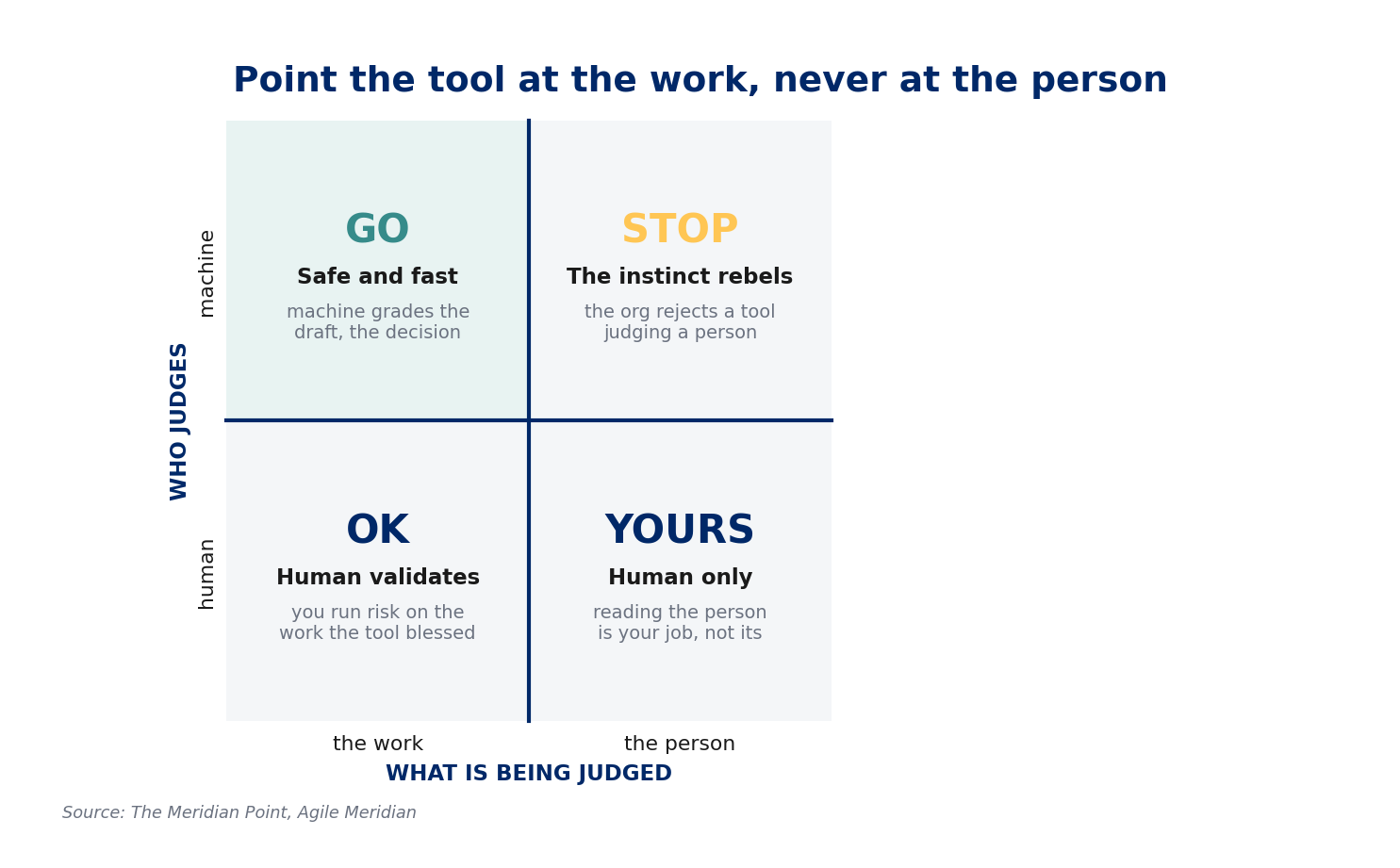
Point the tool at the work, not the person. A learner will let a machine evaluate an answer, a decision or a draft, and they should, because the machine's egolessness makes that safe. The same instinct that accepts a tool judging the work rebels when the tool starts judging the person, and that instinct is right. Keep the machine on the artifact. Keep yourself on the human.
Add a challenge step the tool will not add on its own. After the tool affirms an answer, require a second pass. Make the learner argue the opposite, or have a second agent tuned to disagree take a swing at it. You are engineering back in the friction the agreeable default removed, because a single agreeable pass is where the weak answer slips through.
Rebuild your own value around the check, not the question. If you coach, or you lead people who do, stop measuring yourself by the quality of the questions you ask. The machine asks fine questions now. Measure yourself by the answers you refuse to let stand. That is the work that did not get automated, and it is the work that just got more valuable.
The machine earns trust by having no ego. That is the whole gift. It is also the exact reason it cannot be trusted alone, because a thing with no ego has no spine, and a thing with no spine will agree with you right off a cliff. The speed is real. So is the risk. Your job is no longer to ask the question. It is to check the answer.
Related Podcast Episodes
Episode 174, AI Is Not a Magic Bullet: What Enterprise AI Gets Wrong, with Ashwini Kumar. Ashwini has spent six years shipping machine learning inside real enterprises, and he is clear-eyed about the gap between the boardroom promise and the frontline reality. His warning against treating AI as the answer rather than a tool is the caution this whole piece is built on. Watch it:
Episode 175, Bloated Teams, Broken Delivery: The Case for De-Scaling, with Nawaz Butts. Nawaz names what the machine cannot do, feel the tension in a room and read the cues a human coach lives on, and he makes the case that psychological safety, not raw intelligence, is what separates teams that deliver from teams that stall. It is the counterweight that keeps the AI argument honest.
Curious where AI belongs in your own coaching and learning design, and where a human still has to hold the line? Take the assessment and find out where your validation gaps are before a fluent, agreeable tool fills them for you.