Robust Theme
Dec 09, 2019 2020-04-08 7:40Robust Theme


Waste in Organizations: Why Efficiency Drives Miss the Real Cost
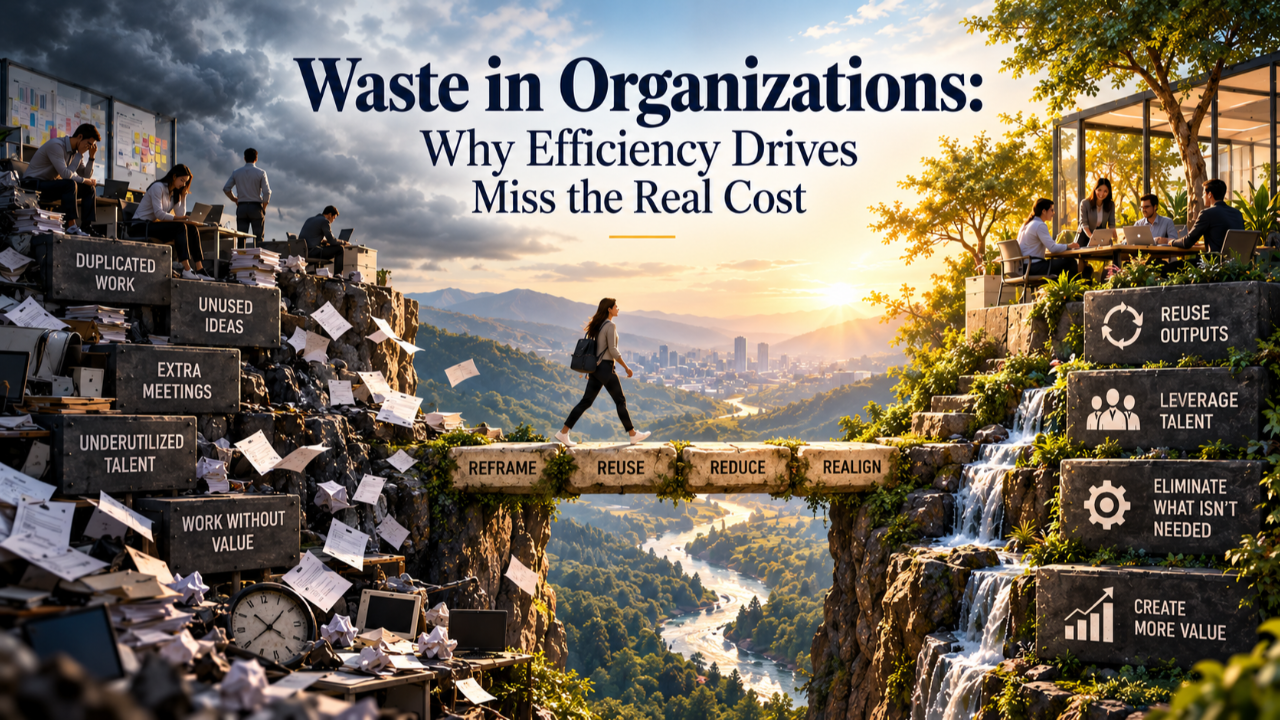
By: Kumar Dattatreyan
Picture the quarter after an efficiency drive. The travel budget shrank. The vendors gave a discount. Two open roles stayed open, and the scrap line posts a number the finance team likes.
Now look at the work. Two teams spent the quarter on the same problem, and neither knew the other was on it. A strong engineer spends most of her week in ceremonies she can't tie to anything a customer asked for. A senior hire uses a fraction of what she could bring, and nobody has asked for the rest. None of that shows up as a line item. All of that counts as waste in your organization, and it costs more than everything the drive cut.
Permaculture's sixth principle, produce no waste, goes after exactly this. XSCALE, the ecosystems thinking model for descaling organizations, translates the principle as mercilessly refactoring business streams so that everything a stream produces gets reused, recycled or reduced and none of it goes to waste. That sentence sounds like an efficiency drive. It isn't one.
This is part six of the permaculture series, and it picks up a question part five left open. Once a shared resource feeds a stream, what does the stream do with what it holds? The answer changes where you look for waste. It isn't in the scrap. It's in motion without value and in capability nobody spends. You can't cut either one with a stopwatch. You refactor the stream.
What the Sixth Principle Actually Targets
Glenn Marshall walked through principle six on The Meridian Point (episode 75), and he started where permaculture starts, in the ecosystem. In a forest nothing gets discarded. Every output becomes another part's input. Then he carried the idea into organizations: "It involves ruthlessly eliminating waste from business streams, reusing and recycling products, and ensuring that resources are used efficiently."
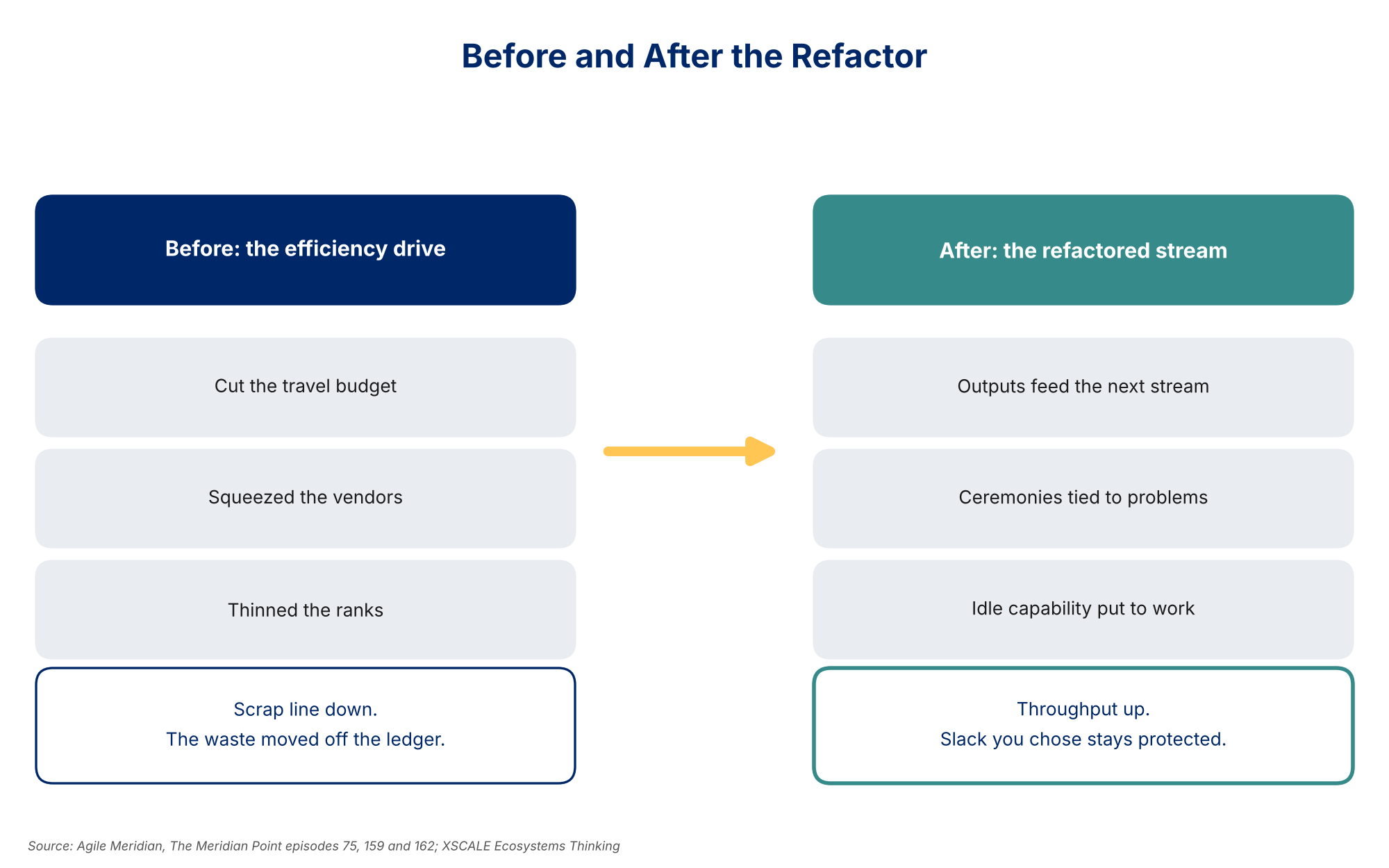
Then he got specific: "This might include repurposing outputs as inputs, tapping into underutilized talent, or exploring partnerships to maximize resources." Scrap doesn't appear in that sentence. Outputs that feed the next stream do. So does talent that sits idle. Glenn's target is the output nobody reuses and the capability nobody spends, and he closed with the picture of the whole system: "It's about creating a closed-loop system where nothing is discarded."
A budget review misses both because cost accounting counts what a stream spends. It doesn't count what a stream makes that nobody uses. XSCALE pairs the sixth principle with a value that fixes the blind spot: throughput accounting over cost accounting. A stream can post a lean cost line and still produce work nobody picks up, and the review will never find it, because the review looks at spend and the waste sits in output.
The Waste Hiding Inside the Process
Knowledge work hides waste in its own process. Sven de Koning, a Product Owner at Cadac Group, gave the cleanest example when he joined the show (episode 162). When he started at his company, a manager ordered one team to use Scrum. Sven asked what it would solve. The manager couldn't say. It was an order.
So Sven looked at the team's actual problems. Communication inside the team was weak, so he introduced the daily Scrum. Communication with stakeholders was weak, so he introduced the review. Planning weeks ahead didn't work for a small team buried in bugs and fixes, so he left it out. The manager could report that the team was doing Scrum, and the team got only the tools that solved its problems.
Sven put the rule this way: "The goal of Scrum isn't having all those, having a daily and having a review and having a retrospective and things like that. The goal is delivering value and having the products that the user needed." When I asked him in the lightning round for the biggest waste of time in most Scrum implementations, his answer fit in two breaths: "Focusing on Scrum. And not focusing on the problem you want to solve."
Toyota calls an activity that consumes resources and creates no value muda. A ceremony you can't tie to a problem fits the definition. It takes hours and produces a status or an artifact. No customer or teammate gets anything from it. Refactoring the stream means keeping the practices that turn into value and dropping the rest. Sven didn't fight the manager's need for a label. He solved the team's problems and let the label stand. That's a refactor, not a purge.
The Most Expensive Waste Is Capability Nobody Asks For
Rafael Ribeiro (episode 159) supplies the other half, and he supplies it from the inside. Talking about his years as a coder, he described what he loved most: "having the permission to do a full refactor, where I could take a legacy code and just throw it in the garbage to start new. Because you do not restart from where you were before, because you're not the same individual. You accumulated knowledge, you accumulated experience, you know how you could do things differently now."
That passage explains why a full refactor wastes nothing that matters. You throw out the artifact and keep the knowledge. The teardown isn't the waste. Discarding what you learned would be.
Then Rafael described the waste that does cost. He was talking about the stretch when agile work had narrowed to teams, processes and frameworks while he wanted to work with leaders and people. He said: "And I felt that I was using 10 or 20% of everything that I knew and I could bring." That's Glenn's underused talent, stated by the person carrying it. Nobody booked a loss. A person with a wide range of capability worked inside a narrow slice of it, and the market kept asking for the slice.
Rafael also gave the image that ties the principle together. Describing forest fires in Portugal, he said: "All the things that were burned become food and nutrition for the next generation of vegetation and even the new animals that are going to be living there." In an ecosystem nothing burned goes to waste, because it feeds whatever grows next. In an organization, capability left on the bench is the nutrient nobody puts back in the soil.
Most Waste Is a Decision Nobody Made
Duplicated effort looks like the obvious target for a cost drive. Send two capable people at the same problem without telling either one and you haven't built redundancy. You've avoided a decision. The duplication looks like waste, and it counts as waste, but it's a symptom. Somewhere a question went unanswered: who owns this problem? The effort of two capable people is the bill for leaving it open.
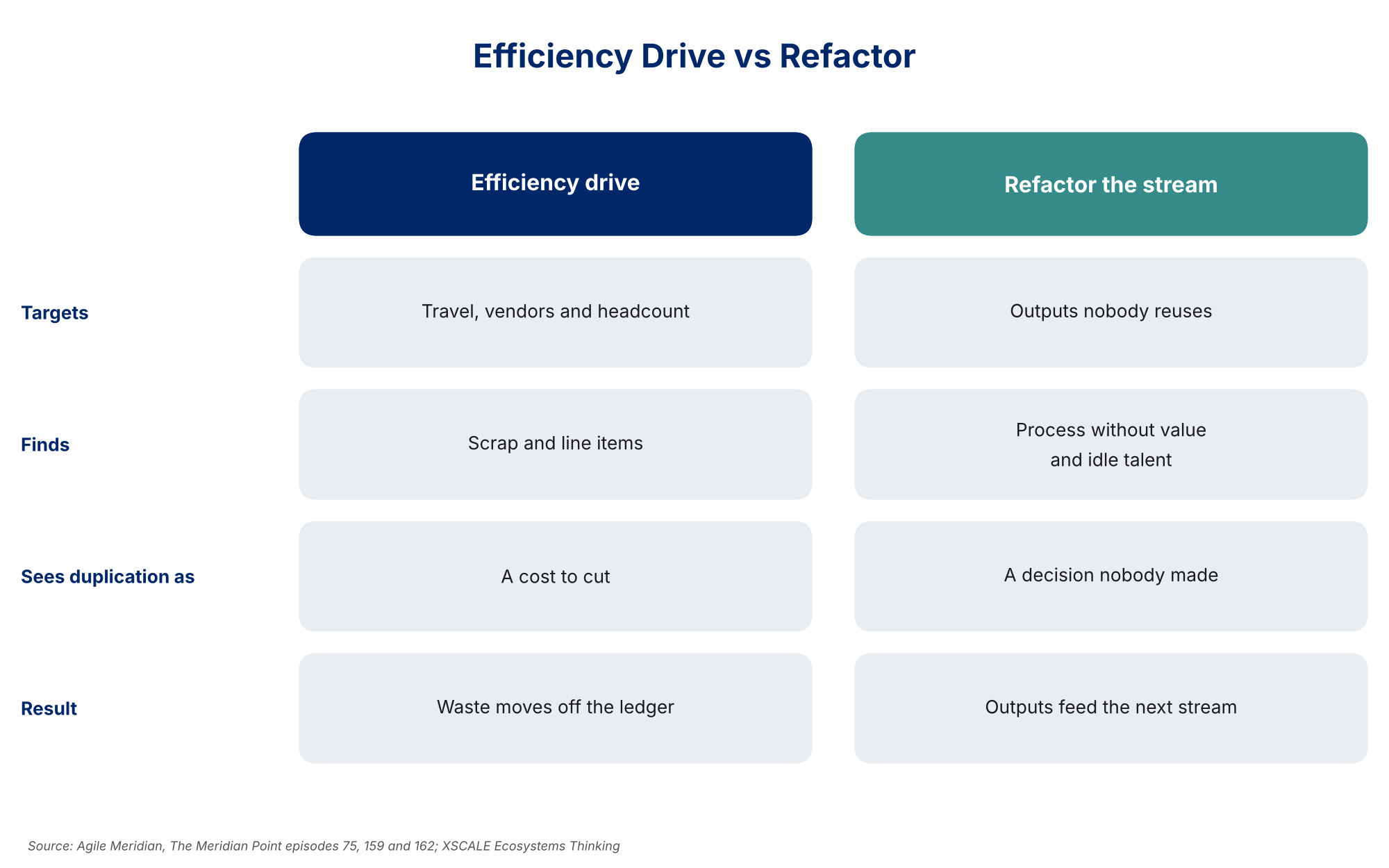
That changes the fix. An efficiency drive attacks the symptom with fewer people and tighter budgets, and neither answers the question. You cut this waste by making the decision, saying it out loud and telling both people. The coordination layer between teams is where these unmade decisions pile up, which I covered in Why Reorgs Fail: The Coordination Layer Is the Bottleneck.
Idle capability usually shares the root. Somebody has to ask a capable person for more, and in most organizations nobody holds that job.
Doesn't Producing No Waste Make an Organization Brittle?
The strongest objection comes from the slack and redundancy school, and it deserves its full weight. Tom DeMarco argued in Slack that slack isn't waste. It's the capacity to change, and an organization tuned for total efficiency has no room left to adapt or to absorb a surprise. Nassim Taleb pushed further in Antifragile. Redundancy isn't inefficiency. It's insurance, which is why nature gives you two kidneys, and the systems that survive shocks carry more than they strictly need. Resilience engineers, building on Erik Hollnagel's work on the efficiency-thoroughness trade-off, add the operational case. A supply chain refactored to the bone for just-in-time throughput snaps the first time the world moves, because every buffer that could have absorbed the shock was booked as waste and cut. On that view, mercilessly refactor is a recipe for a stream that runs efficiently right up until it breaks.
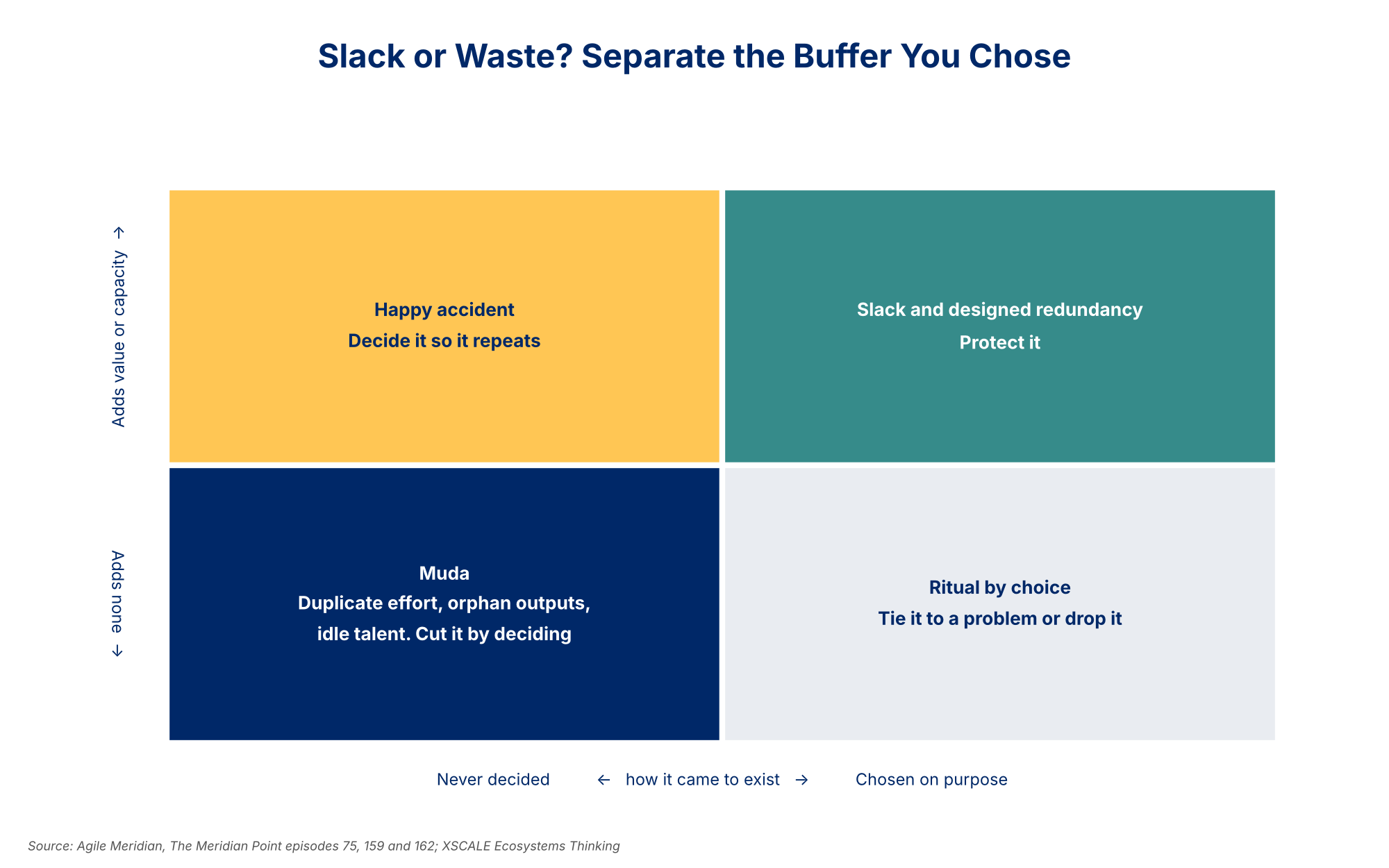
They're right about the failure and wrong about the target. Principle six goes after muda: rework, dead artifacts, activity with no value and talent left idle. It doesn't go after slack. Slack is a use of the renewable resource from principle five, the adaptive capacity a stream chooses to hold. The word that matters is chosen. Taleb's second kidney is designed and load-bearing. Two capable people working the same problem without either knowing isn't a second kidney. It's an accident.
Toyota gave the world the instruction to eliminate waste and still held deliberate slack: the andon cord and the room to stop the line. It still called dead inventory muda. Produce no waste and keep your slack are the same instruction once you separate the buffer you chose from the waste you never decided to stop making. The refactor tells them apart. It exposes the slack so you can protect it, and it cuts the rest.
One more guard keeps the refactor from turning into a purge. A theme from the Coaching and Facilitation Dojo put it well: fail fast is the wrong instruction. Redesign the system so trying and learning cost less. You don't remove the waste of failed experiments by running fewer of them. You make each one cheap and treat what it teaches as an output the next stream reuses.
Three Moves to Make This Month
Trace one stream's outputs to a consumer. Pick one stream and list what it produces: reports, decisions, code, data. Mark which outputs another stream actually uses. Whatever nobody uses is your first target, and you can do one of two things with it: repurpose it as an input somewhere or stop making it. Then look at the manual work behind the outputs that remain. Automation is how a small stream reduces the manual effort that used to go to waste, so the same hands produce more of what matters.
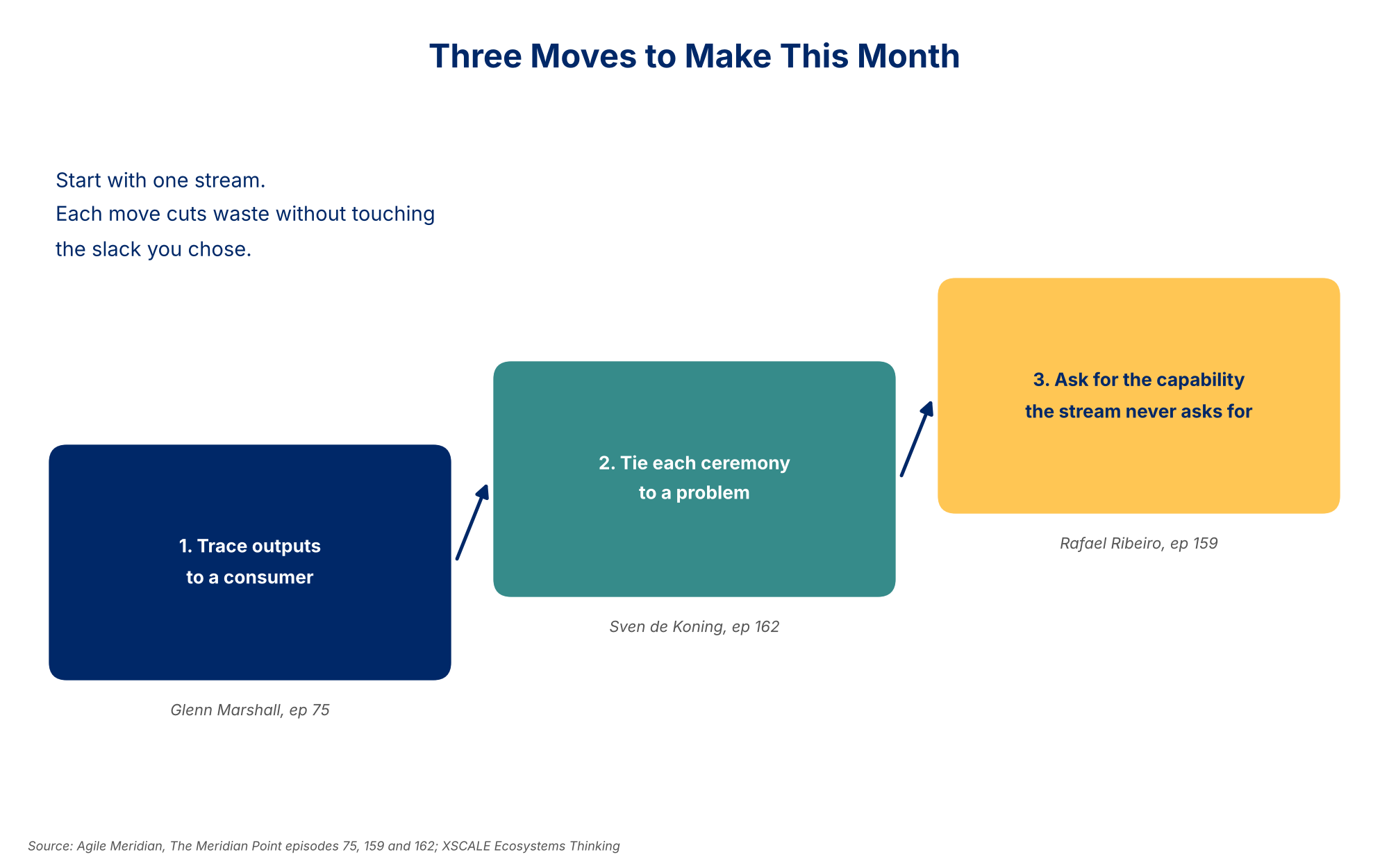
Tie every recurring ceremony to a problem the team has today. Use Sven's test. If the team can't say which problem a meeting or a report solves, pause it for one cycle and see who notices. Keep the practices that turn into value. Drop the rest, even if somebody still wants to report that the team follows the framework.
Ask one capable person what they could bring that the stream never asks for. Rafael's 10 or 20 percent is a question you can put to anyone. Ask it plainly and then give the answer a real job in the stream. Asking without acting teaches people to stop answering.
Related Podcast Episodes
Episode 75: Permaculture and XSCALE, Principles 5 and 6 Explained, with Glenn Marshall. Glenn starts in the ecosystem, where every output feeds another part, and then lands the organizational version. This is the spine of the series, and his list of what to repurpose is the design instruction for principle six.
Episode 162: When Doing Scrum, Don't Do Scrum: Focus on Problems, Not Frameworks, with Sven de Koning. Sven shows where waste hides in knowledge work, in the ceremony nobody can tie to a problem. His fix is to give a team only the tools that solve its problem.
Episode 159: The Abundance Paradox: Finding Wealth in Financial Scarcity, with Rafael Ribeiro. Rafael explains why a full refactor keeps the knowledge while it discards the artifact. His honest account of using a fraction of his capability is the clearest picture of idle talent I've heard.
Where the Series Goes Next
Principle five shared the renewable resource across streams. Principle six stops each stream from squandering what it holds. Principle seven decides the shape of the streams in the first place: design from patterns to details, which means stepping back to see the patterns in and between value streams before you detail what only becomes clear as you learn.
If you suspect your streams carry waste that never reaches a ledger, let's talk it through. Book a 30-minute conversation.