Robust Theme
Dec 09, 2019 2020-04-08 7:40Robust Theme


The Personality Paradox: Why Your Leadership Team's Similarity Is Your Innovation Bottleneck

By: Kumar Dattatreyan
Here's something I've seen play out in boardrooms across Fortune 500 companies more times than I can count: a leadership team filled with extraordinarily talented people who, when placed together in a room, somehow make worse decisions than any one of them would make alone.
You've probably experienced this. Maybe you've sat in that room.
The executive team is sharp. Everyone's credentialed. They've all climbed to the top through drive, competitiveness, and an ability to make things happen fast. They have all the ingredients for a high-performing leadership team. And yet, something keeps breaking down. Decisions get made and then remade. Strategy shifts without warning. Teams below feel the whiplash. Innovation initiatives launch with fanfare and die quietly six months later.
Here's the uncomfortable truth: the problem isn't capability. The problem is sameness.
When Smart People Collectively Get Dumber
There's a paradox at the heart of most executive teams. Organizations promote people who demonstrate high performance in individual contributor roles, people who are decisive, action-oriented, competitive, and results-driven. Over time, these profiles cluster at the top.
Put five or six of these people together in a C-suite, and something counterintuitive happens. Rather than their collective intelligence multiplying, it often collapses. Individually, these leaders might each operate at a high level of analytical sharpness. Together, they behave as if a floor has been placed under how carefully any decision gets examined.
Why? Because there's no one in the room who naturally slows things down.
In work I've done with leadership teams using psychometric tools like the Predictive Index and DISC, I've watched this pattern emerge repeatedly. A team dominated by what DISC categorizes as "D" (Dominant) and "I" (Influential) profiles — action-oriented, fast-moving, high-energy, is a team built for velocity. But velocity without friction isn't innovation. It's just speed. And speed without due diligence produces decisions that have to be walked back, initiatives that launch half-baked, and an organizational culture that eventually stops trusting leadership's direction.
One leadership team I worked with recently illustrated this perfectly. They were running what I'd describe as a high-volume, high-velocity operation. Their pipeline of decisions was impressive. Their execution rate was fast. But a concerning number of those decisions were coming back. They were being remade weeks or months later because critical considerations had been missed the first time around. When we mapped the team's DISC profiles, the pattern was unmistakable: heavy concentration in D and I, virtually nothing in C (Conscientiousness) or S (Steadiness). No one in that room was wired to pump the brakes, ask the analytical questions, or advocate for methodical due diligence. That wasn't a culture problem. That was a composition problem.
The Blind Spot Nobody Talks About
When organizations talk about diversity, they talk about it in demographic terms. Gender. Ethnicity. Background. Those dimensions absolutely matter. But there's a form of diversity that rarely gets a seat at the table: cognitive and behavioral diversity.
The absence of behavioral diversity in a leadership team creates organizational blind spots that are invisible precisely because no one in the room has the wiring to notice them.
Think about what the "C" and "S" profiles in DISC actually bring to a team. The Conscientious profile brings analytical rigor, attention to detail, and a natural skepticism that functions as a quality control mechanism. The Steady profile brings relationship orientation, a focus on team cohesion, and an ability to see around corners at how decisions will land with people. These aren't "soft" capabilities. They're structural safeguards against the kinds of expensive mistakes that fast-moving executive teams make.
When I use the Predictive Index with leadership teams, one of the most powerful moments in the engagement isn't when we build the strategy. It's when I show the team their collective profile on one page. When a room full of high-powered executives can see, visually, unemotionally, that their entire team shares the same behavioral wiring, something shifts. It's not personal. It's a report. You can't argue with data the way you can argue with a coach's observation. And what the data shows, again and again, is that what looks like a strength from the outside, a leadership team full of action-oriented achievers, is also a structural liability.
Your natural strengths, amplified across an entire team, become your biggest blind spots.
The Comfort Trap: Building Teams You Like Instead of Teams You Need
Here's where it gets personal. Leaders tend to hire and promote people who remind them of themselves. It feels like recognizing excellence. What it actually is, in many cases, is recognizing familiarity.
The conflict avoidance trap runs deep in executive culture. Disagreement feels threatening, especially in rooms where everyone is accomplished and competitive. So teams quietly self-select toward profiles that minimize friction. The result is what I call a "comfortable team," a group that operates smoothly, reaches consensus easily, and delivers results that look solid on a quarterly basis.
But comfortable teams don't disrupt markets. Comfortable teams don't catch the strategic blind spots that, three years later, cost the company market share. Comfortable teams execute the existing playbook with minimal friction. And in a moment of disruption, when the market shifts, when a competitor does something unexpected, when a crisis demands rapid organizational adaptation, comfortable teams freeze.
What organizations need are complementary teams. Not teams where everyone agrees, but teams where different cognitive profiles naturally surface different risks, different opportunities, and different perspectives on the same data. The Disruptor Method™ is built on this principle: sustainable transformation doesn't happen despite friction; it happens through friction. But it has to be the right kind of friction. Productive friction. The friction that comes from behavioral diversity doing its job.
What Psychometric Data Actually Tells You
The most common misconception about tools like DISC and the Predictive Index is that they're personality labels, convenient ways to put people in boxes. They're not. They're behavioral maps.
What these tools reveal is not who you are as a person, but how you're naturally wired to approach problems, process information, respond to conflict, and make decisions under pressure. That's not fixed. People can develop capabilities outside their natural profile. But your natural wiring is your baseline, and knowing it, as a team, is the starting point for intentional composition.
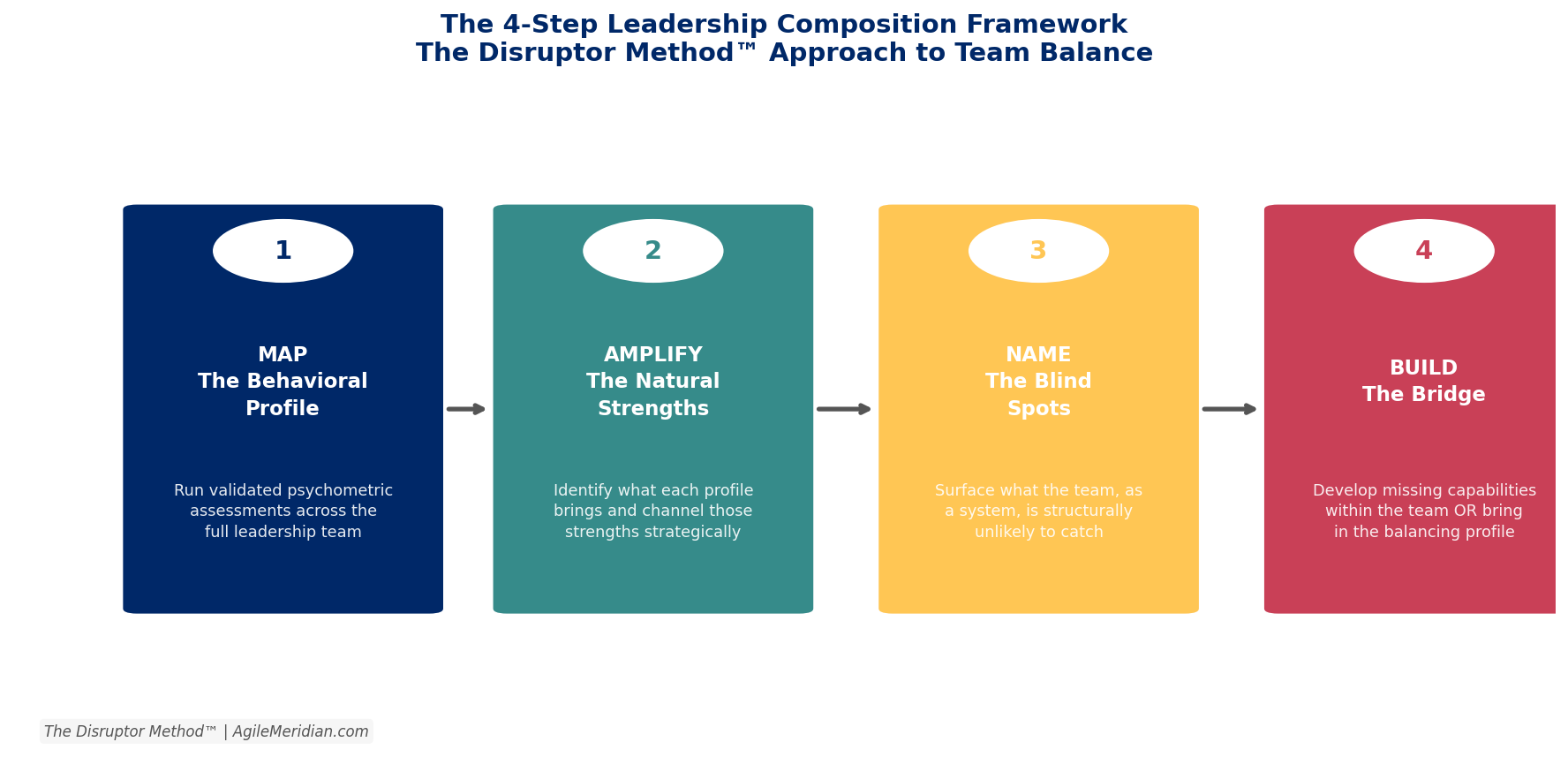
Here's the framework I use when assessing leadership team composition:
Identify the Behavioral Map. Get every member of the leadership team assessed using a validated psychometric tool. Not to label people, but to create a team-wide visibility into what's present and, critically, what's absent.
Amplify the Strengths. Every profile brings genuine value. A team heavy in D profiles has a bias for action that, correctly channeled, is an extraordinary competitive advantage. That doesn't disappear. It gets more powerful when it's balanced.
Name the Blind Spots. This is the work most teams skip. The goal isn't to highlight deficiencies in individuals. The goal is to surface what the team, as a system, is structurally unlikely to catch or consider. That's information. And it's actionable.
Build the Bridge. Once you know what's missing, you have two options: develop those capabilities within the existing team, or bring in someone who carries that wiring naturally. Both are valid paths. The worst option is the one most teams choose: ignoring the gap entirely.
This isn't about turning action-oriented executives into process-oriented analysts. It's about building a team that can access the full spectrum of thinking that leadership demands.
Change Resistance Is Data Too
One dimension that rarely gets discussed in leadership team composition conversations is change orientation. Myers-Briggs research consistently shows that leaders with SJ profiles (Sensing + Judging) tend to be the most resistant to change, not because they lack intelligence or vision, but because their cognitive wiring values stability, consistency, and proven approaches.
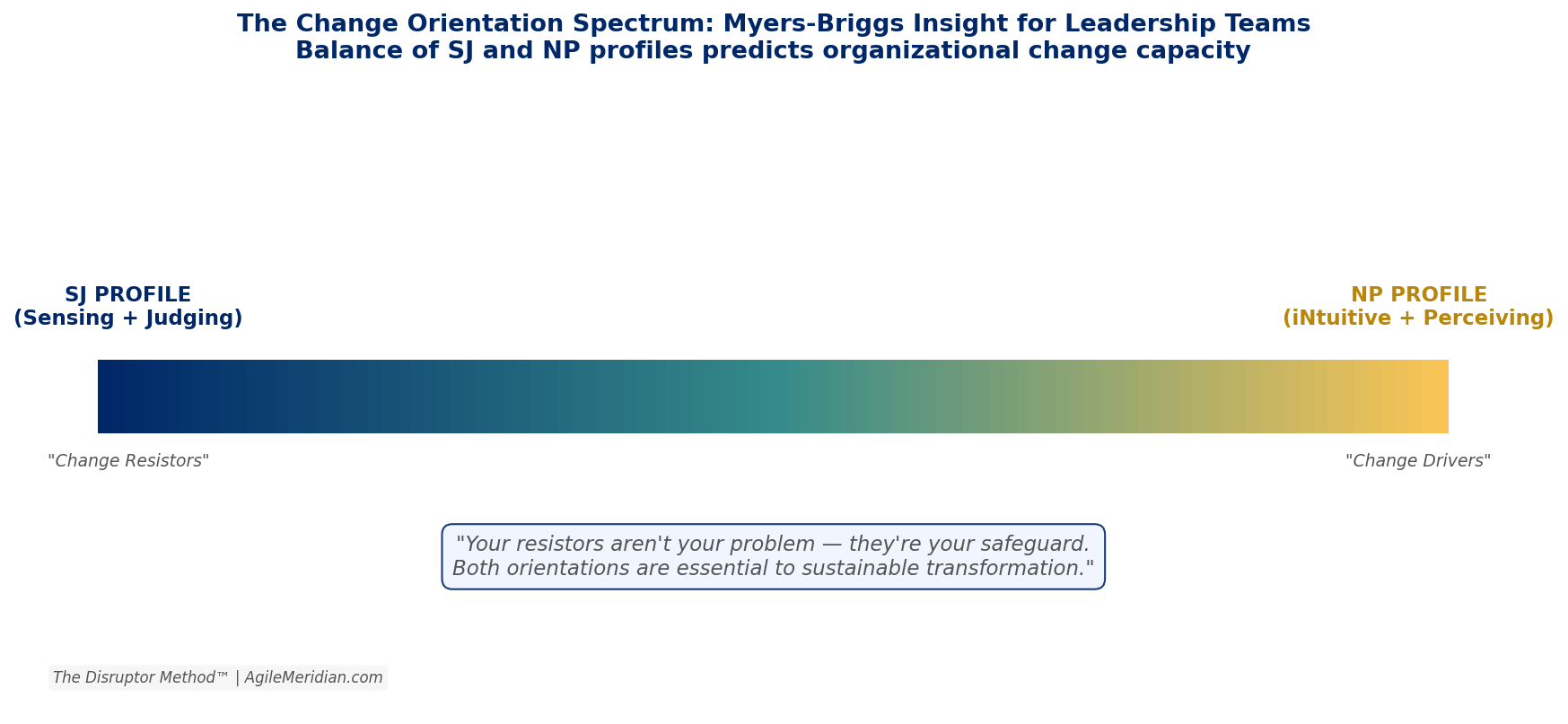
NP profiles (iNtuitive + Perceiving), by contrast, often drive change. They're comfortable with ambiguity, energized by new possibilities, and predisposed toward experimentation.
Here's what's important: both are needed.
A leadership team made entirely of NP profiles will pursue change for its own sake, struggling to execute and institutionalize what works. A team dominated by SJ profiles will optimize existing systems beautifully while the market shifts underneath them. The team that transforms organizations effectively has both, and has done the work to understand the difference between resistance that signals a fatal flaw in the plan and resistance that's reflexive and unconstructive.
The most productive insight I can offer to a leadership team with mixed change orientations is this: your resistors aren't your problem. They're your safeguard. The question is whether you're creating the psychological safety for their resistance to be heard, examined, and either incorporated or respectfully overruled. When resistors feel unheard, they don't stop resisting. They resist underground through passive non-compliance, cultural drag, and the slow erosion of team trust.
Three Steps You Can Take This Week
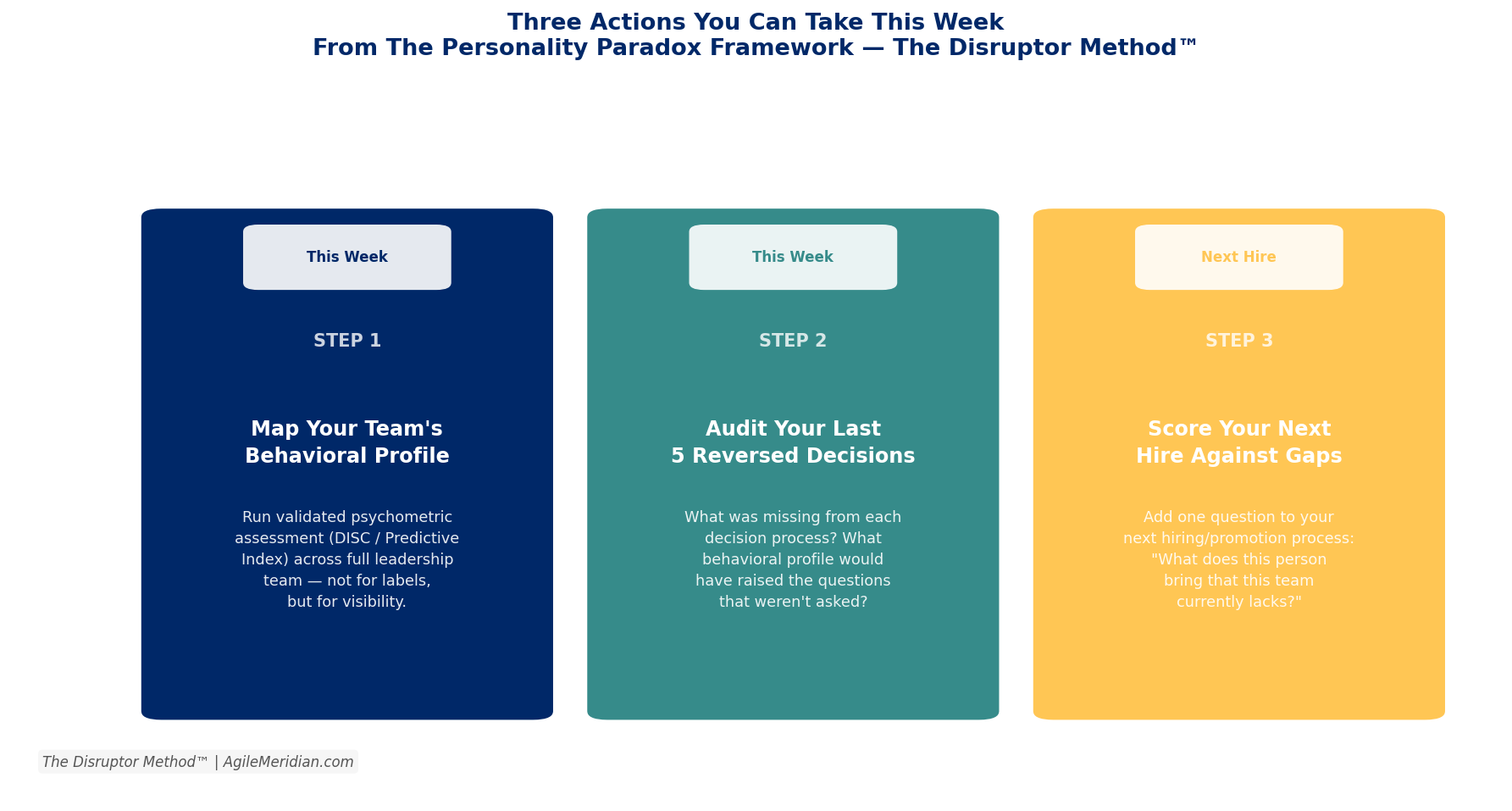
This isn't abstract. Here's where to start:
1. Map your team's behavioral profile. If you haven't run a validated psychometric assessment across your entire leadership team, that's the first conversation to have. You can't address blind spots you can't see. Tools like the Predictive Index and DISC are widely available, validated, and designed for exactly this application. The goal isn't judgment, it's visibility.
2. Examine your last five decisions that had to be reversed or significantly revised. What was missing from the initial decision-making process? With what you now understand about behavioral composition, ask: what kind of profile would have raised the questions that weren't raised? This isn't hindsight as blame, it's hindsight as data.
3. Audit your next hire or promotion against team composition, not just individual competence. You likely have a robust process for evaluating individual qualifications. Add one question to that process: what does this person bring to the team that the team currently lacks? Individual excellence is necessary. But the marginal value of adding another high-D profile to a high-D team is dramatically lower than adding someone who brings a balancing perspective.
The Leadership Team Is the Product
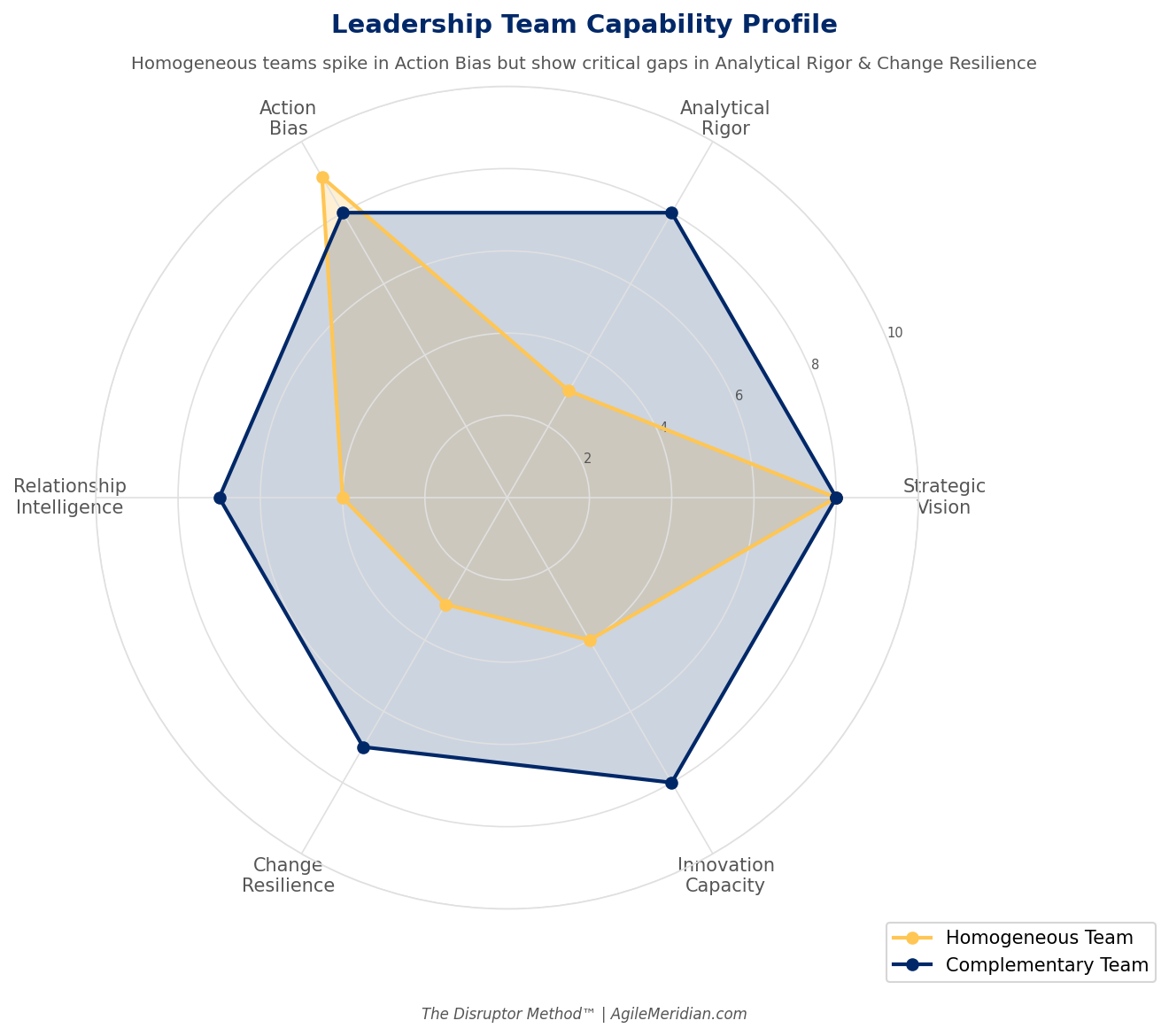
There's a reframe that changes everything for the executive teams I work with: your leadership team isn't just the group that makes decisions. Your leadership team is the product, the operating system through which your entire organization runs.
If the product is built entirely out of one type of component, it has a ceiling. The ceiling isn't about effort or talent. It's structural. And no amount of strategy work, offsite planning, or culture initiatives will break through a structural ceiling until the structure itself changes.

That's the personality paradox. The traits that got each individual leader to the top are real strengths. Those same traits, replicated across the entire team, become the organization's biggest innovation bottleneck.
The good news: unlike most organizational problems, this one is visible. It's measurable. And once you can see it, you can fix it.
The question isn't whether your leadership team has a composition challenge. The question is whether you're willing to look.
Want to Explore These Concepts Further?
Listen to related episodes of The Meridian Point Podcast:
- Episode 133: Self-Awareness Is Broken in Corporate America — Watch here
- Episode 102: Rethinking Organizational Change — Watch here
- Episode 100: 100 Episodes of Disruption — Watch here
- Episode 18: Leadership as a Service — Watch here
Is Your Leadership Team Built for Innovation — or Just for Execution?
Take the Disruptor Method™ Leadership Assessment to understand your team's composition profile, identify your structural blind spots, and get a clear roadmap for building the complementary team that drives breakthrough performance.
Or connect with us directly to explore how The Disruptor Method™ can help your organization build the leadership architecture that turns disruption into competitive advantage.