Robust Theme
Dec 09, 2019 2020-04-08 7:40Robust Theme


How Compensation Quietly Kills Innovation
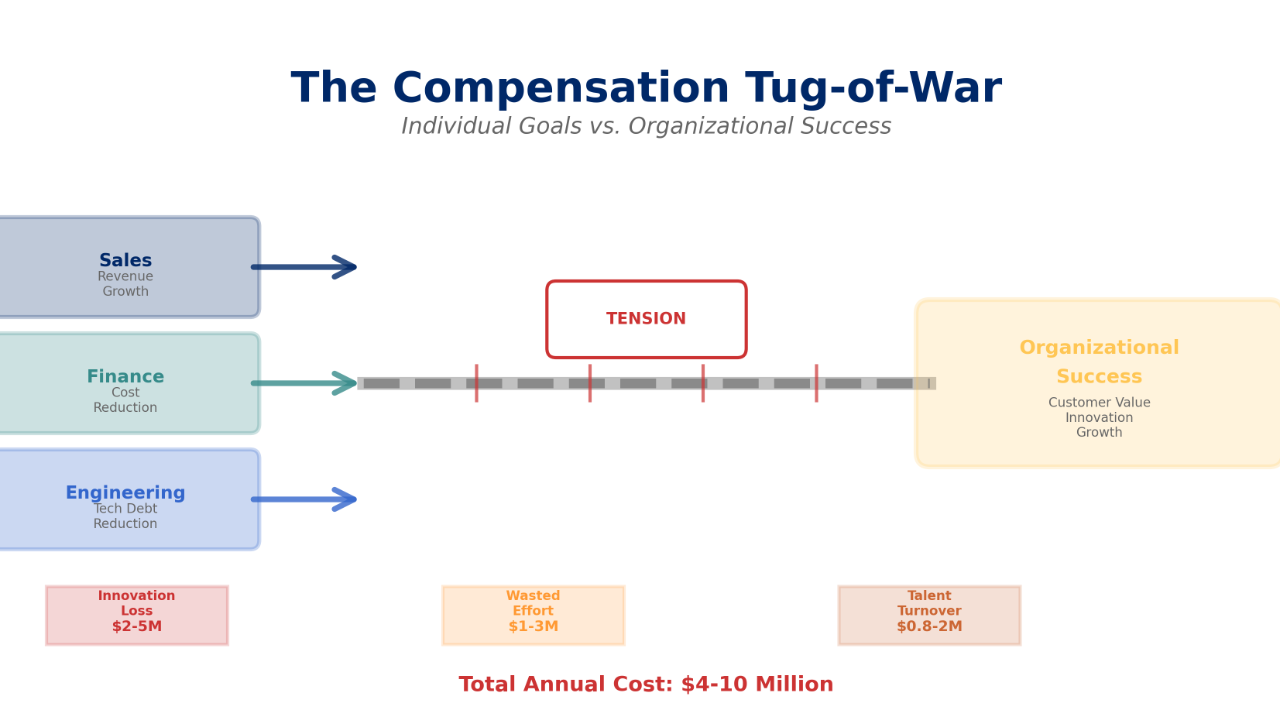
The CFO and the Head of Sales haven't spoken in three weeks. Not because of a personal conflict—they're cordial enough in the hallways. They're not talking because the CFO's bonus depends on cutting costs while the Head of Sales needs to spend to hit quota. Finance celebrates when Sales requests get denied. Sales celebrates when they bypass Finance approval through creative accounting.
This isn't a hypothetical. This is happening in your organization right now.
The Invisible War Between Departments
Walk into most medium to large organizations and you'll find smart, well-intentioned leaders who should be collaborating but aren't. They're stuck in what I call "structural combat"—organizational systems that force them into competition with each other while executives wonder why innovation stalls.
The culprit? Individual KPIs and department-specific incentive structures that turn colleagues into competitors.
When we work with leadership teams through our Disruptor Method, one pattern appears with stunning regularity: leaders are rewarded for goals that directly conflict with other leaders' goals. The Head of Engineering gets bonused for reducing technical debt. The CMO gets bonused for launching new features. These goals are fundamentally incompatible, yet we act surprised when these leaders don't collaborate.
You would think organizations would have figured this out by now. But when we conduct our SORI assessment—examining Strengths, Opportunities, Risks, and Impediments—the "aha" moments are astounding. Leaders discover that their colleagues face the exact same obstacles, but the reward structure has been telling them to solve problems in isolation.
Why Individual KPIs Create Organizational Silos
The logic behind individual KPIs seems sound: measure what matters, reward achievement, drive accountability. But this approach makes a critical assumption—that departmental success equals organizational success. It doesn't.
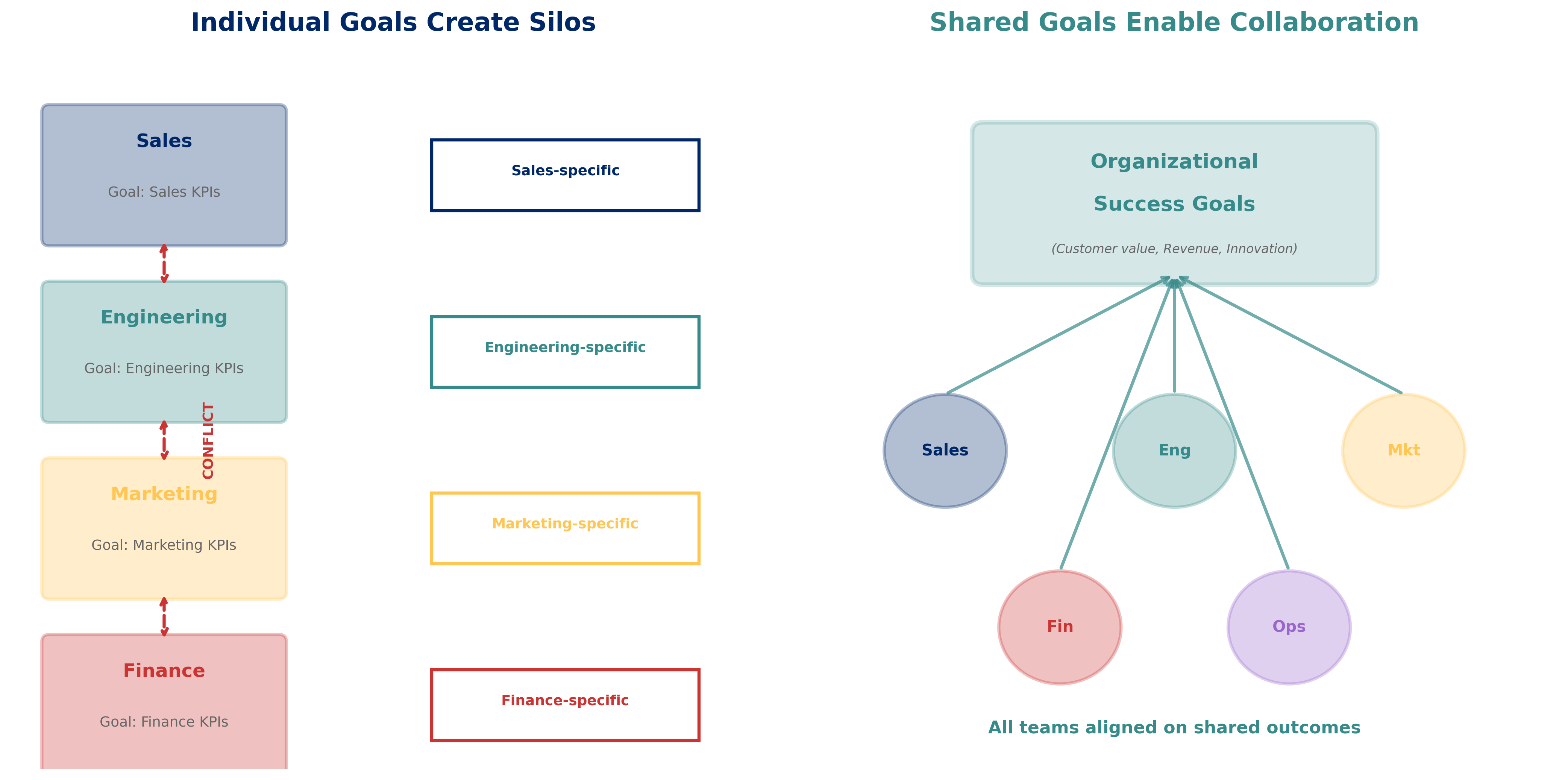
One transformation leader described his experience working with a global bank that shifted from individual KPIs to team-based objectives tied to customer outcomes. The initial resistance was fierce. High performers feared their bonuses would get diluted. But over time, collaboration improved because the system rewarded collective success.
The takeaway? If you don't change incentives, you're asking people to behave against their own interests, which are often deeply entrenched and political.
This isn't just about culture. It's about basic human behavior. When someone's mortgage payment depends on hitting a sales target, they will hit that sales target—even if it means sacrificing what's best for the company. When a leader's bonus comes from keeping their department budget under control, they will protect that budget, even when another team desperately needs those resources for a breakthrough innovation.
The Compounding Effect on Innovation
The damage from misaligned incentives compounds over time. Here's how the cycle works:
Individual KPIs create departmental silos. Silos create information bottlenecks. Bottlenecks create blind spots. Blind spots kill innovation.
A manufacturing example illustrates this perfectly. The operations leader measured success by production efficiency. The quality leader measured success by defect reduction. The innovation leader measured success by new product launches. Each leader optimized their individual metric—and the company's ability to rapidly iterate on customer feedback ground to a halt.
They weren't bad leaders. They were rational actors responding to how they were measured and rewarded.
Consider the hidden costs:
Innovation Loss: When teams protect territorial boundaries instead of collaborating, organizations lose 75% of potential innovation opportunities. That's $2-5 million annually for a mid-sized company, just in missed revenue from products that were never developed.
Wasted Effort: Duplicate initiatives across departments that refuse to coordinate waste 60% of discretionary spending. That's another $1-3 million per year on projects that essentially build the same thing twice.
Turnover Cost: Top talent leaves dysfunctional organizations at 45% higher rates than well-aligned ones. Factor in recruitment, onboarding, and lost productivity, and you're looking at $800K-2M annually in turnover-related costs.
Total annual cost? $4-10 million per year for organizations that haven't aligned their incentive structures.
How Personal Financial Behavior Predicts Business Decisions
There's another layer to this problem that most organizations miss: leaders' personal financial behaviors predict their business decisions with remarkable accuracy.
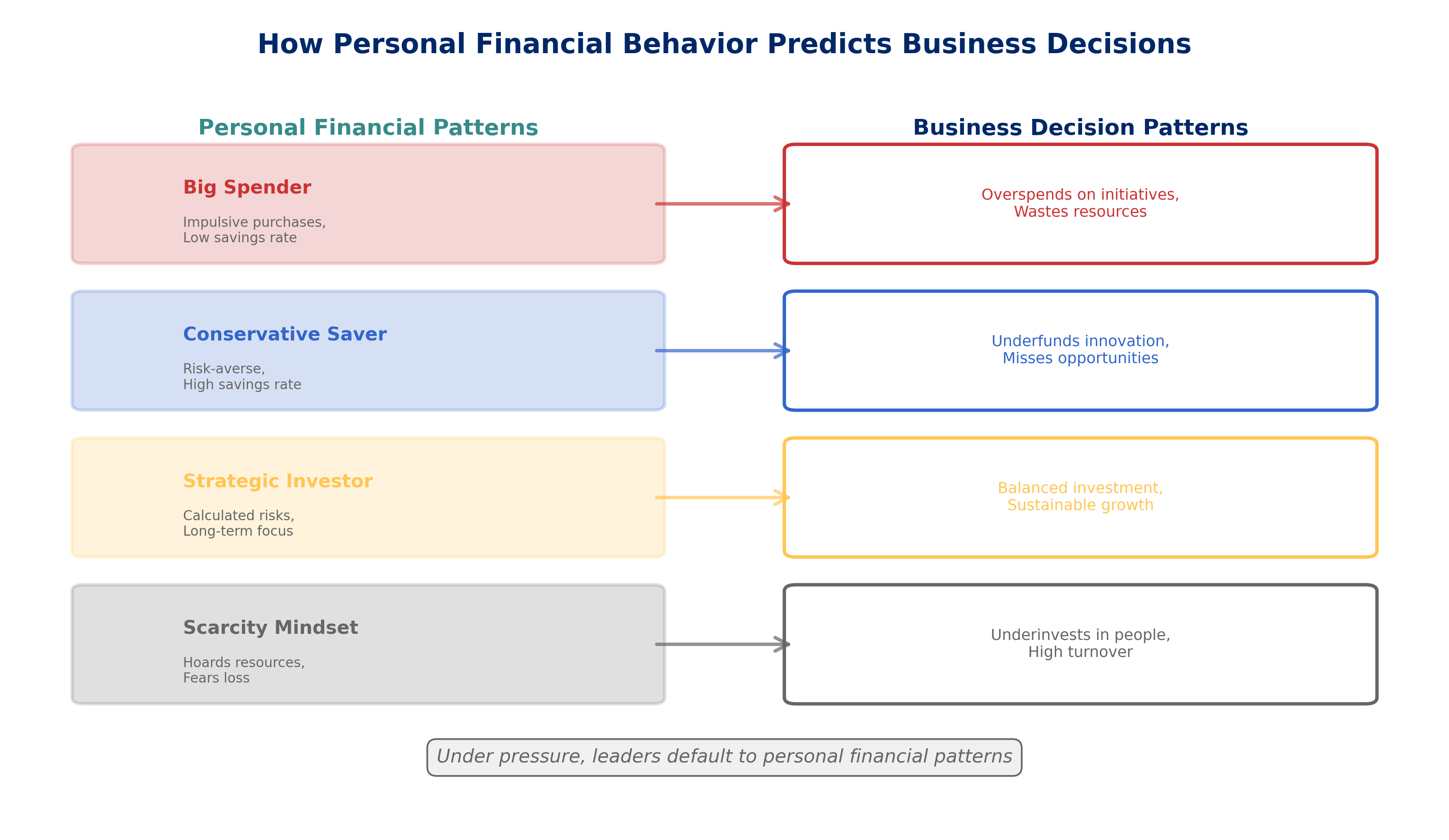
Research on behavioral finance shows that executives who are big spenders in their personal lives tend to overspend on business initiatives. Conservative savers underinvest in innovation. Those with scarcity mindsets hoard resources and create bottlenecks. Strategic investors take calculated risks with long-term focus.
Under pressure, leaders default to their ingrained financial patterns. This matters because compensation structures trigger these patterns. If your bonus structure creates artificial scarcity—"there's only so much bonus pool to go around"—you activate scarcity mindsets across your leadership team. They start hoarding information, protecting resources, and avoiding the very cross-functional risks that drive innovation.
One executive I worked with put it bluntly: "When my bonus depends on my department's numbers, I act like my department's advocate. When my bonus depends on company performance, I act like the company's advocate. It's not complicated."
Creating Shared Goals Without Losing Accountability
The solution isn't to eliminate individual accountability. That's the fear that kills most compensation reform efforts. "If everyone's responsible for everything, no one's responsible for anything."
That's a false binary.
The answer is additive, not subtractive. You create shared goals without eliminating individual ones. Here's how we do it with the Disruptor Method:
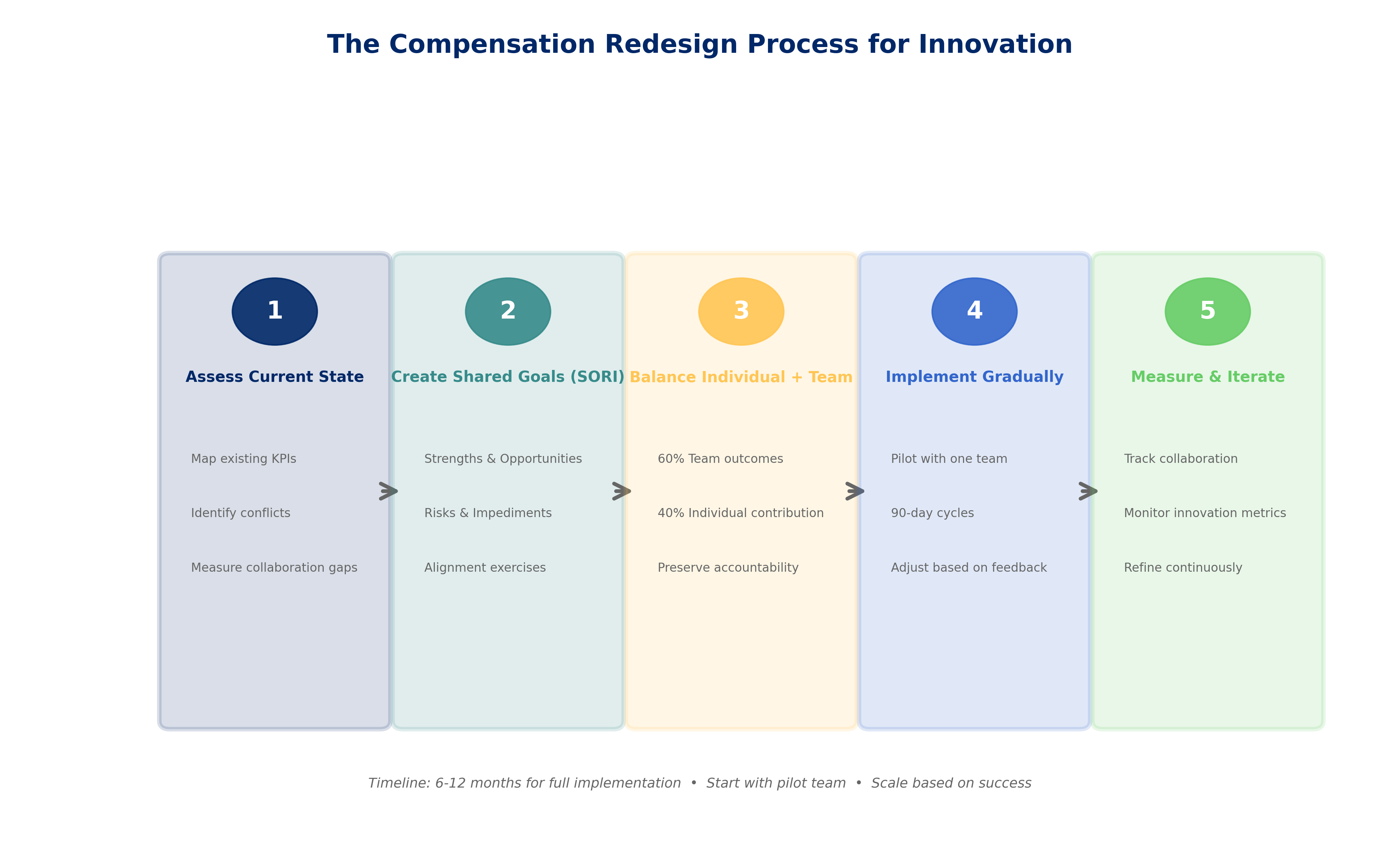
Step 1: Assess the Current State
Map existing KPIs across the leadership team. Identify conflicts and contradictions. One client discovered that seven of their ten leadership team goals directly conflicted with at least two other leaders' goals. No wonder collaboration was painful.
Measure the collaboration gaps. How often do leaders work together? When they do, is it productive or performative? Where are the information bottlenecks?
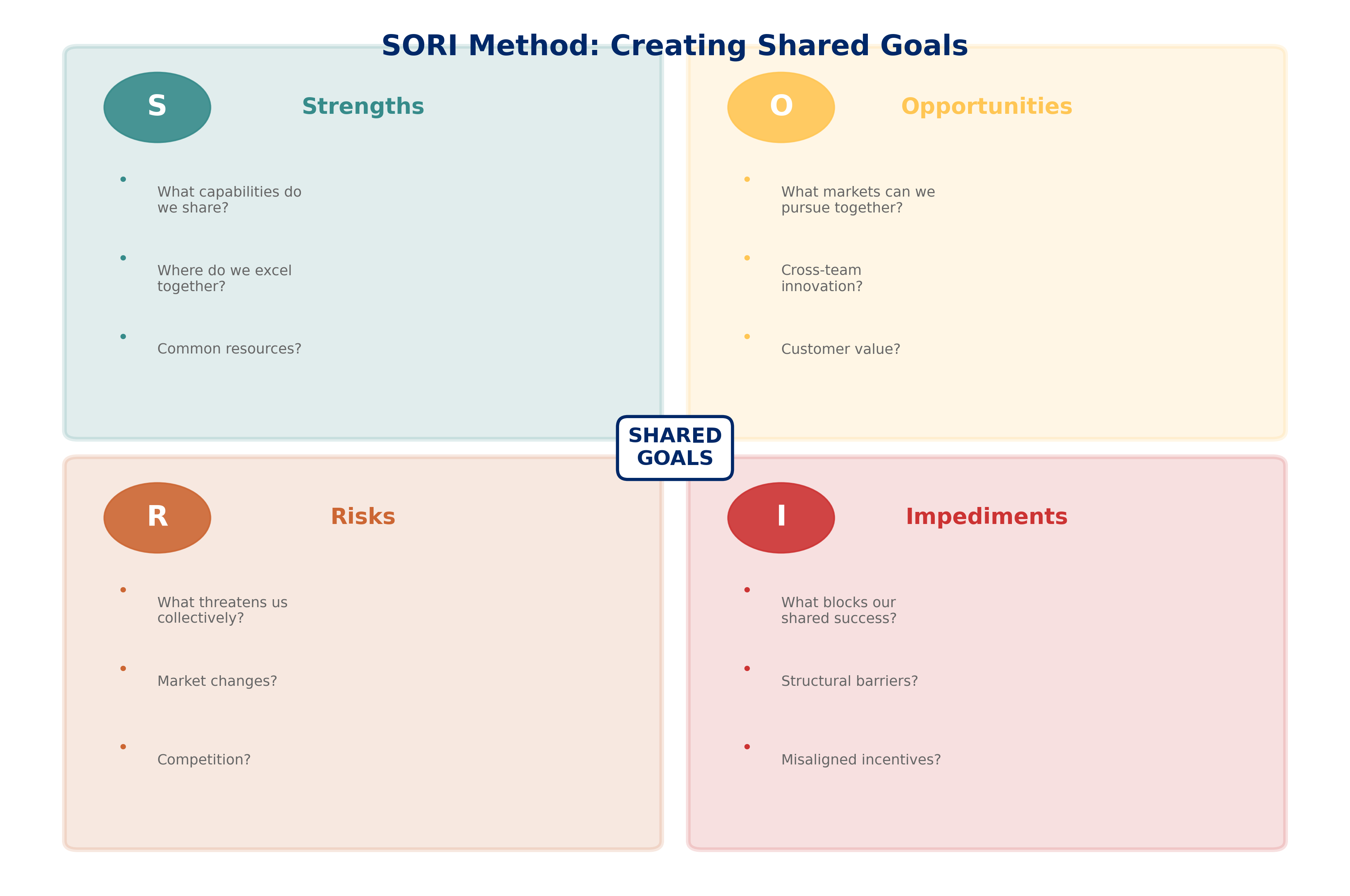
Step 2: Conduct the SORI Exercise
Bring the leadership team together to identify:
- Strengths: What capabilities do we share across departments? Where do we excel together that none of us could achieve alone?
- Opportunities: What market opportunities require cross-functional collaboration? Where could we create outsized value by working together?
- Risks: What threatens us collectively? What competitive or market forces do we need to address as one organization?
- Impediments: What blocks our shared success? (Spoiler: misaligned incentives always appears on this list.)
This exercise serves as an alignment mechanism. Leaders discover they have the same problems. They realize that Glenn in Engineering faces the same vendor management challenges as Sarah in Procurement. Maybe they should work together instead of independently negotiating with the same suppliers.
Step 3: Create the Balanced Scorecard
Design a compensation structure that balances team and individual performance. A typical model:
- 60% based on shared organizational outcomes (customer value, revenue growth, innovation metrics)
- 40% based on individual contribution and departmental excellence
The shared component can't be vague. "Help the company succeed" doesn't drive behavior. Specific, measurable team outcomes do. Customer satisfaction scores. Revenue from new products. Time-to-market for innovations. Cross-functional project completion rates.
Step 4: Implement Gradually with Coaching
Don't change everything overnight. Start with one leadership team. Run 90-day cycles where leaders practice working toward shared goals. Coach them through the inevitable mistakes.
They will make mistakes. Someone will try to game the system. Someone will free-ride on others' efforts. Someone will default to old patterns under pressure. This is where coaching matters. We let the mistakes happen, then we have coaching sessions afterward. It becomes apparent what behaviors need to change—and leaders do change when they see the pattern.
Step 5: Measure and Iterate
Track both leading and lagging indicators. How often do leaders collaborate? How quickly do cross-functional initiatives move? What's the quality of information sharing? These are your leading indicators.
Revenue from innovation. Customer retention rates. Time-to-market. Employee engagement scores. These are your lagging indicators that prove the model works.
One client saw a 40% reduction in time-to-market for new products within six months of implementing shared goals. Another saw employee engagement jump 25 points. A third reduced duplicate spending by $2.3 million in the first year.
The Leadership Team That Changed Their Reward Model
One catalyst team—leaders from different divisions plus members of the C-suite—completely transformed their approach after going through this process. First, we assessed every team member using behavioral profiles similar to the Predictive Index. This wasn't just for our benefit. It was primarily for their benefit, so they could understand each other better.
The revelation? They were all Type A personalities. Every single one wanted to give orders. They had no balancing voice of reason, no one bringing analytical depth, no collaborative counterweight to all that command energy.
They didn't hire new people. They just developed awareness of what they were lacking and worked on becoming a more cohesive team. Once they understood each other's perspectives, they started actually listening to each other instead of just waiting for their turn to talk.
Then we tackled the reward structure. Their individual goals remained in place—we didn't subtract anything. But we added shared goals derived from the SORI exercise. We created a continuous improvement backlog based on their common pains, opportunities, and risks.
The transformation took about 90 days to show clear results. Leadership meetings changed from status updates to actual problem-solving sessions. Information started flowing more freely. Decisions got made faster because people weren't positioning for individual advantage.
Most importantly, innovation accelerated. When leaders stopped protecting their territory and started protecting shared outcomes, the organization's collective IQ went up. Six smart people with IQs of 120 were finally behaving like six smart people instead of like a committee with a collective IQ of 80.
Common Objections and How to Address Them
"Our high performers will leave if we dilute their incentives."
You're not diluting incentives. You're expanding them. High performers often leave because they're frustrated by organizational dysfunction. They want to make an impact, and siloed structures prevent that. Shared goals often attract and retain the best people because they can finally accomplish what they came to do.
"HR will never approve this."
Start with one team as a pilot. Measure results. Use data to make the case. Most HR teams are desperate for solutions to collaboration problems. If you show a 30-40% improvement in key metrics, they'll be advocates for scaling the approach.
"This only works for executives, not for individual contributors."
The principle scales. Software development teams have been using shared goals for decades—it's called Scrum. The whole team owns the sprint commitment. Individual contributions matter, but the team succeeds or fails together. This works at every level when implemented thoughtfully.
"Our industry is too competitive for shared goals."
Your competitors aren't your internal departments. The more competitive your industry, the more you need internal alignment. Companies that fight internally lose to companies that collaborate internally.
Three Immediate Actions You Can Take This Week
You don't need executive approval or a six-month transformation initiative to start addressing this problem. Here are three actions you can take immediately:
Action 1: Map Your Leadership Team's Goals
Create a simple spreadsheet. List each leader's top three goals. Identify conflicts and overlaps. Share it with the team. Just seeing it in black and white creates awareness. "Wow, half of our goals contradict each other" is a powerful realization.
Action 2: Run a Mini-SORI Exercise
In your next leadership meeting, spend 30 minutes on these questions:
- What's one pain point we all share?
- What's one opportunity we could pursue together?
- What's one impediment blocking our collective success?
You'll be amazed at what emerges. Even one shared goal can start changing behavior.
Action 3: Add One Shared Metric
Don't overhaul your entire compensation structure. Just add one shared metric to everyone's scorecard. Make it something meaningful—customer satisfaction, innovation pipeline health, cross-functional project success rate. Start measuring it. Start talking about it. Behavior will follow measurement.
The Path Forward
Compensation structures are just visible symptoms of deeper organizational beliefs. When companies reward individual achievement over collective success, they're saying "protect your territory" louder than any cultural value statement proclaiming collaboration.
The good news? This is fixable. It doesn't require replacing your entire leadership team or burning down your organizational structure. It requires honest assessment, thoughtful redesign, and patient implementation.
The pattern we see across dozens of client engagements is consistent: organizations that align incentives with desired behaviors transform faster, innovate better, and retain top talent longer than those that don't.
Your innovation problem isn't a talent problem. It's not a culture problem. It's not even a strategy problem. It's a structural problem—and misaligned incentives are at the heart of that structure.
The question isn't whether your compensation system is sabotaging innovation. The question is how much it's costing you, and how much longer you're willing to pay that price.
Ready to Align Your Leadership Team?
Misaligned incentives create measurable drag on your organization's performance. The Disruptor Method provides a systematic approach to identifying and resolving these structural conflicts.
Take the Disruptor Method Assessment at disruptormethod.com to discover where your leadership team's incentives might be working against your innovation goals.
Want to explore these concepts further? Watch related episodes:
View the Full Playlist: The Meridian Point and Book a call now!