Robust Theme
Dec 09, 2019 2020-04-08 7:40Robust Theme


Executive Presence: A Biased Filter on Who Leads
By: Kumar Dattatryan
I was twenty-three years old, managing a restaurant in Northern Virginia, and I was good at it. I knew how to run a shift. I knew how to handle a lunch rush that would break most people. I knew how to build a team out of high school kids and recent immigrants who barely spoke English, and I knew how to get that team to perform.
Nobody ever told me I had executive presence.
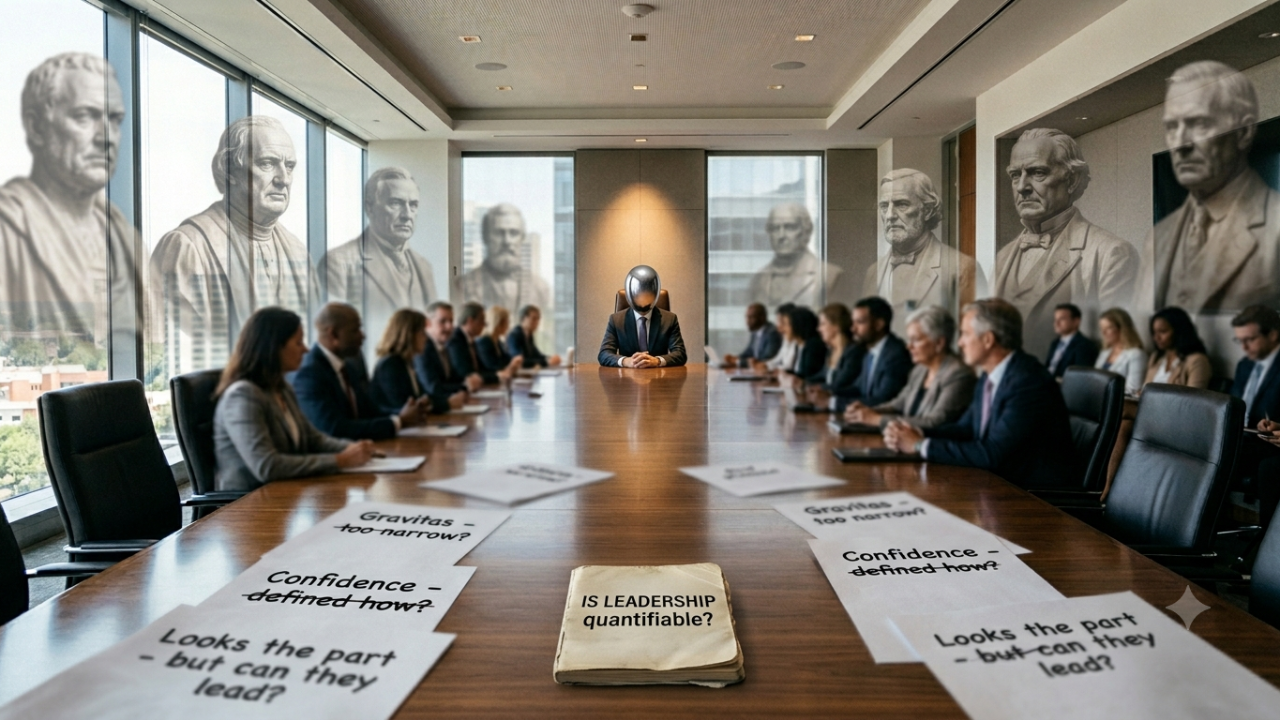
That phrase showed up later, after I had moved into consulting, after I started working with Fortune 500 leadership teams. It showed up in conference rooms where people wore better shoes than I did. It showed up in talent reviews where someone's name would come up and a senior leader would say, almost as an aside, "They just don't have the presence for that role." No specifics. No criteria. Just a phrase everyone nodded at.
I nodded too, at first. I thought I understood what it meant. Confidence. Poise. The ability to command a room. But over the years, as I coached more leaders and sat in more talent calibration sessions, I started to notice a pattern. The people described as "having presence" looked a certain way. They spoke a certain way. They carried themselves according to an archetype that had very little to do with whether they could actually lead.
And the people told they "needed to develop more presence" were disproportionately women, people of color, and anyone whose leadership style did not fit the commanding, authoritative mold.
I know this because I was one of them. I was told, earlier in my career, that I lacked executive presence. It had a big impact. In the moment, it was a deeply negative one. I did not feel good about myself. I kept asking: what am I missing? What am I lacking that these people are saying I don't have? But the feedback was not actionable. Nobody could tell me what to do differently. I was being hammered with something that wasn't quantifiable in any way. It was just: you don't have it.
This is not just my observation. The research confirms it.
The Vagueness Is the Problem
Sylvia Ann Hewlett's research through the Center for Talent Innovation found that executive presence accounts for roughly 26 percent of what it takes to get a promotion into senior leadership. More than a quarter. And yet when you ask the people making those decisions to define it, they cannot. Not precisely. Not in terms that would survive a rigorous evaluation.
Hewlett breaks executive presence into three components: gravitas (how you act), communication (how you speak), and appearance (how you look). Gravitas dominates, accounting for about two-thirds of how presence is perceived. But here is what the data also shows: the standards for presence vary significantly depending on who is being evaluated. Women have a narrower range of acceptable behavior. Professionals of color take pains to mute their differences to fit the expectations of their peers and superiors. The evaluation framework looks objective on the surface. Underneath, it is riddled with bias.
The Bates Executive Presence Index, the first scientifically validated assessment for measuring presence, breaks leadership effectiveness into 15 distinct facets across three dimensions: character, substance, and style. Character includes authenticity, integrity, concern, restraint, and humility. Substance includes practical wisdom, confidence, composure, resonance, and vision. Style includes appearance, intentionality, inclusiveness, interactivity, and assertiveness.
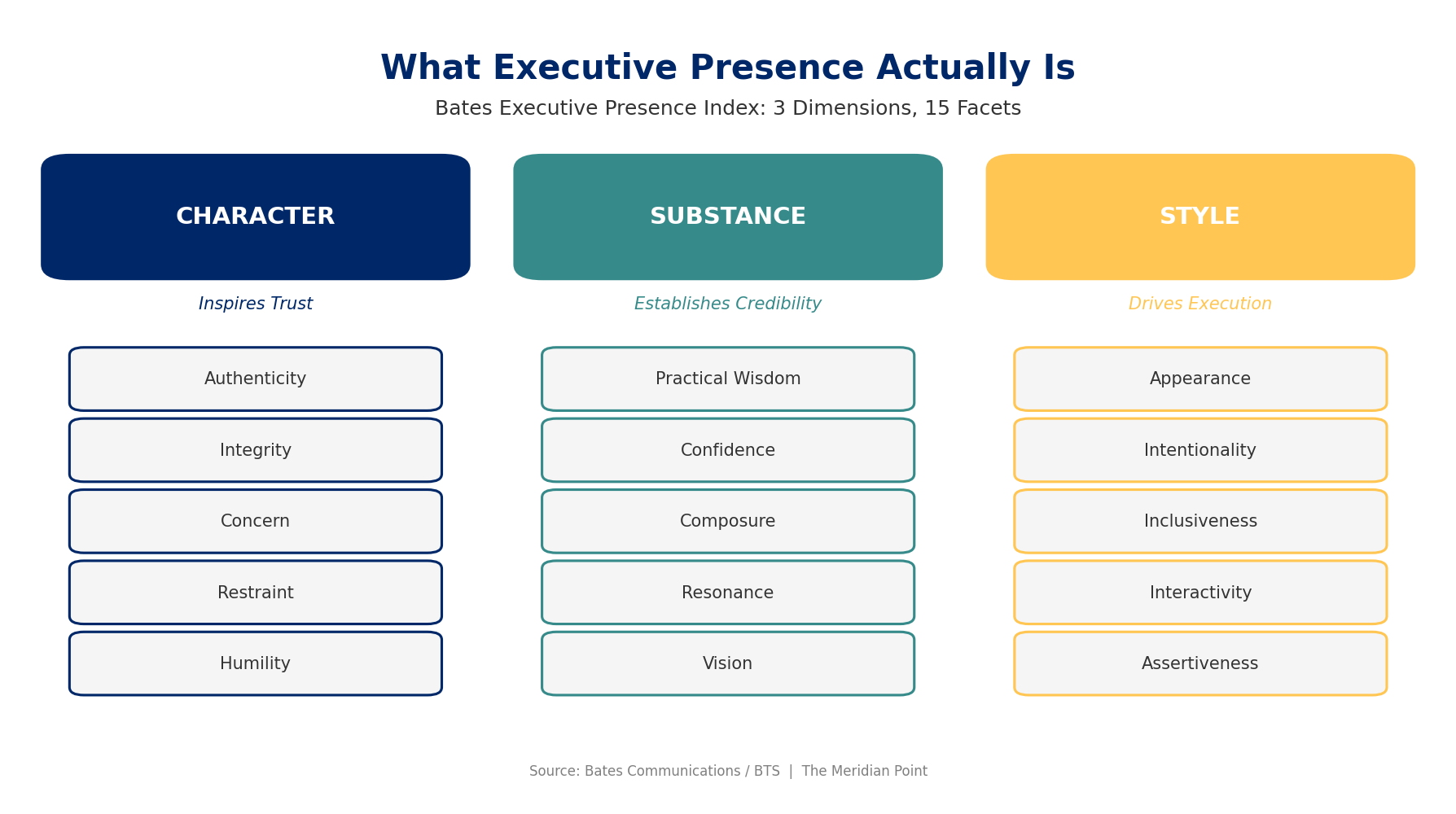
Look at that list carefully. Humility is in there. Concern is in there. Inclusiveness is in there. These are not the traits that come to mind when someone says "executive presence" in a talent review. When that phrase gets used in a conference room, it almost always means confidence, commanding a room, and looking the part.
The gap between what the research says matters and what organizations actually evaluate is enormous.
Ash Siddique, founder of the communication intelligence platform Mivante, took this further in a conversation on my podcast. Ash coaches executives at companies like Cisco, Uber, and Google. What he found is that what we call "presence" in communication is often just one person's preferred style overriding everyone else's. His platform maps the communication preferences of stakeholders so leaders can adapt how they deliver messages. The insight is not that some leaders communicate badly. It is that organizations reward one communication style and penalize everything else. That is not a competency gap. It is a design flaw.
The Affinity Bias Loop
I see this all the time in the leadership teams I work with. We use Predictive Index, which is similar to DISC, and what we find is striking. Leadership teams are almost always skewed toward the same personality profile. High dominance. High influence. Action-oriented, results-driven, competitive. The D and I quadrants on DISC.
Jeff Harnois, a leadership coach and team dynamics specialist, described a client's executive team on my podcast that was so concentrated in those quadrants they were making decisions at extraordinary speed and getting half of them wrong. They had no one on the team who naturally brought skepticism, due diligence, or the patience to slow down and think. Jeff's observation was sharp: the remedy was not to replace people but to teach the D and I profiles how to adopt the behaviors that would naturally come from the C and S quadrants. The personality composition of the team was not an accident. It was the predictable outcome of an evaluation system that rewarded a specific archetype.
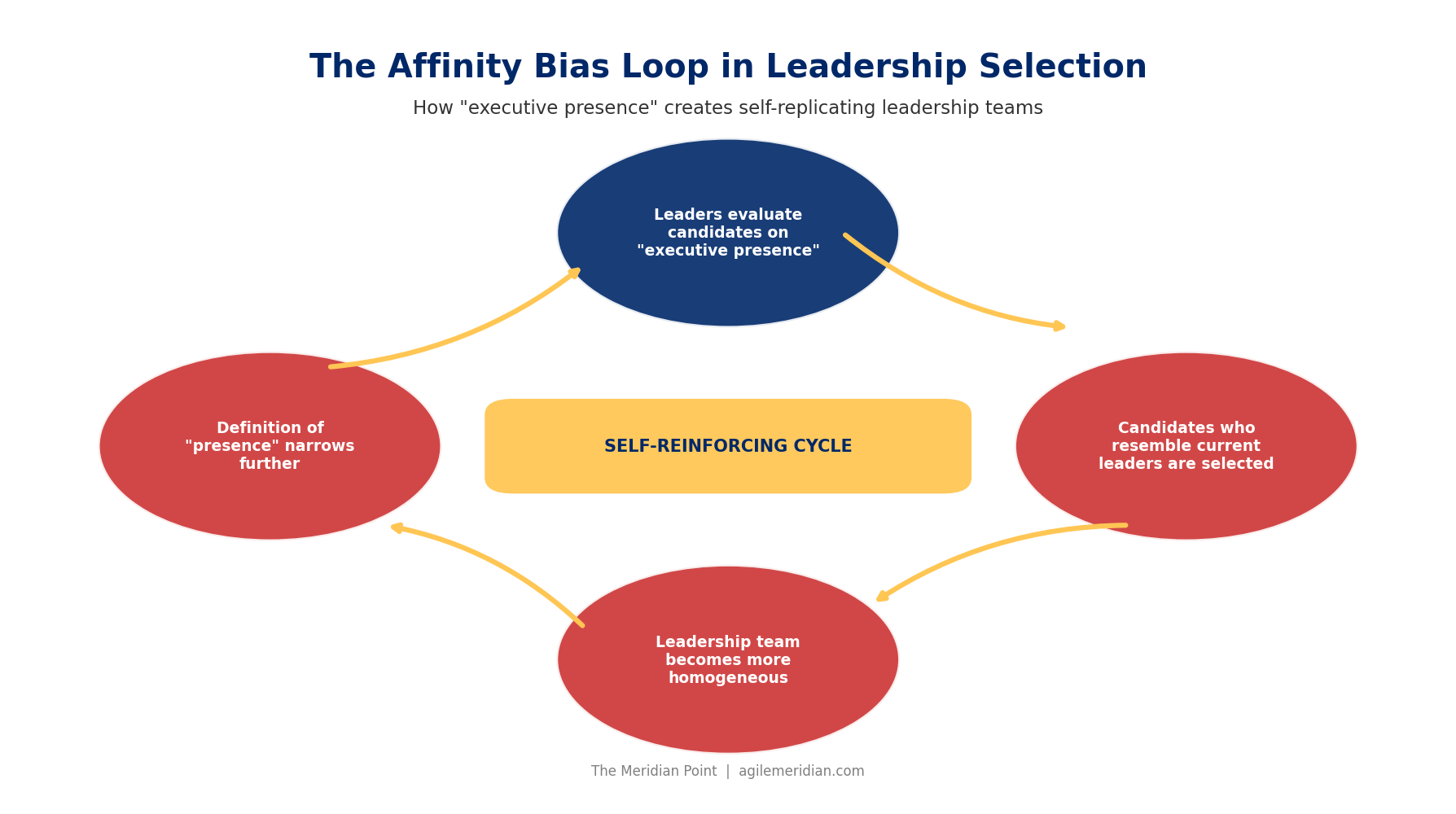
This is how affinity bias operates. It is the tendency to favor people who resemble us, sometimes called the mini-me syndrome. Leaders evaluate future leaders based on resemblance to themselves. The evaluation criteria are subjective. The phrase "executive presence" gives that subjectivity a professional-sounding name. And because the people hired today become the hiring committee of tomorrow, the bias reinforces itself in a loop.
Chris Dyer, a culture and leadership consultant, made the observation on my podcast that when organizations changed what they were actually looking for in leadership, "who started showing up to final interviews was remarkably different." Chris was talking about diversity of thought, about deliberately seeking people who think differently rather than people who look and sound like the existing team. But the point extends further. The filter was never about capability. It was about conformity.
A Word Cloaked in Mystery
A colleague raised this topic in a recent Coaching Dojo session I host, with a small group of coaches and leadership practitioners. She wanted to know how coaches handle it when someone on a diverse team is told they lack executive presence. What she got back was not a clean definition. It was five different definitions, layered with personal experience and frustration.
She was direct. The word has been weaponized. It gets used to filter out exactly the people that inclusion work is supposed to bring in. Women are told they're too emotional or not assertive enough. Black professionals are told they're too direct or not warm enough. The word sounds neutral. It isn't. It's cloaked in subjectivity, and when someone in a position of authority uses it against you, they are attempting to legitimize a judgment they cannot explain. You are left thinking: what does that even mean? And they can't tell you. But it still goes in your performance review.
Another colleague called it a cudgel. If you want to put somebody down, you beat them with it. His reading was that the phrase is code for command and control: either "I wanted you to control those people, and you didn't" or "I want you to beat those guys up and be more controlling." He was told he lacked executive presence fifteen or twenty years ago. His response now: just because you don't come in and beat everybody over the head doesn't mean you don't have it. In fact, that is the hard kind.
A third colleague recognized the pattern from a different angle. Between 2004 and 2008, he was trying to get a team leader position. Every cycle, his managers encouraged him, appreciated his work. Then the performance review came and the answer was the same: you're not ready yet. The disconnect between the daily encouragement and the formal evaluation baffled him. The criteria were invisible.
A fourth observed something subtler. Executive presence, as the term is traditionally understood, barely survives a remote environment. So much of it is anchored in physical presence: eye contact, posture, how you carry yourself in a room. In a world where most leadership happens over a screen, what exactly are we measuring?
I added my own: the phrase might just be code for "you are different, and we don't understand you." And because nobody can define it precisely, nobody has to defend that judgment. It just sits there, shaping careers.
What struck me most was the observation about affinity bias. Leaders hire, promote, mentor, and trust people who remind them of themselves. An organization might say it values diversity. But the roster tells a different story. The word "executive presence" is part of how the roster stays the same.
What the Research Says Is Shifting
Hewlett's updated research, published in Harvard Business Review in 2024, shows that expectations around executive presence have changed significantly over the past decade. Confidence and decisiveness still matter. Those have not gone away. But inclusiveness has risen to become the third most valued component of gravitas, outranking integrity from the 2012 survey. Authenticity, which did not register with respondents ten years ago, is now prized across all three dimensions. "Listen to learn" has emerged as a valued communication trait alongside the traditional "command a room."
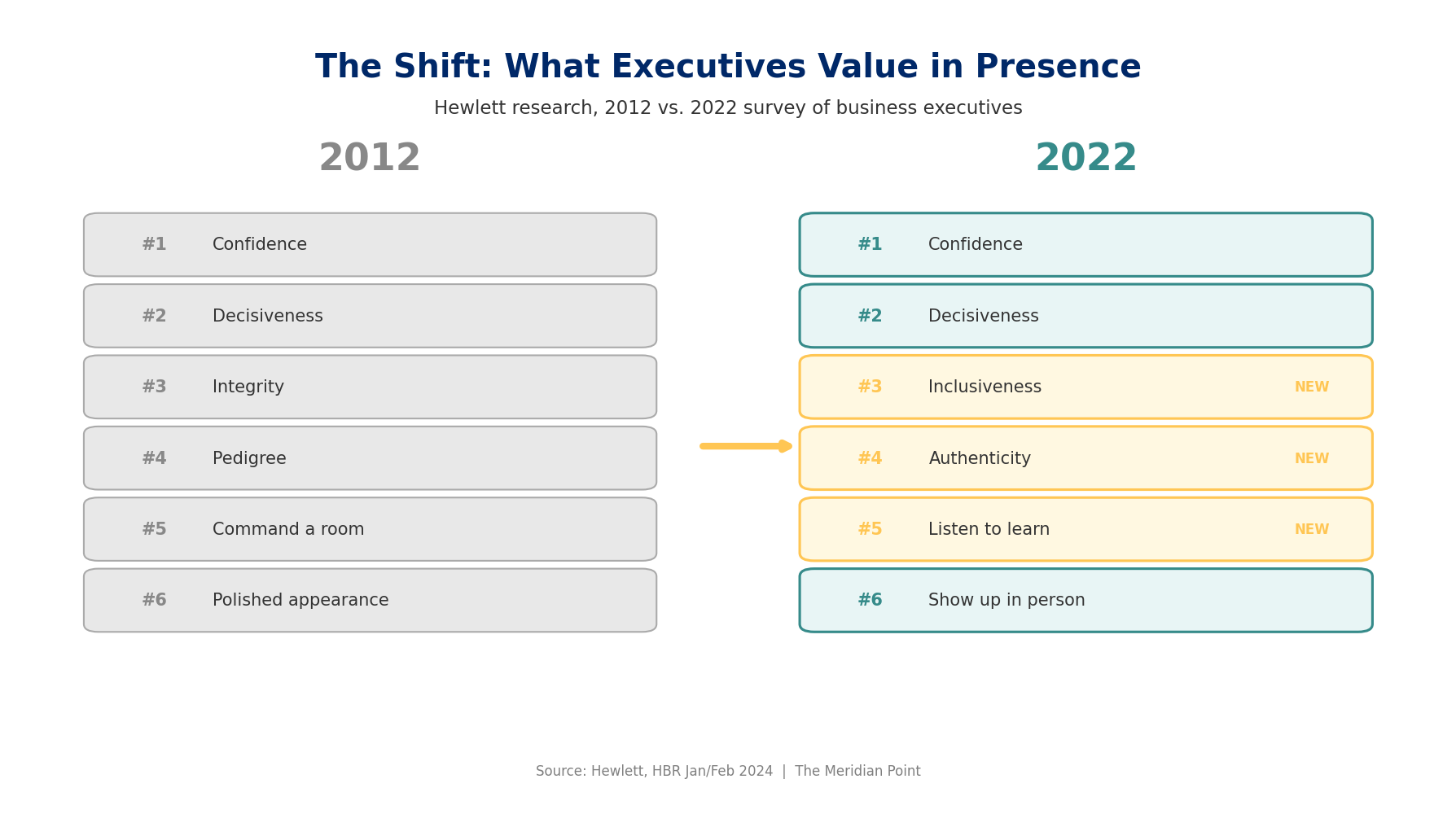
The pandemic, Black Lives Matter, remote work, economic instability: all of these forces shifted what people expect from leaders. The old archetype of the decisive, polished, commanding executive has not disappeared. But it is no longer sufficient. And in many organizations, it is actively counterproductive.
Evan Leybourn, CEO of the Business Agility Institute, shared data on my podcast showing that CEOs who built trust and collaboration during the pandemic flipped straight back to command-and-control when the economy shifted. The leaders trained in the heroic, individualist model returned to it under pressure because that's what they know. And the trust they had built evaporated.
That reversion is the old presence archetype reasserting itself. It is fear dressed up as confidence.
Vulnerability Is the Disruption
One of the coaches in that Dojo session put his finger on something. He looked at the standard definitions of executive presence that another participant had pulled up from Forbes, Brown, and various leadership publications, and he saw a thread running through all of them: directiveness. Code for command and control. Then he pointed to something else: vulnerability. An awful lot of people never get there, he said. They are just very skillfully coercive in a minimally offensive way. That is not leadership. That is performance.
Glenn Marshall and I have had many conversations about this same tension between servant leadership and the command-and-control instinct. One of the things Glenn observed is that when you present leaders with the characteristics of servant leadership, they get defensive. Self-awareness. Empathy. Transparency. Humility. Active listening. Inclusivity. If you are a leader and someone tells you that you need to develop all of those qualities, your first reaction is to push back. "I've been a leader for twenty years. You are telling me I've been doing it wrong?"
That defensiveness reveals the problem. The archetype these leaders were evaluated against, the presence they were told they needed, did not include vulnerability. It did not include concern for others as a measurable leadership competency. It rewarded the appearance of control. And now that the research and the market are both demanding something different, leaders trained in the old model feel threatened rather than inspired.
Servant leadership is not about being soft. Glenn and I have gone back and forth on this. It is about creating conditions for other people to do their best work. Leadership as a Service, a framework from the XSCALE Alliance, operationalizes this into specific behaviors: decentralized decision-making, directly responsible individuals, timeboxed collaboration. It's not an academic exercise in making people feel good. It's a performance model. And the outcomes are measurable.
I've watched it work. I supported a department where the VP would look at me (for reassurance) during leadership meetings as a reminder that he was not supposed to make decisions. His direct reports were. It took a year. The shift was not dramatic. But the team started producing better outcomes because the people closest to the work were making the calls.
That VP would never have been described as having "executive presence" in the traditional sense. He was quiet. He deferred. He asked questions more than he made pronouncements. And his team outperformed.
I've come to believe that executive presence, if the phrase is worth keeping at all, is a combination of confidence and humility. It's the ability to be vulnerable in front of people who outrank you, or who you feel outrank you, and to be yourself anyway. I had to develop that over two decades. Nobody handed it to me with a title.
The Filter You Do Not See
Here is what makes this so difficult to address. The phrase "executive presence" sounds neutral. It sounds like a competency. It sits comfortably in talent reviews, leadership development plans, and job descriptions. Nobody thinks they are being biased when they use it.
But presence is an outcome, not a behavior. Telling someone they need to develop more executive presence is fundamentally ineffective feedback. It's like telling someone to be more likeable. You haven't told them what to do differently. You've told them they don't fit an image you can't articulate.
Alan Zucker, a veteran project management leader and podcast guest, put it plainly when we discussed this dynamic. Most people in management positions were never taught to manage. They were good at their previous role, they got promoted, and they looked around and mimicked what they saw. What they saw was top-down command-and-control. So that became their model of leadership. And the cycle continued: leaders who were never taught to lead evaluating others against a standard they inherited rather than one they examined.
Holly Golebiowski, a leadership trainer I interviewed on the podcast, drew the distinction sharply. A manager manages tasks. A leader improves the team, improves communication, gets people motivated and makes them better at what they do. The problem is that "executive presence" as commonly used selects for the manager archetype, the person who projects control, while screening out the leader archetype, the person who builds capacity in others.
Research shows that men are particularly uncomfortable giving presence-related feedback to women. The result is that women and professionals of color are less likely to receive any feedback on presence at all, and when they do, it is vague and unhelpful. "You need to be more assertive." "You need to take up more space in the room." "You need to project more confidence." Meanwhile, a man displaying identical behavior receives no such feedback.
The top performer who gets passed over for someone with "more presence." The leader who is told she negotiated too aggressively, for doing the exact same thing her male predecessor did. The executive who is brilliant at his job but doesn't fit the mold, so he learns to mute who he is. These are not edge cases. They are the norm.
What Would Change If We Measured What Matters
The Disruptor Method starts with an assessment. When my partners and I work with a leadership team, we begin by understanding who these people are, how they think, what their blind spots look like. Predictive Index gives us the composition data. But what we're really looking for is whether the team has the range to handle complexity.
If your entire leadership team is wired the same way, you don't have a leadership team. You have an echo chamber with titles.
The question is not "does this person have executive presence?" The question is "does this person create the conditions for effective leadership?" Can they build trust? Can they make space for dissenting views? Can they make decisions under uncertainty without reverting to command-and-control? Can they develop other leaders, not just manage them?
Those are measurable behaviors. The Bates ExPI measures them across 15 facets. The Disruptor Method measures them through team composition analysis and collaborative goal-setting. Hewlett's updated research measures them through surveys that now include inclusiveness and authenticity.
The tools exist. The research exists. What is missing is the willingness to retire a phrase that lets subjective evaluation masquerade as leadership science.
Three Things to Do This Week
First, audit your talent review language. Search your last two cycles of performance reviews and succession planning documents for the phrase "executive presence." Every time it appears, ask: what specific behavior is being described? If the answer is vague, the evaluation is suspect.
Second, run a composition check on your leadership team. Use Predictive Index, DISC, or any validated psychometric tool. Map the personality profiles. If more than 70 percent of your leadership team clusters in the same quadrant, your evaluation system is selecting for type, not capability.
Third, replace "executive presence" with measurable criteria. Define what effective leadership looks like in your organization using observable behaviors. The Bates ExPI's 15 facets are a good starting framework. Evaluate people against that, not against a feeling that some leaders trigger in a room.
The phrase "executive presence" has been with us for decades. It has shaped careers, ended them, and filtered out leaders who might have been exactly what their organizations needed. It is time to ask whether it serves the organization or just protects the archetype.
Who gets to lead should not depend on who looks the part.
Take the Disruptor Method Self-Assessment
How aligned is your leadership team? Find out where the gaps are: https://www.thedisruptormethod.com/quiz
Book a Conversation
If your organization is evaluating leadership potential, let us show you what a composition-based approach looks like: https://tidycal.com/coachkumar/30-minute-meeting
Related Podcast Episodes
Executive Presence Beyond Appearance (EP101) The episode that started this conversation, exploring what presence actually means when you strip away the surface.
Business Agility in Crisis: 2025 Trends with Evan Leybourn (EP167) Evan shares data on the return of authoritarian leadership and what it means for organizations trying to build trust.
How AI Is Disrupting Leadership Communication and Executive Coaching (EP147) Ash Siddique's work on communication intelligence reveals how much of "presence" is just one communication style overriding all others.