Robust Theme
Dec 09, 2019 2020-04-08 7:40Robust Theme


Why Organizational Silos Survive: The Leadership Turf Problem
By: Kumar Dattatreyan
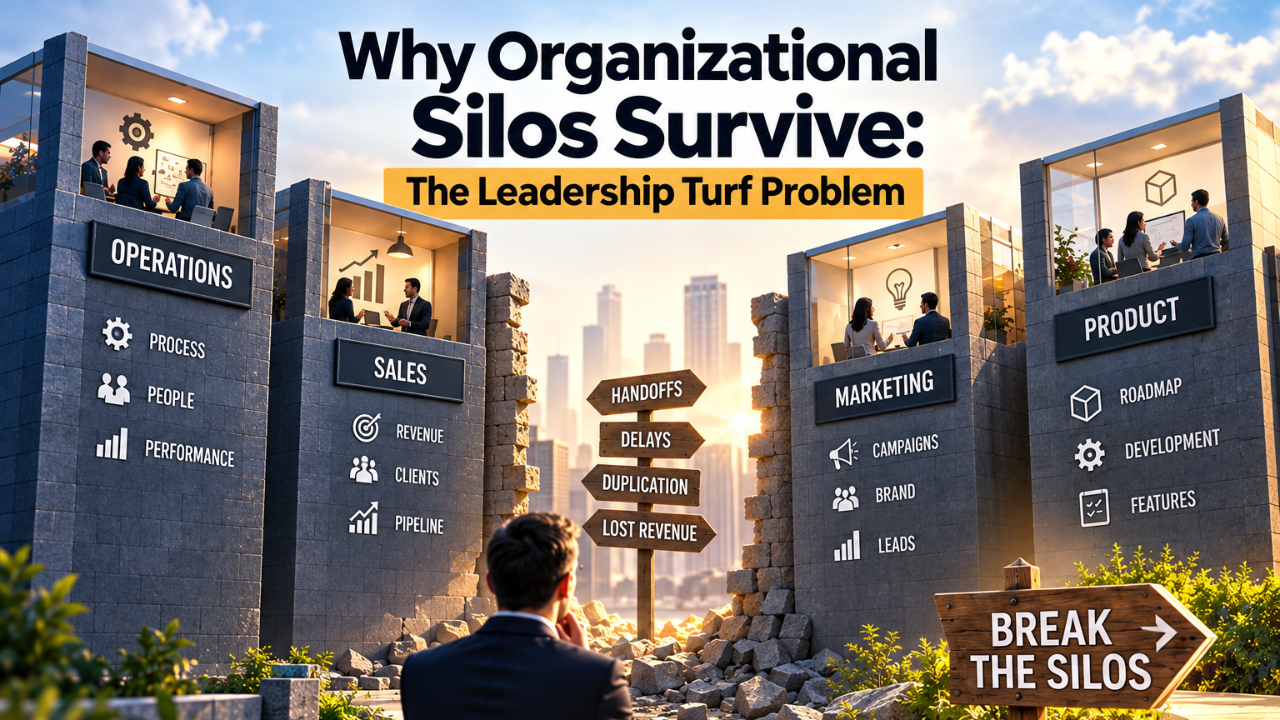
I can walk into almost any organization and tell you where the silos are inside thirty minutes. That isn't a special talent. You can do it too. You feel it the moment a simple request has to cross a line and stops.
The silos are never the mystery. The mystery is why organizational silos are still standing years after everyone started complaining about them, long after the offsite and the reorg that was supposed to fix exactly this.
A silo survives because it belongs to somebody. It carries a headcount and a budget, and it carries a job title that depends on both.
It started as a reasonable wall around a real problem. Then it became a tower, and the person who would have to take the tower down is the person who lives in it. You won't fix that with another chart. You break down organizational silos by changing what a leader loses when the wall comes down.
Organizational silos and leadership belong in the same sentence, because the wall isn't a design flaw. It's a decision that's hard to make.
Why Organizational Silos Outlive Their Usefulness
Most advice on organizational silos and leadership prescribes better communication and more cross-functional teams. Those moves help, but they don't address the reason the walls still stand.
An org chart is a finished-looking slide. It shows clean boxes and clean lines. It hides the question that matters, which is who actually holds the decision and the budget behind each box. That gap stays invisible until work has to cross a line. Then the silo shows up as the place the work stops.
The bill arrives as duplicated work and stalled handoffs. A request that should take a day waits in a queue that belongs to a different leader, and nobody with the authority to fix the queue feels the delay personally. Customers feel it. Revenue leaks through the gap between two boxes that each look healthy on their own measures. That's the cost Glenn Marshall had in mind when we recorded the episode on the subject Organizational Silos Are Bleeding Your Revenue.
Patrick Lencioni wrote an entire leadership fable about the pattern, Silos, Politics and Turf Wars. Call it silo mentality or call it turf wars. The label matters less than the cause. The pattern keeps repeating because the standard fixes treat the silo as a structure problem. I'd call it a turf problem dressed as structure. Someone built a wall to control a problem. The wall acquired an owner, and the owner now has every reason to keep it.
That's why another reorg never fixes it. A reorg redraws the structure. It never touches the interest that built the structure in the first place.
The Strongest Objection: Blame the System, Not the Leader
Systems thinkers will push back hard here, and they've earned the right. W. Edwards Deming taught that most problems are built into the system, not caused by the people working in it. On that view, a manager who guards a department is usually responding rationally to the incentives he was handed. Conway's law adds that an organization's structure mirrors the way its people already communicate. It reflects no one's ambition. Calling a silo a turf grab, they say, is the fundamental attribution error. It moralizes a structural problem and sends the company hunting for empire builders while the incentives that reward empire building stay untouched.
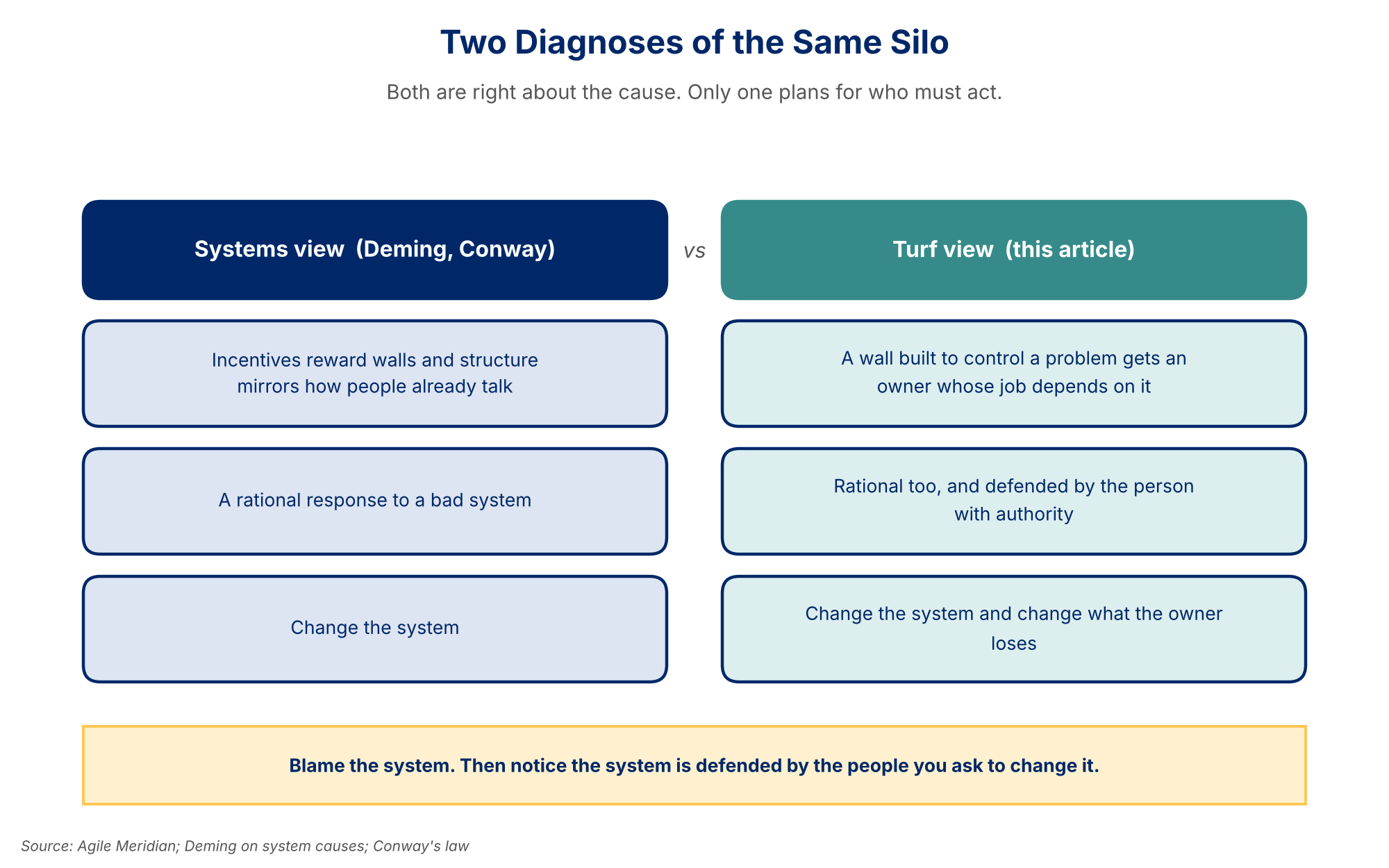
I agree with most of that. The system does reward the tower, and most silo behavior is rational rather than villainous. Pointing at self-interest isn't calling the leader a bad person. It's refusing to pretend he's neutral about a structure that happens to be his budget and his job.
Deming's method also depends on someone with authority changing the system. That's exactly where a silo bites. The person with the authority to redraw the chart is the person the chart protects, so he's the least motivated actor in the building to touch it. Blame the system. Then notice that the people you're asking to change it are the people defending it, and design for that.
Where Organizational Silos Come From: The Control Reflex
Glenn gave the origin story on Episode 137 of The Meridian Point, and it starts with a reflex. Something goes wrong, and in his words, "humans' natural reaction is to control when you have something bad." So someone puts process around the problem to make sure it never happens again. The process makes sense on the day it's written. Then it becomes permanent, and a wall goes up.
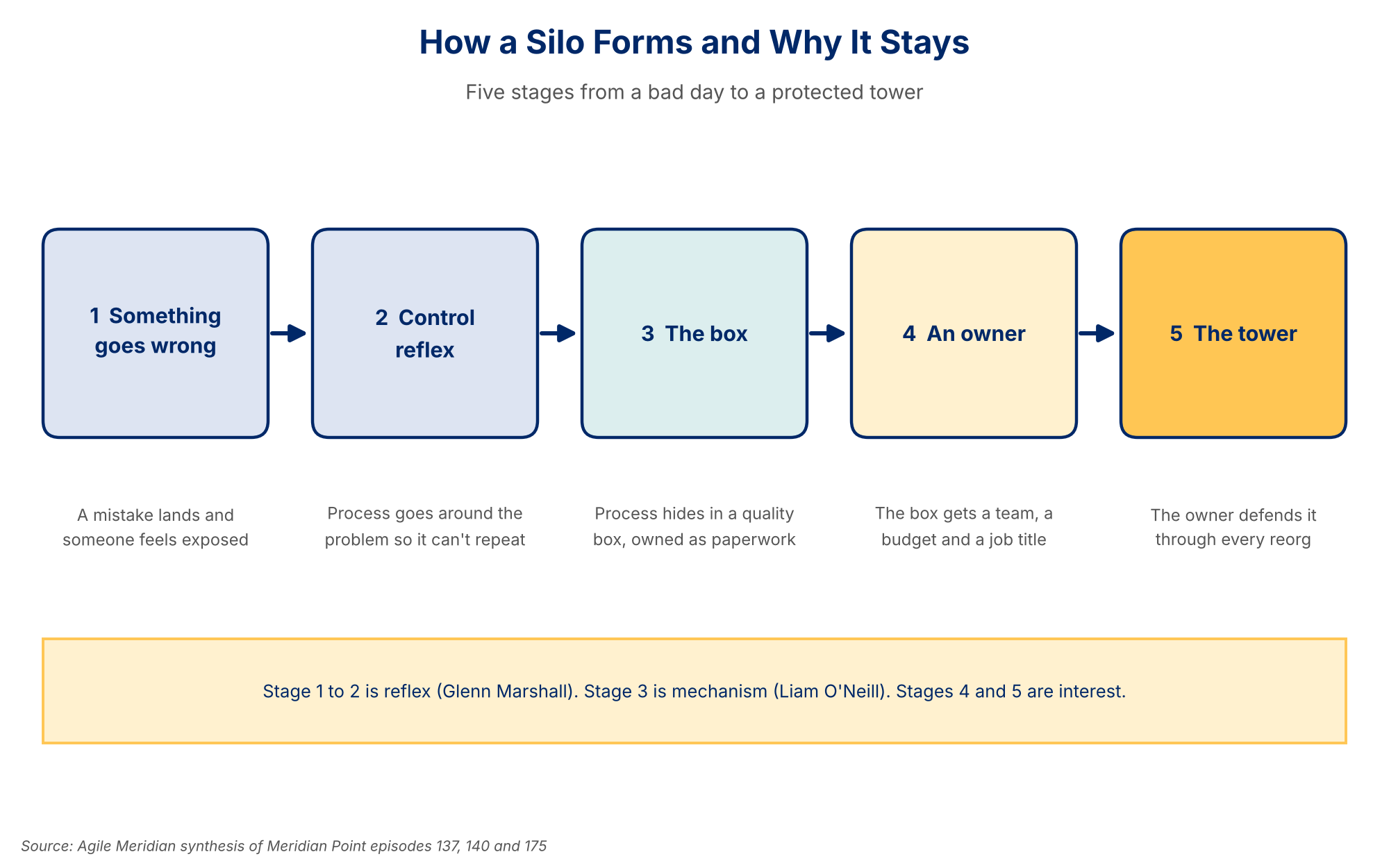
Glenn doesn't accept the usual excuse that a regulated business has to run through deep hierarchy. Regulation sets what must be true. It doesn't dictate how you get there. He wants leaders to treat the mistake differently: "Nothing is ever perfect. Mistakes are going to happen. They need to be viewed as a learning opportunity." A mistake treated as a learning opportunity starts a better conversation. A mistake treated as a threat starts another wall.
Glenn's origin story explains the first process. It doesn't explain why a silo that everyone can see survives for years. That part isn't reflex. It's interest, and Liam O'Neill supplies the mechanism.
How Process Becomes Turf: The Hidden Quality Box
Liam runs a London process management consultancy, and on Episode 140 he described process work trapped inside a quality box, hidden away from the people who deliver change. His job was to drag that work into the open. The cost of leaving it there showed up at a logistics company, where the handover from a process team to a project management team stalled delivery for about six months. Each side expected something different from the other. The momentum the change had built drained out in the gap.
The mechanism sits in how Liam talks about ownership. In the traditional process world, the owner signs off on the SOP and the model and moves on. Liam says it plainly: "Ownership shouldn't be about ticking a box on an SOP or filling a form in for an audit prep. It should be about, like you said, taking accountability for that process, making sure it's working."
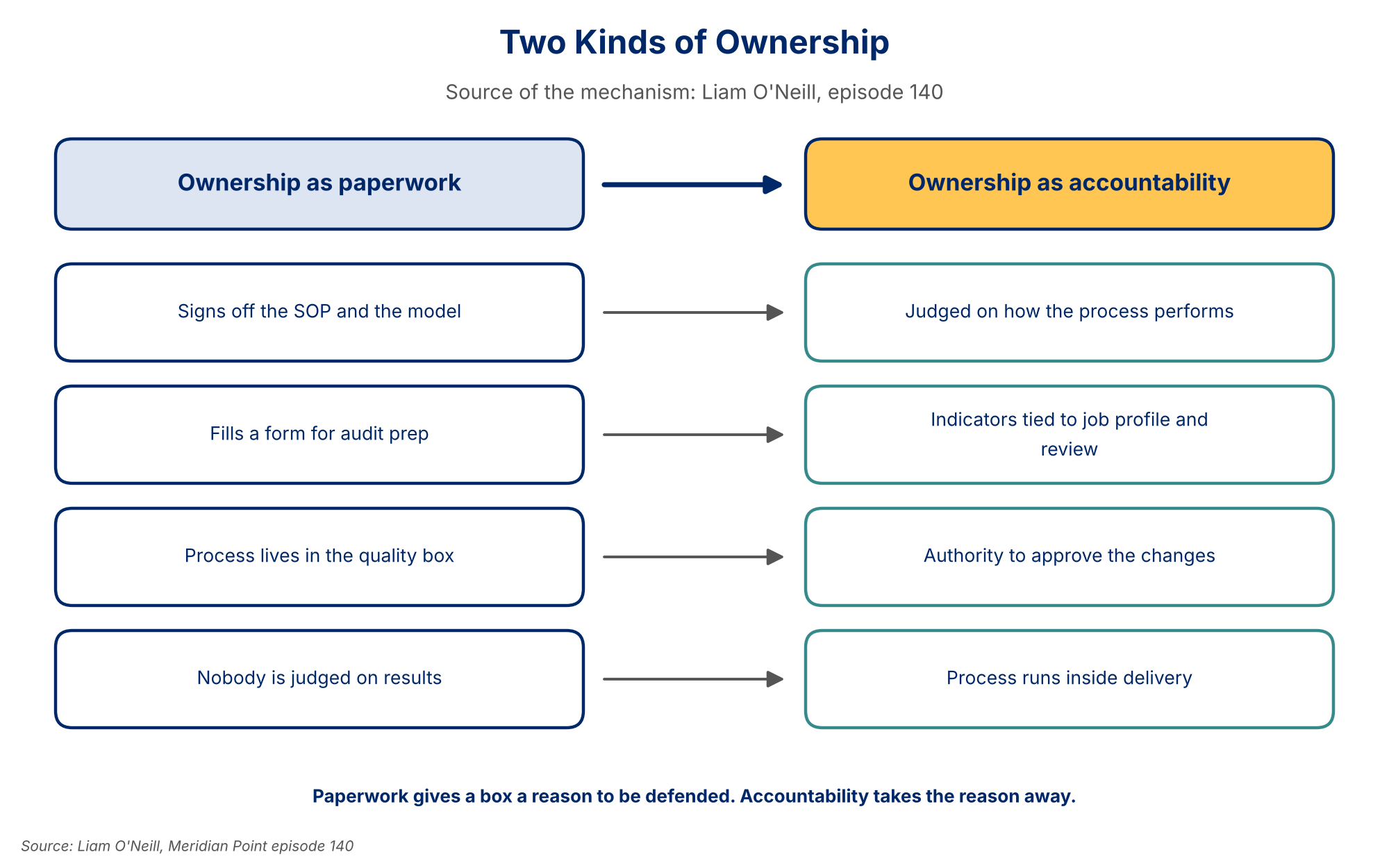
Take that as a diagnosis of turf. Ownership treated as paperwork is what a protected box produces to justify itself. A box owned as paperwork exists to be defended, because nothing else gives it a reason to exist. Redefine ownership as accountability for whether the thing works, and the box loses its reason to stay walled off.
Liam makes the same point about AI. "You can't just have an AI agent sitting in a silo doing all the work on its own." The agent fails without cross-context. But the silo was never built to serve the work. It was built to control the work, and then someone kept it.
The Move a Silo Leader Can't Make
Nawaz Butt supplies the other half. On Episode 175 he argues for de-scaling: "The aim has to be not to have more teams, but to have fewer teams in the organization." He wants decisions pushed down to where the work happens, so that "the team needs to own some of the decisions about their commitments and how they deliver against them." His instruction to leaders is blunt. Get out of the way.
His line about coaching exposes the silo leader by contrast. "My job as a coach is not to preserve my role. It's to create conditions where people can become more self-organized and self-sufficient." That's the opposite of turf. A coach builds conditions where people stop needing him. A silo leader can't make that move, because her role is the bottleneck, and designing the bottleneck away means designing her job away.
So nobody lacks the knowledge to descale. I've written before about why fewer teams deliver more capacity, and the practice isn't the obstacle. The question is whether the person who holds the authority to descale is also the person it costs.
A coaching and facilitation dojo i facilitate keeps coming back to the same theme from the other direction. In a large organization, the hard part of transformation is the political system around the work, not the practice itself. Politics, not practice. Everyone in the room already knows how to redraw the chart. The chart's easy to draw. It's hard to change because the redraw costs someone a tower.
How to Break Down Organizational Silos: Change What the Leader Loses
So how do you fix it? You don't ask the owner of the tower to be selfless. You change the math.
Liam gives a working example. One of his clients has assigned an owner to each of roughly 600 level three processes and is tying the performance indicators for every process to its owner's job profile and review cycle. An accounts receivable lead whom the whole team loves still isn't doing a good job if the receivables process is broken. Accountability moves from the document to the outcome, and the box loses its place to hide.
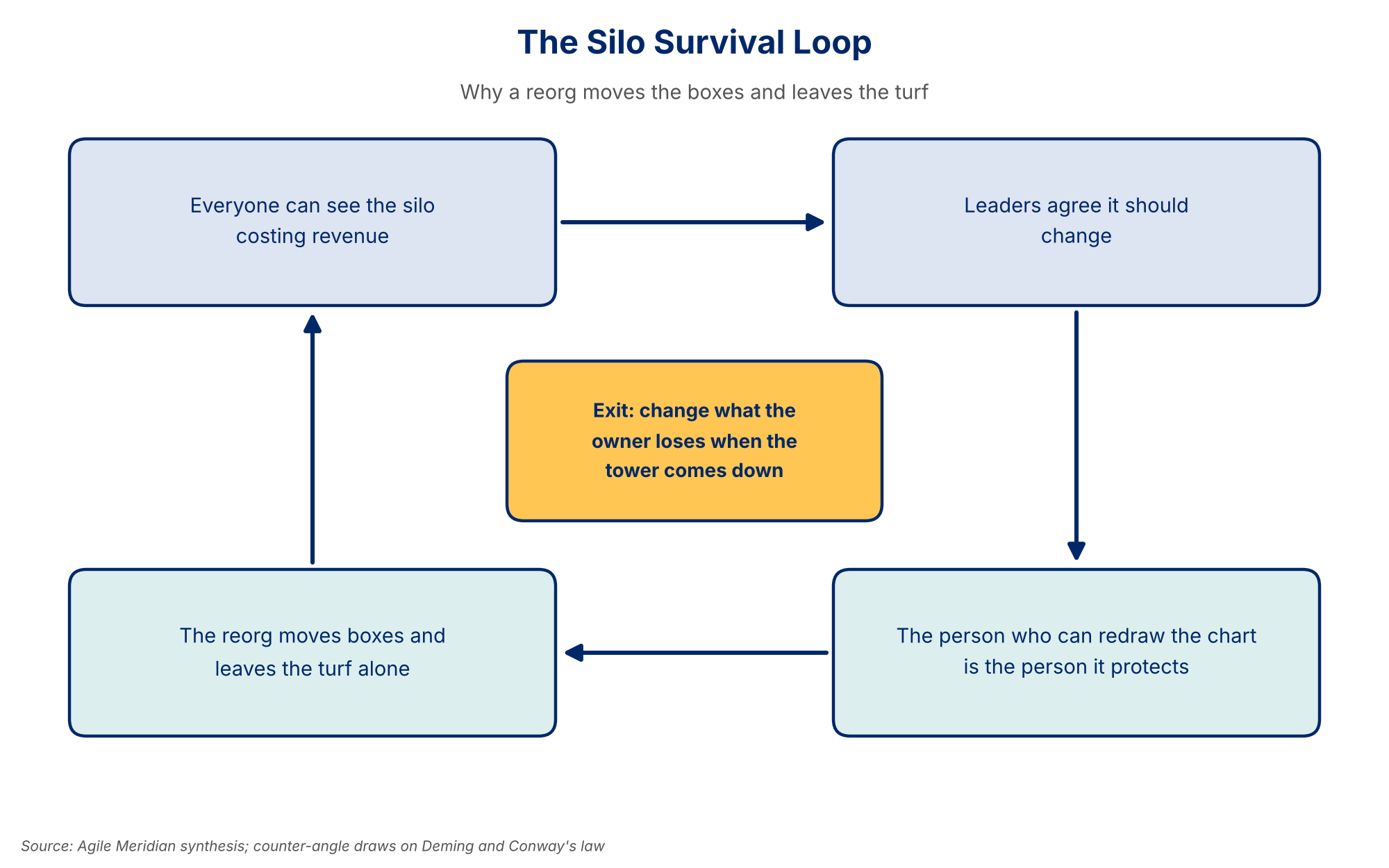
That's the lever, and it's a leadership accountability lever. When a leader's standing depends on the end-to-end result instead of the health of the box, the wall stops paying and cross-functional collaboration starts to pay. When dissolving a silo leads to a larger remit instead of a smaller one, the owner of the tower has a reason to start the demolition.
Without that lever you get the pattern I described in why reorgs fail and the coordination layer becomes the bottleneck. The structure changes and the turf survives. This piece goes upstream of that one. Before the reorg draws a single new line, the walls are already there, and they're there because someone is protecting them. The same applies to decision rights. An empty decider seat leaves the silo's owner in charge by default.
Three Immediate Actions to Break Down Organizational Silos
Map the tower. For each silo that slows your work, write down the budget line and the reporting lines that disappear if it dissolves. Then write down who owns them. You now know who you're asking to give something up, and you can start the conversation there instead of in the org chart.
Move one decision down in public. Pick a decision the silo currently holds and hand it to the team with guidelines. Glenn's formula works as a script: "Give them the authority and the guidelines. And if there's an issue, train them and guide them in the right direction, but don't put obstacles in the way." Then leave it alone for a quarter and watch what the leader does when a mistake is made.
Rewrite the scorecard. Assign a directly responsible individual, a DRI, for an end-to-end result that crosses the silo. Tie the performance indicators for that result to every leader whose box touches it, and give the leader who shrinks a silo a larger remit. Cross-team collaboration breaks when you reward local wins, so stop paying for them.
Related Podcast Episodes
Episode 137: Organizational Silos Are Bleeding Your Revenue with Glenn Marshall. Glenn gives the origin story I build on here, the control reflex that turns one bad day into permanent process. Start here if you want the cost of organizational silos before the argument about who keeps them standing.
Episode 140: From Red Tape to Innovation Engine: Disrupting Business Process Management with Liam O'Neill. Liam shows how process work gets hidden in a quality box and what happens to delivery when it comes out. His account of ownership as accountability is the mechanism behind the scorecard fix above.
Episode 175: Bloated Teams, Broken Delivery: The Case for De-Scaling with Nawaz Butt. Nawaz makes the case for fewer teams and decisions pushed down to the people doing the work. Listen for what he says about a coach designing his own role away, because it's the move a silo leader can't make.
Where to Start
Every organization I talk with already knows where its silos are. The harder conversation is about who they protect and what it would cost those people to let go. If you'd like to work through that for one silo in your organization, book a 30-minute conversation with me. We'll look at where the work stops, who owns the wall and what would change the math.