Robust Theme
Dec 09, 2019 2020-04-08 7:40Robust Theme


Why Your Estimates Are Wrong: Who's Missing
By: Kumar Dattatreyan
You shipped the wrong estimate and you blamed the data. The data was fine. The person who knew what the number meant wasn't in the room when you made it.
I see this all the time in coaching. A team commits to a number. Leadership trusts it. Everyone downstream plans against it, budgets against it, promises against it. And then it's wrong, and the postmortem goes hunting for a bad dataset or a broken tool. The dataset was fine. The room was too small.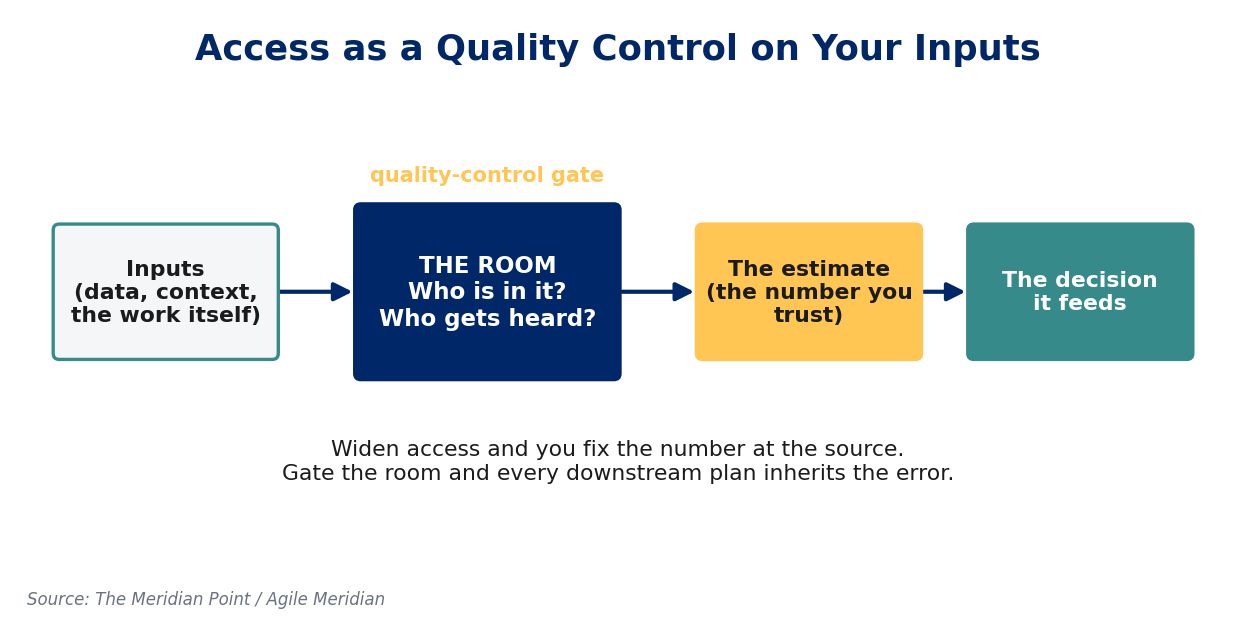
Access to the estimating room isn't a scheduling courtesy. It's a quality control on the numbers you're about to trust. Who you let in, and who you let stay quiet once they're in, decides how good your inputs are before anybody opens a spreadsheet.
The wrong number is an access problem wearing a data costume
When an estimate blows up, "our data isn't good enough" is the comfortable story. It's comfortable because it points at a system and not at a seating chart. Systems get fixed with tools and budget. Seating charts get fixed by admitting you built the wrong room.
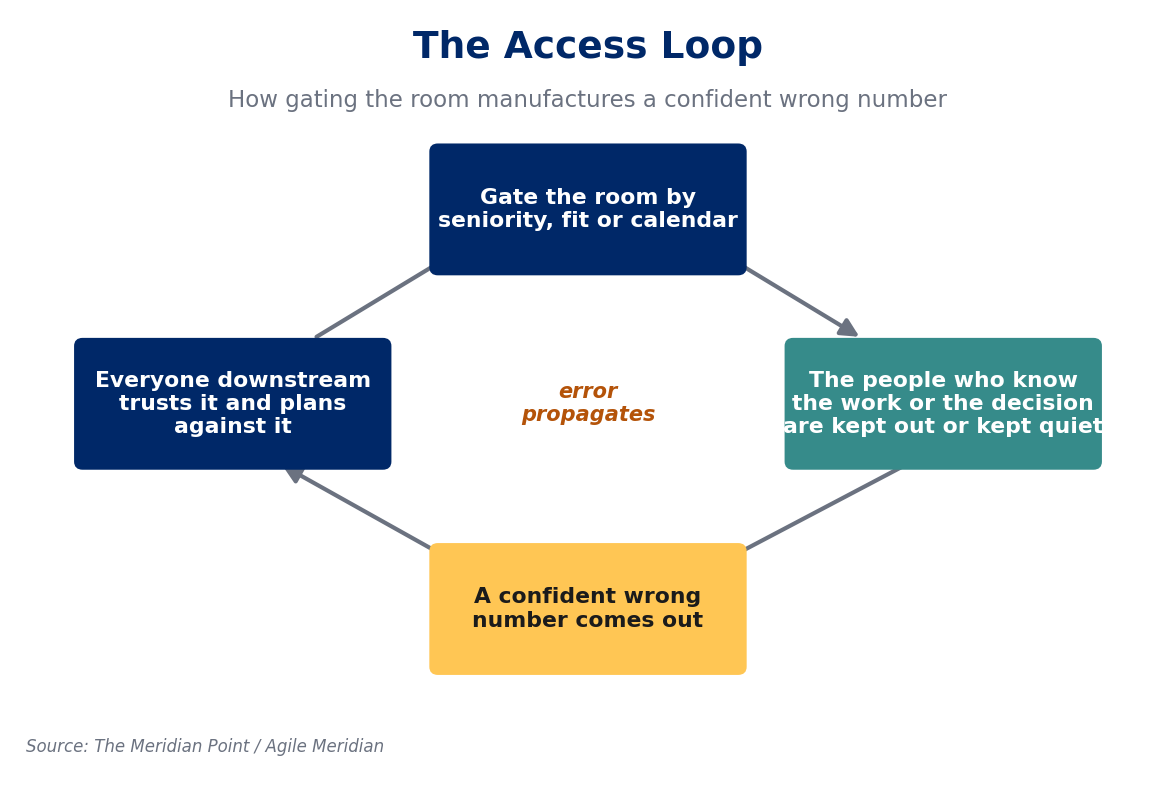
But the number came out of a room, and somebody chose who was in it. The person who would have caught the flaw got gated out by seniority, by fit or by the calendar. And here's the part that should worry you. Gate the room and you don't get an obviously bad number. You get a confident wrong number that everyone downstream trusts. A confident wrong number is more expensive than a messy one, because nobody questions it. They plan against it. They ship it.
Managers keep asking the wrong room for the number
Johanna Rothman named this pattern on Episode 153. The people you pull the estimate from often sit at a distance from the work itself.
In her words: "I still see managers spend an enormous amount of time trying to get estimates from teams about work the teams have not yet started."
Read that again. The team hasn't started the work, and you're asking them to price it. So they guess, and the guess wears a decimal point, and the decimal point makes it look like measurement. When that number comes back wrong, the reflex is to demand a better estimate from the same room. Not a wider one. The same people, asked harder.
And there's a second failure stacked on the first. Rothman told a story about her own reaction as a leader. A VP watched her frown when someone brought her bad news. She was frowning at the news, not the person, but that distinction lives in her head and not on her face. So she went straight to the guy and set the record clear: "I want nothing in between your bad news and me."
She wanted the discipline stated plainly, because a leader who flinches at bad news, even by accident, teaches the room to stop carrying it in. Now you've got both failures at once. The right people aren't in the room, and the ones who are have learned to hand you a clean number instead of a true one.
You can't judge the data until you know the decision
Here's where most data-quality arguments fall apart. James Taylor put the sharpest version of it on Episode 173: "if you don't know what the decision is, then how do you know whether the data is good enough or not?"
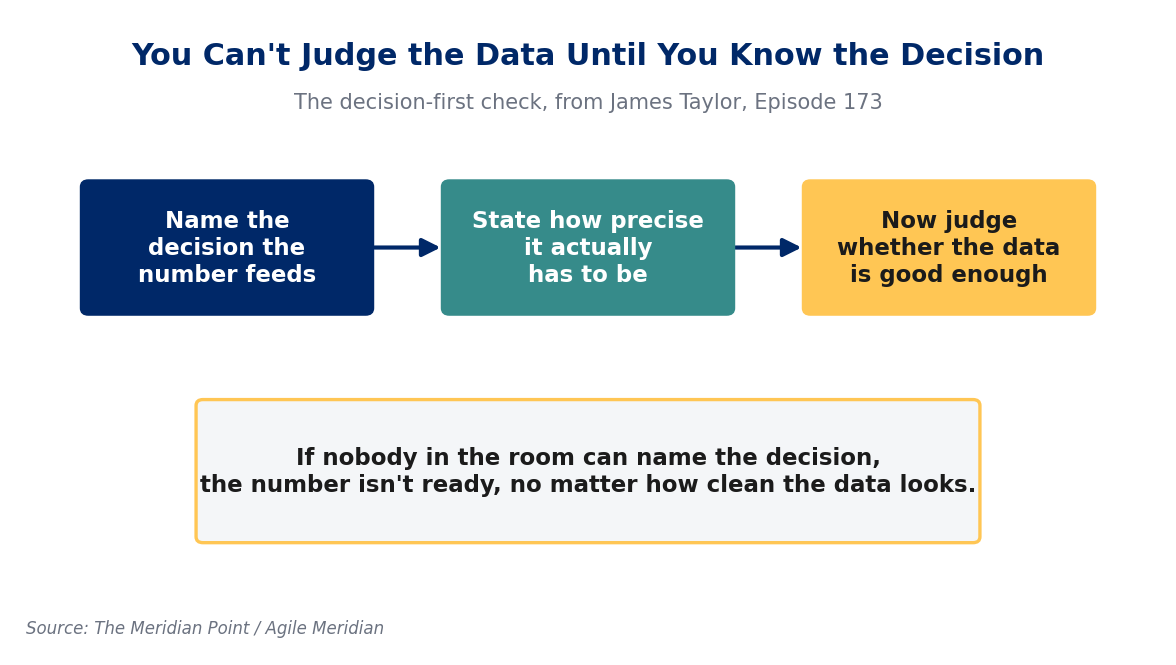
You can't. "The data isn't good enough" is almost always a misunderstood decision. You can't rate the data until you know what decision it feeds, how precise that decision actually needs to be, and who understands it well enough to say. And that person, the one who knows what the number is for, is often not the one sitting in the estimating room.
Taylor took it further: "You're asserting that your data is not good enough to support a particular decision-making approach, and you haven't really thought through it."
The blame lands on the data because the data can't argue back. The decision owner could argue back, if you'd put them in the room. Half the time the data is plenty good for the decision at hand, and the room just never knew what the decision was. The other half, the data really is thin, and only the decision owner could have told you which fields matter and which ones don't. Either way, the answer was a person, not a pipeline.
The person who saw it coming is in the back of the room
Sometimes the person who'd catch the error is already in the room. They're just silent. Larry Moss described exactly who they are on Episode 68: "the introverts are usually in the back of the room going I don't think this is going to work but I'm scared to say anything so leaders should take advantage of that skill."
Being present isn't access. Access is being heard. You can seat the sharpest analyst in the building at the table and still lose their judgment, because the room rewards the fast confident voice and talks over the slow careful one.
And the slow careful one is usually the one you needed. As Moss put it: "what an introvert does is they analyze very deeply before they commit and that is so needed in business today." That deep, late-committing judgment is the exact input an estimate depends on. It's also the first thing a status-driven room runs over on its way to a number it likes.
Access is a quality control on your inputs
Put Rothman, Taylor and Moss side by side and one claim falls out. The quality of your estimate is capped by the quality of the room that made it.
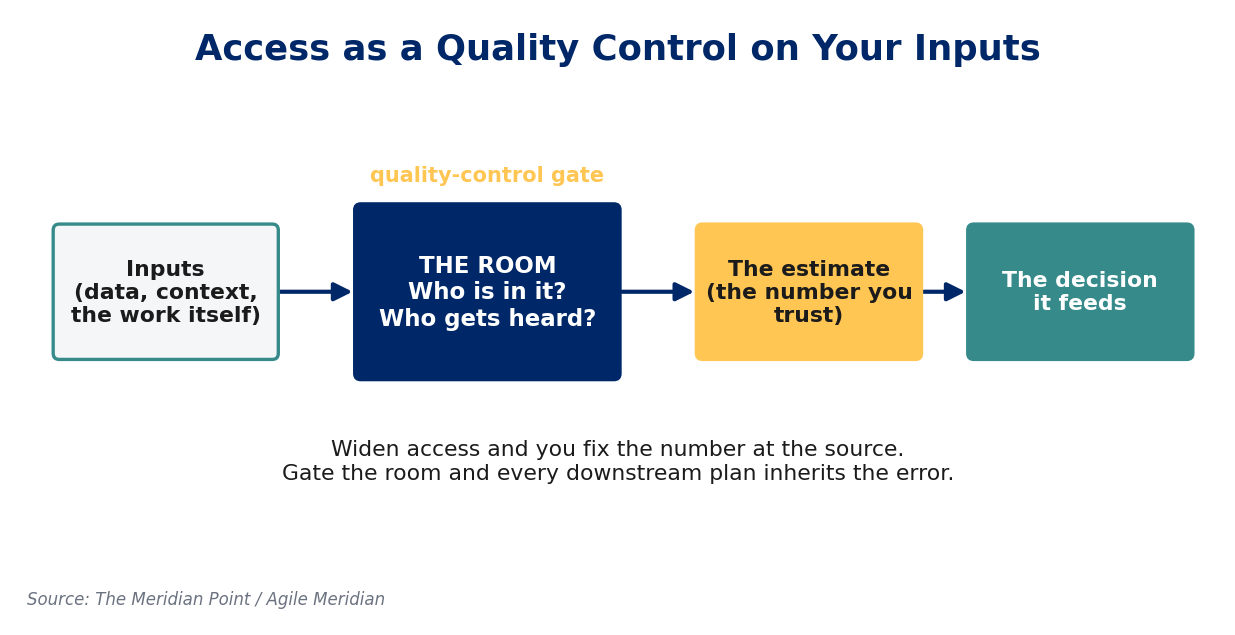
Rothman shows you pulling numbers from people at a distance from the work, then flinching when the bad news arrives. Taylor shows you can't even judge the data until the decision owner is in the room to say what the number is for. Moss shows the person who saw the flaw sitting in the back, analyzing deeply, saying nothing. None of that is a data problem. All of it is an access problem.
This is the measurement case for something I wrote about earlier from a fairness angle in Who Gets to Lead? The Problem With "Executive Presence". That piece argued that presence screens capable people out of leadership. This one is narrower and colder. Exclusion doesn't just cost a person a seat. It corrupts the number the room then trusts. The estimate itself gets worse.
Inside The Disruptor Method™, we treat access to the room as a control point, the same way you'd treat any other quality gate on your inputs. You inspect the inputs before you trust the output. Access is the input nobody inspects, because it feels like a people question and not a measurement question. It's both. Widen access and you fix the estimate at the source. Punish candor and you train the room to hand you clean numbers that are wrong. You don't get to pick a third option where the room is small, quiet and accurate. That room doesn't exist.
And this compounds. Every wrong number that leaves a small room becomes an input to the next room's estimate, so the error doesn't just ship once. It propagates. A confident wrong number at the team level becomes a confident wrong number at the portfolio level becomes a confident wrong commitment to a customer. By the time it's visible, it's three rooms deep and nobody can trace it back to the seat you left empty in the first one.
What this looks like on Monday
Before you accept a number, ask who's missing. Not who's senior. Who touches the work the number describes. If the people producing the estimate have never done the work, you don't have an estimate. You have a hope with a decimal point, and Rothman already told you how that ends.
Then ask Taylor's question out loud, in the room, before anyone locks anything: what decision does this number feed, and how precise does it actually have to be? If nobody can answer, the number isn't ready, no matter how clean the underlying data looks. Most of the time you'll find the decision needs far less precision than the room assumed, and the argument about data quality evaporates. Sometimes you'll find the opposite, and the decision owner will tell you exactly which input is thin. Both outcomes are wins. Both required a person you might not have invited.
And watch the back of the room. When someone goes quiet right after a bold claim, that's a signal, not an absence. Draw them out before the number leaves the room. Moss is right that the deep analyzers commit last, and last is usually right.
But you can't invite everyone to every meeting
Of course you can't. If access meant a bigger invite list, nothing would ever ship. That's not the argument.
Access is a deliberate check on whether the people who understand the work and the decision are represented before the number gets locked. That's a five-minute question at the top of a planning session, not a standing meeting on everyone's calendar. You're not widening the room for its own sake. You're closing the specific gap between who's in the room and who knows whether the number is true.
The number you're about to trust came out of a room you designed. If you want a clear read on whether your rooms are built to surface the truth or bury it, that's what The Disruptor Method™ assessment is built to show you. It takes a few minutes, and it tends to point straight at the seat you left empty.
Related Podcast Episodes
Episode 153: Management Myths Busted with Johanna Rothman Johanna and I get into why managers chase estimates from teams that haven't started the work, and why wait time buries more value than work time ever does. Her line about wanting nothing between your bad news and you is the whole argument for candor in one sentence.
Episode 173: The AI Decisions Are Wrong (And Your Data Isn't the Problem) James Taylor makes the case that "our data isn't good enough" is almost always a misunderstood decision. If you can't name the decision the number feeds, you can't judge whether the data is good enough for it. This is the episode that reframes data quality as a decision problem.
Episode 68: Leadership Matters! An Interview with Larry Moss Larry talks about the introverts in the back of the room who analyzed the problem deeply and are too scared to speak. His point that deep, late-committing judgment is exactly what business needs right now is the reason presence in the room isn't the same as access.
Related Reading
- Friction Is Data: Your Org Is Telling You What's Broken
- Who Gets to Lead? The Problem With "Executive Presence"
- You Can't Innovate in a Blame Culture. Full Stop.